




Europe Microfluidics Market
Market Size in USD Billion
CAGR :
% 
 USD
11.85 Billion
USD
50.61 Billion
2025
2033
USD
11.85 Billion
USD
50.61 Billion
2025
2033
 Forecast Period Forecast Period |
2026 –2033 |
 Market Size (Base Year) Market Size (Base Year) |
USD 11.85 Billion |
 Market Size (Forecast Year) Market Size (Forecast Year) |
USD 50.61 Billion |
 CAGR CAGR |
% |
| Major Markets Players |
|
Europe Microfluidics Market Size
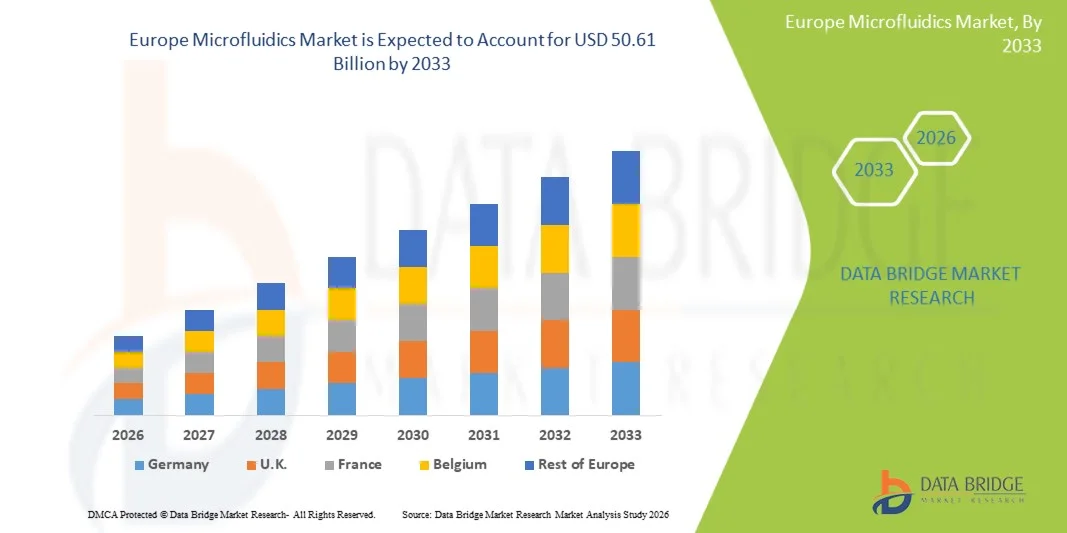
- The Europe Microfluidics Market size was valued at USD 11.85 billion in 2025 and is expected to reach USD 50.61 billion by 2033, at a CAGR of19.90% during the forecast period
- The market growth is largely fueled by the increasing demand for miniaturized and efficient analytical systems, along with rapid advancements in biotechnology, diagnostics, and pharmaceutical research, leading to enhanced precision and reduced sample and reagent consumption across laboratory and clinical settings
- Furthermore, rising adoption of point-of-care testing, growing focus on personalized medicine, and increasing use of lab-on-a-chip technologies are establishing microfluidics as a critical component in modern healthcare and life sciences. These converging factors are accelerating the uptake of Microfluidics solutions, thereby significantly boosting the industry's growth
Europe Microfluidics Market Analysis
- Microfluidics, enabling precise manipulation of small volumes of fluids for applications in diagnostics, drug development, and life sciences research, is becoming increasingly vital in modern healthcare and laboratory settings due to its efficiency, accuracy, and cost-effectiveness
- The escalating demand for microfluidics is primarily fueled by the growing adoption of point-of-care diagnostics, increasing focus on personalized medicine, and rising utilization of lab-on-a-chip technologies in clinical and research applications
- The U.K. dominated the Europe Microfluidics Market with the largest revenue share of approximately 34.1% in 2025, supported by strong research infrastructure, a well-established biotechnology sector, and high adoption of advanced diagnostic technologies. The country is witnessing substantial growth in microfluidics applications across research laboratories, hospitals, and diagnostic centers, driven by continuous technological advancements and increasing demand for rapid and accurate testing solutions
- Germany is expected to be the fastest-growing region in the Europe Microfluidics Market during the forecast period, registering a CAGR of approximately 8.7%, driven by rising investments in life sciences research, increasing adoption of advanced diagnostic technologies, and expanding healthcare and industrial applications of microfluidics
- The healthcare segment dominated the largest market revenue share of 52.3% in 2025, driven by the extensive use of microfluidics in diagnostics, drug delivery, and clinical research
Report Scope and Europe Microfluidics Market Segmentation
|
Attributes |
Microfluidics Key Market Insights |
|
Segments Covered |
|
|
Countries Covered |
Europe
|
|
Key Market Players |
• Danaher Corporation (U.S.) |
|
Market Opportunities |
|
|
Value Added Data Infosets |
In addition to the insights on market scenarios such as market value, growth rate, segmentation, geographical coverage, and major players, the market reports curated by the Data Bridge Market Research also include in-depth expert analysis, patient epidemiology, pipeline analysis, pricing analysis, and regulatory framework. |
Europe Microfluidics Market Trends
“Rising Adoption of Lab-on-a-Chip and Point-of-Care Testing Technologies”
- A significant and accelerating trend in the Europe Microfluidics Market is the increasing adoption of lab-on-a-chip technologies and point-of-care (POC) diagnostic solutions
- These technologies enable rapid, accurate, and cost-effective analysis using minimal sample volumes, making them highly suitable for clinical diagnostics and research applications
- For instance, microfluidic-based platforms are widely used in applications such as infectious disease detection, cancer diagnostics, and glucose monitoring, offering faster turnaround times compared to conventional laboratory methods
- Continuous advancements in microfabrication techniques, material science, and integration capabilities are enabling the development of highly efficient and portable microfluidic devices. These innovations are improving analytical performance while reducing operational complexity
- The growing integration of microfluidics into clinical workflows and diagnostic laboratories is enhancing efficiency and enabling decentralized testing, particularly in remote and resource-limited settings
- This trend toward miniaturized, high-throughput, and cost-efficient diagnostic solutions is transforming healthcare delivery and expanding the application scope of microfluidics across biotechnology, pharmaceuticals, and life sciences
- The demand for microfluidic technologies is increasing rapidly due to their ability to support precision medicine, early disease detection, and real-time monitoring
Europe Microfluidics Market Dynamics
Driver
“Growing Demand for Rapid Diagnostics and Advancements in Life Sciences Research”
- The increasing demand for rapid and accurate diagnostic solutions is a major driver for the growth of the Europe Microfluidics Market. The rising prevalence of infectious diseases, chronic conditions, and the need for early diagnosis are fueling the adoption of microfluidic-based diagnostic platforms
- For instance, the growing use of microfluidic devices in point-of-care testing has enabled faster detection of diseases, improving patient management and treatment outcomes in clinical settings
- In addition, the expansion of life sciences and biotechnology research is driving demand for microfluidic systems in applications such as genomics, proteomics, and drug discovery. These systems allow precise handling of small fluid volumes, improving experimental efficiency and reducing reagent costs
- The increasing focus on personalized medicine and targeted therapies is further supporting the adoption of microfluidic technologies, as they enable high-throughput screening and detailed biological analysis
- Moreover, rising investments in healthcare infrastructure and research and development activities are accelerating the deployment of advanced microfluidic solutions across academic institutions, pharmaceutical companies, and diagnostic laboratories
Restraint/Challenge
“High Development Costs and Technical Complexity”
- The high cost associated with the development and commercialization of microfluidic devices is a significant challenge for market growth. Advanced fabrication processes, specialized materials, and the need for precision engineering increase the overall cost of these systems
- For instance, small and medium-sized enterprises and research laboratories may face financial constraints in adopting sophisticated microfluidic platforms, limiting widespread adoption
- In addition, the technical complexity involved in device design, integration, and operation can pose challenges for end-users. The requirement for skilled professionals and specialized training further restricts market penetration, particularly in developing regions
- Issues related to standardization, scalability, and integration with existing laboratory infrastructure can also hinder the adoption of microfluidic technologies across various applications
- Overcoming these challenges will require the development of cost-effective manufacturing techniques, simplified device designs, and increased focus on user training and standardization to enhance accessibility and adoption of microfluidic solutions
Europe Microfluidics Market Scope
The market is segmented on the basis of product type, material, application, sector, and end user.
• By Product Type
On the basis of product type, the Europe Microfluidics Market is segmented into microfluidic-based devices and microfluidic components. The microfluidic-based devices segment dominated the largest market revenue share of 47.5% in 2025, driven by their extensive use in diagnostics, drug delivery, and point-of-care applications. These devices enable precise handling of small fluid volumes, improving efficiency and accuracy in laboratory and clinical settings. Increasing demand for rapid diagnostic solutions is significantly boosting adoption. Hospitals and research laboratories rely heavily on integrated microfluidic systems for advanced testing. Technological advancements in lab-on-a-chip platforms enhance usability and scalability. Growing prevalence of chronic diseases further supports demand. Rising investments in healthcare infrastructure globally are accelerating market growth. Continuous innovation in device miniaturization strengthens segment dominance.
The microfluidic components segment is expected to witness the fastest CAGR of 12.8% from 2026 to 2033, fueled by increasing demand for customizable and modular systems across research and industrial applications. Components such as pumps, valves, and chips are widely used in developing advanced microfluidic devices. Growing adoption in pharmaceutical and biotechnology industries supports expansion. Technological advancements in fabrication techniques improve performance and cost efficiency. Rising R&D activities in life sciences drive demand for high-quality components. Emerging markets are contributing to increased adoption. Integration with automation and AI-based systems further accelerates growth. Continuous product innovation enhances functionality and flexibility.
• By Material
On the basis of material, the Europe Microfluidics Market is segmented into polymer, glass, silicon, and other. The polymer segment dominated the largest market revenue share of 43.9% in 2025, driven by its cost-effectiveness, flexibility, and ease of fabrication. Polymers such as PDMS are widely used in microfluidic chip manufacturing due to their biocompatibility and transparency. Increasing demand for disposable diagnostic devices supports segment growth. Laboratories and healthcare providers prefer polymer-based systems for their scalability and affordability. Advancements in polymer processing technologies enhance device performance. Growing adoption in point-of-care testing further boosts demand. Expansion of healthcare infrastructure in emerging markets contributes to growth. Continuous innovation in material science reinforces segment leadership.
The glass segment is expected to witness the fastest CAGR of 11.9% from 2026 to 2033, driven by its superior chemical resistance and optical clarity. Glass-based microfluidic devices are increasingly used in high-precision analytical applications. Growing demand in pharmaceutical research and lab analytics supports adoption. Enhanced durability and compatibility with various reagents improve usability. Technological advancements in glass microfabrication are reducing production costs. Increasing use in high-throughput screening accelerates growth. Research institutions and advanced laboratories are key adopters. Expansion in developed markets further strengthens demand.
• By Application
On the basis of application, the Europe Microfluidics Market is segmented into in vitro diagnostics, point-of-care testing, clinical diagnostics, pharmaceutical research, lab analytics, microdispensing, microreaction, drug delivery, laboratory testing, and high throughput screening. The in vitro diagnostics segment accounted for the largest market revenue share of 41.6% in 2025, driven by the increasing demand for rapid and accurate diagnostic solutions. Microfluidic technologies enable efficient sample processing and high sensitivity in diagnostic assays. Hospitals and diagnostic centers widely adopt these systems for disease detection. Rising prevalence of infectious and chronic diseases supports demand. Technological advancements in lab-on-chip platforms enhance testing capabilities. Government initiatives for early disease detection further boost adoption. Increasing healthcare expenditure globally contributes to growth.
The point-of-care testing segment is expected to witness the fastest CAGR of 13.4% from 2026 to 2033, fueled by the growing need for decentralized and rapid diagnostic solutions. Microfluidics enables portable and easy-to-use testing devices suitable for remote and emergency settings. Increasing demand for home-based healthcare solutions accelerates growth. Technological advancements improve accuracy and speed of results. Rising awareness regarding early diagnosis supports adoption. Expansion in emerging markets with limited laboratory infrastructure contributes significantly. Integration with digital health technologies further enhances usability. Continuous innovation in portable diagnostic devices drives expansion.
• By Sector
On the basis of sector, the Europe Microfluidics Market is segmented into industrial and healthcare. The healthcare segment dominated the largest market revenue share of 52.3% in 2025, driven by the extensive use of microfluidics in diagnostics, drug delivery, and clinical research. Hospitals and diagnostic laboratories are primary adopters of microfluidic technologies. Increasing burden of chronic diseases and demand for personalized medicine support growth. Technological advancements in diagnostic platforms enhance efficiency. Rising healthcare expenditure globally contributes to adoption. Government initiatives promoting advanced diagnostic solutions further boost demand. Continuous innovation in biomedical applications strengthens market presence.
The industrial segment is expected to witness the fastest CAGR of 11.5% from 2026 to 2033, fueled by increasing applications in chemical synthesis, environmental testing, and food safety analysis. Microfluidic systems enable precise control of chemical reactions and material processing. Growing adoption in manufacturing industries supports expansion. Technological advancements improve scalability and efficiency. Increasing focus on quality control and safety regulations drives demand. Expansion of industrial automation further accelerates growth. Emerging markets contribute significantly to segment expansion.
• By End User
On the basis of end user, the Europe Microfluidics Market is segmented into hospitals and diagnostic centers, academic and research institutes, and pharmaceutical and biotechnology companies. The hospitals and diagnostic centers segment dominated the largest market revenue share of 44.7% in 2025, driven by the high volume of diagnostic testing and clinical procedures. These facilities rely on microfluidic technologies for accurate and rapid results. Increasing patient admissions and disease prevalence support demand. Availability of advanced healthcare infrastructure enhances adoption. Government funding and reimbursement policies further contribute to growth. Continuous advancements in diagnostic technologies strengthen segment dominance.
The pharmaceutical and biotechnology companies segment is expected to witness the fastest CAGR of 12.6% from 2026 to 2033, driven by increasing use of microfluidics in drug discovery, development, and testing. These technologies enable high-throughput screening and precise drug formulation. Growing R&D investments in the pharmaceutical sector support expansion. Integration with automation and AI-based platforms enhances efficiency. Rising demand for personalized medicine accelerates adoption. Expansion of biotech startups globally contributes to growth. Continuous innovation in drug development processes further boosts segment demand.
Europe Microfluidics Market Regional Analysis
- Europe dominated the Europe Microfluidics Market with a significant revenue share in 2025, driven by strong research infrastructure, a well-established biotechnology and pharmaceutical industry, and high adoption of advanced diagnostic technologies across the region
- The region benefits from extensive utilization of microfluidic technologies across research laboratories, hospitals, and diagnostic centers for applications such as genomics, proteomics, drug discovery, and point-of-care testing
- This widespread adoption is further supported by high healthcare and R&D expenditure, a robust academic and clinical research ecosystem, and increasing demand for rapid, accurate, and cost-effective testing solutions, establishing microfluidics as a critical technology in life sciences and diagnostics
U.K. Europe Microfluidics Market Insight
The U.K. Europe Microfluidics Market dominated with the largest revenue share of approximately 34.1% in 2025 within Europe, supported by strong research infrastructure, a well-established biotechnology sector, and high adoption of advanced diagnostic technologies. The country is witnessing substantial growth in microfluidics applications across research laboratories, hospitals, and diagnostic centers, driven by continuous technological advancements and increasing demand for rapid and accurate testing solutions. Additionally, growing investments in precision medicine, genomics research, and point-of-care diagnostics are further propelling market growth.
Germany Europe Microfluidics Market Insight
The Germany Europe Microfluidics Market is expected to be the fastest-growing region in Europe during the forecast period, registering a CAGR of approximately 8.7%. This growth is driven by rising investments in life sciences research, increasing adoption of advanced diagnostic technologies, and expanding healthcare and industrial applications of microfluidics. The country is witnessing growing utilization of microfluidic platforms in academic research, clinical diagnostics, and biotechnology sectors. Furthermore, strong government support for innovation and a focus on improving healthcare outcomes are contributing to the increased adoption of microfluidics technologies across Germany.
Europe Microfluidics Market Share
The Microfluidics industry is primarily led by well-established companies, including:
• Danaher Corporation (U.S.)
• Thermo Fisher Scientific Inc. (U.S.)
• Agilent Technologies, Inc. (U.S.)
• Illumina, Inc. (U.S.)
• Bio-Rad Laboratories, Inc. (U.S.)
• PerkinElmer, Inc. (U.S.)
• Dolomite Microfluidics (U.K.)
• Fluidigm Corporation (U.S.)
• Microfluidic ChipShop GmbH (Germany)
• Elveflow (France)
• Sphere Fluidics Limited (U.K.)
• Fluigent (France)
• Aline Inc. (U.S.)
• Micronit Microtechnologies B.V. (Netherlands)
• uFluidix (Canada)
• Standard BioTools Inc. (U.S.)
• RainDance Technologies (U.S.)
• Abbott Laboratories (U.S.)
• F. Hoffmann-La Roche Ltd. (Switzerland)
• QIAGEN N.V. (Netherlands)
Latest Developments in Europe Microfluidics Market
- In April 2023, Precedence Research announced strong growth trends in the Europe Microfluidics Market, emphasizing advancements in microfabrication technologies and increasing use in in-vitro diagnostics (IVD). The study highlighted that rising demand for rapid, cost-effective diagnostic tools and personalized medicine is accelerating the adoption of microfluidic devices across healthcare and life sciences sectors
- In June 2025, DataM Intelligence reported continued expansion of the Europe Microfluidics Market, driven by increasing applications in biomedical research, drug discovery, and point-of-care testing. The report emphasized the growing role of microfluidic chips and cartridges in enabling efficient sample analysis and reducing reagent consumption, supporting scalable and high-throughput testing solutions
- In September 2025, Microsoft introduced an advanced microfluidics-based cooling technology for data centers, enabling liquid coolant to flow through microscopic channels within chips. This innovation demonstrated up to three times more efficient heat dissipation compared to conventional cooling methods, highlighting the expanding application of microfluidics beyond healthcare into high-performance computing and AI infrastructure
- In September 2025, Sphere Bio (formerly Sphere Fluidics) underwent acquisition by Fluidic Sciences Ltd, strengthening its portfolio of microfluidics-based technologies for biopharmaceutical discovery and single-cell analysis. The acquisition included patented microfluidic platforms such as picodroplet-based systems, reinforcing industry consolidation and innovation in advanced microfluidic solutions
SKU-
Get online access to the report on the World's First Market Intelligence Cloud

- Interactive Data Analysis Dashboard
- Company Analysis Dashboard for high growth potential opportunities
- Research Analyst Access for customization & queries
- Competitor Analysis with Interactive dashboard
- Latest News, Updates & Trend analysis
- Harness the Power of Benchmark Analysis for Comprehensive Competitor Tracking
Research Methodology
Data collection and base year analysis are done using data collection modules with large sample sizes. The stage includes obtaining market information or related data through various sources and strategies. It includes examining and planning all the data acquired from the past in advance. It likewise envelops the examination of information inconsistencies seen across different information sources. The market data is analysed and estimated using market statistical and coherent models. Also, market share analysis and key trend analysis are the major success factors in the market report. To know more, please request an analyst call or drop down your inquiry.
The key research methodology used by DBMR research team is data triangulation which involves data mining, analysis of the impact of data variables on the market and primary (industry expert) validation. Data models include Vendor Positioning Grid, Market Time Line Analysis, Market Overview and Guide, Company Positioning Grid, Patent Analysis, Pricing Analysis, Company Market Share Analysis, Standards of Measurement, Global versus Regional and Vendor Share Analysis. To know more about the research methodology, drop in an inquiry to speak to our industry experts.
Customization Available
Data Bridge Market Research is a leader in advanced formative research. We take pride in servicing our existing and new customers with data and analysis that match and suits their goal. The report can be customized to include price trend analysis of target brands understanding the market for additional countries (ask for the list of countries), clinical trial results data, literature review, refurbished market and product base analysis. Market analysis of target competitors can be analyzed from technology-based analysis to market portfolio strategies. We can add as many competitors that you require data about in the format and data style you are looking for. Our team of analysts can also provide you data in crude raw excel files pivot tables (Fact book) or can assist you in creating presentations from the data sets available in the report.












