


Europe Next Generation Sequencing (NGS) Market Size
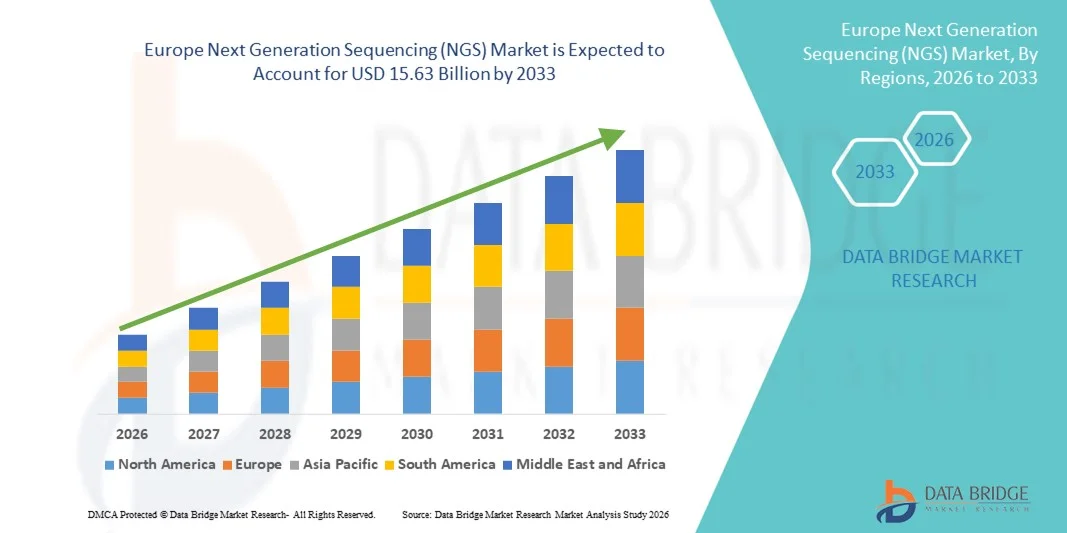
- As per Data Bridge Market Research Analysis the Europe Next Generation Sequencing (NGS) market size was valued at USD 4.87 billion in 2025 and is expected to reach USD 15.63 billion by 2033, at a CAGR of 15.7% during the forecast period
- The market growth is primarily driven by the increasing adoption of genomic research, advancements in sequencing technologies, and the expansion of personalized medicine and molecular diagnostics across the region
- Moreover, rising investments in healthcare infrastructure, coupled with growing demand for accurate, high-throughput, and cost-effective genomic solutions in research and clinical applications, are positioning NGS as a key tool for precision medicine. These combined factors are accelerating the deployment of NGS platforms, thereby substantially propelling the market’s growth
Market Size & Forecast
- Global Market Value (2025): USD 4.87 billion in 2025
- Expected Market Value (2033): USD 15.63 billion by 2033
- Forecast CAGR (2026–2033): CAGR of 15.7%
Europe Next Generation Sequencing (NGS) Market Analysis
- Next Generation Sequencing (NGS), enabling high-throughput genomic analysis for applications such as diagnostics, drug discovery, and research, is becoming an essential component of modern healthcare and life sciences due to its speed, accuracy, and scalability across clinical and research settings
- The growing adoption of NGS is primarily driven by increasing investments in precision medicine, rising demand for genetic testing, and the need for comprehensive genomic profiling in both oncology and rare disease research
- Germany dominated the Europe NGS market with the largest revenue share of 38.5% in 2025, fueled by strong healthcare infrastructure, widespread adoption of advanced sequencing technologies, and the presence of leading NGS platform providers, with extensive uptake in clinical diagnostics, research centers, and pharmaceutical applications
- France is expected to be the fastest-growing country during the forecast period due to rising government initiatives in genomics research, expanding healthcare infrastructure, and increasing collaborations between local research institutions and global NGS providers
- Instruments segment dominated the Europe NGS market by product with a market share of 42.7% in 2025, driven by increasing demand for high-performance sequencing platforms and advanced laboratory equipment for genomics research and clinical applications
Report Scope and Europe Next Generation Sequencing (NGS) Market Segmentation
|
Attributes |
Europe Next Generation Sequencing (NGS) Key Market Insights |
|
Segments Covered |
|
|
Countries Covered |
Europe
|
|
Key Market Players |
|
|
Market Opportunities |
|
|
Value Added Data Infosets |
In addition to the insights on market scenarios such as market value, growth rate, segmentation, geographical coverage, and major players, the market reports curated by the Data Bridge Market Research also include in-depth expert analysis, patient epidemiology, pipeline analysis, pricing analysis, and regulatory framework |
Europe Next Generation Sequencing (NGS) Market Trends
Integration of AI and Bioinformatics for Enhanced Genomic Insights
- A key and rapidly growing trend in the Europe NGS market is the integration of artificial intelligence (AI) and advanced bioinformatics tools with sequencing platforms, significantly improving data analysis speed, accuracy, and interpretation
- For instance, Illumina’s DRAGEN Bio-IT Platform leverages AI to accelerate genome analysis, enabling researchers to process whole genomes in hours with higher precision and reduced computational time
- AI-driven NGS platforms can identify patterns, predict variants, and suggest actionable insights for precision medicine, enhancing research efficiency and clinical decision-making. For instance, Sophia Genetics’ AI-based platform analyzes sequencing data to support diagnostics and therapeutic decisions across multiple disease areas
- The integration of NGS with bioinformatics pipelines and cloud computing allows researchers and clinicians to manage and interpret massive genomic datasets from a centralized interface, facilitating collaborative studies and cross-institutional research
- This trend toward more intelligent, automated, and scalable genomic analysis is reshaping expectations for sequencing capabilities. For instance, companies such as QIAGEN are developing AI-enhanced NGS solutions to streamline workflows and enable real-time genomic insights
- The demand for NGS platforms with integrated AI and bioinformatics solutions is expanding rapidly across research institutions, hospitals, and pharmaceutical companies, as stakeholders increasingly prioritize efficiency, precision, and actionable genomic insights
- Real-time NGS data visualization and interpretation tools are gaining traction, enabling faster decision-making in clinical trials and personalized treatment planning. For instance, Genestack offers platforms that allow researchers to interactively explore sequencing datasets
Europe Next Generation Sequencing (NGS) Market Dynamics
Driver
Rising Demand for Precision Medicine and Genomic Research
- The growing emphasis on personalized medicine, targeted therapies, and comprehensive genomic profiling is a major driver for NGS adoption in Europe
- For instance, in March 2025, Eurofins Genomics expanded its NGS services to support large-scale biomarker discovery and precision medicine programs across oncology and rare disease research
- As healthcare providers and researchers aim to deliver tailored therapies, NGS offers high-throughput, accurate, and cost-effective genomic sequencing solutions, enabling precise disease characterization and treatment selection
- Furthermore, increasing government funding for genomics research and clinical trials is encouraging the adoption of NGS platforms across hospitals, research centers, and pharmaceutical companies
- The ability to generate large volumes of actionable genomic data quickly, combined with decreasing sequencing costs, is driving the integration of NGS into routine research, diagnostics, and drug development workflows
- For instance, Novogene expanded its European operations to meet the rising demand for high-quality NGS services, supporting pharmaceutical and academic research initiatives in precision medicine
- The growing focus on infectious disease genomics, including pathogen surveillance and outbreak tracking, is driving NGS adoption in public health initiatives. For instance, Institut Pasteur uses NGS to monitor viral mutations across Europe
- Collaborations between academic institutions and biotech companies for multi-omics research are increasing the need for advanced NGS platforms. For instance, Cambridge University and GSK are jointly using NGS to accelerate biomarker discovery
Restraint/Challenge
High Costs and Data Privacy Concerns
- The relatively high cost of NGS instruments, consumables, and services continues to pose a barrier to adoption, particularly for smaller research facilities and hospitals
- For instance, some premium sequencing platforms from Illumina or Thermo Fisher Scientific involve substantial initial investment and maintenance costs, limiting accessibility for budget-conscious institutions
- Cybersecurity and data privacy concerns also challenge the deployment of NGS in clinical and research settings, as sensitive genomic data must be securely stored, transmitted, and analyzed
- For instance, strict GDPR compliance requirements in Europe necessitate robust data encryption, secure cloud storage, and controlled access protocols, adding operational complexity for institutions
- While technological advancements are gradually reducing costs, the perceived financial barrier and regulatory compliance burden can slow adoption, particularly in smaller labs or emerging markets
- Overcoming these challenges through cost-effective sequencing solutions, secure data management practices, and increased awareness of compliance standards will be critical for sustained growth in the European NGS market
- Limited trained personnel and expertise in bioinformatics can hinder the effective utilization of NGS platforms. For instance, smaller hospitals often struggle to recruit skilled genomic data analysts
- Inconsistent reimbursement policies for NGS-based diagnostics across European countries may delay clinical adoption. For instance, some insurers in Italy and Spain cover limited NGS tests, affecting broader deployment
Europe Next Generation Sequencing (NGS) Market Scope
The market is segmented on the basis of product, application, and end user.
- By Product
On the basis of product, the Europe NGS market is segmented into instruments, consumables, and services. The instruments segment dominated the market with the largest revenue share of 42.7% in 2025, driven by increasing demand for high-performance sequencing platforms and advanced laboratory equipment across research and clinical settings. Sequencing instruments are critical for generating accurate genomic data, and their adoption is fueled by technological advancements such as high-throughput capabilities, automation, and integration with AI-based analysis tools. European research institutions and hospitals are investing heavily in instruments to support precision medicine, oncology research, and rare disease studies. In addition, manufacturers are continuously innovating to provide versatile, scalable, and user-friendly platforms compatible with multiple NGS workflows. The established presence of major instrument providers such as Illumina, Thermo Fisher Scientific, and Oxford Nanopore further consolidates this segment’s dominance.
The services segment is expected to witness the fastest growth during the forecast period, driven by the increasing outsourcing of sequencing tasks to specialized service providers. Services offer cost-effective solutions for institutions that cannot afford high-end instruments, enabling access to high-throughput sequencing and expert bioinformatics support. Growing demand for genomic research, clinical trials, and multi-center studies in Europe is fueling the need for flexible, high-quality NGS services.
- By Application
On the basis of application, the Europe NGS market is segmented into diagnostics, biomarker discovery, precision medicine, drug discovery, agriculture & animal research, and others. The diagnostics segment dominated the market with the largest revenue share in 2025 due to the rising adoption of NGS for early disease detection, cancer genomics, and hereditary disorder analysis. NGS-based diagnostics provides comprehensive genomic profiling, enabling clinicians to deliver personalized treatment plans and improve patient outcomes. Hospitals and clinical labs increasingly rely on sequencing for oncology panels, prenatal testing, and infectious disease monitoring. The ability to rapidly generate accurate results, coupled with decreasing sequencing costs, supports the growing preference for NGS in diagnostics.
The precision medicine segment is expected to witness the fastest growth during the forecast period, fueled by the rising adoption of targeted therapies and tailored treatment plans in Europe. Advances in NGS allow precise identification of genetic mutations, actionable biomarkers, and patient-specific therapeutic options. Pharmaceutical companies and research institutions are increasingly integrating NGS into clinical trials and drug development pipelines to optimize efficacy and safety, driving demand in precision medicine applications.
- By End User
On the basis of end user, the Europe NGS market is segmented into pharmaceutical & biotechnology companies, research centers & academic and government institutes, and hospitals & clinics. The research centers & academic institutes segment dominated the market in 2025, holding the largest revenue share due to their extensive involvement in genomics research, multi-omics studies, and biomarker discovery programs. Academic institutions and government-funded research facilities are major adopters of NGS platforms, leveraging them for high-throughput sequencing projects, collaborative studies, and innovation in molecular biology and genetics. Established partnerships with instrument and service providers further reinforce their market position.
The pharmaceutical & biotechnology companies segment is expected to witness the fastest growth during the forecast period, driven by the rising integration of NGS in drug discovery, clinical trials, and biomarker validation. Companies increasingly use sequencing to accelerate target identification, optimize clinical development, and support regulatory submissions. The growing focus on personalized therapies, oncology drugs, and rare disease treatment development is boosting the adoption of NGS solutions in the pharmaceutical and biotech sectors.
Europe Next Generation Sequencing (NGS) Market Regional Analysis
- Germany dominated the Europe NGS market with the largest revenue share of 38.5% in 2025, fueled by strong healthcare infrastructure, widespread adoption of advanced sequencing technologies, and the presence of leading NGS platform providers, with extensive uptake in clinical diagnostics, research centers, and pharmaceutical applications
- Researchers and clinicians in the country highly value the accuracy, high-throughput capabilities, and integration of NGS platforms with bioinformatics tools, enabling comprehensive genomic analysis for diagnostics, precision medicine, and biomarker discovery
- This widespread adoption is further supported by government initiatives in genomics research, collaborations between academic institutions and pharmaceutical companies, and increasing investments in NGS platforms, establishing Germany as a leading hub for sequencing applications in Europe
The U.K. Next Generation Sequencing (NGS) Market Insight
The U.K. NGS market is anticipated to grow at a noteworthy CAGR during the forecast period, driven by the growing trend of precision medicine and genomic research. In addition, rising government funding, coupled with robust academic and biotech collaborations, is encouraging the adoption of NGS platforms. The U.K.’s emphasis on innovation in healthcare and life sciences, alongside the increasing availability of high-quality sequencing services, is expected to continue to stimulate market growth. Furthermore, hospitals and research institutes are actively deploying NGS for oncology panels, infectious disease monitoring, and biomarker discovery.
Germany Next Generation Sequencing (NGS) Market Insight
The Germany NGS market is expected to expand at a considerable CAGR during the forecast period, fueled by well-established healthcare and research infrastructure and increasing adoption of advanced sequencing platforms. Germany’s emphasis on innovation, precision medicine, and multi-center clinical research promotes the uptake of NGS across hospitals, academic institutions, and biotech companies. Integration of NGS with AI and bioinformatics solutions is becoming increasingly prevalent, while government initiatives and collaborations with global NGS providers are further strengthening market expansion. The preference for secure, reliable, and high-throughput sequencing aligns with local consumer and institutional expectations.
France Next Generation Sequencing (NGS) Market Insight
The France NGS market is poised to grow at a significant CAGR during the forecast period, driven by government-backed genomics initiatives and strong investments in research and clinical sequencing applications. French hospitals and research centers are increasingly adopting NGS for precision medicine, oncology studies, and rare disease research. The integration of NGS platforms with bioinformatics and AI tools supports rapid data analysis and interpretation, enhancing research efficiency. Moreover, collaborations between academic institutions and pharmaceutical companies are expanding the use of NGS in clinical trials and drug development.
Italy Next Generation Sequencing (NGS) Market Insight
The Italy NGS market is gaining momentum due to increasing awareness of genomic research, rising demand for precision medicine, and investments in healthcare infrastructure. Hospitals, research centers, and biotech firms are adopting NGS platforms for early disease detection, biomarker discovery, and drug development studies. The availability of specialized sequencing service providers and government support for genomics programs is further propelling market growth. Integration of NGS with bioinformatics solutions enables faster analysis and decision-making, making the technology increasingly attractive across clinical and research applications.
Europe Next Generation Sequencing (NGS) Market Share
The Europe Next Generation Sequencing (NGS) industry is primarily led by well-established companies, including:
- Illumina, Inc. (U.S.)
- Thermo Fisher Scientific Inc. (U.S.)
- F. Hoffmann La Roche Ltd. (Switzerland)
- Oxford Nanopore Technologies plc (U.K.)
- Pacific Biosciences of California, Inc. (U.S.)
- QIAGEN (Netherlands)
- Agilent Technologies, Inc. (U.S.)
- BGI Genomics (China)
- Eurofins Genomics Europe (Luxembourg)
- Bio Rad Laboratories, Inc. (U.S.)
- PerkinElmer, Inc. (U.S.)
- Genomatix Software GmbH (Germany)
- DNASTAR, Inc. (U.S.)
- Takara Bio Inc. (Japan)
- Sophia Genetics (Switzerland)
- WuXi NextCODE (China)
- GenScript (China)
- Macrogen Inc. (South Korea)
- Biomatters Ltd. (New Zealand)
- SeqWell (U.S.)
What are the Recent Developments in Europe Next Generation Sequencing (NGS) Market?
- In October 2025, a next‑generation sequencing (NGS)‑based diagnostic method to identify sepsis pathogens using high‑throughput cell‑free DNA sequencing won the EARTO Innovation Award at the European Innovation Council event in Brussels, highlighting its commercial availability and clinical impact in improving pathogen identification compared to traditional culture methods
- In August 2025, Eurofins Genomics Europe announced the strategic relocation and expansion of its NGS operations from Constance to Ebersberg, Germany, aimed at increasing service capacity and enhancing sequencing infrastructure to better support genomic analysis across Europe
- In May 2025, research efforts in Europe showed that long‑read sequencing technologies are improving clinical diagnostics with enhanced detection of complex genetic variants—indicating the increasing real‑world use of advanced NGS methods beyond short‑read platforms in clinical settings
- In April 2025, Devyser launched Devyser Thalassemia v2, an updated next‑generation sequencing assay designed to simplify comprehensive thalassemia genetic testing by reducing workflow complexity and improving precision in variant detection
- In April 2025, a pan‑European consortium called the European Long Read Innovation Network (ELRIN) was launched to advance the integration of long‑read sequencing (e.g., nanopore technology) into clinical diagnostics across Europe, aiming to improve rare disease and cancer genomic analyses

- Interactive Data Analysis Dashboard
- Company Analysis Dashboard for high growth potential opportunities
- Research Analyst Access for customization & queries
- Competitor Analysis with Interactive dashboard
- Latest News, Updates & Trend analysis
- Harness the Power of Benchmark Analysis for Comprehensive Competitor Tracking
Data collection and base year analysis are done using data collection modules with large sample sizes. The stage includes obtaining market information or related data through various sources and strategies. It includes examining and planning all the data acquired from the past in advance. It likewise envelops the examination of information inconsistencies seen across different information sources. The market data is analysed and estimated using market statistical and coherent models. Also, market share analysis and key trend analysis are the major success factors in the market report. To know more, please request an analyst call or drop down your inquiry.
The key research methodology used by DBMR research team is data triangulation which involves data mining, analysis of the impact of data variables on the market and primary (industry expert) validation. Data models include Vendor Positioning Grid, Market Time Line Analysis, Market Overview and Guide, Company Positioning Grid, Patent Analysis, Pricing Analysis, Company Market Share Analysis, Standards of Measurement, Global versus Regional and Vendor Share Analysis. To know more about the research methodology, drop in an inquiry to speak to our industry experts.
Data Bridge Market Research is a leader in advanced formative research. We take pride in servicing our existing and new customers with data and analysis that match and suits their goal. The report can be customized to include price trend analysis of target brands understanding the market for additional countries (ask for the list of countries), clinical trial results data, literature review, refurbished market and product base analysis. Market analysis of target competitors can be analyzed from technology-based analysis to market portfolio strategies. We can add as many competitors that you require data about in the format and data style you are looking for. Our team of analysts can also provide you data in crude raw excel files pivot tables (Fact book) or can assist you in creating presentations from the data sets available in the report.













