


Market Analysis and Insights
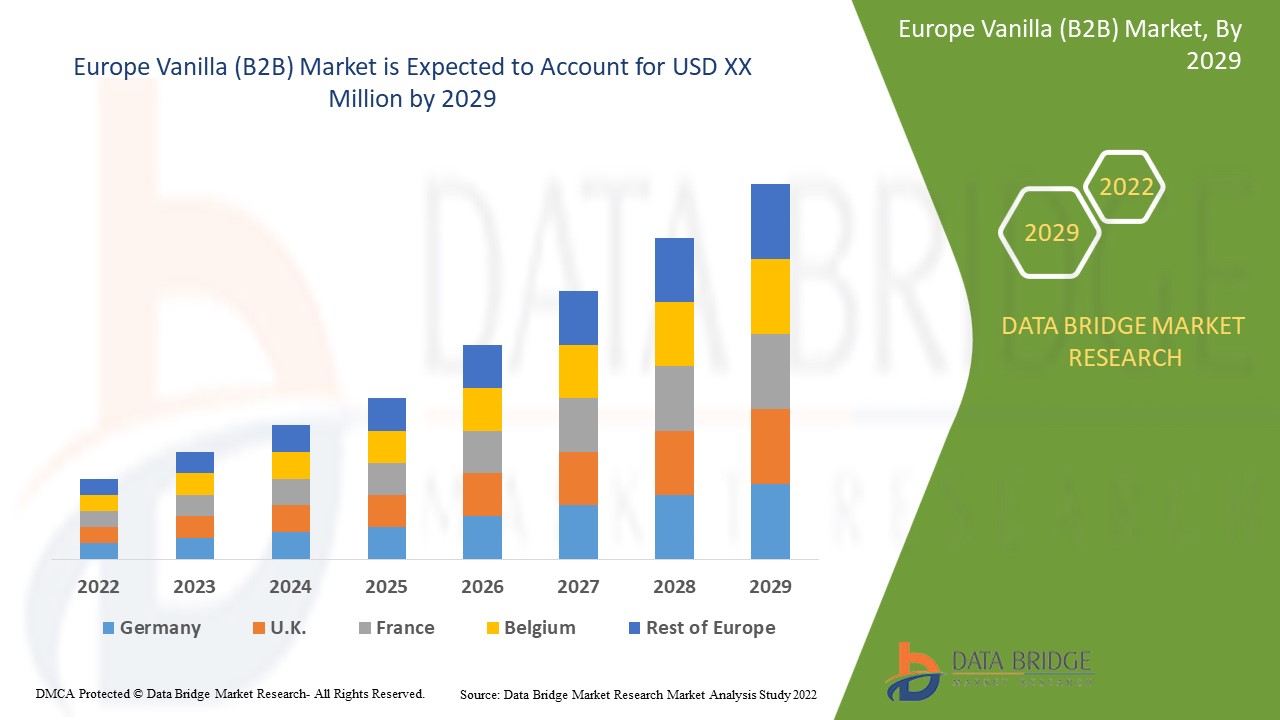
The Europe vanilla (B2B) market is gaining significant growth due to the growing food & beverage industry and the rise in demand for bakery products. The increase in demand for different types of confectionary products is also boosting the growth of the Europe vanilla (B2B) market. However, stringent government regulations associated with synthetic vanilla is expected to restrain the market growth of vanilla market during the forecast period.
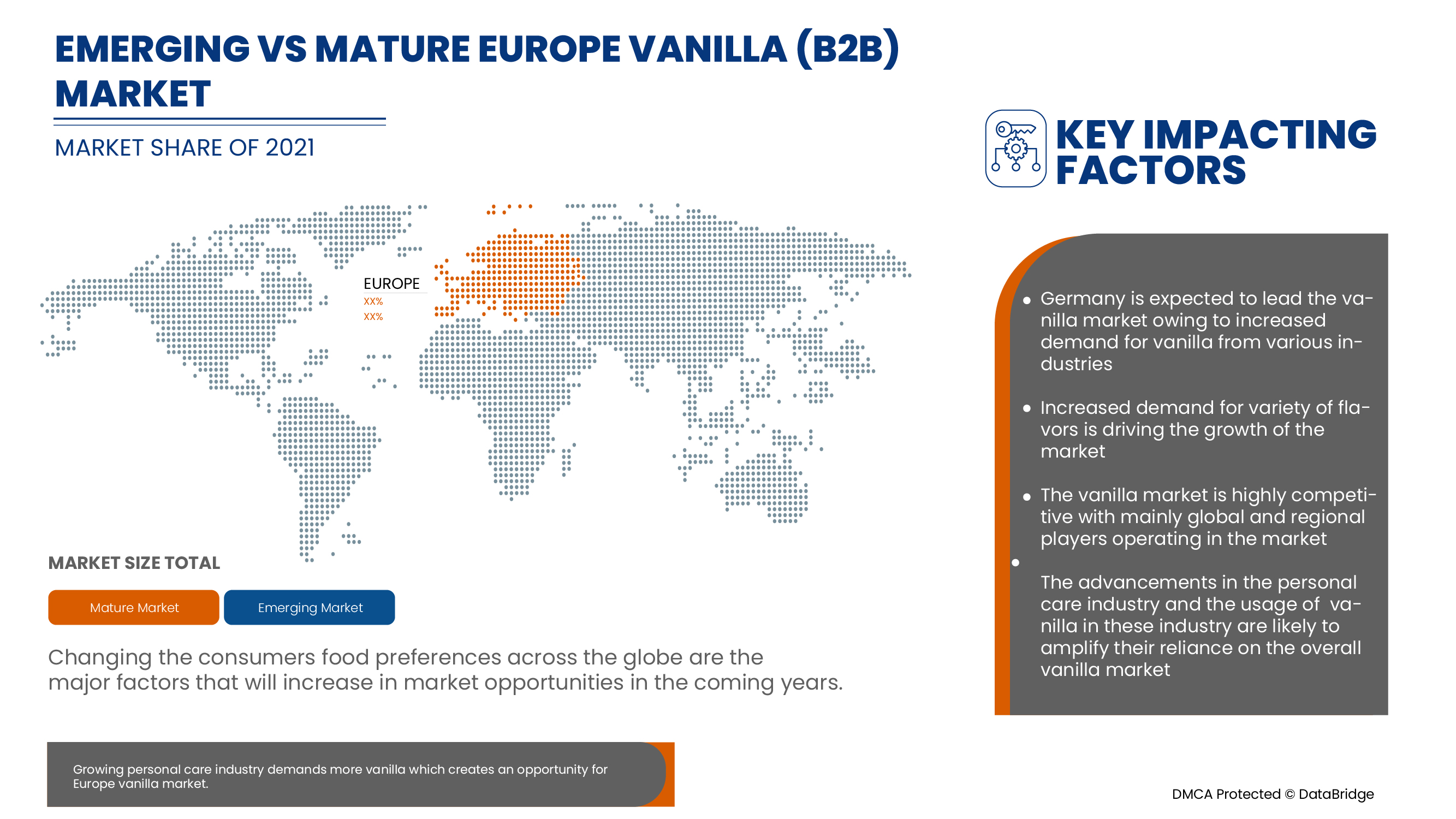
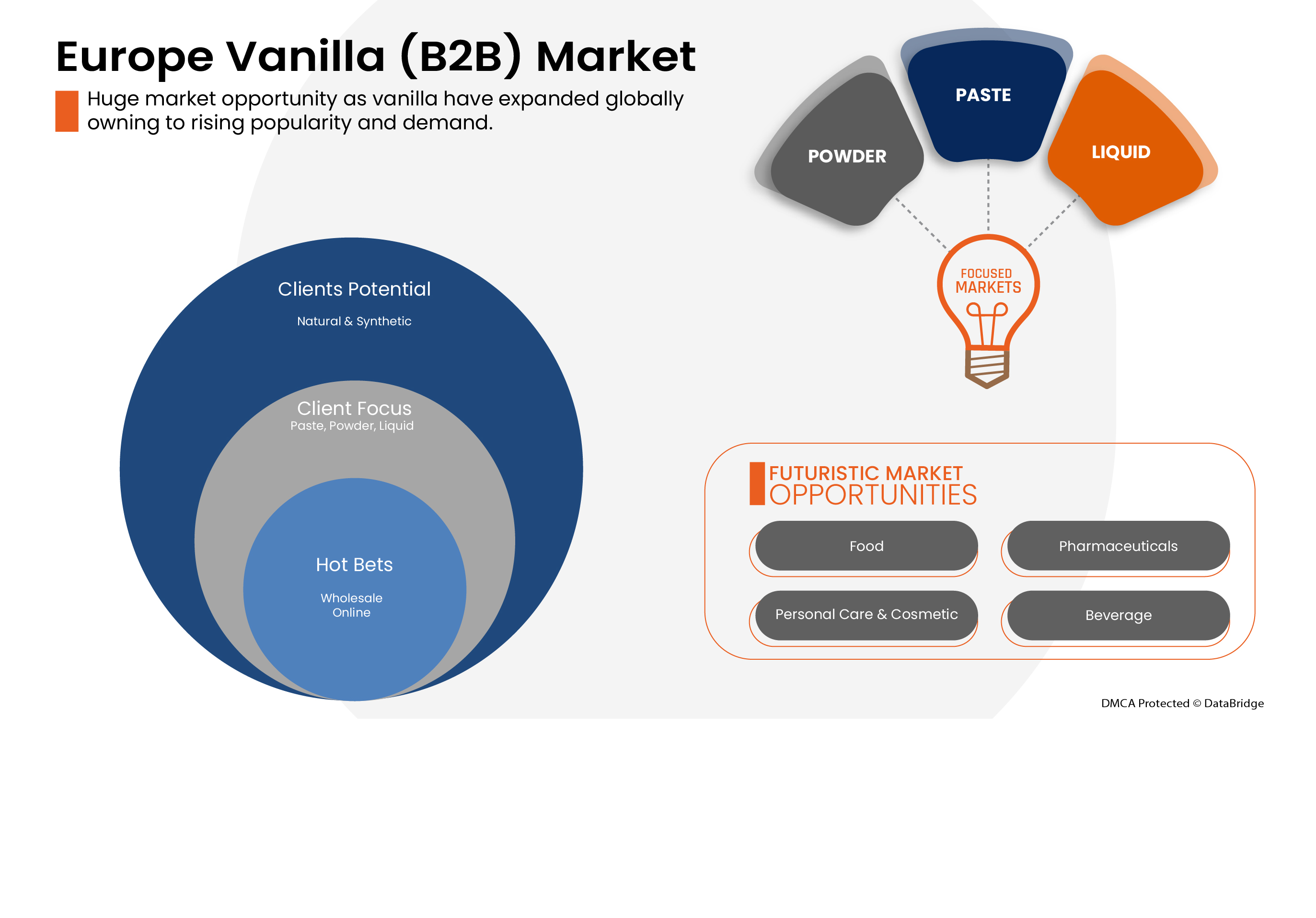
Data Bridge Market Research analyses that the Europe vanilla (B2B) market will grow at a CAGR of 4.5% during the forecast period of 2022 to 2029.
|
Report Metric |
Details |
|
Forecast Period |
2022 to 2029 |
|
Base Year |
2021 |
|
Historic Years |
2020 (Customizable to 2019- 2015) |
|
Quantitative Units |
Revenue in USD Million, Volume in Tons, Pricing in USD |
|
Segments Covered |
By Vanilla Type (Madagascar, Mexican, Synthetic Origin, India, Indonesian, Tahitian, Tonga, Papua New Guinea, Ugandan and Others), Vanilla Origin (Natural and Synthetic), Grade (Grade A (30% Moisture), Grade B (20% Moisture) and Others), Form (Liquid, Powder and Paste), End-Use (Food, Beverages, Personal Care & Cosmetic, Pharmaceuticals, Household/Retail and Others) Distribution Channel (Wholesale and Online) |
|
Countries Covered |
Germany, U.K., France, Spain, Netherlands, Italy, Belgium, Turkey, Switzerland, Russia, Luxembourg and Rest of Europe |
|
Market Players Covered |
Nielsen-Massey Vanillas, Inc., McCormick & Company, Inc., Prova, SYNERGY, IFFinc, Kerry, Takasago International Corporation, ADM, Madagascar Vanilla Company LLC and Firmenich SA among others |
Market Definition
Vanilla is a spice derived from the orchids of the genus vanilla. It is widely cultivated in various regions across the world. Moreover, Madagascar, Mexico, and Indonesia are leading in the production of vanilla beans. Vanilla flavor is extracted from the vanilla beans, named natural vanilla extract in the market. However, the demand for vanilla flavor is rising promptly among consumers, leading the vanilla processor to produce synthetic vanilla extract from renewable resource. The vanilla beans are classified into grade A, grade B, and others based on the quality.
Similarly, vanilla is segmented into various forms such as liquid, powder, and paste. The vanilla beans, and extracts are widely used in bakery, confectionery, and dairy based products. In addition, vanilla has extensive pharmaceutical, and personal care products applications.
Europe Vanilla (B2B) Market Dynamics
Drivers
-
Growing demand for vanilla in the food & beverage industry
The demand for vanilla in the food & beverage industries is growing rapidly. Vanilla extract is an important flavouring agent in the food and beverage processing industry. In the food industry, vanilla is added to various food applications, including dairy-based products, bakery products, processed foods, chocolate& confectionery, and others, to enhance its flavours and taste. Thus, the increase in demand for vanilla powder, paste, and liquid in the food industry is expected to drive growth in the market.
Meanwhile, vanilla extracts play an important role in reducing bitterness and enhancing the product's flavour in the chocolate industry. In addition, vanilla will mask the taste variation in chocolate caused by cocoa bran. Hence, the increase in demand for vanilla in the chocolate industry is propelling the growth of vanilla in the market.
-
Growing demand for vanilla in the pharmaceutical, and personal care industry
In recent years, the demand for fragrance-based cosmetic, and personal care products has been increasing among customers across the globe. Hence, the rise in the need for vanilla-added cosmetic products is impelling the growth of vanilla in the market. Besides fragrance, vanilla has a particular functional property that enables the repair of skin damage.
For instance, vanilla is naturally rich in antioxidants, which help neutralize the free radicals and reduce skin damage. Due to its functional property, vanilla liquids, powders, and pastes are largely used in cosmetic products. Thus, the increasing usage of vanilla in the cosmetic industry will drive growth in the market. Moreover, the Madagascar vanilla has extensive application in personal care products such as lotion, anti-aging creams, and lip balm enriched with vitamin B, which is responsible for healthy skin. Thus, cosmetic manufacturers are adding vanilla into their products.
Hence, the growing demand for Madagascar vanilla in personal care product will propel the market growth.
Opportunity
-
Rising demand for synthetic vanilla extracts
Although the low production of vanilla beans reduces the production of natural vanilla extracts in the market. To encounter the demand, the vanilla extracts manufacturers are focused on producing synthetic vanilla extract. This further creates an opportunity for vanilla extract producers to expand their value in the global market. As a result of rising consumer preference for vanilla-flavored food products, the food industry demands more synthetic vanilla extract in the market.
In recent years, immense interest has been grown among chemical industries due to the viable opportunity to substitute synthetic vanilla products with renewable resources. According to U.S. regulation, the derivation of vanilla extract from renewable sources can be labeled as natural. Thus, the manufacturers emphasize producing vanilla extract using the biotechnological method.
Restraints/Challenges
- Fluctuating price of raw materials
The demand for vanilla flavors is increasing among industries, and customers across the globe. However, the demand for vanilla exceeds the supply of vanilla in the market.
For instance,
- Based on the NPR report, the rising demand for Madagascar vanilla bean increased the product's price by ten times in 2017 compared to previous years. Hence, the increasing price of Madagascar beans will decrease the growth in the market as the customers are sensitive to price
- In June 2019, Solvay introduced a new vanilla solution under the brand name vanifolia, and vanifolia bean. The new products have offered a natural substituent for vanilla extract which is cost-effective. Hence, vanifolia and vanifolia bean has met the customer’s expectation for authentic taste and consistent quality
Similarly, the customers are looking for clean label products and demand natural and organic products. Therefore, the companies produce vanilla extracts from a natural source to satisfy the customers. Despite that, less raw material availability leads the manufacturers to sell their products at a higher cost. As a result of elevated prices, the demand for vanilla will decline and obstruct the global market's growth.
- Availability of substitute products
Vanilla is the most common flavor among consumers, although the availability of alternative flavors in the market is a major challenge for the growth of vanilla in the market. Maple syrup, almond extract, citrus zest, and others are the substituent flavors available in the market. Maple syrup is a substitute for vanilla extracts which offers a pleasant aroma, and vanilla's mellow flavors.
Maple syrup is ideal for preparing pancakes, cookies, roasted vegetables, and other food applications.
As it is cost-effective, the consumers opt for maple syrup as an alternative to vanilla flavor. Hence, the increasing demand for maple syrup will decline the growth of vanilla in the market. Consequently, almond extract is also used as an alternative source of vanilla extract. Moreover, almond extract is significantly more potent than vanilla flavor. This extract is widely added to baked goods and other desserts to enhance its flavor and taste. Therefore, the rising demand for almond extract in the bakery industry will obstruct the growth of vanilla in the market.
Post COVID-19 Impact Europe Vanilla (B2B) Market
Post COVID-19, the demand for vanilla is increased in Europe region due to change in buying pattern of consumers and gradual shift towards to increasing the demand of variety of flavored products among various end users such as food & beverages and others. Due to the discontinuation of many strict mandates and restrains manufactures and producers are able to fulfil the demand for vanilla in the Europe region.
The increased demand for different flavored food items enables manufacturers to launch various organic and synthetic vanilla, which has helped the market grow.
Recent Developments
- In October 2020, Firmenich SA, a leading privately-owned perfume and taste company signed a partnership with authentic products, a leading producer in Madagascar and a founding member of Group's Naturals Together. This partnership strengthens the responsible source of vanilla in the market. In addition, the companies offer agricultural training facilities to teenagers from Madagascar and create a unique opportunity for vanilla-growing families to improve their livelihoods
- In January 2020, ADM acquired Yerbalatina Phytoactives, a leading manufacturer of plant-based extracts and ingredients. This acquisition helped to expand ADM's business in Brazil and strengthen its position in the health & wellness market
Europe Vanilla (B2B) Market Scope
The Europe vanilla (B2B) market is segmented into six notable segments based on vanilla type, grade, vanilla origin, form, end-use, and distribution channel. The growth amongst these segments will help you analyze major growth segments in the industries and provide the users with a valuable market overview and market insights to make strategic decisions to identify core market applications.
Vanilla Type
- Madagascar
- Indonesian
- Mexican
- Synthetic Origin
- Papua New Guinea
- Uganda
- Tahitian
- India
- Tonga
- Others
On the basis of vanilla type, the Europe vanilla (B2B) market is segmented into Madagascar, Mexican, Synthetic origin, India, Indonesian, Tahitian, Tonga, Papua New Guinea, Ugandan and others.
Form
- Liquid
- Powder
- Paste
On the basis of form, the Europe vanilla (B2B) market is segmented into liquid, powder and paste.
Vanilla Origin
- Natural
- Synthetic
On the basis of vanilla origin, the Europe vanilla (B2B) market is segmented into natural and synthetic.
Grade
- Grade A (30% Moisture)
- Grade B (20% Moisture)
- Others
On the basis of grade, the Europe vanilla (B2B) market is segmented into grade A (30% moisture), grade B (20% moisture) and others.
End-Use
- Food
- Pharmaceutical
- Beverage
- Personal Care & Cosmetic
- Household/Retail
- Others
On the basis of end-use, the Europe vanilla (B2B) market is segmented into food, beverages, personal care & cosmetic, pharmaceuticals, household/retail and others.
Distribution Channel
- Wholesale
- Online
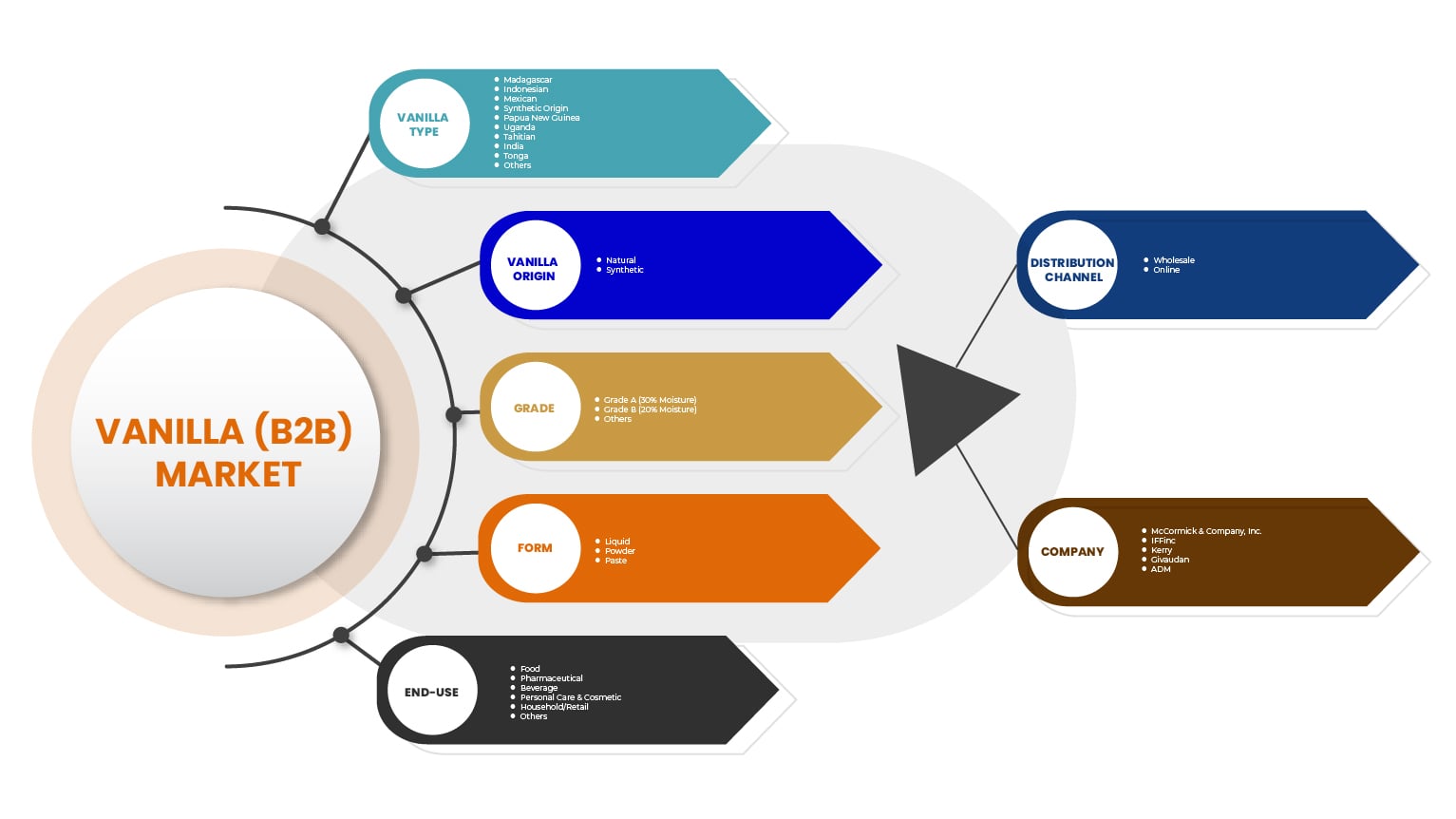
On the basis of distribution channel, the Europe vanilla (B2B) market is segmented into wholesale and online.
Europe Vanilla (B2B) Market Regional Analysis/Insights
The Europe vanilla (B2B) market analyzed and market size insights and trends are provided based on as referenced above.
The countries covered in the Europe vanilla (B2B) market report are Germany, U.K., France, Spain, Netherlands, Italy, Belgium, Turkey, Switzerland, Russia, Luxembourg and Rest of Europe
Germany dominates the Europe vanilla (B2B) market in terms of market share and market revenue and will continue to flourish its dominance during the forecast period. This is due to growing demand for vanilla in various industries in North America such as food, beverages, personal care and others.
The country section of the report also provides individual market impacting factors and changes in regulations in the market that impact the current and future trends of the market. Data points, such as new and replacement sales, country demographics, disease epidemiology, and import-export tariffs, are some of the major pointers used to forecast the market scenario for individual countries. In addition, the presence and availability of Europe brands and their challenges faced due to high competition from local and domestic brands, and the impact of sales channels are considered while providing forecast analysis of the country data.
Competitive Landscape and Global Vanilla Market Share Analysis
The Europe vanilla (B2B) market competitive landscape provides details by the competitors. Details included are company overview, company financials, revenue generated, market potential, investment in research and development, new market initiatives, Asia-Pacific presence, production sites and facilities, production capacities, company strengths and weaknesses, product launch, product width and breadth, and application dominance. The above data points provided are only related to the companies' focus on Europe vanilla (B2B) market.
Some of the key market players are Nielsen-Massey Vanillas, Inc., McCormick & Company, Inc., Prova, SYNERGY, IFFinc, Kerry, Takasago International Corporation, ADM, Madagascar Vanilla Company LLC and Firmenich SA.
Research Methodology
Data collection and base year analysis are done using data collection modules with large sample sizes. The market data is analyzed and estimated using market statistical and coherent models. In addition, market share analysis and key trend analysis are the major success factors in the market report. The key research methodology used by DBMR research team is data triangulation which involves data mining, analysis of the impact of data variables on the market, and primary (industry expert) validation. Apart from this, data models include Vendor Positioning Grid, Market Time Line Analysis, Market Overview and Guide, Company Positioning Grid, Company Market Share Analysis, Standards of Measurement, Europe Vs Regional and Vendor Share Analysis. Please request analyst call in case of further inquiry.

- Interactive Data Analysis Dashboard
- Company Analysis Dashboard for high growth potential opportunities
- Research Analyst Access for customization & queries
- Competitor Analysis with Interactive dashboard
- Latest News, Updates & Trend analysis
- Harness the Power of Benchmark Analysis for Comprehensive Competitor Tracking
Table of Content
1. INTRODUCTION
1.1 OBJECTIVES OF THE STUDY
1.2 MARKET DEFINITION
1.3 OVERVIEW OF EUROPE VANILLA (B2B) MARKET
1.4 CURRENCY AND PRICING
1.5 LIMITATION
1.6 MARKETS COVERED
2. MARKET SEGMENTATION
2.1 KEY TAKEAWAYS
2.2 ARRIVING AT THE EUROPE VANILLA (B2B) MARKET SIZE
2.2.1 VENDOR POSITIONING GRID
2.2.2 TECHNOLOGY LIFE LINE CURVE
2.2.3 MARKET GUIDE
2.2.4 COMPANY POSITIONING GRID
2.2.5 COMAPANY MARKET SHARE ANALYSIS
2.2.6 MULTIVARIATE MODELLING
2.2.7 DEMAND AND SUPPLY-SIDE VARIABLES
2.2.8 TOP TO BOTTOM ANALYSIS
2.2.9 STANDARDS OF MEASUREMENT
2.2.10 VENDOR SHARE ANALYSIS
2.2.11 DATA POINTS FROM KEY PRIMARY INTERVIEWS
2.2.12 DATA POINTS FROM KEY SECONDARY DATABASES
2.3 EUROPE VANILLA (B2B) MARKET: RESEARCH SNAPSHOT
2.4 ASSUMPTIONS
3. MARKET OVERVIEW
3.1 DRIVERS
3.2 RESTRAINTS
3.3 OPPORTUNITIES
3.4 CHALLENGES
4. EXECUTIVE SUMMARY
5. PREMIUM INSIGHTS
5.1 VALUE CHAIN ANALYSIS
5.2 SUPPLY CHAIN ANALYSIS
5.3 IMPORT-EXPORT ANALYSIS
5.4 PORTER’S FIVE FORCES ANALYSIS
5.4.1 BARGAINING POWER OF SUPPLIERS
5.4.2 BARGAINING POWER OF BUYERS/CONSUMERS
5.4.3 THREAT OF NEW ENTRANTS
5.4.4 THREAT OF SUBSTITUTE PRODUCTS
5.4.5 INTENSITY OF COMPETITIVE RIVALRY
5.5 RAW MATERIAL SOURCING ANALYSIS
5.6 OVERVIEW OF TECHNOLOGICAL INNOVATIONS
5.7 INDUSTRY TRENDS AND FUTURE PERSPECTIVE
5.8 GROWTH STRATEGIES ADOPTED BY KEY MARKET PLAYERS
5.9 FACTORS INFLUENCING PURCHASING DECISION OF END-USERS
6. IMPACT OF ECONOMIC SLOW DOWN ON MARKET
6.1 IMPACT ON PRICE
6.2 IMPACT ON SUPPLY CHAIN
6.3 IMPACT ON SHIPMENT
6.4 IMPACT ON COMPANY’S STRATEGIC DECISIONS
7. REGULATORY FRAMEWORK AND GUIDELINES
8. PRICING INDEX (PRICE AT B2B END & PRICES AT FOB)
9. PRODUCTION CAPACITY OF KEY MANUFACTURERES
10. BRAND OUTLOOK
10.1 COMPARATIVE BRAND ANALYSIS
10.2 PRODUCT VS BRAND OVERVIEW
11. EUROPE VANILLA (B2B) MARKET, BY TYPE, 2022-2031 (USD MILLION) (TONS)
(ASP, VALUE AND VOLUME WILL BE PROVIDED FOR ALL THE SEGMENTS)
11.1 OVERVIEW
11.2 MADAGASCAR
11.3 MEXICAN
11.4 INDIAN
11.5 INDONESIAN
11.6 TAHITIAN
11.7 TONGA
11.8 PAPUA
11.9 UGANDAN
11.10 OTHERS
12. EUROPE VANILLA (B2B) MARKET, BY GRADE, 2022-2031 (USD MILLION)
12.1 OVERVIEW
12.2 GRADE A
12.3 GRADE B
13. EUROPE VANILLA (B2B) MARKET, BY ORIGIN, 2022-2031 (USD MILLION)
13.1 OVERVIEW
13.2 NATURAL
13.3 SYNTHETIC
14. EUROPE VANILLA (B2B) MARKET, BY NATURE, 2022-2031 (USD MILLION)
14.1 OVERVIEW
14.2 ORGANIC
14.3 CONVENTIONAL
15. EUROPE VANILLA (B2B) MARKET, BY FORM, 2022-2031 (USD MILLION)
15.1 OVERVIEW
15.2 LIQUID
15.3 POWDER
15.4 PASTE
15.5 BEANS
15.6 OTHERS
16. EUROPE VANILLA (B2B) MARKET, BY APPLICATION, 2022-2031 (USD MILLION)
16.1 OVERVIEW
16.2 FOOD
16.3 FOOD, BY TYPE
16.3.1.1. CHOCOLATE & CONFECTIONERY
16.3.1.1.1. CHOCOLATE
16.3.1.1.2. CANDY
16.3.1.1.3. CHEWS
16.3.1.1.4. GUMMIES
16.3.1.1.5. OTHERS
16.3.1.2. BAKERY PRODUCTS
16.3.1.2.1. COOKIES & BISCUITS
16.3.1.2.2. CAKES AND PASTRIES
16.3.1.2.3. DOUGHNUTS
16.3.1.2.4. OTHERS
16.3.1.3. DAIRY BASED PRODUCTS
16.3.1.3.1. ICE CREAM
16.3.1.3.2. YOGHURT
16.3.1.3.3. FLAVOURED MILK
16.3.1.3.4. DESSERTS
16.3.1.3.5. OTHERS
16.3.1.4. PROCESSED FOODS
16.3.1.5. OTHERS
16.4 FOOD, BY VANILLA (B2B) TYPE
16.4.1.1. MADAGASCAR
16.4.1.2. MEXICAN
16.4.1.3. INDIAN
16.4.1.4. INDONESIAN
16.4.1.5. TAHITIAN
16.4.1.6. TONGA
16.4.1.7. PAPUA
16.4.1.8. UGANDAN
16.4.1.9. OTHERS
16.5 BEVERAGES
16.5.1 BEVERAGES, BY TYPE
16.5.1.1.1. RTD COFFEE
16.5.1.1.2. FLAVOURED DRINKS
16.5.1.1.3. NUTRITIONAL DRINKS
16.5.1.1.4. PLANT BASED BEVERAGES
16.5.1.1.5. OTHERS
16.6 BEVERAGES, BY VANILLA (B2B) TYPE
16.6.1.1. MADAGASCAR
16.6.1.2. MEXICAN
16.6.1.3. INDIAN
16.6.1.4. INDONESIAN
16.6.1.5. TAHITIAN
16.6.1.6. TONGA
16.6.1.7. PAPUA
16.6.1.8. UGANDAN
16.6.1.9. OTHERS
16.7 PERSONAL CARE PRODUCTS
16.8 PERSONAL CARE PRODUCTS, BY TYPE
16.8.1.1. CONDITIONER
16.8.1.2. LOTIONS
16.8.1.3. BALM
16.8.1.4. OTHERS
16.9 PERSONAL CARE PRODUCTS, BY VANILLA (B2B) TYPE
16.9.1.1. MADAGASCAR
16.9.1.2. MEXICAN
16.9.1.3. INDIAN
16.9.1.4. INDONESIAN
16.9.1.5. TAHITIAN
16.9.1.6. TONGA
16.9.1.7. PAPUA
16.9.1.8. UGANDAN
16.9.1.9. OTHERS
16.10 PHARMACEUTICALS INDUSTRY
16.11 PHARMACEUTICALS INDUSTRY, BY PRODUCT TYPE
16.11.1.1. TABLETS
16.11.1.2. SYRUPS
16.11.1.3. OTHERS
16.12 PHARMACEUTICALS INDUSTRY, BY VANILLA (B2B) TYPE
16.12.1.1. MADAGASCAR
16.12.1.2. MEXICAN
16.12.1.3. INDIAN
16.12.1.4. INDONESIAN
16.12.1.5. TAHITIAN
16.12.1.6. TONGA
16.12.1.7. PAPUA
16.12.1.8. UGANDAN
16.12.1.9. OTHERS
16.13 OTHERS
17. EUROPE VANILLA (B2B) MARKET, BY COUNTRY, 2022-2031 (USD MILLION) (TONS)
17.1 OVERVIEW (ALL SEGMENTATION PROVIDED ABOVE IS REPRESNTED IN THIS CHAPTER BY COUNTRY)
17.2 EUROPE
17.2.1 GERMANY
17.2.2 FRANCE
17.2.3 U.K.
17.2.4 ITALY
17.2.5 SPAIN
17.2.6 RUSSIA
17.2.7 TURKEY
17.2.8 BELGIUM
17.2.9 NETHERLANDS
17.2.10 SWITZERLAND
17.2.11 LUXEMBURG
17.2.12 NORWAY
17.2.13 SWEDEN
17.2.14 FINLAND
17.2.15 DENMARK
17.2.16 POLAND
17.2.17 REST OF EUROPE
18. EUROPE VANILLA (B2B) MARKET, COMPANY LANDSCAPE
18.1 COMPANY SHARE ANALYSIS: EUROPE
18.2 MERGERS & ACQUISITIONS
18.3 NEW PRODUCT DEVELOPMENT & APPROVALS
18.4 EXPANSIONS & PARTNERSHIP
18.5 REGULATORY CHANGES
19. SWOT AND DBMR ANALYSIS, EUROPE VANILLA (B2B) MARKET
20. EUROPE VANILLA (B2B) MARKET, COMPANY PROFILES
20.1 ADM
20.1.1 COMPANY OVERVIEW
20.1.2 REVENUE ANALYSIS
20.1.3 PRODUCT PORTFOLIO
20.1.4 RECENT DEVELOPMENTS
20.2 SYMRISE
20.2.1 COMPANY OVERVIEW
20.2.2 REVENUE ANALYSIS
20.2.3 PRODUCT PORTFOLIO
20.2.4 RECENT DEVELOPMENTS
20.3 INTERNATIONAL FLAVORS & FRAGRANCES INC. (IFF)
20.3.1 COMPANY OVERVIEW
20.3.2 REVENUE ANALYSIS
20.3.3 PRODUCT PORTFOLIO
20.3.4 RECENT DEVELOPMENTS
20.4 GIVAUDAN
20.4.1 COMPANY OVERVIEW
20.4.2 REVENUE ANALYSIS
20.4.3 PRODUCT PORTFOLIO
20.4.4 RECENT DEVELOPMENTS
20.5 KERRY GROUP PLC
20.5.1 COMPANY OVERVIEW
20.5.2 REVENUE ANALYSIS
20.5.3 PRODUCT PORTFOLIO
20.5.4 RECENT DEVELOPMENTS
20.6 MANE
20.6.1 COMPANY OVERVIEW
20.6.2 REVENUE ANALYSIS
20.6.3 PRODUCT PORTFOLIO
20.6.4 RECENT DEVELOPMENTS
20.7 TAKASAGO INTERNATIONAL CORPORATION
20.7.1 COMPANY OVERVIEW
20.7.2 REVENUE ANALYSIS
20.7.3 PRODUCT PORTFOLIO
20.7.4 RECENT DEVELOPMENTS
20.8 MCCORMICK & COMPANY, INC.
20.8.1 COMPANY OVERVIEW
20.8.2 REVENUE ANALYSIS
20.8.3 PRODUCT PORTFOLIO
20.8.4 RECENT DEVELOPMENTS
20.9 NIELSEN-MASSEY VANILLAS, INC.
20.9.1 COMPANY OVERVIEW
20.9.2 REVENUE ANALYSIS
20.9.3 PRODUCT PORTFOLIO
20.9.4 RECENT DEVELOPMENTS
20.10 FIRMENICH SA
20.10.1 COMPANY OVERVIEW
20.10.2 REVENUE ANALYSIS
20.10.3 PRODUCT PORTFOLIO
20.10.4 RECENT DEVELOPMENTS
20.11 SYNTHITE INDUSTRIES LTD
20.11.1 COMPANY OVERVIEW
20.11.2 REVENUE ANALYSIS
20.11.3 PRODUCT PORTFOLIO
20.11.4 RECENT DEVELOPMENTS
20.12 VANILLA ETC LTD
20.12.1 COMPANY OVERVIEW
20.12.2 REVENUE ANALYSIS
20.12.3 PRODUCT PORTFOLIO
20.12.4 RECENT DEVELOPMENTS
20.13 STRINGER FLAVOUR. LTD
20.13.1 COMPANY OVERVIEW
20.13.2 REVENUE ANALYSIS
20.13.3 PRODUCT PORTFOLIO
20.13.4 RECENT DEVELOPMENTS
20.14 HEILALA VANILLA
20.14.1 COMPANY OVERVIEW
20.14.2 REVENUE ANALYSIS
20.14.3 PRODUCT PORTFOLIO
20.14.4 RECENT DEVELOPMENTS
20.15 AUST & HACHMANN
20.15.1 COMPANY OVERVIEW
20.15.2 REVENUE ANALYSIS
20.15.3 PRODUCT PORTFOLIO
20.15.4 RECENT DEVELOPMENTS
NOTE: THE COMPANIES PROFILED IS NOT EXHAUSTIVE LIST AND IS AS PER OUR PREVIOUS CLIENT REQUIREMENT. WE PROFILE MORE THAN 100 COMPANIES IN OUR STUDY AND HENCE THE LIST OF COMPANIES CAN BE MODIFIED OR REPLACED ON REQUEST
21. RELATED REPORTS
22. CONCLUSION
23. QUESTIONNAIRE
24. ABOUT DATA BRIDGE MARKET RESEARCH

Europe Vanilla B2b Market, Supply Chain Analysis and Ecosystem Framework
To support market growth and help clients navigate the impact of geopolitical shifts, DBMR has integrated in-depth supply chain analysis into its Europe Vanilla B2b Market research reports. This addition empowers clients to respond effectively to global changes affecting their industries. The supply chain analysis section includes detailed insights such as Europe Vanilla B2b Market consumption and production by country, price trend analysis, the impact of tariffs and geopolitical developments, and import and export trends by country and HSN code. It also highlights major suppliers with data on production capacity and company profiles, as well as key importers and exporters. In addition to research, DBMR offers specialized supply chain consulting services backed by over a decade of experience, providing solutions like supplier discovery, supplier risk assessment, price trend analysis, impact evaluation of inflation and trade route changes, and comprehensive market trend analysis.
Data collection and base year analysis are done using data collection modules with large sample sizes. The stage includes obtaining market information or related data through various sources and strategies. It includes examining and planning all the data acquired from the past in advance. It likewise envelops the examination of information inconsistencies seen across different information sources. The market data is analysed and estimated using market statistical and coherent models. Also, market share analysis and key trend analysis are the major success factors in the market report. To know more, please request an analyst call or drop down your inquiry.
The key research methodology used by DBMR research team is data triangulation which involves data mining, analysis of the impact of data variables on the market and primary (industry expert) validation. Data models include Vendor Positioning Grid, Market Time Line Analysis, Market Overview and Guide, Company Positioning Grid, Patent Analysis, Pricing Analysis, Company Market Share Analysis, Standards of Measurement, Global versus Regional and Vendor Share Analysis. To know more about the research methodology, drop in an inquiry to speak to our industry experts.
Data Bridge Market Research is a leader in advanced formative research. We take pride in servicing our existing and new customers with data and analysis that match and suits their goal. The report can be customized to include price trend analysis of target brands understanding the market for additional countries (ask for the list of countries), clinical trial results data, literature review, refurbished market and product base analysis. Market analysis of target competitors can be analyzed from technology-based analysis to market portfolio strategies. We can add as many competitors that you require data about in the format and data style you are looking for. Our team of analysts can also provide you data in crude raw excel files pivot tables (Fact book) or can assist you in creating presentations from the data sets available in the report.













