


Global 3d Reconstruction Technology Market
Market Size in USD Billion
CAGR :
% 
 USD
2.15 Billion
USD
4.33 Billion
2025
2033
USD
2.15 Billion
USD
4.33 Billion
2025
2033
 Forecast Period Forecast Period |
2026 –2033 |
 Market Size (Base Year) Market Size (Base Year) |
USD 2.15 Billion |
 Market Size (Forecast Year) Market Size (Forecast Year) |
USD 4.33 Billion |
 CAGR CAGR |
% |
| Major Markets Players |
|
3D Reconstruction Technology Market Size
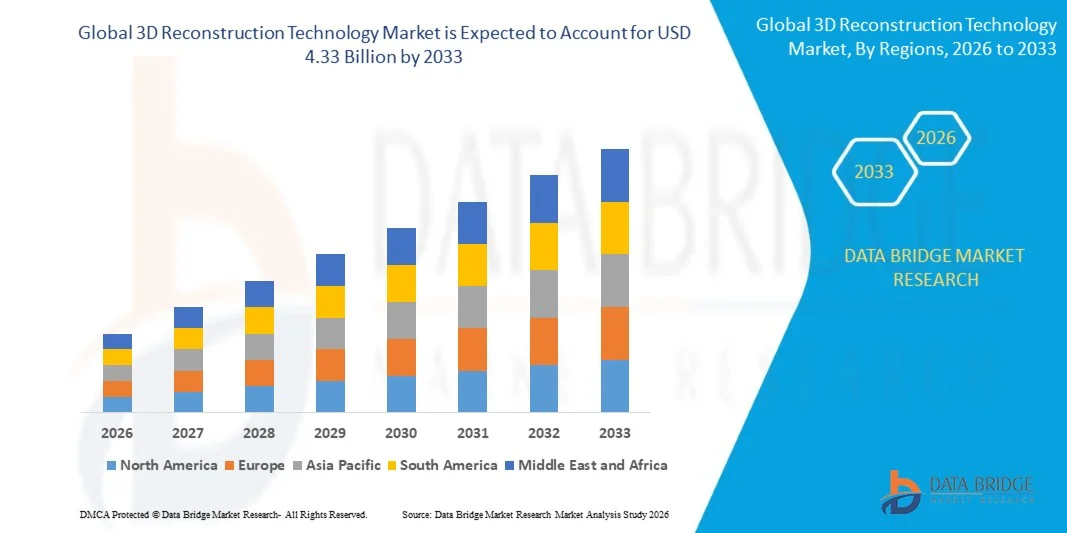
- The global 3D reconstruction technology market size was valued at USD 2.15 billion in 2025 and is expected to reach USD 4.33 billion by 2033, at a CAGR of 9.15% during the forecast period
- The market growth is largely fueled by increasing adoption of advanced 3D modeling, photogrammetry, and digital twin technologies across industries such as construction, automotive, aerospace, healthcare, and media. Technological progress in AI, machine learning, and cloud-based reconstruction solutions is accelerating precise and scalable 3D model generation for diverse applications
- Furthermore, rising demand for accurate, cost-effective, and real-time 3D reconstruction solutions is driving companies to integrate software and hardware platforms for enhanced operational efficiency. These converging factors are accelerating the adoption of 3D reconstruction technologies, thereby significantly boosting the market’s growth
3D Reconstruction Technology Market Analysis
- 3D reconstruction technology, which converts images, video, or scans into high-fidelity 3D models, is increasingly critical for industrial design, infrastructure monitoring, virtual content creation, and heritage preservation due to its ability to improve accuracy, visualization, and workflow efficiency
- The escalating demand for 3D reconstruction solutions is primarily fueled by rapid industrial digitization, the growing need for digital twins in manufacturing and construction, and expanding applications in media, gaming, and healthcare. Increasing awareness of the benefits of real-time 3D modeling and the integration with AR/VR platforms further supports market expansion
- North America dominated the 3D reconstruction technology market with a share of 36.1% in 2025, due to strong adoption across automotive, aerospace, media, and industrial sectors
- Asia-Pacific is expected to be the fastest growing region in the 3D reconstruction technology market during the forecast period due to rapid industrialization, technological modernization, and government initiatives supporting digital transformation
- 3D reconstruction software segment dominated the market with a market share of 41.8% in 2025, due to its versatility in converting raw data into high-precision 3D models across industries. Businesses and research institutions increasingly rely on software solutions for accurate and cost-effective reconstruction without the need for specialized hardware. The availability of advanced algorithms, AI-assisted processing, and cloud-based platforms enhances efficiency and scalability for large datasets, strengthening its market position
Report Scope and 3D Reconstruction Technology Market Segmentation
|
Attributes |
3D Reconstruction Technology Key Market Insights |
|
Segments Covered |
|
|
Countries Covered |
North America
Europe
Asia-Pacific
Middle East and Africa
South America
|
|
Key Market Players |
|
|
Market Opportunities |
|
|
Value Added Data Infosets |
In addition to the insights on market scenarios such as market value, growth rate, segmentation, geographical coverage, and major players, the market reports curated by the Data Bridge Market Research also include in-depth expert analysis, geographically represented company-wise production and capacity, network layouts of distributors and partners, detailed and updated price trend analysis and deficit analysis of supply chain and demand. |
3D Reconstruction Technology Market Trends
“Rising Adoption of AI-Enabled and Cloud-Based 3D Reconstruction Solutions”
- A significant trend in the 3D reconstruction technology market is the increasing integration of AI-driven and cloud-based platforms, which enhance the speed, accuracy, and scalability of 3D modeling and reconstruction processes across industries. These solutions enable organizations to process large datasets efficiently and generate detailed digital replicas of physical objects or environments
- For instance, companies such as Autodesk and Matterport offer cloud-based 3D reconstruction platforms that utilize AI algorithms for automated modeling, allowing architects, engineers, and real estate professionals to create precise 3D models rapidly. These solutions improve collaboration, reduce manual effort, and support real-time updates in dynamic projects
- The adoption of 3D reconstruction in manufacturing and industrial design is rising as AI-assisted photogrammetry and LiDAR scanning enable high-precision measurements and virtual prototyping. This trend is positioning 3D reconstruction technologies as crucial tools for product development, quality control, and process optimization
- In the healthcare sector, 3D reconstruction is being used for surgical planning, prosthetics design, and anatomical modeling, where accurate digital representations enhance patient-specific solutions. Hospitals and research institutions are increasingly relying on platforms such as Materialise and 3D Systems to improve procedural outcomes and training efficiency
- Construction and infrastructure projects are leveraging 3D reconstruction to create digital twins of sites for planning, monitoring, and maintenance. Technologies provided by Trimble and Bentley Systems are enabling project managers to detect errors, track progress, and improve overall operational efficiency
- The market is witnessing growing interest from cultural heritage and entertainment sectors, where 3D reconstruction supports preservation, virtual tourism, and immersive experiences. The rising adoption of these solutions is reinforcing the role of 3D reconstruction as a transformative technology for visualization, documentation, and interactive applications
3D Reconstruction Technology Market Dynamics
Driver
“Growing Demand for Digital Twins and Accurate 3D Modeling Across Industries”
- The increasing demand for digital twins and highly accurate 3D models is driving the 3D reconstruction technology market, as organizations seek to enhance simulation, monitoring, and decision-making capabilities. Digital twin adoption enables real-time insights into physical assets, improving operational efficiency and reducing downtime
- For instance, Siemens leverages 3D reconstruction and digital twin technologies in manufacturing and industrial automation to optimize production lines and predictive maintenance processes. This approach allows manufacturers to simulate scenarios virtually and enhance overall system reliability
- The expansion of smart city projects and urban planning initiatives is fueling the requirement for precise 3D reconstructions of buildings, landscapes, and infrastructure. Accurate modeling ensures efficient planning, better resource management, and informed policymaking
- Automotive and aerospace industries are increasingly implementing 3D reconstruction to support design, testing, and assembly of complex components. This adoption reduces prototype iterations, shortens development cycles, and enhances product performance
- The rising integration of augmented reality (AR) and virtual reality (VR) applications is encouraging the use of detailed 3D reconstructions for immersive experiences in training, simulation, and entertainment. These applications rely on accurate and high-resolution models to deliver realistic and interactive user experiences
Restraint/Challenge
“High Costs and Complexity of Advanced 3D Reconstruction Systems”
- The 3D reconstruction technology market faces challenges due to the high costs and operational complexity of advanced hardware and software solutions, which require specialized expertise and substantial investment. The need for LiDAR scanners, high-resolution cameras, and sophisticated AI algorithms can create entry barriers for smaller organizations
- For instance, Matterport’s professional-grade 3D scanning solutions involve considerable equipment costs and subscription-based cloud services, which may be restrictive for small-scale enterprises. In addition, training personnel to operate and interpret reconstructed models adds to operational challenges
- The processing of large datasets and the integration of multiple imaging modalities demand robust computing infrastructure, which increases deployment costs and limits accessibility
- Maintenance, calibration, and software updates of 3D reconstruction systems are critical to ensure accuracy and consistency, further adding to the total cost of ownership. Organizations must balance investment with expected benefits to justify adoption
- The market continues to face limitations in standardization and interoperability across platforms, which complicates integration into existing workflows. These challenges collectively restrain rapid deployment and widespread adoption despite growing industry demand
3D Reconstruction Technology Market Scope
The market is segmented on the basis of type, application, construction method, and end use.
• By Type
On the basis of type, the 3D reconstruction technology market is segmented into 3D reconstruction software, based on images and video, and based on 3D scanning. The 3D reconstruction software segment dominated the market with the largest revenue share of 41.8% in 2025, driven by its versatility in converting raw data into high-precision 3D models across industries. Businesses and research institutions increasingly rely on software solutions for accurate and cost-effective reconstruction without the need for specialized hardware. The availability of advanced algorithms, AI-assisted processing, and cloud-based platforms enhances efficiency and scalability for large datasets, strengthening its market position.
The 3D scanning segment is anticipated to witness the fastest growth rate of 22.3% from 2026 to 2033, fueled by rising demand for high-fidelity and real-time 3D modeling in automotive, aerospace, and healthcare sectors. For instance, companies such as Artec 3D are innovating portable scanners that enable rapid digitization of complex surfaces. The increasing integration of scanning devices with AI and machine learning accelerates precise reconstruction, making it attractive for both industrial and consumer applications. Its compatibility with augmented reality (AR) and virtual reality (VR) projects also drives adoption in entertainment and design sectors.
• By Application
On the basis of application, the 3D reconstruction technology market is segmented into culture heritage and museum, films and games, 3D printing, and drones and robots. The films and games segment held the largest revenue share in 2025 due to extensive adoption of realistic 3D modeling in visual effects, animation, and immersive gaming environments. Studios leverage reconstruction technology to create lifelike characters, sets, and scenarios, enhancing viewer engagement and creative flexibility. Its integration with AR and VR experiences enables producers to develop interactive content with higher fidelity and lower production costs.
The 3D printing segment is expected to witness the fastest CAGR from 2026 to 2033, driven by increasing demand for precise prototypes, custom components, and rapid manufacturing solutions. For instance, companies such as Stratasys are utilizing reconstruction data to optimize 3D-printed designs. The synergy between reconstruction technology and additive manufacturing reduces material waste and improves design iteration speed, supporting industrial, medical, and consumer applications. This trend is strengthened by advancements in high-resolution scanning and model refinement software, making 3D printing more accessible and efficient.
• By Construction Method
On the basis of construction method, the market is segmented into active and passive 3D reconstruction technologies. The active segment dominated the market with the largest revenue share in 2025, driven by its high accuracy and capability to capture detailed geometry using structured light, lasers, or sensors. Active methods are widely preferred in industrial inspection, quality control, and medical imaging due to their precision and repeatability. The adoption of advanced sensors and automated reconstruction pipelines enhances speed and reduces human error, reinforcing their market leadership.
The passive segment is anticipated to witness the fastest growth rate from 2026 to 2033, fueled by its low-cost implementation using standard cameras and photogrammetry techniques. For instance, companies such as RealityCapture provide software that reconstructs detailed 3D models solely from images and video. Passive methods are gaining traction in architecture, cultural heritage documentation, and drone-based mapping due to ease of deployment, minimal hardware requirements, and integration with cloud-based processing workflows. Increasing interest in large-scale outdoor and urban mapping further supports market expansion.
• By End Use
On the basis of end use, the 3D reconstruction technology market is segmented into automotive, aerospace & defence, industrial machinery, electrical & electronics, media & entertainment, healthcare, and construction & architecture. The media & entertainment segment dominated the market with the largest revenue share in 2025, driven by demand for realistic visual content, immersive gaming experiences, and cinematic production enhancements. Studios and production houses increasingly rely on reconstruction technologies to create lifelike models for VFX, virtual sets, and AR/VR content. Its ability to accelerate production timelines while maintaining high precision supports broad adoption across creative industries.
The healthcare segment is expected to witness the fastest CAGR from 2026 to 2033, fueled by growing applications in surgical planning, prosthetics design, and patient-specific anatomical modeling. For instance, companies such as Materialise leverage reconstruction technology to produce custom implants and preoperative models. The increasing integration of AI and high-resolution imaging improves diagnostic accuracy and surgical outcomes, driving adoption in hospitals, clinics, and research institutions. Rising investment in digital healthcare infrastructure and personalized medicine further supports the expansion of this segment.
3D Reconstruction Technology Market Regional Analysis
- North America dominated the 3D reconstruction technology market with the largest revenue share of 36.1% in 2025, driven by strong adoption across automotive, aerospace, media, and industrial sectors
- Organizations in the region increasingly leverage advanced reconstruction solutions for rapid prototyping, digital twin creation, and immersive media experiences, benefiting from seamless integration with AI and cloud platforms
- High investment in R&D, a technologically adept workforce, and widespread awareness of the advantages of 3D reconstruction technology support robust demand across both commercial and academic applications
U.S. 3D Reconstruction Technology Market Insight
The U.S. market captured the largest revenue share in 2025 within North America, fueled by early adoption of cutting-edge technologies in media production, industrial design, and healthcare. Corporations and research institutions prioritize high-precision modeling and real-time 3D visualization to optimize workflows and reduce production timelines. The rising trend of AI-assisted reconstruction and cloud-based software adoption further accelerates growth. In addition, integration with AR, VR, and IoT-enabled systems enhances operational efficiency, strengthening the U.S. market position.
Europe 3D Reconstruction Technology Market Insight
The Europe market is projected to expand at a significant CAGR throughout the forecast period, driven by strong industrial modernization initiatives and the adoption of digital solutions in media, architecture, and heritage preservation. Governments and organizations are increasingly investing in 3D reconstruction for cultural heritage documentation, smart manufacturing, and simulation-based training. Rising urbanization, coupled with stringent quality and precision standards, fosters adoption across industrial and academic sectors. Integration with advanced imaging systems and sustainability-focused practices further boosts regional growth.
U.K. 3D Reconstruction Technology Market Insight
The U.K. market is anticipated to grow at a noteworthy CAGR during the forecast period, driven by increasing demand for immersive media, digital content creation, and industrial prototyping. Rising investment in AR/VR applications, gaming, and film production is fueling the adoption of reconstruction technologies. Academic and research institutions are also leveraging software-based reconstruction for cultural and scientific projects. The country’s strong IT infrastructure and innovation-driven ecosystem support rapid integration of new 3D reconstruction solutions across multiple sectors.
Germany 3D Reconstruction Technology Market Insight
The Germany market is expected to expand at a considerable CAGR, supported by industrial digitization, advanced manufacturing, and precision engineering applications. High demand for accurate 3D modeling in automotive, aerospace, and machinery sectors promotes adoption of active and passive reconstruction technologies. Germany’s focus on innovation, sustainability, and smart factory implementation enhances the integration of 3D reconstruction in commercial and industrial operations. Academic and research initiatives further contribute to regional growth through development of novel algorithms and software solutions.
Asia-Pacific 3D Reconstruction Technology Market Insight
The Asia-Pacific market is poised to grow at the fastest CAGR during the forecast period of 2026 to 2033, driven by rapid industrialization, technological modernization, and government initiatives supporting digital transformation. Countries such as China, Japan, and India are witnessing rising adoption in manufacturing, media, healthcare, and construction sectors. Increasing investments in smart factories, AR/VR content creation, and heritage digitization are accelerating technology uptake. The region’s growing middle-class and expanding industrial infrastructure support affordable deployment of software and scanning solutions.
Japan 3D Reconstruction Technology Market Insight
The Japan market is gaining momentum due to high-tech adoption, urbanization, and industrial modernization. Organizations prioritize 3D reconstruction for robotics, automotive prototyping, and media content creation. The integration of reconstruction solutions with AI, IoT, and VR/AR platforms enhances operational efficiency and workflow optimization. Japan’s aging population also drives demand for user-friendly modeling tools in healthcare and architectural applications, further supporting growth.
China 3D Reconstruction Technology Market Insight
The China market accounted for the largest revenue share in Asia-Pacific in 2025, driven by rapid urbanization, strong industrial and media growth, and adoption of advanced technologies. The country’s emphasis on smart cities, digital twin implementation, and AR/VR content creation is increasing demand for high-precision 3D reconstruction solutions. Affordable software and hardware solutions, coupled with strong domestic manufacturers, are making technology accessible across industries such as manufacturing, construction, and entertainment. Government-backed initiatives to promote industrial digitization further propel market growth.
3D Reconstruction Technology Market Share
The 3D reconstruction technology industry is primarily led by well-established companies, including:
- Pix4D SA (Switzerland)
- Agisoft (Russia)
- Autodesk Inc. (U.S.)
- Capturing Reality s.r.o. (Slovakia)
- Bentley Systems, Incorporated (U.S.)
- Photometrix Photogrammetry Software (U.K.)
- PMS AG (Germany)
- Vi3DIM TECHNOLOGIES (France)
- Occipital, Inc. (U.S.)
- Matterport, Inc. (U.S.)
- Intel Corporation (U.S.)
- Skyline Software Systems (U.S.)
- Airbus S.A.S. (France)
- Koninklijke Philips N.V. (Netherlands)
- PhotoModeler Technologies (Canada)
Latest Developments in Global 3D Reconstruction Technology Market
- In 2024, Luma AI secured $43 million in a Series B funding round to accelerate the expansion of its generative AI-based 3D reconstruction platform. This investment is expected to significantly impact the market by enhancing the ability to create photorealistic 3D models from images and video, catering to industries such as media, gaming, architecture, and e-commerce. The infusion of capital allows Luma AI to scale its platform, improve AI algorithms, and expand commercial deployment, strengthening the adoption of generative 3D reconstruction solutions globally
- In 2024, NVIDIA launched Omniverse Cloud APIs designed to enable real-time 3D reconstruction and simulation for industrial and manufacturing applications. This development significantly advances the market by integrating AI-driven modeling with digital twin workflows, facilitating faster, more accurate visualization of industrial assets. By providing scalable cloud-based solutions, NVIDIA supports manufacturers and industrial clients in improving operational efficiency, predictive maintenance, and simulation-driven design, further accelerating the adoption of 3D reconstruction technologies in enterprise environments
- In 2024, Bentley Systems completed the acquisition of Eagle.io, a cloud-based environmental data management platform, to strengthen its 3D reconstruction and digital twin capabilities for infrastructure monitoring. This strategic move enhances Bentley’s position in the market by offering integrated solutions for construction, civil engineering, and urban planning. The acquisition enables clients to merge environmental data with 3D models, improving decision-making, predictive analytics, and the efficiency of infrastructure projects, thereby driving the broader adoption of 3D reconstruction in the infrastructure sector
- In 2024, Pix4D introduced Pix4Dcatch RTK, a mobile application coupled with RTK GNSS hardware that allows survey-grade 3D reconstruction using smartphones. This launch impacts the market by democratizing access to high-precision 3D mapping, particularly for construction, surveying, and geospatial professionals. By enabling mobile and field-ready reconstruction, Pix4D facilitates faster data collection, improved accuracy, and cost-effective workflows, enhancing efficiency across industries reliant on geospatial and construction applications
- In 2024, Matterport partnered with Autodesk to integrate its 3D digital twin technology into the Autodesk Construction Cloud. This collaboration strengthens the 3D reconstruction technology market by streamlining the creation and visualization of digital twins in architecture, engineering, and construction workflows. The partnership enables professionals to seamlessly incorporate 3D models into project management, design validation, and site planning, thereby improving operational efficiency and accelerating adoption of digital twin-based reconstruction solutions across commercial and residential construction projects
SKU-
Get online access to the report on the World's First Market Intelligence Cloud

- Interactive Data Analysis Dashboard
- Company Analysis Dashboard for high growth potential opportunities
- Research Analyst Access for customization & queries
- Competitor Analysis with Interactive dashboard
- Latest News, Updates & Trend analysis
- Harness the Power of Benchmark Analysis for Comprehensive Competitor Tracking
Global 3d Reconstruction Technology Market, Supply Chain Analysis and Ecosystem Framework
To support market growth and help clients navigate the impact of geopolitical shifts, DBMR has integrated in-depth supply chain analysis into its Global 3d Reconstruction Technology Market research reports. This addition empowers clients to respond effectively to global changes affecting their industries. The supply chain analysis section includes detailed insights such as Global 3d Reconstruction Technology Market consumption and production by country, price trend analysis, the impact of tariffs and geopolitical developments, and import and export trends by country and HSN code. It also highlights major suppliers with data on production capacity and company profiles, as well as key importers and exporters. In addition to research, DBMR offers specialized supply chain consulting services backed by over a decade of experience, providing solutions like supplier discovery, supplier risk assessment, price trend analysis, impact evaluation of inflation and trade route changes, and comprehensive market trend analysis.
Research Methodology
Data collection and base year analysis are done using data collection modules with large sample sizes. The stage includes obtaining market information or related data through various sources and strategies. It includes examining and planning all the data acquired from the past in advance. It likewise envelops the examination of information inconsistencies seen across different information sources. The market data is analysed and estimated using market statistical and coherent models. Also, market share analysis and key trend analysis are the major success factors in the market report. To know more, please request an analyst call or drop down your inquiry.
The key research methodology used by DBMR research team is data triangulation which involves data mining, analysis of the impact of data variables on the market and primary (industry expert) validation. Data models include Vendor Positioning Grid, Market Time Line Analysis, Market Overview and Guide, Company Positioning Grid, Patent Analysis, Pricing Analysis, Company Market Share Analysis, Standards of Measurement, Global versus Regional and Vendor Share Analysis. To know more about the research methodology, drop in an inquiry to speak to our industry experts.
Customization Available
Data Bridge Market Research is a leader in advanced formative research. We take pride in servicing our existing and new customers with data and analysis that match and suits their goal. The report can be customized to include price trend analysis of target brands understanding the market for additional countries (ask for the list of countries), clinical trial results data, literature review, refurbished market and product base analysis. Market analysis of target competitors can be analyzed from technology-based analysis to market portfolio strategies. We can add as many competitors that you require data about in the format and data style you are looking for. Our team of analysts can also provide you data in crude raw excel files pivot tables (Fact book) or can assist you in creating presentations from the data sets available in the report.












