




Global 3d Sensor Market
Market Size in USD Billion
CAGR :
% 
 USD
4.61 Billion
USD
7.98 Billion
2025
2033
USD
4.61 Billion
USD
7.98 Billion
2025
2033
 Forecast Period Forecast Period |
2026 –2033 |
 Market Size (Base Year) Market Size (Base Year) |
USD 4.61 Billion |
 Market Size (Forecast Year) Market Size (Forecast Year) |
USD 7.98 Billion |
 CAGR CAGR |
% |
| Major Markets Players |
|
3D Sensor Market Size
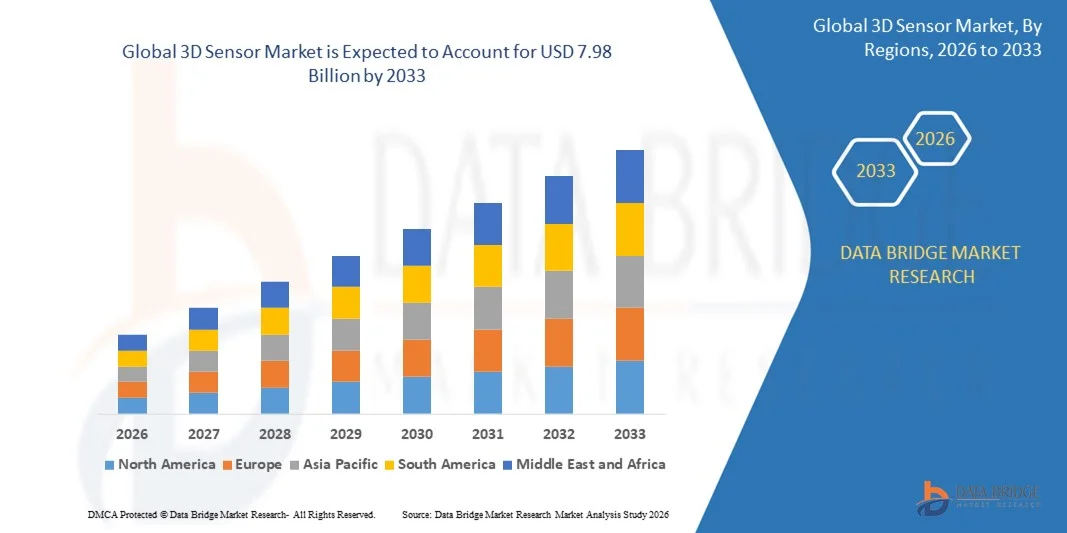
- The global 3D sensor market size was valued at USD 4.61 billion in 2025 and is expected to reach USD 7.98 billion by 2033, at a CAGR of 7.10% during the forecast period
- The market growth is largely fuelled by the increasing adoption of 3D sensors in consumer electronics, automotive applications, and industrial automation
- Rising demand for advanced gesture recognition, facial recognition, and augmented reality (AR) applications is further driving market expansion
3D Sensor Market Analysis
- The market is witnessing significant growth due to rapid technological innovation and the integration of 3D sensors in smartphones, tablets, automotive ADAS systems, and industrial robotics
- Increasing investments in smart devices, autonomous vehicles, and AR/VR applications are contributing to market adoption
- North America dominated the 3D sensor market with the largest revenue share of 36.85% in 2025, driven by the rising adoption of consumer electronics, automotive safety systems, and industrial automation.
- Asia-Pacific region is expected to witness the highest growth rate in the global 3D sensor market, driven by technological advancements, government initiatives supporting smart cities, expanding consumer electronics demand, and the region’s position as a manufacturing hub for high-performance 3D sensors
- The Image Sensor segment held the largest market revenue share in 2025, driven by its widespread use in smartphones, tablets, cameras, and AR/VR devices. Image sensors offer high accuracy in depth perception, gesture recognition, and facial recognition, making them a preferred choice for consumer electronics and industrial applications
Report Scope and 3D Sensor Market Segmentation
|
Attributes |
3D Sensor Key Market Insights |
|
Segments Covered |
|
|
Countries Covered |
North America
Europe
Asia-Pacific
Middle East and Africa
South America
|
|
Key Market Players |
|
|
Market Opportunities |
|
|
Value Added Data Infosets |
In addition to the market insights such as market value, growth rate, market segments, geographical coverage, market players, and market scenario, the market report curated by the Data Bridge Market Research team includes in-depth expert analysis, import/export analysis, pricing analysis, production consumption analysis, and pestle analysis. |
3D Sensor Market Trends
Rising Adoption In Consumer Electronics And Automotive Applications
- The growing integration of 3D sensors in smartphones, tablets, cameras, and automotive systems is significantly shaping the 3D sensor market, as manufacturers aim to enhance depth perception, gesture recognition, and facial recognition capabilities. These sensors improve user experience, safety, and device functionality, encouraging widespread adoption across consumer electronics and automotive segments
- Increasing deployment of 3D sensors in industrial automation, robotics, and healthcare is driving demand for precise motion tracking, object detection, and spatial mapping. Industries are leveraging these sensors to optimize production efficiency, quality control, and safety monitoring, reinforcing their importance in modern automated systems
- Technological advancements such as LiDAR, time-of-flight (ToF), and structured light sensors are enhancing performance, accuracy, and integration potential. These developments are enabling innovative applications in AR/VR, autonomous vehicles, and smart manufacturing, further fueling market growth
- For instance, in 2025, Apple in the U.S. and Samsung in South Korea incorporated advanced 3D sensing technologies into flagship smartphones to enable facial recognition, AR features, and improved camera performance. These implementations enhanced user experience, strengthened brand differentiation, and drove competitive market positioning
- Sustained market expansion depends on continued R&D, cost-effective manufacturing, and the ability to meet growing demand across multiple sectors. Companies are focusing on improving sensor accuracy, miniaturization, and compatibility with diverse devices to drive adoption across consumer, automotive, and industrial applications
3D Sensor Market Dynamics
Driver
Technological Innovation And Integration Across Multiple Industries
- Rapid technological advancements in 3D sensing technologies such as LiDAR, ToF, and structured light are driving market growth. Manufacturers are increasingly integrating these sensors into smartphones, wearables, automotive systems, and industrial robotics to enhance functionality, safety, and user experience
- Growing applications in consumer electronics, automotive ADAS, AR/VR, healthcare, and industrial automation are expanding market potential. The demand for accurate depth sensing, motion tracking, and spatial mapping is encouraging continuous innovation and product diversification
- Leading technology companies are investing in partnerships, collaborations, and product development initiatives to introduce advanced 3D sensor solutions. This is boosting market penetration, fostering competitive differentiation, and accelerating adoption across various end-use sectors
- For instance, in 2024, Sony in Japan and STMicroelectronics in Switzerland launched new 3D sensor modules with enhanced precision and lower power consumption, targeting smartphones, autonomous vehicles, and industrial robots. These innovations reinforced their technological leadership and expanded market share
- Despite rapid growth, wider adoption depends on reducing manufacturing costs, improving supply chain efficiency, and ensuring compatibility with multiple platforms. Investment in scalable production, miniaturization, and software integration remains critical to meeting global demand
Restraint/Challenge
High Costs And Technical Complexity
- The relatively high cost of 3D sensors compared to traditional 2D sensors remains a key challenge, limiting adoption among cost-sensitive manufacturers. Advanced fabrication techniques, high-quality materials, and complex calibration processes contribute to elevated pricing
- Integration complexity and compatibility issues restrict deployment across certain devices and applications. Developers must ensure seamless software-hardware interaction, which requires technical expertise and additional resources
- Supply chain constraints and component shortages, particularly for LiDAR and ToF modules, can disrupt production and delay product launches. Manufacturers must invest in robust sourcing, quality control, and logistics management to maintain timely delivery and performance standards
- For instance, in 2024, automotive and smartphone manufacturers in Germany and China reported delays in incorporating high-precision 3D sensors due to component scarcity and technical integration challenges. These issues affected product availability and market expansion in certain regions
- Overcoming these challenges requires cost optimization, streamlined production processes, and enhanced technical support. Collaboration with component suppliers, R&D investment, and the development of standardized platforms can help unlock the full growth potential of the global 3D sensor market
3D Sensor Market Scope
The market is segmented on the basis of product, technology, and end-user.
- By Product
On the basis of product, the 3D sensor market is segmented into Position Sensor, Image Sensor, and Temperature Sensor. The Image Sensor segment held the largest market revenue share in 2025, driven by its widespread use in smartphones, tablets, cameras, and AR/VR devices. Image sensors offer high accuracy in depth perception, gesture recognition, and facial recognition, making them a preferred choice for consumer electronics and industrial applications.
The Position Sensor segment is expected to witness the fastest growth rate from 2026 to 2033, driven by its critical role in automotive safety systems, robotics, and industrial automation. Position sensors provide precise spatial tracking and motion detection, enabling accurate navigation and control. Their adoption is increasing due to rising demand for autonomous vehicles, smart manufacturing, and advanced robotics applications.
- By Technology
On the basis of technology, the market is segmented into Ultrasound, Structured Light, and Time of Flight (ToF). The Time of Flight segment held the largest revenue share in 2025, attributed to its ability to provide high-precision distance measurements and reliable 3D mapping for consumer electronics, automotive, and industrial applications. ToF sensors are widely used for gesture recognition, depth mapping, and proximity detection.
The Structured Light segment is expected to witness the fastest growth from 2026 to 2033, driven by its high accuracy in capturing complex surfaces and shapes. Structured light sensors are increasingly used in AR/VR devices, industrial inspection, and biometric authentication, offering enhanced performance for applications requiring fine-detail 3D imaging.
- By End-user
On the basis of end-user, the 3D sensor market is segmented into Consumer Electronics, Automotive, and Healthcare. The Consumer Electronics segment held the largest market revenue share in 2025, driven by the integration of 3D sensors in smartphones, tablets, laptops, and gaming devices for facial recognition, gesture control, and augmented reality applications.
The Automotive segment is expected to witness the fastest growth rate from 2026 to 2033, fueled by the rising adoption of advanced driver-assistance systems (ADAS), autonomous driving technologies, and in-vehicle safety monitoring. 3D sensors provide critical functionality for collision avoidance, parking assistance, and occupant monitoring, driving their increasing incorporation in modern vehicles.
3D Sensor Market Regional Analysis
- North America dominated the 3D sensor market with the largest revenue share of 36.85% in 2025, driven by the rising adoption of consumer electronics, automotive safety systems, and industrial automation.
- Consumers and industries in the region highly value precision, advanced depth-sensing capabilities, and seamless integration with devices such as smartphones, AR/VR systems, and robotics.
- This widespread adoption is further supported by high disposable incomes, technological awareness, and strong R&D infrastructure, establishing 3D sensors as a preferred solution across multiple sectors
U.S. 3D Sensor Market Insight
The U.S. 3D sensor market captured the largest revenue share in 2025 within North America, fueled by rapid adoption in smartphones, automotive ADAS, AR/VR devices, and industrial robotics. Manufacturers are increasingly prioritizing precision sensing, gesture recognition, and depth mapping to enhance device functionality and user experience. The growing integration of 3D sensors with AI-driven platforms, autonomous systems, and connected devices further drives market expansion.
Europe 3D Sensor Market Insight
The Europe 3D sensor market is expected to witness the fastest growth rate from 2026 to 2033, primarily driven by investments in automotive safety technologies, industrial automation, and AR/VR applications. Increasing urbanization and strong demand for smart manufacturing solutions are fostering adoption. European industries are also adopting 3D sensors for precise motion tracking, quality control, and robotics applications, with significant growth across consumer electronics and automotive sectors.
U.K. 3D Sensor Market Insight
The U.K. 3D sensor market is expected to witness the fastest growth rate from 2026 to 2033, driven by growing adoption in industrial automation, smart devices, and AR/VR technologies. The focus on innovation and integration with AI-driven applications is encouraging industries to deploy 3D sensors for improved performance and operational efficiency. Strong R&D capabilities and digital infrastructure are expected to continue supporting market growth.
Germany 3D Sensor Market Insight
The Germany 3D sensor market is expected to witness the fastest growth rate from 2026 to 2033, fueled by increasing adoption in automotive ADAS systems, industrial robotics, and precision manufacturing. Germany’s emphasis on technological innovation and industrial automation promotes the deployment of high-accuracy 3D sensors. Integration with smart manufacturing platforms and automotive safety systems is becoming increasingly prevalent, aligning with local industry standards and consumer expectations.
Asia-Pacific 3D Sensor Market Insight
The Asia-Pacific 3D sensor market is expected to witness the fastest growth rate from 2026 to 2033, driven by rapid urbanization, rising disposable incomes, and strong technology adoption in countries such as China, Japan, and India. The region’s growing electronics manufacturing base, coupled with government initiatives supporting smart devices and automation, is boosting 3D sensor adoption. Increasing affordability and accessibility of high-performance sensors are expanding their use across consumer electronics, automotive, and industrial sectors.
Japan 3D Sensor Market Insight
The Japan 3D sensor market is expected to witness the fastest growth rate from 2026 to 2033 due to the country’s advanced technological ecosystem, high smartphone penetration, and demand for automation in industrial and consumer applications. The integration of 3D sensors in AR/VR devices, robotics, and automotive systems is driving market growth. Japan’s aging population and focus on user-friendly technology solutions are further encouraging adoption in both residential and commercial sectors.
China 3D Sensor Market Insight
The China 3D sensor market accounted for the largest market revenue share in Asia-Pacific in 2025, attributed to the country’s expanding electronics manufacturing industry, rapid urbanization, and high technological adoption. China is a leading hub for smartphones, automotive components, and industrial automation, driving strong demand for 3D sensors. Government support for smart cities and industrial IoT, combined with local manufacturing capabilities, is facilitating market expansion and broader adoption of high-performance 3D sensor solutions.
3D Sensor Market Share
The 3D Sensor industry is primarily led by well-established companies, including:
- Texas Instruments Incorporated (U.S.)
- Infineon Technologies AG (Germany)
- Qualcomm Technologies, Inc (U.S.)
- Stereolabs Inc. (U.S.)
- Sony Depthsensing Solutions SA/NV (Japan)
- Intel Corporation (U.S.)
- Melexis (Belgium)
- Tower Semiconductor (Israel)
- ESPROS Photonics (Switzerland)
- ASUSTeK Computer Inc. (Taiwan)
- LIPS Corporation (Taiwan)
- Sunny Optical Technology (Group) Company Limited (China)
- Creative Technology Ltd. (Singapore)
- Nerian Vision Technologies (Germany)
- BECOM Bluetechnix GmbH (Austria)
Latest Developments in Global 3D Sensor Market
- In March 2025, SK Keyfoundry introduced a new 3D Hall-effect sensor technology designed to measure speed and direction by detecting 3D magnetic fields. This innovation provides higher precision for automotive, industrial, and consumer applications, enabling more accurate motion tracking and positioning. The launch strengthens SK Keyfoundry’s technological portfolio and expands its foundry customer base, reinforcing its presence in the growing 3D sensor market
- In March 2025, Ouster, Inc. launched on-sensor 3D Zone Monitoring, a feature that detects surrounding objects within user-defined zones and triggers real-time alerts. This development enhances safety and operational efficiency for autonomous systems, robotics, and smart infrastructure. By broadening the addressable market and improving product usability, Ouster positions itself as a key player in advanced 3D sensing solutions
- In September 2024, Structure introduced the Structure Sensor 3, an advanced 3D scanning platform offering three times the battery life, performance, and durability of its predecessor. The sensor enables higher-quality 3D scans for consumer electronics, AR/VR, and industrial customization, supporting diverse applications in precision scanning and spatial mapping. This launch reinforces Structure’s market leadership in high-performance 3D sensing technology
- In May 2024, Lattice Semiconductor unveiled a 3D sensor fusion design to accelerate autonomous application development. The solution enhances perception and decision-making capabilities for automotive, robotics, and smart city applications, enabling more reliable and intelligent systems. This innovation strengthens Lattice Semiconductor’s role in advanced 3D sensor integration for real-time AI-driven environments
- In May 2024, Zebra Technologies Corporation launched the 3S Series and FS42 fixed industrial scanner 3D sensors aimed at enhancing operational efficiency in manufacturing and logistics. These sensors support AI-enabled automation, precise object detection, and secure industrial processes. The launch boosts Zebra Technologies’ portfolio in industrial 3D sensing and contributes to the adoption of smart manufacturing solutions
SKU-
Get online access to the report on the World's First Market Intelligence Cloud

- Interactive Data Analysis Dashboard
- Company Analysis Dashboard for high growth potential opportunities
- Research Analyst Access for customization & queries
- Competitor Analysis with Interactive dashboard
- Latest News, Updates & Trend analysis
- Harness the Power of Benchmark Analysis for Comprehensive Competitor Tracking
Research Methodology
Data collection and base year analysis are done using data collection modules with large sample sizes. The stage includes obtaining market information or related data through various sources and strategies. It includes examining and planning all the data acquired from the past in advance. It likewise envelops the examination of information inconsistencies seen across different information sources. The market data is analysed and estimated using market statistical and coherent models. Also, market share analysis and key trend analysis are the major success factors in the market report. To know more, please request an analyst call or drop down your inquiry.
The key research methodology used by DBMR research team is data triangulation which involves data mining, analysis of the impact of data variables on the market and primary (industry expert) validation. Data models include Vendor Positioning Grid, Market Time Line Analysis, Market Overview and Guide, Company Positioning Grid, Patent Analysis, Pricing Analysis, Company Market Share Analysis, Standards of Measurement, Global versus Regional and Vendor Share Analysis. To know more about the research methodology, drop in an inquiry to speak to our industry experts.
Customization Available
Data Bridge Market Research is a leader in advanced formative research. We take pride in servicing our existing and new customers with data and analysis that match and suits their goal. The report can be customized to include price trend analysis of target brands understanding the market for additional countries (ask for the list of countries), clinical trial results data, literature review, refurbished market and product base analysis. Market analysis of target competitors can be analyzed from technology-based analysis to market portfolio strategies. We can add as many competitors that you require data about in the format and data style you are looking for. Our team of analysts can also provide you data in crude raw excel files pivot tables (Fact book) or can assist you in creating presentations from the data sets available in the report.












