




Global Acrylate Monomers Market
Market Size in USD Billion
CAGR :
% 
 USD
12.96 Billion
USD
21.20 Billion
2025
2033
USD
12.96 Billion
USD
21.20 Billion
2025
2033
 Forecast Period Forecast Period |
2026 –2033 |
 Market Size (Base Year) Market Size (Base Year) |
USD 12.96 Billion |
 Market Size (Forecast Year) Market Size (Forecast Year) |
USD 21.20 Billion |
 CAGR CAGR |
% |
| Major Markets Players |
|
Acrylate Monomers Market Size
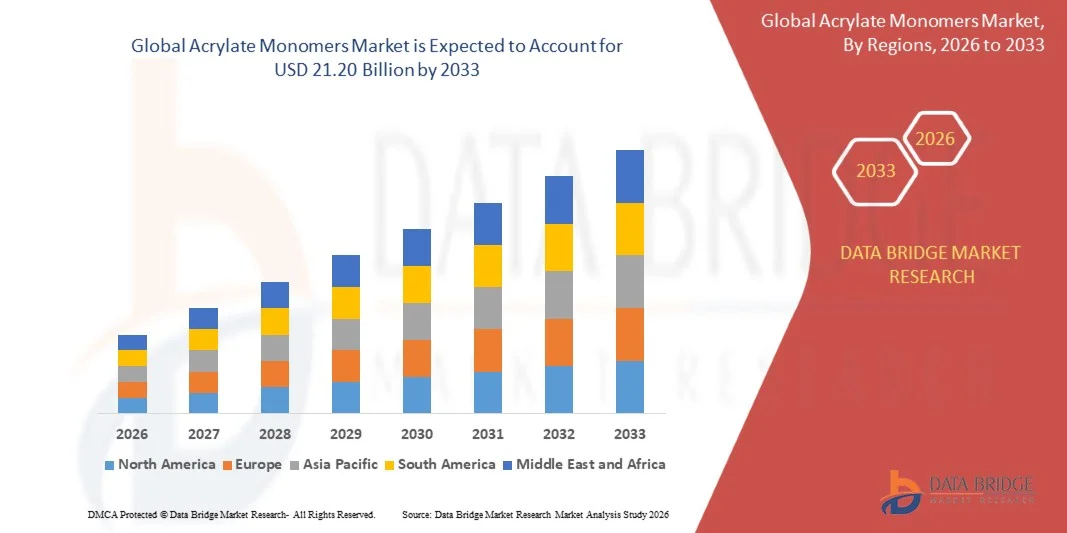
- The global acrylate monomers market size was valued at USD 12.96 billion in 2025and is expected to reach USD 21.20 billion by 2033, at a CAGR of 6.35% during the forecast period
- The market growth is largely fueled by the growing adoption and technological progress within waterborne coating systems and adhesive technologies, leading to increased utilization of acrylate monomers in both industrial and consumer-facing coating, bonding, and polymer synthesis applications
- In addition, rising demand for high-performance superabsorbent polymers, emulsion polymers, and UV-curable systems is establishing acrylate monomers as the modern reactive monomer of choice for diverse polymer synthesis and formulation applications. These converging factors are accelerating the uptake of acrylate monomer solutions, thereby significantly boosting the industry's growth
Acrylate Monomers Market Analysis
- Acrylate monomers, offering reactive vinyl functionality for a broad spectrum of emulsion polymerization, solution polymerization, and UV-curing applications, are increasingly vital components of modern paints and coatings, adhesive, and superabsorbent polymer industries in both developed and emerging markets due to their enhanced polymerization reactivity, broad copolymerization compatibility, and seamless integration with waterborne and solvent-free formulation platforms
- The escalating demand for acrylate monomers is primarily fueled by the widespread growth of the waterborne coatings sector, rising demand for pressure-sensitive adhesive formulations, and a growing preference for acrylate-based superabsorbent polymers in hygiene and agricultural water retention applications
- North America dominated the acrylate monomers market with the largest revenue share of 36.2% in 2025, characterized by early industrial adoption of waterborne and UV-curable polymer systems, high manufacturing capabilities, and a strong presence of key industry players, with the U.S. experiencing substantial growth in acrylate monomer consumption, particularly in architectural coatings and pressure-sensitive adhesive applications, driven by innovations from both established chemical companies and specialty polymer startups
- Asia-Pacific is expected to be the fastest growing region in the acrylate monomers market during the forecast period due to increasing industrialization and rising demand for paints, coatings, and superabsorbent polymer products
- The Butyl Acrylate segment dominated the largest market revenue share of 38.5% in 2025, driven by its extensive use in surface coatings, adhesives, and sealants due to its excellent flexibility, durability, and weather resistance
Report Scope and Acrylate Monomers Market Segmentation
|
Attributes |
Acrylate Monomers Key Market Insights |
|
Segments Covered |
|
|
Countries Covered |
North America · U.S. · Canada · Mexico Europe · Germany · France · U.K. · Netherlands · Switzerland · Belgium · Russia · Italy · Spain · Turkey · Rest of Europe Asia-Pacific · China · Japan · India · South Korea · Singapore · Malaysia · Australia · Thailand · Indonesia · Philippines · Rest of Asia-Pacific Middle East and Africa · Saudi Arabia · U.A.E. · South Africa · Egypt · Israel · Rest of Middle East and Africa South America · Brazil · Argentina · Rest of South America |
|
Key Market Players |
· BASF SE (Germany) · Dow Chemical Company (U.S.) · Arkema S.A. (France) · Evonik Industries AG (Germany) · Nippon Shokubai Co., Ltd. (Japan) · LG Chem Ltd. (South Korea) · Mitsubishi Chemical Corporation (Japan) · Eastman Chemical Company (U.S.) · Formosa Plastics Corporation (Taiwan) · Toagosei Co., Ltd. (Japan) · Solvay S.A. (Belgium) · Hexion Inc. (U.S.) · Wanhua Chemical Group Co., Ltd. (China) · Jiangsu Jurong Chemical Co., Ltd. (China) · Sinopec Group (China) · Luoyang Petrochemical (China) · Sanmu Group (China) · KH Chemicals (Netherlands) · Zhejiang Satellite Petrochemical Co., Ltd. (China) · Trinseo S.A. (U.S.) |
|
Market Opportunities |
· Expanding Use in Waterborne Coatings and UV-Curable Polymer Systems · Rising Demand in Emerging Markets |
|
Value Added Data Infosets |
In addition to the insights on market scenarios such as market value, growth rate, segmentation, geographical coverage, and major players, the market reports curated by the Data Bridge Market Research also include import export analysis, production capacity overview, production consumption analysis, price trend analysis, climate change scenario, supply chain analysis, value chain analysis, raw material/consumables overview, vendor selection criteria, PESTLE Analysis, Porter Analysis, and regulatory framework. |
Acrylate Monomers Market Trends
“Enhanced Sustainability Through Bio-Based Acrylic Acid and Low-VOC Formulation Development”
- A significant and accelerating trend in the global acrylate monomers market is the deepening integration with bio-based acrylic acid production technologies and growing investment in low-VOC polymer formulation platforms. This fusion of sustainability chemistry and high-performance polymer technology is significantly reshaping the competitive positioning of acrylate monomer producers and downstream polymer formulators
- For instance, Cargill and OPX Biotechnologies have collaborated on bio-based 3-hydroxypropionic acid fermentation routes as a renewable precursor for bio-acrylic acid, which can serve as the feedstock for sustainable acrylate monomer production. Similarly, Arkema has advanced its Rheology research into bio-sourced acrylate intermediates with improved sustainability credentials for waterborne coating applications
- Bio-based and low-VOC developments in acrylate monomer production enable features such as reduced fossil feedstock dependency, improved regulatory compliance with evolving global VOC emission standards, and enhanced sustainability profile for formulated polymer products. For instance, Dow Chemical's FASTRACK emulsion polymer technology platform leverages optimized acrylate monomer blends to achieve low-odor and low-formaldehyde performance in waterborne architectural coating formulations. In addition, UV-curable acrylate systems offer manufacturers completely solvent-free and near-zero VOC emission profiles, allowing them to meet the most stringent indoor air quality and environmental compliance requirements in construction and packaging applications
- The seamless integration of next-generation acrylate monomers with waterborne dispersion, UV-cure, and hot-melt adhesive platforms facilitates broader adoption across the full spectrum of paints, coatings, adhesives, and sealant end markets. Through advanced monomer selection and copolymer design optimization, formulators can engineer acrylate-based polymers with precisely tailored glass transition temperatures, adhesion profiles, and mechanical performance characteristics across diverse substrate and application requirements
- This trend towards more sustainable, performance-optimized, and application-tailored acrylate monomer chemistries is fundamentally reshaping formulator expectations for polymer raw material procurement. Consequently, companies such as BASF are developing next-generation bio-acrylate monomer grades with enhanced renewable content credentials and improved UV-cure reactivity profiles for next-generation printing ink and electronics coating markets
- The demand for acrylate monomers that offer seamless integration with bio-based and low-VOC polymer formulation platforms is growing rapidly across both industrial and consumer goods sectors, as manufacturers increasingly prioritize sustainability and comprehensive polymer performance
Acrylate Monomers Market Dynamics
Driver
“Growing Need Due to Rising Coatings Demand and Waterborne Polymer Adoption”
- The increasing prevalence of environmental regulations restricting solvent-based coatings and the accelerating adoption of high-performance waterborne polymer systems are significant drivers for the heightened demand for acrylate monomers
- For instance, in February 2025, BASF SE announced a capacity expansion at its Antwerp, Belgium acrylates production complex, aimed at meeting rising demand from the waterborne coatings and pressure-sensitive adhesive sectors across European and global markets. Such strategies by key companies are expected to drive the acrylate monomers industry growth in the forecast period
- As coating formulators increasingly transition from solvent-borne to waterborne polymer platforms, acrylate monomers offer advanced performance attributes including excellent weathering resistance, broad copolymerization flexibility, and strong adhesion to diverse substrate types, providing a compelling performance advantage over alternative vinyl monomer chemistries
- In addition, the growing deployment of superabsorbent polymers in baby diaper, adult incontinence, and agricultural water retention applications and the desire for advanced pressure-sensitive adhesive performance in labeling, tape, and medical device markets are making acrylate monomers an integral component of these high-value polymer systems, offering seamless integration with emulsion and solution polymerization production platforms
- The functionality of acrylate monomers in UV-curable ink, electronics coating, and dental material applications for rapid cure performance, corrosion protection for architectural and industrial coating systems, and softening agent synthesis for textile fiber processing are key factors propelling their adoption in both industrial and consumer-facing chemical sectors. The trend towards environmentally compliant polymer formulations and the increasing availability of application-specific acrylate monomer grades further contribute to market growth
Restraint/Challenge
“Concerns Regarding Acrylic Acid Feedstock Volatility and Handling Hazards”
- Concerns surrounding the propylene feedstock cost volatility underlying acrylic acid and acrylate monomer production, as well as the handling hazards associated with reactive acrylate compounds, pose significant challenges to broader market supply stability and downstream adoption
- For instance, major disruptions in propylene supply chains during global petrochemical capacity shutdowns have historically triggered significant acrylate monomer price spikes, creating cost management challenges for downstream coating and adhesive formulators
- Addressing these supply chain concerns through strategic feedstock inventory management, long-term acrylic acid supply agreements, and investment in alternative feedstock routes is crucial for building customer supply security confidence. Companies such as Nippon Shokubai and Dow Chemical emphasize their vertically integrated acrylic acid and acrylate production capabilities as key supply security advantages in their commercial positioning. In addition, the skin sensitization and eye irritation hazards associated with acrylate monomers require specialized handling protocols and exposure control measures, adding operational complexity and cost for downstream polymer manufacturers. While occupational hygiene technology and enclosed production equipment have significantly mitigated these risks for large-scale industrial users, smaller formulators may still face challenges in safely incorporating highly reactive acrylate monomers into their production environments
- While production technologies and safety management systems are continuously improving, the price sensitivity of acrylate monomers to upstream propylene market movements can still create procurement uncertainty, especially for smaller formulation companies operating on tight margin structures
- Overcoming these challenges through enhanced feedstock diversification, consumer education on safe acrylate handling practices, and the development of more stabilized and less sensitizing acrylate monomer formulations will be vital for sustained market growth
Acrylate Monomers Market Scope
The market is segmented on the basis of type, application and end user.
- By Type
On the basis of type, the Acrylate Monomers market is segmented into Methyl Acrylate, Ethyl Acrylate, Butyl Acrylate, 2-Ethylhexyl Acrylate, and Others. The Butyl Acrylate segment dominated the largest market revenue share of 38.5% in 2025, driven by its extensive use in surface coatings, adhesives, and sealants due to its excellent flexibility, durability, and weather resistance. It is widely preferred in paints and coatings formulations because of its strong binding properties and cost-effectiveness. The segment benefits from high demand in construction and automotive industries where durable coating materials are essential. Increasing infrastructure development and industrialization further support its dominance. Strong global production capacity and stable supply chains reinforce market leadership. The versatility of butyl acrylate across multiple end-use industries strengthens its widespread adoption.
The 2-Ethylhexyl Acrylate segment is expected to witness the fastest growth rate of 22.9% from 2026 to 2033, driven by rising demand in pressure-sensitive adhesives and specialty coatings. It offers superior flexibility and water resistance, making it highly suitable for high-performance applications. Growing demand from automotive and packaging industries is significantly boosting consumption. Expanding use in weather-resistant coatings and sealants is further supporting growth. Rapid industrialization and product innovation are increasing adoption globally. Rising demand for lightweight and durable materials is also fueling segment expansion. Increasing investment in advanced polymer formulations is accelerating market penetration.
- By Application
On the basis of application, the Acrylate Monomers market is segmented into Surface Coatings, Adhesives & Sealants, Superabsorbent Polymers, Textiles, Paper Treatment, and Others. The Surface Coatings segment held the largest market revenue share of 41.3% in 2025, driven by rising demand from construction, automotive, and industrial sectors. Acrylate monomers are widely used in coatings due to their excellent durability, UV resistance, and flexibility. Growing infrastructure development and renovation activities are significantly supporting demand. Increasing automotive production and focus on aesthetic coatings further strengthen segment dominance. The segment benefits from continuous innovation in high-performance coating materials. Expanding industrial applications and protective coating requirements reinforce its leadership. Strong global demand for long-lasting coatings supports sustained growth.
The Adhesives & Sealants segment is expected to witness the fastest CAGR of 23.4% from 2026 to 2033, driven by increasing use in packaging, automotive, and construction industries. Acrylate-based adhesives offer strong bonding strength, flexibility, and temperature resistance. Rising demand for lightweight and durable packaging materials is fueling growth. Expansion of e-commerce and packaging industries is further boosting consumption. Increasing adoption of eco-friendly adhesive solutions is also supporting market expansion. Growth in automotive lightweight assembly processes is accelerating demand. Continuous technological advancements in adhesive formulations are strengthening segment adoption globally.
- By End User
On the basis of end user, the Acrylate Monomers market is segmented into Paints & Coatings, Personal Care & Hygiene, Construction, Automotive, Packaging, and Others. The Paints & Coatings segment accounted for the largest market revenue share of 36.8% in 2025, driven by increasing demand for protective and decorative coatings across residential, commercial, and industrial sectors. Acrylate monomers provide excellent weather resistance, durability, and gloss retention, making them highly preferred. Rapid urbanization and infrastructure development are key growth drivers. Expanding construction and renovation activities further strengthen demand. Automotive refinishing and industrial coating applications also support segment leadership. Strong global consumption of coating materials reinforces dominance. Continuous innovation in high-performance coatings enhances adoption across industries.
The Packaging segment is expected to witness the fastest growth rate of 24.2% from 2026 to 2033, driven by rising demand for flexible, durable, and sustainable packaging materials. Acrylate monomers are widely used in adhesives and coatings for packaging applications. Growth in e-commerce and food delivery industries is significantly boosting demand. Increasing focus on recyclable and eco-friendly packaging solutions supports expansion. Rapid growth in consumer goods and retail sectors is further accelerating adoption. Technological advancements in packaging materials are enhancing performance and durability. Expanding global trade and logistics activities continue to drive strong market growth.
Acrylate Monomers Market Regional Analysis
- North America dominated the acrylate monomers market with the largest revenue share of 36.2% in 2025, driven by strong demand for waterborne coating intermediates and specialty adhesive polymer applications, as well as significant production capacity investments by leading chemical manufacturers
- Manufacturers in the region highly value the polymerization versatility, regulatory compliance, and well-established supply chain infrastructure of acrylate monomers across multiple high-value end-use sectors including architectural coatings, pressure-sensitive adhesives, and superabsorbent polymers
- This widespread adoption is further supported by high industrial chemical consumption, a technologically advanced polymer manufacturing base, and the growing preference for waterborne and UV-curable acrylate polymer platforms, establishing acrylate monomers as a preferred building block for both architectural and industrial chemical applications
U.S. Acrylate Monomers Market Insight
The U.S. acrylate monomers market captured the largest revenue share within North America in 2025, fueled by the strong domestic waterborne coatings manufacturing base and the expanding deployment of acrylate-based pressure-sensitive adhesive polymers across packaging, medical device, and graphic arts markets. Polymer formulators are increasingly prioritizing the development of acrylate monomer-based systems optimized for performance-critical low-VOC and UV-curable applications. The growing preference for sustainable polymer chemistry, combined with robust demand from superabsorbent polymer manufacturers and specialty adhesive producers, further propels the acrylate monomers industry. Moreover, the increasing integration of acrylate polymers into next-generation waterborne industrial coating and construction sealant platforms is significantly contributing to the market's expansion.
Europe Acrylate Monomers Market Insight
The Europe acrylate monomers market is projected to expand at a substantial CAGR throughout the forecast period, primarily driven by stringent EU environmental regulations promoting the transition to waterborne and UV-curable polymer coating systems and the escalating demand for high-performance pressure-sensitive adhesive formulations across packaging and graphic arts markets. The growth in sustainable polymer chemistry adoption, coupled with the demand for low-VOC and bio-based acrylate monomer grades, is fostering innovation across European polymer formulation industries.
U.K. Acrylate Monomers Market Insight
The U.K. acrylate monomers market is anticipated to grow at a noteworthy CAGR during the forecast period, driven by the escalating demand for acrylate-based waterborne coating and adhesive intermediates in construction, packaging, and graphic arts formulation applications. In addition, growing regulatory pressure to reduce solvent-based coating VOC emissions is encouraging both large-scale industrial coating manufacturers and specialty adhesive formulators to accelerate their transition to acrylate-based waterborne and UV-curable polymer systems. The U.K.'s emphasis on sustainable coatings and advanced polymer technology development, alongside its well-developed specialty chemical distribution infrastructure, is expected to continue to stimulate market growth.
Germany Acrylate Monomers Market Insight
The Germany acrylate monomers market is expected to expand at a considerable CAGR during the forecast period, fueled by increasing demand for high-performance waterborne coatings, UV-curable inks, and advanced pressure-sensitive adhesive systems across the country's highly developed industrial manufacturing and automotive supply chain sectors. Germany's well-established chemical industry infrastructure, combined with its strong emphasis on technological innovation and environmental compliance, promotes the adoption of next-generation acrylate monomer grades in both consumer and industrial polymer applications.
Asia-Pacific Acrylate Monomers Market Insight
The Asia-Pacific acrylate monomers market is poised to grow at the fastest CAGR of 11.3% during the forecast period of 2026 to 2033, driven by rapidly expanding construction activity, rising demand for consumer hygiene products, and high-growth coatings and adhesives manufacturing sectors in countries such as China, India, and South Korea. The region's strong orientation toward domestic specialty chemical production capacity growth, supported by government industrial development initiatives, is driving the adoption of acrylate monomers across all major polymer application segments.
Japan Acrylate Monomers Market Insight
The Japan acrylate monomers market is gaining momentum due to the country's advanced polymer chemistry manufacturing capabilities, continued investment in high-performance coating and adhesive technologies, and demand for application-optimized specialty acrylate monomer grades. The Japanese market places a significant emphasis on formulation precision and product quality, and the adoption of specialty acrylate grades is driven by the increasing sophistication of domestic electronic materials, optical coating, and medical device adhesive manufacturing industries.
China Acrylate Monomers Market Insight
The China acrylate monomers market accounted for the largest market revenue share in Asia-Pacific in 2025, attributed to the country's massive expansion of domestic acrylic acid and acrylate ester production capacity, rapidly growing waterborne coatings manufacturing sector, and high-growth superabsorbent polymer production for domestic hygiene product markets. China stands as one of the largest global producers and consumers of acrylate monomers, and strong domestic demand across coatings, adhesives, and SAP application segments is supported by an increasingly competitive local manufacturing base.
Acrylate Monomers Market Share
The Acrylate Monomers industry is primarily led by well-established companies, including:
- BASF SE (Germany)
- Dow Chemical Company (U.S.)
- Arkema S.A. (France)
- Evonik Industries AG (Germany)
- Nippon Shokubai Co., Ltd. (Japan)
- LG Chem Ltd. (South Korea)
- Mitsubishi Chemical Corporation (Japan)
- Eastman Chemical Company (U.S.)
- Formosa Plastics Corporation (Taiwan)
- Toagosei Co., Ltd. (Japan)
- Solvay S.A. (Belgium)
- Hexion Inc. (U.S.)
- Wanhua Chemical Group Co., Ltd. (China)
- Jiangsu Jurong Chemical Co., Ltd. (China)
- Sinopec Group (China)
- Luoyang Petrochemical (China)
- Sanmu Group (China)
- KH Chemicals (Netherlands)
- Zhejiang Satellite Petrochemical Co., Ltd. (China)
- Trinseo S.A. (U.S.)
Latest Developments in Global Acrylate Monomers Market
- In May 2023, BASF SE announced a strategic capacity expansion initiative at its Antwerp, Belgium acrylates production complex, aimed at strengthening the reliability of butyl acrylate and 2-ethylhexyl acrylate supply for its growing European and global waterborne coatings and pressure-sensitive adhesive customer base, underscoring the company's commitment to delivering secure and competitive acrylate monomer supply solutions
- In March 2023, Arkema S.A. introduced its next-generation bio-based acrylate monomer research platform under its Rheology innovation program, specifically targeting the development of partially renewable acrylate intermediates for sustainable waterborne coating and adhesive applications, highlighting the company's commitment to advancing green polymer chemistry
- In March 2023, Nippon Shokubai Co., Ltd. announced the successful commissioning of an expanded acrylic acid and acrylate ester production facility in Japan, aimed at enhancing domestic supply security for high-purity acrylate monomer grades demanded by advanced optical, electronic, and medical device coating applications
- In February 2023, Zhejiang Satellite Petrochemical announced a strategic commercial capacity expansion to support the growing demand for butyl acrylate and acrylic acid from China's rapidly expanding waterborne coatings and superabsorbent polymer manufacturing industries, underscoring the company's commitment to supporting domestic polymer chemistry supply chain development
- In January 2023, Dow Chemical Company unveiled an enhanced acrylate monomer product line under its FASTRACK emulsion polymer platform, specifically designed for low-VOC and low-odor waterborne architectural coating formulations, enabling users to meet increasingly stringent indoor air quality standards while maintaining high coating film performance
SKU-
Get online access to the report on the World's First Market Intelligence Cloud

- Interactive Data Analysis Dashboard
- Company Analysis Dashboard for high growth potential opportunities
- Research Analyst Access for customization & queries
- Competitor Analysis with Interactive dashboard
- Latest News, Updates & Trend analysis
- Harness the Power of Benchmark Analysis for Comprehensive Competitor Tracking
Global Acrylate Monomers Market, Supply Chain Analysis and Ecosystem Framework
To support market growth and help clients navigate the impact of geopolitical shifts, DBMR has integrated in-depth supply chain analysis into its Global Acrylate Monomers Market research reports. This addition empowers clients to respond effectively to global changes affecting their industries. The supply chain analysis section includes detailed insights such as Global Acrylate Monomers Market consumption and production by country, price trend analysis, the impact of tariffs and geopolitical developments, and import and export trends by country and HSN code. It also highlights major suppliers with data on production capacity and company profiles, as well as key importers and exporters. In addition to research, DBMR offers specialized supply chain consulting services backed by over a decade of experience, providing solutions like supplier discovery, supplier risk assessment, price trend analysis, impact evaluation of inflation and trade route changes, and comprehensive market trend analysis.
Research Methodology
Data collection and base year analysis are done using data collection modules with large sample sizes. The stage includes obtaining market information or related data through various sources and strategies. It includes examining and planning all the data acquired from the past in advance. It likewise envelops the examination of information inconsistencies seen across different information sources. The market data is analysed and estimated using market statistical and coherent models. Also, market share analysis and key trend analysis are the major success factors in the market report. To know more, please request an analyst call or drop down your inquiry.
The key research methodology used by DBMR research team is data triangulation which involves data mining, analysis of the impact of data variables on the market and primary (industry expert) validation. Data models include Vendor Positioning Grid, Market Time Line Analysis, Market Overview and Guide, Company Positioning Grid, Patent Analysis, Pricing Analysis, Company Market Share Analysis, Standards of Measurement, Global versus Regional and Vendor Share Analysis. To know more about the research methodology, drop in an inquiry to speak to our industry experts.
Customization Available
Data Bridge Market Research is a leader in advanced formative research. We take pride in servicing our existing and new customers with data and analysis that match and suits their goal. The report can be customized to include price trend analysis of target brands understanding the market for additional countries (ask for the list of countries), clinical trial results data, literature review, refurbished market and product base analysis. Market analysis of target competitors can be analyzed from technology-based analysis to market portfolio strategies. We can add as many competitors that you require data about in the format and data style you are looking for. Our team of analysts can also provide you data in crude raw excel files pivot tables (Fact book) or can assist you in creating presentations from the data sets available in the report.












