




Global Activated Bleaching Earth Market
Market Size in USD Billion
CAGR :
% 
 USD
4.76 Billion
USD
6.32 Billion
2025
2033
USD
4.76 Billion
USD
6.32 Billion
2025
2033
 Forecast Period Forecast Period |
2026 –2033 |
 Market Size (Base Year) Market Size (Base Year) |
USD 4.76 Billion |
 Market Size (Forecast Year) Market Size (Forecast Year) |
USD 6.32 Billion |
 CAGR CAGR |
% |
| Major Markets Players |
|
Activated Bleaching Earth Market Size
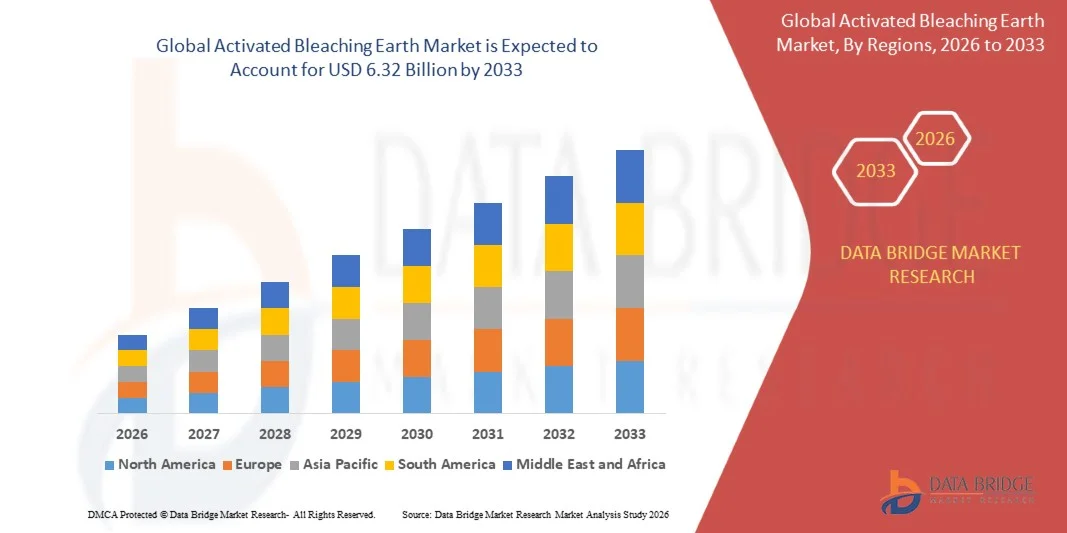
- The global activated bleaching earth market size was valued at USD 4.76 billion in 2025 and is expected to reach USD 6.32 billion by 2033, at a CAGR of 3.62% during the forecast period
- The market growth is largely fuelled by the increasing demand for refining and purifying edible oils, growing applications in cosmetics and personal care products, and rising industrial usage in wastewater treatment
Activated Bleaching Earth Market Analysis
- The activated bleaching earth market is driven by strong growth in the edible oil processing industry, particularly in developing economies where consumption of refined oils is increasing
- Expansion of end‑use industries such as cosmetics, pharmaceuticals, and animal feed, which utilize bleaching earth for decolorization and impurity removal, supports steady market development
- Asia-Pacific dominated the activated bleaching earth market with the largest revenue share of 65.10% in 2025, driven by rapid urbanization, rising edible oil consumption, and expanding industrial applications in countries such as China, India, and Japan
- North America region is expected to witness the highest growth rate in the global activated bleaching earth market, driven by technological advancements in production, increasing industrial usage, and investments in sustainable and high-performance bleaching earth solutions
- The Bentonite segment held the largest market revenue share in 2025, driven by its high adsorption capacity, wide availability, and cost-effectiveness for decolorization and purification processes. Bentonite-based bleaching earth is extensively used in edible oil refining, industrial purification, and wastewater treatment, making it a preferred choice among manufacturers
Report Scope and Activated Bleaching Earth Market Segmentation
|
Attributes |
Activated Bleaching Earth Key Market Insights |
|
Segments Covered |
|
|
Countries Covered |
North America
Europe
Asia-Pacific
Middle East and Africa
South America
|
|
Key Market Players |
• BASF SE (Germany) |
|
Market Opportunities |
• Growing Demand For Refined Edible Oils |
|
Value Added Data Infosets |
In addition to the insights on market scenarios such as market value, growth rate, segmentation, geographical coverage, and major players, the market reports curated by the Data Bridge Market Research also include import export analysis, production capacity overview, production consumption analysis, price trend analysis, climate change scenario, supply chain analysis, value chain analysis, raw material/consumables overview, vendor selection criteria, PESTLE Analysis, Porter Analysis, and regulatory framework. |
Activated Bleaching Earth Market Trends
“Increasing Demand for Edible Oil Purification and Industrial Applications”
• The rise in global consumption of edible oils is significantly shaping the activated bleaching earth market, as the refining process requires high‑quality bleaching earth for decolorization and impurity removal. Activated bleaching earth is gaining traction due to its effectiveness in improving oil quality, stability, and shelf life across edible oil processing industries, and its ability to reduce processing time and enhance operational efficiency in large-scale refineries. The growing focus on producing premium-quality edible oils for both domestic and export markets is further boosting adoption
• Growth in industrial sectors such as wastewater treatment, cosmetics, pharmaceuticals, and animal feed is accelerating the demand for activated bleaching earth. Manufacturers are adopting advanced bleaching earth grades to meet performance requirements while complying with environmental and safety standards, encouraging product innovation and diversification. The expanding application of bleaching earth in removing impurities, colorants, and toxins from various industrial products strengthens its importance across multiple sectors
• Sustainability and environmental compliance trends are influencing purchasing decisions, with manufacturers emphasizing eco‑friendly production, efficient resource utilization, and regulatory adherence. These factors help brands differentiate products in competitive markets and build trust, driving the adoption of certified and high‑performance bleaching earth products. The push towards low-carbon, energy-efficient processing methods and reduced chemical usage in refining operations is also motivating companies to prioritize sustainable bleaching earth options
• For instance, in 2024, major edible oil refiners in India and Indonesia expanded their refining capacities by incorporating high‑efficiency activated bleaching earth in their processes. These upgrades aimed to enhance oil quality, reduce processing time, and meet stringent food safety standards, strengthening product portfolios across retail and bulk supply channels. Such strategic investments also improved operational scalability and enabled companies to serve growing domestic and international markets efficiently
• While demand for activated bleaching earth is growing, sustained market expansion depends on continuous improvements in adsorption efficiency, cost-effective production, and wider availability of high‑grade products. Manufacturers are focusing on enhancing functional performance, scalability, and supply chain reliability to support broader adoption. Research into advanced bleaching earth types with higher adsorption capacity, lower ash content, and better reusability is expected to further drive market competitiveness
Activated Bleaching Earth Market Dynamics
Driver
“Growing Consumption of Refined Edible Oils and Industrial Usage”
• Rising global demand for refined edible oils is a major driver for the activated bleaching earth market, as the refining process necessitates effective decolorization and purification agents to meet quality standards. Increasing awareness among consumers about health, taste, and aesthetic quality of edible oils is encouraging manufacturers to invest in high-grade bleaching earth for superior product outcomes. In addition, expansion of packaged edible oil markets in developing countries is reinforcing the need for reliable purification solutions
• Expanding industrial sectors such as wastewater treatment, chemicals, pharmaceuticals, and animal feed increase the utilization of activated bleaching earth for purification, decolorization, and impurity removal across processes. Activated bleaching earth is also being integrated into industrial waste treatment to remove hazardous substances, reduce environmental pollution, and improve effluent quality, thereby supporting regulatory compliance and sustainable operations. Companies are exploring specialty bleaching earth grades for tailored applications in diverse industrial segments
• Manufacturers are promoting advanced activated bleaching earth grades through product innovation and collaborations with end‑use industries to improve process efficiency, regulatory compliance, and product performance. Efforts include developing bleaching earth with higher adsorption capacity, lower oil loss, and environmentally-friendly production processes, helping end-users reduce operational costs and achieve higher throughput. Strategic partnerships between suppliers and refiners are also facilitating knowledge sharing and co-development of next-generation solutions
• For instance, in 2023, leading edible oil processors in Malaysia and Turkey reported increased use of activated bleaching earth in refining operations to achieve higher oil clarity and align with export quality standards, supporting repeat purchases and customer satisfaction. The integration of advanced bleaching earth in their refining lines also helped reduce waste, improve yield, and enhance overall process reliability. This has further encouraged regional players to adopt premium-quality bleaching earth to maintain competitiveness
• Although growing end‑use applications support market growth, wider adoption requires cost‑effective production, improved adsorption properties, and expanded manufacturing capacities to meet global demand. Innovations in low-ash, high-performance bleaching earth, combined with investment in sustainable extraction and processing techniques, are key to driving future market expansion and maintaining supply chain resilience
Restraint/Challenge
“Raw Material Price Volatility and Competitive Alternatives”
• Fluctuating prices of raw materials used in activated bleaching earth production pose a significant challenge, affecting cost stability and market penetration across price‑sensitive regions. In addition, seasonal and geopolitical factors influencing raw material availability can create supply bottlenecks, leading to increased production costs and operational delays. Companies must develop strategic sourcing and inventory management plans to mitigate these risks
• Competition from alternative purification technologies and materials limits adoption in certain applications where cost or performance trade‑offs are considered. Innovations in chemical bleaching agents, membrane filtration, and other decolorization methods present viable substitutes, particularly in regions where cost sensitivity is high. This competitive pressure encourages manufacturers to improve product efficiency, quality, and differentiation to maintain market share
• Supply chain and distribution challenges also impact market growth, as bleaching earth requires proper handling, storage, and logistics to maintain performance characteristics. Issues such as transportation delays, storage facility limitations, and adherence to safety and environmental regulations increase operational complexity and cost for manufacturers and distributors alike. Optimizing supply chain networks and investing in modern storage infrastructure is critical for consistent market supply
• For instance, in 2024, edible oil refiners in Brazil and South Africa reported constrained adoption of premium activated bleaching earth grades due to raw material cost increases and availability issues, affecting procurement planning and operational budgets. These challenges also limited the introduction of advanced bleaching earth grades in smaller refiners and emerging markets, delaying potential market growth and expansion
• Overcoming these challenges will require cost‑efficient production processes, reliable raw material sourcing, expanded distribution networks, and focused educational initiatives for manufacturers to unlock long‑term growth potential in the global activated bleaching earth market. Collaboration with suppliers, end-use industries, and certification bodies will help ensure consistent quality, improve market awareness, and promote the adoption of high-performance bleaching earth solutions
Activated Bleaching Earth Market Scope
The market is segmented on the basis of material type, technology, and application.
• By Material Type
On the basis of material type, the activated bleaching earth market is segmented into Bentonite, Attapulgite, Sepiolite, and Others. The Bentonite segment held the largest market revenue share in 2025, driven by its high adsorption capacity, wide availability, and cost-effectiveness for decolorization and purification processes. Bentonite-based bleaching earth is extensively used in edible oil refining, industrial purification, and wastewater treatment, making it a preferred choice among manufacturers.
The Attapulgite segment is expected to witness the fastest growth rate from 2026 to 2033, driven by its superior thermal stability, high porosity, and enhanced performance in removing impurities and colorants. Attapulgite-based activated bleaching earth is increasingly adopted in specialty applications such as high-quality edible oils, cosmetics, and pharmaceutical formulations, where precise purification and minimal product loss are critical.
• By Technology
On the basis of technology, the market is categorized into Dry Bleaching and Wet Bleaching. The Wet Bleaching segment held the largest share in 2025 due to its high efficiency in decolorizing oils and chemicals, reduced processing time, and better overall purification performance. Wet bleaching is particularly favored in large-scale edible oil refining and industrial applications where product quality and operational efficiency are key considerations.
The Dry Bleaching segment is projected to grow at the fastest rate from 2026 to 2033, driven by its cost-effectiveness, ease of handling, and suitability for small to medium-scale operations. Dry bleaching is gaining popularity in regions with emerging edible oil industries and smaller refineries, offering a practical solution for quality improvement with minimal infrastructure requirements.
• By Application
On the basis of application, the activated bleaching earth market is segmented into Edible Oils, Mineral Oils & Lubricants, Chemicals, Cosmetics, and Others. The Edible Oils segment accounted for the largest revenue share in 2025, driven by the increasing consumption of refined oils and the need for high-quality, impurity-free products. Activated bleaching earth ensures clarity, stability, and compliance with food safety standards, making it indispensable in the edible oil industry.
The Chemicals segment is expected to witness the fastest growth rate from 2026 to 2033, fueled by rising demand for purification and decolorization in chemical manufacturing, wastewater treatment, and specialty chemical applications. Activated bleaching earth enhances product quality, removes unwanted impurities, and supports regulatory compliance in chemical processes, thereby driving its adoption across the industrial sector.
Activated Bleaching Earth Market Regional Analysis
- Asia-Pacific dominated the activated bleaching earth market with the largest revenue share of 65.10% in 2025, driven by rapid urbanization, rising edible oil consumption, and expanding industrial applications in countries such as China, India, and Japan
- Government initiatives promoting industrial growth, coupled with the region emerging as a manufacturing hub for bleaching earth and refining equipment, are enhancing affordability and accessibility. This is supporting wider adoption across industrial and edible oil refining applications
Japan Activated Bleaching Earth Market Insight
The Japan activated bleaching earth market is expected to witness strong growth from 2026 to 2033 due to high standards for edible oil quality, increasing industrial purification needs, and technological advancements in bleaching earth production. Japan’s emphasis on efficiency, sustainability, and high-quality outputs is driving the demand for advanced bleaching earth solutions in both edible oil refining and industrial applications. The aging population and the need for safer, high-quality food and industrial products further support market adoption.
China Activated Bleaching Earth Market Insight
The China activated bleaching earth market accounted for the largest revenue share in Asia-Pacific in 2025, attributed to the country’s expanding edible oil industry, rapid urbanization, and growing industrial applications. China’s large-scale production capacities, availability of raw materials, and strong domestic manufacturers are key factors supporting market growth. The increasing adoption of high-performance bleaching earth in edible oil refining, chemical processing, and cosmetic applications is driving the market across both domestic and export segments.
North America Activated Bleaching Earth Market Insight
North America activated bleaching earth market is expected to witness the fastest growth rate from 2026 to 2033, driven by the growing demand for edible oil refining, industrial purification, and increasing applications in chemicals, cosmetics, and animal feed. Manufacturers and consumers in the region highly value high-performance bleaching earth for its ability to remove impurities, colorants, and toxins efficiently while maintaining product quality and compliance with regulatory standards. This widespread adoption is further supported by well-established industrial infrastructure, high production capacities, and technological advancements in bleaching earth processing, making North America a leading market for both domestic consumption and export
U.S. Activated Bleaching Earth Market Insight
The U.S. activated bleaching earth market is expected to witness the fastest growth rate from 2026 to 2033, fueled by the robust edible oil refining industry and expanding industrial applications. Companies are increasingly adopting advanced grades of bleaching earth to meet stringent quality and safety standards. The rising trend of specialty oils, sustainable industrial processes, and eco-friendly production methods is further boosting market growth. Moreover, continuous innovation in high-adsorption and low-ash bleaching earth products is contributing to enhanced operational efficiency and wider adoption across industrial sectors.
Europe Activated Bleaching Earth Market Insight
The Europe activated bleaching earth market is expected to witness the fastest growth rate from 2026 to 2033, primarily driven by strict food safety regulations, increasing demand for high-quality edible oils, and the expansion of industrial purification applications. Growth in urbanization and food processing industries is fostering adoption across residential, commercial, and industrial applications. European manufacturers are also emphasizing sustainable and eco-friendly bleaching earth products, which is supporting higher market uptake and technological advancements.
U.K. Activated Bleaching Earth Market Insight
The U.K. activated bleaching earth market is expected to witness significant growth from 2026 to 2033, driven by the growing edible oil industry, rising demand for refined oils, and increasing use in chemical and cosmetic applications. Regulatory requirements for product quality and safety are encouraging manufacturers to adopt high-performance bleaching earth. The country’s strong industrial infrastructure, along with advancements in eco-friendly production methods, is further stimulating market expansion.
Germany Activated Bleaching Earth Market Insight
The Germany activated bleaching earth market is expected to witness considerable growth from 2026 to 2033, fueled by increasing awareness of quality standards, sustainability initiatives, and the adoption of technologically advanced bleaching earth solutions. Germany’s established chemical and edible oil refining industries, combined with its focus on innovation and environmental compliance, promote the adoption of high-performance bleaching earth in industrial and commercial sectors.
Activated Bleaching Earth Market Share
The Activated Bleaching Earth industry is primarily led by well-established companies, including:
• BASF SE (Germany)
• Clariant (Switzerland)
• Taiko Holdings Co. Ltd. (Japan)
• The W Clay Industries Sdn. Bhd. (Malaysia)
• AMC (UK) Limited (U.K.)
• Shenzhen Aoheng Science and Technology Co., Ltd. (China)
• Musim Mas (Singapore)
• HRP Industries (India)
• Manek Active Clay Pvt. Ltd. (India)
• Refoil Earth Pvt. Ltd (India)
• Phoenix Chemicals Pvt. Ltd. (India)
• Ashapura Group (India)
• Fullers Earth India Corporation (India)
• Korvi Activated Earth (India)
• Indian Clay & Mineral Co. (India)
• Zeotec Adsorbents Private Limited (India)
• Oil-Dri Corporation of America (U.S.)
• 20 Microns Nano Minerals Limited (India)
Latest Developments in Global Activated Bleaching Earth Market
- In June 2025, Imerys, acquisition, completed the EUR 50 million acquisition of Chemviron’s European diatomite and perlite operations, incorporating three mines in France and Italy. This acquisition is set to strengthen Imerys’ raw material supply for filtration and bleaching applications, enhance production capabilities, and reinforce its position in the activated bleaching earth market, supporting broader industrial and edible oil refining demands
- In October 2024, USDA, market data release, confirmed Indonesia’s crude palm oil production for 2024 at 47.5 million tons, with biodiesel feedstock usage projected at 11.96 million tons. This data underlines structural clay demand, a critical input in activated bleaching earth used for palm oil refining, and highlights opportunities for market growth in Asia-Pacific edible oil and industrial applications
SKU-
Get online access to the report on the World's First Market Intelligence Cloud

- Interactive Data Analysis Dashboard
- Company Analysis Dashboard for high growth potential opportunities
- Research Analyst Access for customization & queries
- Competitor Analysis with Interactive dashboard
- Latest News, Updates & Trend analysis
- Harness the Power of Benchmark Analysis for Comprehensive Competitor Tracking
Global Activated Bleaching Earth Market, Supply Chain Analysis and Ecosystem Framework
To support market growth and help clients navigate the impact of geopolitical shifts, DBMR has integrated in-depth supply chain analysis into its Global Activated Bleaching Earth Market research reports. This addition empowers clients to respond effectively to global changes affecting their industries. The supply chain analysis section includes detailed insights such as Global Activated Bleaching Earth Market consumption and production by country, price trend analysis, the impact of tariffs and geopolitical developments, and import and export trends by country and HSN code. It also highlights major suppliers with data on production capacity and company profiles, as well as key importers and exporters. In addition to research, DBMR offers specialized supply chain consulting services backed by over a decade of experience, providing solutions like supplier discovery, supplier risk assessment, price trend analysis, impact evaluation of inflation and trade route changes, and comprehensive market trend analysis.
Research Methodology
Data collection and base year analysis are done using data collection modules with large sample sizes. The stage includes obtaining market information or related data through various sources and strategies. It includes examining and planning all the data acquired from the past in advance. It likewise envelops the examination of information inconsistencies seen across different information sources. The market data is analysed and estimated using market statistical and coherent models. Also, market share analysis and key trend analysis are the major success factors in the market report. To know more, please request an analyst call or drop down your inquiry.
The key research methodology used by DBMR research team is data triangulation which involves data mining, analysis of the impact of data variables on the market and primary (industry expert) validation. Data models include Vendor Positioning Grid, Market Time Line Analysis, Market Overview and Guide, Company Positioning Grid, Patent Analysis, Pricing Analysis, Company Market Share Analysis, Standards of Measurement, Global versus Regional and Vendor Share Analysis. To know more about the research methodology, drop in an inquiry to speak to our industry experts.
Customization Available
Data Bridge Market Research is a leader in advanced formative research. We take pride in servicing our existing and new customers with data and analysis that match and suits their goal. The report can be customized to include price trend analysis of target brands understanding the market for additional countries (ask for the list of countries), clinical trial results data, literature review, refurbished market and product base analysis. Market analysis of target competitors can be analyzed from technology-based analysis to market portfolio strategies. We can add as many competitors that you require data about in the format and data style you are looking for. Our team of analysts can also provide you data in crude raw excel files pivot tables (Fact book) or can assist you in creating presentations from the data sets available in the report.












