


What is the Aerosol Packaging Market Size and Growth Rate?
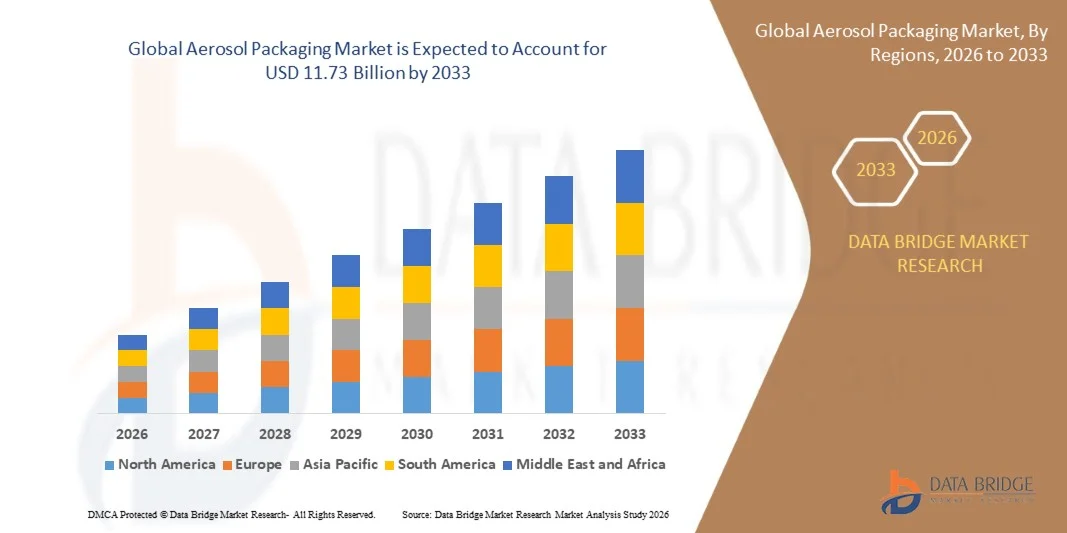
- As per Data Bridge Market Research analysis, the aerosol packaging market was valued at USD 8.09 billion in 2025 and is projected to reach USD 11.73 billion by 2033, growing at a CAGR of 4.76% from 2026 to 2033.
- The market is experiencing consistent growth driven by rising demand for convenient and sustainable packaging solutions, increasing adoption of aerosol products across personal care and household applications, and advancements in lightweight, recyclable, and high-performance packaging materials.
- The growing consumption of deodorants, hair sprays, air fresheners, paints, automotive products, and pharmaceutical aerosols, combined with increasing consumer preference for convenient dispensing formats, is encouraging manufacturers to adopt innovative aerosol packaging solutions. Aluminum and steel aerosol containers are gaining traction due to their durability, recyclability, product protection, and compatibility with diverse formulations.
Market Size & Forecast
- Global Market Value (2025): USD 8.09 Billion
- Expected Market Value (2033): USD 11.73 Billion
- Forecast CAGR (2026–2033): 4.76%
- Leading Region in 2025: North America
- Fastest Growing Region: Asia Pacific
What are the Major Takeaways of the Aerosol Packaging Market?
- North America dominated the aerosol packaging market with the largest revenue share of 35.9% in 2025, supported by strong demand for personal care, household, pharmaceutical, and automotive aerosol products.
- Asia-Pacific is expected to be the fastest-growing region at a CAGR of 7.1% from 2026 to 2033, fueled by rapid urbanization, rising disposable incomes, expanding personal care consumption, and increasing pharmaceutical manufacturing activities
- The aluminum segment led the market with a 52% share in 2025, driven by its lightweight construction, corrosion resistance, recyclability, and suitability for premium packaging applications.
- Tin-plated steel is the fastest-growing material type, projected to register a CAGR of 4.5%, reflecting the surge in strength, pressure resistance, cost-effectiveness, and established manufacturing infrastructure.
- The aerosol cans segment dominated the product type category with a 78% revenue share in 2025, led by widespread use across cosmetics, personal care, household, automotive, and industrial applications.
- Necked-in accounted for 55% of the market share in 2025, preferred by efficient material utilization, compatibility with standard valves and closures, and widespread adoption across consumer aerosol applications.
- The household products segment is the fastest-growing application category, with a CAGR of 7.1%, driven by increasing consumption of air fresheners, disinfectants, insecticides, cleaning sprays, furniture polishes, and other household aerosol products.
Report Scope and Aerosol Packaging Market Segmentation
|
Attributes |
Aerosol Packaging Key Market Insights |
|
Segments Covered |
|
|
Countries Covered |
North America
Europe
Asia-Pacific
Middle East and Africa
South America
|
|
Key Market Players |
|
|
Market Opportunities |
|
|
Value Added Data Infosets |
In addition to the insights on market scenarios such as market value, growth rate, segmentation, geographical coverage, and major players, the market reports curated by the Data Bridge Market Research also include import export analysis, production capacity overview, production consumption analysis, price trend analysis, climate change scenario, supply chain analysis, value chain analysis, raw material/consumables overview, vendor selection criteria, PESTLE Analysis, Porter Analysis, and regulatory framework. |
What is the Key Trend in the Aerosol Packaging Market?
- Sustainability is becoming a major trend in aerosol packaging, with manufacturers increasingly shifting toward lightweight, recyclable aluminum and steel cans, higher post-consumer recycled content, and lower-carbon materials to reduce packaging-related environmental impact.
- For instance, in April 2025, Ball Corporation and Beiersdorf were recognized for developing NIVEA MEN aerosol cans using 100% recycled aluminum, increasing recycled content from 50% and reinforcing the shift toward more sustainable aerosol packaging
- Lightweighting is enabling manufacturers to reduce material consumption, transportation weight, and carbon emissions while maintaining the strength and pressure resistance required for aerosol applications.
- Refillable and reusable aerosol dispensing systems are also gaining attention as brands seek to reduce single-use packaging, improve material efficiency, and support circular packaging models across personal care and household applications.
- For instance, in January 2025, Ball Corporation entered into an alliance with Meadow to commercialize fully recyclable aluminum cans as pre-filled cartridges for personal and home-care products, supporting the development of reusable and circular aerosol packaging systems.
- Compressed-gas propellants such as nitrogen and air are gaining traction as manufacturers seek alternatives to conventional hydrocarbon propellants, supporting lower-carbon aerosol systems and improved environmental performance.
What are the Key Drivers of the Aerosol Packaging Market?
- The rising consumption of personal care, household, pharmaceutical, food, and automotive aerosol products is increasing demand for convenient packaging formats that provide controlled dispensing, product protection, portability, and extended shelf life across consumer and industrial applications.
- For instance, in June 2024, Sonoco Products Company announced its USD 3.9 billion acquisition of Eviosys to expand its metal and aerosol packaging business, strengthening its ability to serve growing demand for aerosol and other metal packaging solutions across global consumer markets.
- Growing consumer preference for lightweight, recyclable, and environmentally responsible packaging is encouraging brands to replace conventional packaging with aluminum and steel aerosol containers containing recycled materials and improved lightweight designs.
- The expansion of emerging consumer markets is further supporting aerosol packaging demand as rising disposable incomes, urbanization, and personal-care consumption increase the use of deodorants, grooming products, household sprays, and other packaged aerosol products.
- For instance, in March 2025, Influx Healthtech expanded into aerosol manufacturing for its cosmetics division, adding production capabilities for deodorants, body sprays, perfume sprays, hair sprays, dry shampoos, face mists, shaving foams, and sunscreen sprays, demonstrating growing demand for aerosol formats across personal-care applications
- Pharmaceutical and healthcare applications are creating additional demand for specialized aerosol packaging, particularly for inhalers, antiseptic sprays, topical treatments, and other products requiring controlled and protected delivery.
Which Factors are Challenging the Growth of the Aerosol Packaging Market?
- Fluctuations in aluminum, steel, energy, and other raw-material prices can increase aerosol packaging production costs, creating margin pressure for manufacturers and potentially raising packaging costs for consumer brands.
- For instance, in June 2025, the U.S. increased tariffs on imported steel and aluminum to 50%, pushing up aluminum and steel costs and creating additional cost pressure for packaging manufacturers that depend on these metals for aerosol cans.
- The increasing technical requirements for lightweighting and recycled-content integration can create manufacturing challenges because aerosol containers must maintain pressure resistance, structural integrity, corrosion protection, and compatibility with different formulations.
- The transition toward sustainable aerosol packaging can also require significant investment in recycled-material supply chains, low-carbon aluminum production, recycling infrastructure, and new dispensing technologies, which may slow adoption among smaller manufacturers and price-sensitive markets.
- For instance, in March 2025, a recycling-plant explosion in Australia involving pressurized aerosol cans injured six workers, highlighting the safety and handling challenges associated with collecting, processing, and recycling aerosol containers that still contain residual pressure or contents.
- Limited recycling infrastructure in several emerging markets can restrict the recovery of aerosol containers and reduce the environmental benefits of recyclable packaging, creating challenges for manufacturers seeking to establish effective circular packaging systems.
How is the Aerosol Packaging Market Segmented?
The aerosol packaging market is segmented on the basis of volume, material, product type, can type, and application.
- By Volume
On the basis of volume, the aerosol packaging market is segmented into less than 100 ml, 100 ml–250 ml, 251 ml–500 ml, and more than 500 ml. The 100 ml–250 ml segment dominated the market with 35% share in 2025, supported by its broad use across personal care, household, automotive, and other consumer applications. This volume provides a practical balance between portability, product quantity, and consumer convenience. It is widely used for deodorants, hair sprays, air fresheners, cleaning products, and other frequently consumed aerosol products. The format is also convenient for transportation, storage, and everyday use. Strong adoption across consumer-oriented aerosol applications continues to support its leading position globally.
The more than 500 ml segment is projected to witness the fastest growth at a CAGR of 6.5% during forecast period, driven by increasing demand for larger aerosol containers in automotive, industrial, institutional, and specialty applications. Larger formats allow users to obtain greater product quantities while reducing the frequency of replacement. They are particularly suitable for lubricants, paints, coatings, adhesives, insecticides, and other professional-use products. Industrial users also benefit from fewer package changes during continuous operations. Increasing demand for maintenance and technical aerosol products is supporting adoption of larger capacities. Growing preference for efficient dispensing and reduced replacement frequency is expected to further strengthen this segment.
- By Material
On the basis of material, the aerosol packaging market is segmented into glass, coated glass, tin-plated steel, stainless steel, aluminum, and plastic. The aluminum segment dominated the market with a 52% share in 2025, owing to its lightweight construction, corrosion resistance, recyclability, and suitability for premium packaging applications. Aluminum provides strong protection against moisture, oxygen, and external contamination. Its seamless construction also supports reliable performance for pressurized aerosol products. The material is extensively used in cosmetics and personal-care products where lightweight packaging and attractive appearance are important. Increasing sustainability initiatives and demand for recyclable packaging are further strengthening aluminum's market position.
The tin-plated steel segment is projected to register the fastest growth at a CAGR of 4.5% during forecast period, supported by its strength, pressure resistance, cost-effectiveness, and established manufacturing infrastructure. Steel containers are widely suitable for household, automotive, industrial, and other applications requiring durable packaging. Their mechanical strength enables manufacturers to produce robust containers capable of handling pressurized formulations. Established recycling systems and large-scale production capabilities further support their commercial attractiveness. Advances in coatings are improving corrosion protection and extending product compatibility. Rising demand for industrial sprays, paints, lubricants, insecticides, and household products is expected to sustain growth in this material category.
- By Product Type
On the basis of product type, the aerosol packaging market is segmented into aerosol cans, bottles & cylinders, jars, and others. The aerosol cans segment dominated the market with 78% share in 2025, supported by widespread use across cosmetics, personal care, household, automotive, and industrial applications. Aerosol cans provide controlled dispensing and are specifically designed to safely contain pressurized formulations. Their durable construction provides protection during transportation, storage, and consumer use. Aluminum and steel cans can also be produced in lightweight and recyclable formats. Established filling, valve, and closure infrastructure makes aerosol cans highly accessible to manufacturers. Their broad application base and established production ecosystem continue to make them the dominant product format.
The bottles & cylinders segment is projected to witness the fastest growth at a CAGR of 5.2% during forecast period, driven by increasing demand for convenient, portable, and easy-to-dispense packaging formats. These formats provide manufacturers with greater flexibility in capacity, shape, material selection, and dispensing configuration. They are increasingly relevant to specialized personal-care, household, healthcare, and industrial applications. Lightweight construction can also improve transportation efficiency and handling convenience. Growing interest in reusable and sustainable packaging solutions is creating additional opportunities for innovative bottle and cylinder designs. Continued product development focused on durability, recyclability, and convenience is expected to accelerate segment growth.
- By Can Type
On the basis of can type, the aerosol packaging market is segmented into necked-in, shaped wall, and straight wall cans. The necked-in segment dominated the market with 55% share in 2025, supported by efficient material utilization, compatibility with standard valves and closures, and widespread adoption across consumer aerosol applications. Its narrowed upper profile enables efficient use of metal while maintaining the required structural strength. Necked-in cans are extensively used in personal care, household, and industrial products. Their standardized design facilitates filling, sealing, transportation, and storage operations. The format also provides opportunities for attractive labeling and branding. Established manufacturing capabilities and compatibility with high-speed production lines continue to support its leading position.
The shaped wall segment is projected to witness the fastest growth at a CAGR of 5.0% during forecast period, driven by increasing demand for distinctive and visually appealing aerosol packaging. Shaped cans allow brands to create differentiated silhouettes that improve shelf visibility and product recognition. This is particularly important in cosmetics and personal-care categories where packaging aesthetics influence consumer purchasing decisions. Advanced metal-forming technologies are enabling manufacturers to develop more complex designs while maintaining container integrity. Ergonomic shapes can also improve grip and ease of application. Increasing competition among consumer brands and growing demand for premium packaging are expected to accelerate adoption of shaped-wall cans.
- By Application
On the basis of application, the aerosol packaging market is segmented into cosmetics and personal care, household products, automotive/industrial products, and others. The cosmetics and personal care segment dominated the market with a 45.3% share in 2025, supported by extensive use of aerosol packaging for deodorants, hair sprays, shaving products, body sprays, dry shampoos, and other grooming products. Aerosol formats provide convenient, hygienic, and controlled dispensing for personal-care formulations. Consumers also value their portability and ease of application. Aluminum packaging is particularly attractive to personal-care brands because of its lightweight construction and premium appearance. Rising grooming expenditure and continued innovation in personal-care formulations are supporting demand. These factors collectively maintain cosmetics and personal care as the leading application segment.
The household products segment is projected to witness the fastest growth at a CAGR of 7.1% during forecast period, driven by increasing consumption of air fresheners, disinfectants, insecticides, cleaning sprays, furniture polishes, and other household aerosol products. Aerosol systems provide controlled application and convenient coverage across household surfaces. Rising hygiene awareness continues to support demand for disinfectant and sanitizing sprays. Urbanization and changing lifestyles are also increasing consumer preference for convenient home-care formats. Manufacturers are increasingly developing recyclable and lightweight aerosol containers to meet sustainability expectations. Growing consumption of household-care products across emerging markets is expected to provide further opportunities for aerosol packaging manufacturers.
Which Region Holds the Largest Share of the Aerosol Packaging Market?
- North America dominated the aerosol packaging market with the largest revenue share of 35.9% in 2025, supported by strong demand for personal care, household, pharmaceutical, and automotive aerosol products.
- The region also benefits from established aerosol manufacturing infrastructure, widespread recycling capabilities, stringent packaging regulations, and increasing adoption of recyclable aluminum and steel containers. Strong sustainability initiatives and environmental regulations are encouraging manufacturers to develop lower-impact packaging solutions, while continued demand for convenient aerosol formats across consumer and industrial applications further strengthens Europe’s leadership position.
U.S. Aerosol Packaging Market Insight
The U.S. aerosol packaging market is witnessing strong growth due to rising demand for convenient packaging across personal care, household, pharmaceutical, automotive, and industrial applications. The country’s mature consumer goods and packaging ecosystem, along with increasing adoption of lightweight aluminum and recyclable aerosol containers, is driving demand across major end-use industries. In addition, growing sustainability commitments, recycling initiatives, and consumer preference for convenient dispensing formats are accelerating the adoption of innovative aerosol packaging solutions across brands and manufacturers.
Asia-Pacific Aerosol Packaging Market Insight
The Asia-Pacific aerosol packaging market is expected to witness rapid growth, driven by increasing urbanization, expanding consumer goods production, and rising demand for personal-care and household products across countries such as China, India, and Japan. Growing consumer awareness regarding convenient packaging, rising disposable incomes, and increasing adoption of aerosol-based products are supporting regional market expansion. In addition, the growing presence of packaging manufacturers, expanding cosmetics industries, and increasing investments in sustainable aluminum and steel packaging are accelerating aerosol packaging adoption across consumer and industrial sectors.
Japan Aerosol Packaging Market Insight
The Japan aerosol packaging market is witnessing consistent growth due to rising demand for advanced packaging solutions, premium personal-care products, and environmentally responsible packaging formats. Personal-care manufacturers, household-product companies, and industrial users are increasingly adopting lightweight and recyclable aerosol containers for convenient product delivery and improved packaging performance. Moreover, increasing integration of recycled materials, lightweighting technologies, and efficient manufacturing processes, along with Japan’s focus on resource efficiency and sustainable packaging, is further contributing to market growth.
China Aerosol Packaging Market Insight
The China aerosol packaging market is growing rapidly, driven by expanding consumer goods manufacturing, rising urbanization, and increasing demand for personal-care, household, automotive, and industrial aerosol products. Growing adoption of aluminum and steel packaging, together with increasing emphasis on recyclable and lightweight packaging solutions, is significantly boosting market demand. In addition, rising investments in cosmetics and personal-care manufacturing, increasing consumer preference for convenient products, and rapid development of domestic packaging capabilities are positioning China as one of the fastest-growing markets for aerosol packaging globally.
U.K. Aerosol Packaging Market Insight
The U.K. aerosol packaging market is experiencing steady growth, supported by rising demand for sustainable packaging across personal care, household, pharmaceutical, and industrial applications. Increasing investments in recyclable aluminum and steel containers and growing demand for lightweight, resource-efficient packaging solutions are contributing to market growth. Furthermore, stricter sustainability requirements, improved recycling initiatives, and increasing adoption of recycled-content packaging are encouraging manufacturers and consumer brands to develop lower-impact aerosol packaging solutions, positioning the U.K. as an important market for sustainable packaging innovation.
Germany Aerosol Packaging Market Insight
The Germany aerosol packaging market is expanding steadily due to the country’s strong packaging manufacturing base, advanced recycling infrastructure, and increasing adoption of sustainable packaging technologies. Personal-care companies, household-product manufacturers, and industrial users are increasingly utilizing aerosol containers for convenient product dispensing and improved product protection. Continuous advancements in lightweight aluminum packaging, recycled materials, and low-impact manufacturing processes, along with strong regulatory focus on circularity and resource efficiency, are further driving market growth in Germany.
Which are the Top Companies in Aerosol Packaging Market?
The aerosol packaging industry is primarily led by well-established companies, including:
- Ball Corporation (U.S.)
- Sonoco Products Company (U.S.)
- Crown Holdings, Inc. (U.S.)
- Trivium Packaging (Netherlands)
- LINDAL Group GmbH (Germany)
- AptarGroup, Inc. (U.S.)
- COSTER TECNOLOGIE SPECIALI S.p.A. (Italy)
- Precision Valve Corporation (U.S.)
- LINHARDT Group GmbH (Germany)
- Massilly Group (France)
- Plastipak Holdings, Inc. (U.S.)
- Colep Packaging (Portugal)
- TUBEX Aluminium Tubes & Aerosols (Germany)
- Envases Group (Mexico)
- Nampak Limited (South Africa)
- Unette Corporation (U.S.)
- Albea Group (France)
- Tecnocap S.p.A. (Italy)
- Toyoseikan Group Holdings, Ltd. (Japan)
- Daiwa Can Company (Japan)
What are Latest Developments in Aerosol Packaging Market?
- In November 2025, Alcoa, Ball Corporation, and Unilever announced the launch of an aerosol can incorporating ELYSIS carbon-free aluminum technology, combining low-carbon primary aluminum with post-consumer recycled aluminum. The initiative targets personal-care and home-care packaging and represents a significant step toward reducing the carbon footprint of aluminum aerosol cans.
- In April 2025, Ball Corporation and Beiersdorf were recognized for their sustainability innovation after developing NIVEA MEN aerosol cans using 100% recycled aluminum, replacing the previous 50% recycled-content level. The development demonstrates the growing use of recycled aluminum to reduce the environmental impact of aerosol packaging while maintaining the required performance of pressurized containers.
- In January 2025, Ball Corporation and Henkel received the ADF Sustainable Innovation Award for their ReAl Gen 2 Fa Can 150ml aerosol can, which had been launched in September 2024. The lightweight aluminum container was developed to reduce material use and environmental impact while maintaining the performance requirements of aerosol packaging for personal-care products.
- In November 2024, Ball Corporation completed the acquisition of Alucan, expanding its capabilities in large-diameter aerosol cans and impact-extruded aluminum bottles. The acquisition strengthened Ball’s aerosol packaging portfolio and expanded its ability to serve personal-care, household, and other consumer-product applications with sustainable aluminum packaging formats
- In October 2022, Plastipak launched SprayPET Revolution, a metal-free aerosol container designed as a 100% polymer solution compatible with PET recycling streams. The development offered an alternative to conventional metal aerosol containers and highlighted growing industry efforts to improve recyclability and develop packaging formats that integrate more effectively with existing recycling systems.

- Interactive Data Analysis Dashboard
- Company Analysis Dashboard for high growth potential opportunities
- Research Analyst Access for customization & queries
- Competitor Analysis with Interactive dashboard
- Latest News, Updates & Trend analysis
- Harness the Power of Benchmark Analysis for Comprehensive Competitor Tracking
Global Aerosol Packaging Market, Supply Chain Analysis and Ecosystem Framework
To support market growth and help clients navigate the impact of geopolitical shifts, DBMR has integrated in-depth supply chain analysis into its Global Aerosol Packaging Market research reports. This addition empowers clients to respond effectively to global changes affecting their industries. The supply chain analysis section includes detailed insights such as Global Aerosol Packaging Market consumption and production by country, price trend analysis, the impact of tariffs and geopolitical developments, and import and export trends by country and HSN code. It also highlights major suppliers with data on production capacity and company profiles, as well as key importers and exporters. In addition to research, DBMR offers specialized supply chain consulting services backed by over a decade of experience, providing solutions like supplier discovery, supplier risk assessment, price trend analysis, impact evaluation of inflation and trade route changes, and comprehensive market trend analysis.
Data collection and base year analysis are done using data collection modules with large sample sizes. The stage includes obtaining market information or related data through various sources and strategies. It includes examining and planning all the data acquired from the past in advance. It likewise envelops the examination of information inconsistencies seen across different information sources. The market data is analysed and estimated using market statistical and coherent models. Also, market share analysis and key trend analysis are the major success factors in the market report. To know more, please request an analyst call or drop down your inquiry.
The key research methodology used by DBMR research team is data triangulation which involves data mining, analysis of the impact of data variables on the market and primary (industry expert) validation. Data models include Vendor Positioning Grid, Market Time Line Analysis, Market Overview and Guide, Company Positioning Grid, Patent Analysis, Pricing Analysis, Company Market Share Analysis, Standards of Measurement, Global versus Regional and Vendor Share Analysis. To know more about the research methodology, drop in an inquiry to speak to our industry experts.
Data Bridge Market Research is a leader in advanced formative research. We take pride in servicing our existing and new customers with data and analysis that match and suits their goal. The report can be customized to include price trend analysis of target brands understanding the market for additional countries (ask for the list of countries), clinical trial results data, literature review, refurbished market and product base analysis. Market analysis of target competitors can be analyzed from technology-based analysis to market portfolio strategies. We can add as many competitors that you require data about in the format and data style you are looking for. Our team of analysts can also provide you data in crude raw excel files pivot tables (Fact book) or can assist you in creating presentations from the data sets available in the report.













