


Global Afterburner Market
Market Size in USD Million
CAGR :
% 
 USD
165.85 Million
USD
318.53 Million
2025
2033
USD
165.85 Million
USD
318.53 Million
2025
2033
 Forecast Period Forecast Period |
2026 –2033 |
 Market Size (Base Year) Market Size (Base Year) |
USD 165.85 Million |
 Market Size (Forecast Year) Market Size (Forecast Year) |
USD 318.53 Million |
 CAGR CAGR |
% |
| Major Markets Players |
|
Afterburner Market Size
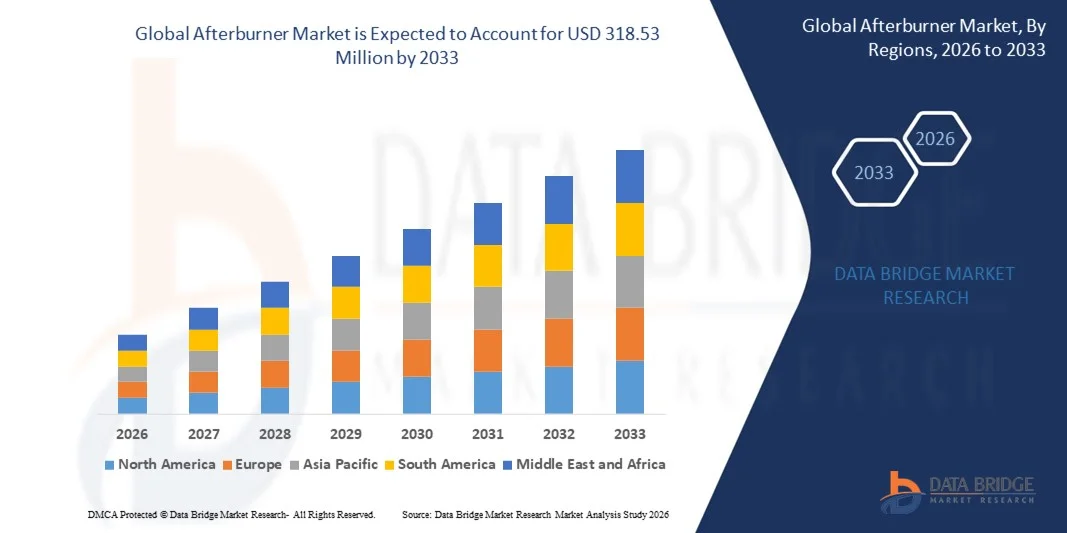
- The global afterburner market size was valued at USD 165.85 million in 2025 and is expected to reach USD 318.53 million by 2033, at a CAGR of 8.50% during the forecast period
- • The market growth is largely fuelled by increasingly stringent emission regulations across industrial sectors, rising adoption of thermal oxidation systems for air pollution control, and growing focus on reducing volatile organic compound and hazardous air pollutant emissions
- Expanding applications in chemical processing, pharmaceuticals, food processing, and automotive manufacturing are supporting sustained demand for advanced afterburner solutions
Afterburner Market Analysis
- The afterburner market is characterised by steady demand driven by regulatory compliance requirements and the need for effective emission control technologies across multiple end-use industries
- Manufacturers are focusing on innovation in design, integration with heat recovery systems, and optimisation of fuel consumption to enhance overall system performance and cost efficiency
- North America dominated the global afterburner market with the largest revenue share in 2025, driven by strict environmental regulations, strong enforcement of air quality standards, and the presence of advanced industrial infrastructure
- Asia-Pacific region is expected to witness the highest growth rate in the global afterburner market, driven by rising military modernization programs, increasing procurement of advanced combat aircraft, and growing investments in aerospace infrastructure across emerging economies
- The turbofan engine segment held the largest market revenue share in 2025 driven by its widespread use in modern military aircraft and its ability to deliver higher thrust efficiency with comparatively better fuel economy. Turbofan afterburners are widely adopted in advanced fighter jets as they support supersonic flight, enhanced combat performance, and improved mission flexibility, making them a preferred choice for air forces globally
Report Scope and Afterburner Market Segmentation
|
Attributes |
Afterburner Key Market Insights |
|
Segments Covered |
|
|
Countries Covered |
North America
Europe
Asia-Pacific
Middle East and Africa
South America
|
|
Key Market Players |
|
|
Market Opportunities |
|
|
Value Added Data Infosets |
In addition to the market insights such as market value, growth rate, market segments, geographical coverage, market players, and market scenario, the market report curated by the Data Bridge Market Research team includes in-depth expert analysis, import/export analysis, pricing analysis, production consumption analysis, and pestle analysis. |
Afterburner Market Trends
Rising Focus on Industrial Emission Control and Environmental Compliance
- The increasing emphasis on reducing harmful industrial emissions is significantly shaping the global afterburner market, as industries face stricter air pollution control regulations and environmental standards. Afterburner systems are gaining wider adoption due to their effectiveness in oxidizing volatile organic compounds, hazardous air pollutants, and odorous gases generated during industrial processes. This trend is strengthening demand across chemical processing, pharmaceuticals, food processing, and automotive manufacturing, encouraging manufacturers to develop high-efficiency and compliant solutions
- Growing awareness around environmental sustainability and corporate responsibility has accelerated the adoption of afterburners in industrial facilities aiming to minimize environmental impact. Industries are increasingly investing in advanced emission control technologies to meet compliance requirements while maintaining operational efficiency. This has led to higher demand for afterburners integrated with thermal oxidizers and air pollution control systems, supporting long-term market growth
- Regulatory compliance and sustainability goals are influencing capital investment decisions, with manufacturers prioritizing systems that ensure consistent emission reduction and regulatory adherence. Companies are emphasizing system reliability, low maintenance requirements, and energy efficiency to enhance overall value propositions. These factors are also driving the adoption of modern afterburner technologies with improved combustion efficiency and reduced fuel consumption
- For instance, in 2024, industrial facilities in Germany and the U.S. across chemical and automotive manufacturing sectors upgraded emission control systems by installing advanced afterburners to comply with updated emission norms. These installations supported improved regulatory compliance and operational safety while reinforcing environmental commitments. The systems were widely adopted across large-scale production units and specialized manufacturing plants
- While demand for afterburners is increasing, sustained market growth depends on technological innovation, cost-effective system integration, and energy optimization. Manufacturers are focusing on developing solutions that balance performance, operational costs, and environmental benefits to support wider adoption across diverse industrial applications
Afterburner Market Dynamics
Driver
Stringent Environmental Regulations and Industrial Emission Standards
- Increasingly strict environmental regulations aimed at controlling industrial air pollution are a major driver for the global afterburner market. Regulatory bodies are enforcing limits on volatile organic compounds and hazardous air pollutants, prompting industries to adopt efficient emission control systems. Afterburners play a critical role in meeting these requirements by ensuring effective thermal oxidation of harmful gases
- Expanding industrial activities in sectors such as chemicals, pharmaceuticals, automotive manufacturing, and food processing are contributing to higher emission levels, thereby increasing demand for afterburner systems. These systems help maintain compliance while supporting uninterrupted production, making them essential components of industrial pollution control infrastructure
- Industrial operators are actively investing in afterburner-based solutions to avoid regulatory penalties and improve environmental performance. These investments are supported by government initiatives promoting cleaner production practices and the adoption of advanced emission reduction technologies. Partnerships between system manufacturers and industrial operators are also increasing to deliver customized and compliant solutions
- For instance, in 2023, manufacturing plants operated by BASF in Germany and Dow in the U.S. expanded their use of afterburner systems within chemical processing units to comply with tightening emission standards. These installations supported continuous operations while improving air quality compliance and strengthening sustainability commitments
- Although regulatory pressure continues to drive market growth, long-term expansion depends on improving system efficiency, reducing fuel consumption, and integrating afterburners with heat recovery technologies. Ongoing investment in innovation and system optimization will remain essential for maintaining compliance and cost efficiency
Restraint/Challenge
High Installation Costs and Energy Consumption Requirements
- The relatively high capital investment required for installing afterburner systems remains a key challenge, particularly for small and medium-sized industrial facilities. Equipment costs, integration with existing systems, and installation complexity contribute to higher upfront expenditure, limiting adoption among cost-sensitive operators
- Energy consumption associated with afterburner operation is another challenge, as maintaining high combustion temperatures can increase operational costs. Industries with tight energy budgets may hesitate to adopt or upgrade afterburner systems, especially when alternative emission control technologies appear more cost-effective in the short term
- Maintenance requirements and system downtime can also affect adoption, as afterburners require regular inspection and servicing to ensure optimal performance and compliance. Unplanned shutdowns or inefficiencies can disrupt industrial operations and increase total cost of ownership
- For instance, in 2024, small-scale manufacturers in Southeast Asia reported slower adoption of afterburner systems due to high installation costs and increased fuel consumption compared to alternative emission control solutions. Energy price volatility and limited access to technical expertise further constrained adoption across cost-sensitive industries
- Addressing these challenges will require the development of energy-efficient afterburner designs, integration with waste heat recovery systems, and flexible financing options. Improving system efficiency and reducing operational costs will be critical for expanding adoption and supporting sustainable growth in the global afterburner market
Afterburner Market Scope
The market is segmented on the basis of type and plane type.
- By Type
On the basis of type, the global afterburner market is segmented into turbofan engine and turbojet engine. The turbofan engine segment held the largest market revenue share in 2025 driven by its widespread use in modern military aircraft and its ability to deliver higher thrust efficiency with comparatively better fuel economy. Turbofan afterburners are widely adopted in advanced fighter jets as they support supersonic flight, enhanced combat performance, and improved mission flexibility, making them a preferred choice for air forces globally.
The turbojet engine segment is expected to witness steady growth from 2026 to 2033, driven by its continued application in legacy aircraft, interceptor platforms, and specialized military programs. Turbojet afterburners are valued for their high thrust-to-weight ratio and simple design, which makes them suitable for short-duration high-speed missions. Ongoing modernization and maintenance of existing fleets are supporting the sustained demand for turbojet engine afterburners.
- By Plane Type
On the basis of plane type, the global afterburner market is segmented into air superiority fighter, interceptor aircraft, and light fighter. The air superiority fighter segment accounted for the largest market share in 2025 due to the high reliance on afterburners for achieving superior speed, maneuverability, and combat dominance during aerial missions. These aircraft require advanced propulsion systems with afterburners to maintain tactical advantages in modern warfare.
The interceptor aircraft and light fighter segments is expected to witness steady growth from 2026 to 2033, supported by increasing investments in air defense capabilities and the development of cost-effective combat aircraft. Interceptor aircraft rely on afterburners for rapid acceleration and quick response to aerial threats, while light fighters utilize afterburners to enhance performance without significantly increasing operational complexity, contributing to their adoption among emerging and mid-sized air forces.
Afterburner Market Regional Analysis
- North America dominated the global afterburner market with the largest revenue share in 2025, driven by strict environmental regulations, strong enforcement of air quality standards, and the presence of advanced industrial infrastructure
- Industries in the region place high importance on emission control compliance, operational safety, and sustainable manufacturing practices, leading to increased adoption of afterburner systems across chemical, pharmaceutical, automotive, and food processing sectors
- This widespread adoption is further supported by high industrial investments, continuous upgrades of emission control equipment, and growing awareness of environmental responsibility, establishing afterburners as a critical solution for industrial air pollution control
U.S. Afterburner Market Insight
The U.S. afterburner market captured the largest revenue share in 2025 within North America, fueled by stringent emission norms set by environmental regulatory agencies and the strong presence of large-scale manufacturing industries. Industrial operators are increasingly investing in afterburner systems to ensure compliance with volatile organic compound and hazardous air pollutant regulations. The focus on upgrading aging industrial infrastructure, coupled with rising adoption of advanced thermal oxidation systems, continues to support market growth in the country.
Europe Afterburner Market Insight
The Europe afterburner market is expected to witness the fastest growth rate from 2026 to 2033, primarily driven by tightening environmental regulations and aggressive climate targets across the region. Increasing industrial emphasis on reducing carbon footprint and improving emission efficiency is fostering the adoption of afterburner systems. Growth is supported by widespread implementation across chemical processing, pharmaceuticals, and specialty manufacturing industries, as well as strong investments in sustainable industrial technologies.
U.K. Afterburner Market Insight
The U.K. afterburner market is expected to witness steady growth from 2026 to 2033, driven by increasing regulatory scrutiny on industrial emissions and rising investments in cleaner production technologies. Manufacturing facilities are adopting afterburner systems to meet emission compliance requirements while improving operational efficiency. The country’s focus on sustainability initiatives and industrial modernization is further encouraging the deployment of advanced emission control solutions.
Germany Afterburner Market Insight
The Germany afterburner market is expected to witness strong growth from 2026 to 2033, fueled by the country’s robust industrial base and strong emphasis on environmental protection and energy efficiency. Germany’s advanced manufacturing sector, particularly in chemicals and automotive production, is driving demand for high-performance afterburner systems. The integration of afterburners with energy-efficient and heat recovery technologies aligns well with Germany’s sustainability and innovation-driven industrial approach.
Asia-Pacific Afterburner Market Insight
The Asia-Pacific afterburner market is expected to witness the fastest growth rate from 2026 to 2033, driven by rapid industrialization, expanding manufacturing activities, and tightening emission regulations across emerging economies. Rising awareness of air pollution control and increasing investments in industrial infrastructure are accelerating afterburner adoption. The region’s growth is further supported by the expansion of chemical, pharmaceutical, and food processing industries.
Japan Afterburner Market Insight
The Japan afterburner market is expected to witness steady growth from 2026 to 2033 due to the country’s advanced manufacturing capabilities and strong regulatory framework for environmental protection. Japanese industries emphasize high-efficiency and reliable emission control systems, driving the adoption of technologically advanced afterburners. Integration with precision-controlled industrial processes and a strong focus on operational safety are key factors supporting market expansion.
China Afterburner Market Insight
The China afterburner market accounted for the largest market revenue share in Asia Pacific in 2025, attributed to rapid industrial expansion, rising environmental concerns, and stricter enforcement of emission control policies. China’s large-scale chemical and manufacturing sectors are increasingly adopting afterburner systems to comply with national air quality standards. Government initiatives targeting pollution reduction, along with growing investments in industrial emission control infrastructure, continue to propel the market in China.
Afterburner Market Share
The Afterburner industry is primarily led by well-established companies, including:
- Rolls-Royce plc (U.K.)
- GE Aviation (U.S.)
- Raytheon Technologies Corporation (U.S.)
- Honeywell International Inc. (U.S.)
- SE Ivchenko-Progress (Ukraine)
- Aviadvigatel (Russia)
- Safran (France)
- EuroJet Turbo GmbH (Germany)
- JSC “Klimov” — United Engine Corporation (Russia)
- MTU Aero Engines AG (Germany)
SKU-
Get online access to the report on the World's First Market Intelligence Cloud

- Interactive Data Analysis Dashboard
- Company Analysis Dashboard for high growth potential opportunities
- Research Analyst Access for customization & queries
- Competitor Analysis with Interactive dashboard
- Latest News, Updates & Trend analysis
- Harness the Power of Benchmark Analysis for Comprehensive Competitor Tracking
Research Methodology
Data collection and base year analysis are done using data collection modules with large sample sizes. The stage includes obtaining market information or related data through various sources and strategies. It includes examining and planning all the data acquired from the past in advance. It likewise envelops the examination of information inconsistencies seen across different information sources. The market data is analysed and estimated using market statistical and coherent models. Also, market share analysis and key trend analysis are the major success factors in the market report. To know more, please request an analyst call or drop down your inquiry.
The key research methodology used by DBMR research team is data triangulation which involves data mining, analysis of the impact of data variables on the market and primary (industry expert) validation. Data models include Vendor Positioning Grid, Market Time Line Analysis, Market Overview and Guide, Company Positioning Grid, Patent Analysis, Pricing Analysis, Company Market Share Analysis, Standards of Measurement, Global versus Regional and Vendor Share Analysis. To know more about the research methodology, drop in an inquiry to speak to our industry experts.
Customization Available
Data Bridge Market Research is a leader in advanced formative research. We take pride in servicing our existing and new customers with data and analysis that match and suits their goal. The report can be customized to include price trend analysis of target brands understanding the market for additional countries (ask for the list of countries), clinical trial results data, literature review, refurbished market and product base analysis. Market analysis of target competitors can be analyzed from technology-based analysis to market portfolio strategies. We can add as many competitors that you require data about in the format and data style you are looking for. Our team of analysts can also provide you data in crude raw excel files pivot tables (Fact book) or can assist you in creating presentations from the data sets available in the report.












