




Global Agricultural Microbials Market
Market Size in USD Billion
CAGR :
% 
 USD
8.51 Billion
USD
25.67 Billion
2025
2033
USD
8.51 Billion
USD
25.67 Billion
2025
2033
 Forecast Period Forecast Period |
2026 –2033 |
 Market Size (Base Year) Market Size (Base Year) |
USD 8.51 Billion |
 Market Size (Forecast Year) Market Size (Forecast Year) |
USD 25.67 Billion |
 CAGR CAGR |
% |
| Major Markets Players |
|
Agricultural Microbial Market Size
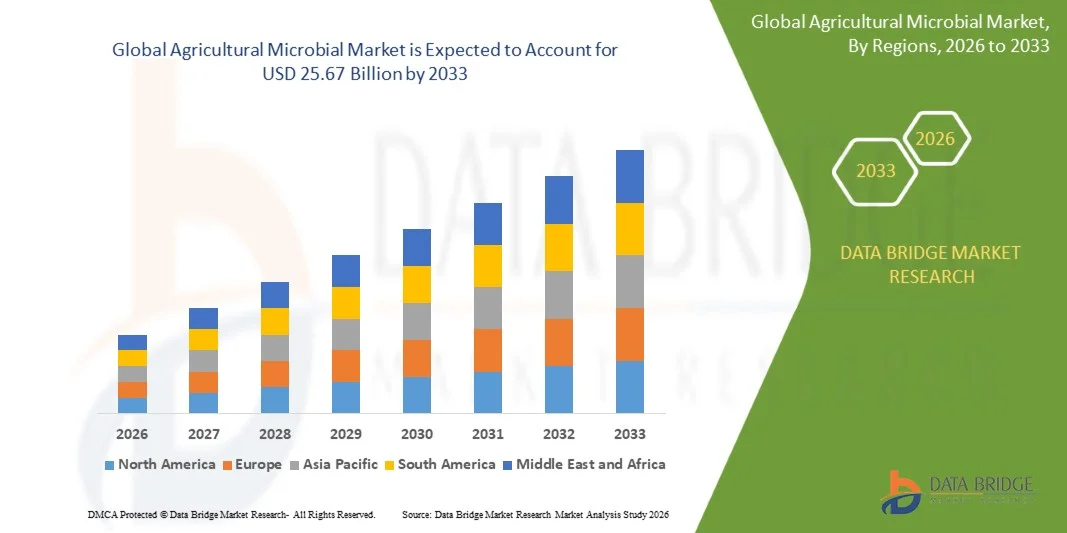
- The global agricultural microbial market size was valued at USD 8.51 billion in 2025 and is expected to reach USD 25.67 billion by 2033, at a CAGR of 14.80% during the forecast period
- The market growth is largely fuelled by the increasing demand for sustainable and eco-friendly agricultural practices
- Rising awareness regarding soil health and crop productivity is further accelerating the adoption of microbial solutions
Agricultural Microbial Market Analysis
- The market is witnessing strong growth due to the rising adoption of biofertilizers and biopesticides across both developed and emerging economies
- Increasing investments in agricultural biotechnology and supportive government initiatives are further strengthening market expansion
- North America dominated the agricultural microbial market with the largest revenue share in 2025, driven by the increasing adoption of sustainable farming practices and rising demand for organic food products
- Asia-Pacific region is expected to witness the highest growth rate in the global agricultural microbial market, driven by increasing population, rising food demand, rapid adoption of modern farming techniques, and growing awareness of eco-friendly agricultural inputs
- The bacteria segment held the largest market revenue share in 2025 driven by its wide application in biofertilizers and biopesticides, along with its effectiveness in enhancing nutrient availability and improving soil fertility. Bacteria-based products are widely adopted due to their proven efficiency, ease of formulation, and compatibility with various crops and soil conditions. They also play a crucial role in nitrogen fixation and phosphate solubilization, improving overall crop yield. In addition, continuous advancements in microbial strain development are further strengthening their commercial adoption
Report Scope and Agricultural Microbial Market Segmentation
|
Attributes |
Agricultural Microbial Key Market Insights |
|
Segments Covered |
|
|
Countries Covered |
North America
Europe
Asia-Pacific
Middle East and Africa
South America
|
|
Key Market Players |
• Sumitomo Chemical Co., Ltd. (Japan) |
|
Market Opportunities |
• Increasing Adoption Of Organic Farming Practices |
|
Value Added Data Infosets |
In addition to the insights on market scenarios such as market value, growth rate, segmentation, geographical coverage, and major players, the market reports curated by the Data Bridge Market Research also include in-depth expert analysis, pricing analysis, brand share analysis, consumer survey, demography analysis, supply chain analysis, value chain analysis, raw material/consumables overview, vendor selection criteria, PESTLE Analysis, Porter Analysis, and regulatory framework. |
Agricultural Microbial Market Trends
“Rising Demand for Sustainable and Eco-Friendly Agricultural Solutions”
• The increasing focus on sustainable farming practices is significantly shaping the agricultural microbial market, as farmers and agribusinesses shift toward environmentally friendly inputs that enhance soil fertility and crop productivity. Agricultural microbials are gaining traction due to their ability to improve nutrient uptake, protect crops from pests, and reduce dependency on chemical fertilizers and pesticides. This trend is encouraging manufacturers to innovate and develop advanced microbial formulations that align with sustainable agriculture goals
• Growing awareness regarding soil health, environmental impact, and food safety has accelerated the adoption of agricultural microbials across crop production systems. Farmers are increasingly utilizing biofertilizers and biopesticides to improve yield quality while maintaining ecological balance. This shift is further supported by the expansion of organic farming and the rising demand for residue-free agricultural products in global markets
• Sustainability and regulatory trends are influencing purchasing decisions, with governments and agricultural bodies promoting the use of biological inputs through subsidies, policies, and awareness programs. These factors are helping companies expand their product portfolios and strengthen their market presence while supporting environmentally responsible farming practices
• For instance, in 2024, companies such as BASF SE in Germany and Cargill, Incorporated in the U.S. expanded their agricultural biological portfolios by introducing advanced microbial-based crop solutions. These launches were aimed at improving soil health and crop yield while addressing sustainability concerns, with distribution across global agricultural markets
• While demand for agricultural microbials is increasing, sustained market expansion depends on continuous research and development, cost-effective production, and improving product efficacy under diverse environmental conditions. Companies are also focusing on enhancing shelf life, formulation stability, and farmer awareness to ensure broader adoption
Agricultural Microbial Market Dynamics
Driver
“Growing Adoption of Biofertilizers and Biopesticides”
• Increasing demand for eco-friendly crop protection and nutrition solutions is a major driver for the agricultural microbial market. Farmers are shifting from synthetic agrochemicals to microbial-based inputs to meet regulatory requirements and consumer demand for safe food products. This transition is also encouraging innovation in microbial strains and formulations for enhanced performance
• Expanding applications across cereals, fruits, vegetables, and oilseeds are contributing to market growth. Agricultural microbials help improve soil structure, nutrient availability, and resistance to pests and diseases, enabling farmers to achieve higher productivity and better crop quality. The increasing global population and need for food security further strengthen this demand
• Agricultural input companies are actively promoting microbial-based products through training programs, demonstration projects, and partnerships with farmers and distributors. These initiatives are supported by favorable government policies and increasing investment in agricultural biotechnology, driving widespread adoption
• For instance, in 2023, Bayer AG in Germany and Syngenta AG in Switzerland increased their focus on biological crop solutions, including microbial products, in response to growing demand for sustainable agriculture. These developments also supported product diversification and market expansion
• Although the shift toward biological solutions is accelerating, long-term growth depends on improving product consistency, enhancing farmer awareness, and ensuring cost competitiveness compared to conventional agrochemicals
Restraint/Challenge
“Limited Awareness and Variable Field Performance”
• Limited awareness among farmers regarding the benefits and application of agricultural microbials remains a key challenge, particularly in developing regions. Many farmers are still reliant on conventional chemical inputs due to familiarity and immediate results, restricting the adoption of microbial alternatives
• Variability in field performance due to environmental conditions such as soil type, temperature, and moisture can impact product effectiveness. This inconsistency creates hesitation among farmers, especially when compared to the predictable performance of synthetic inputs
• Distribution and storage challenges also affect market growth, as microbial products often require specific handling conditions to maintain viability. Inadequate infrastructure and supply chain inefficiencies can limit accessibility and increase operational costs for manufacturers and distributors
• For instance, in 2024, distributors in regions such as Southeast Asia and Latin America supplying products from companies such as UPL Limited and Novozymes A/S reported slower adoption due to limited farmer awareness and challenges in maintaining product stability during transportation and storage. These factors also affected product availability and usage across small-scale farms
• Addressing these challenges will require extensive farmer education, investment in supply chain infrastructure, and continuous improvement in product formulations. Strengthening collaboration between governments, agricultural organizations, and private companies will be essential to unlock the full potential of the agricultural microbial market
Agricultural Microbial Market Scope
The market is segmented on the basis of type, function, form, crop type, and mode of application.
• By Type
On the basis of type, the agricultural microbial market is segmented into bacteria, fungi, protozoa, viruses, and others. The bacteria segment held the largest market revenue share in 2025 driven by its wide application in biofertilizers and biopesticides, along with its effectiveness in enhancing nutrient availability and improving soil fertility. Bacteria-based products are widely adopted due to their proven efficiency, ease of formulation, and compatibility with various crops and soil conditions. They also play a crucial role in nitrogen fixation and phosphate solubilization, improving overall crop yield. In addition, continuous advancements in microbial strain development are further strengthening their commercial adoption.
The fungi segment is expected to witness the fastest growth rate from 2026 to 2033, driven by its ability to improve plant resilience and nutrient absorption, particularly through mycorrhizal associations. Fungi-based microbials are increasingly used for crop protection and soil health improvement, especially in organic farming practices. They help plants withstand environmental stress such as drought and salinity, enhancing productivity. Growing research in fungal biotechnology and increasing adoption in high-value crops are further supporting segment growth.
• By Function
On the basis of function, the agricultural microbial market is segmented into crop protection, soil enhancement, and others. The crop protection segment held the largest market revenue share in 2025 driven by the increasing need to control pests and diseases using environmentally friendly solutions. Microbial-based biopesticides are widely used to reduce reliance on chemical pesticides while maintaining crop productivity and safety. These products offer targeted action against harmful organisms while preserving beneficial microbes. In addition, regulatory support for reducing chemical pesticide usage is further boosting demand.
The soil enhancement segment is expected to witness the fastest growth rate from 2026 to 2033, driven by rising awareness regarding soil health and fertility management. Soil enhancement products improve nutrient availability, enhance microbial activity, and support sustainable farming practices. They contribute to long-term soil productivity and reduce the need for synthetic fertilizers. Increasing adoption of regenerative agriculture practices and government initiatives promoting soil conservation are accelerating growth.
• By Form
On the basis of form, the agricultural microbial market is segmented into dry and liquid. The liquid segment held the largest market revenue share in 2025 driven by its ease of application, better shelf life stability, and uniform distribution across crops. Liquid formulations are widely preferred by farmers due to their convenience and compatibility with modern irrigation systems such as drip and sprinkler methods. They also provide quicker microbial activation and effective coverage. Continuous product innovation is further enhancing their performance and usability.
The dry segment is expected to witness the fastest growth rate from 2026 to 2033, driven by its cost-effectiveness, longer shelf life, and ease of storage and transportation. Dry formulations are particularly suitable for regions with limited cold storage infrastructure. They are widely used in seed coating and soil application due to their stability and extended usability. Increasing focus on reducing logistics costs and improving product accessibility is contributing to segment expansion.
• By Crop Type
On the basis of crop type, the agricultural microbial market is segmented into cereals and grains, oilseeds and pulses, fruits and vegetables, and others. The cereals and grains segment held the largest market revenue share in 2025 driven by the high global demand for staple crops and the extensive cultivation area. Agricultural microbials help improve nutrient uptake, enhance resistance to pests, and increase yield in these crops. Their adoption is further supported by government initiatives aimed at improving food security. Increasing demand for sustainable cultivation practices is also boosting segment growth.
The fruits and vegetables segment is expected to witness the fastest growth rate from 2026 to 2033, driven by increasing demand for high-quality, residue-free produce. Microbial solutions are widely used to improve crop quality, shelf life, and resistance to diseases in horticulture. The rising popularity of organic farming and export-oriented agriculture is encouraging farmers to adopt biological inputs. In addition, consumer preference for fresh and chemical-free produce is accelerating segment growth.
• By Mode of Application
On the basis of mode of application, the agricultural microbial market is segmented into foliar spray, soil treatment, seed treatment, and post-harvest. The soil treatment segment held the largest market revenue share in 2025 driven by its effectiveness in improving soil fertility, enhancing microbial activity, and supporting plant growth from the early stages. Soil application ensures better root development and nutrient absorption, leading to improved crop performance. It is widely adopted across various crop types due to its long-term benefits.
The seed treatment segment is expected to witness the fastest growth rate from 2026 to 2033, driven by its efficiency in protecting seeds from pathogens and promoting early plant development. Seed treatment methods ensure uniform germination and improved crop establishment. They also reduce the need for excessive chemical inputs, supporting sustainable agriculture practices. Increasing awareness among farmers regarding the benefits of early-stage crop protection is further driving adoption.
Agricultural Microbial Market Regional Analysis
• North America dominated the agricultural microbial market with the largest revenue share in 2025, driven by the increasing adoption of sustainable farming practices and rising demand for organic food products
• Farmers in the region highly value the efficiency, eco-friendly nature, and soil health benefits offered by agricultural microbials, which enhance crop productivity while reducing dependence on chemical inputs
• This widespread adoption is further supported by strong regulatory frameworks, advanced agricultural infrastructure, and high awareness regarding environmental sustainability, establishing agricultural microbials as a preferred solution across modern farming systems
U.S. Agricultural Microbial Market Insight
The U.S. agricultural microbial market captured the largest revenue share in 2025 within North America, fueled by the strong adoption of biofertilizers and biopesticides and increasing focus on sustainable agriculture. Farmers are increasingly prioritizing soil health improvement and crop yield enhancement through biological solutions. The growing demand for organic and residue-free food products, combined with technological advancements in microbial formulations, further propels market growth. Moreover, supportive government initiatives and investments in agricultural biotechnology are significantly contributing to the expansion of the market.
Europe Agricultural Microbial Market Insight
The Europe agricultural microbial market is expected to witness the fastest growth rate from 2026 to 2033, primarily driven by stringent environmental regulations and increasing restrictions on chemical pesticides and fertilizers. The rising demand for organic farming and sustainable agricultural practices is fostering the adoption of microbial solutions. European farmers are also focusing on improving soil fertility and crop quality, which is encouraging the use of bio-based inputs across various crop types.
U.K. Agricultural Microbial Market Insight
The U.K. agricultural microbial market is expected to witness the fastest growth rate from 2026 to 2033, driven by the growing emphasis on sustainable agriculture and environmental conservation. Increasing awareness regarding soil health and the need to reduce chemical input usage are encouraging farmers to adopt microbial products. In addition, government support for eco-friendly farming practices and the expansion of organic agriculture are expected to support market growth.
Germany Agricultural Microbial Market Insight
The Germany agricultural microbial market is expected to witness the fastest growth rate from 2026 to 2033, fueled by strong focus on innovation and sustainable farming technologies. Germany’s well-developed agricultural sector and emphasis on environmental protection promote the adoption of microbial-based inputs. The integration of advanced agricultural practices and increasing investment in biotechnology are further supporting market expansion.
Asia-Pacific Agricultural Microbial Market Insight
The Asia-Pacific agricultural microbial market is expected to witness the fastest growth rate from 2026 to 2033, driven by rapid population growth, increasing food demand, and rising awareness regarding sustainable farming. The region’s expanding agricultural sector, coupled with growing adoption of modern farming techniques in countries such as China, India, and Japan, is boosting the demand for microbial products. Furthermore, supportive government initiatives and increasing investments in agricultural development are enhancing market growth.
Japan Agricultural Microbial Market Insight
The Japan agricultural microbial market is expected to witness the fastest growth rate from 2026 to 2033 due to the country’s strong focus on food safety, quality, and technological innovation. The increasing adoption of precision agriculture and sustainable farming practices is encouraging the use of microbial solutions. Moreover, the integration of advanced biotechnology and the demand for high-quality agricultural produce are driving market expansion.
China Agricultural Microbial Market Insight
The China agricultural microbial market accounted for the largest market revenue share in Asia Pacific in 2025, attributed to rapid agricultural modernization, increasing use of biofertilizers, and strong government support for sustainable farming. China represents one of the largest agricultural markets globally, where microbial products are increasingly used to improve crop productivity and soil health. The availability of cost-effective production and expanding domestic manufacturing capabilities are key factors propelling market growth in China.
Agricultural Microbial Market Share
The Agricultural Microbial industry is primarily led by well-established companies, including:
• Sumitomo Chemical Co., Ltd. (Japan)
• FMC Corporation (U.S.)
• Dow (U.S.)
• Bayer AG (Germany)
• Gujarat State Fertilizers & Chemicals Limited (India)
• Koppert B.V. (Netherlands)
• Marrone Bio Innovations, Inc. (U.S.)
• DuPont (U.S.)
• Certis USA LLC. (U.S.)
• Syngenta Crop Protection AG (Switzerland)
• Novozymes (Denmark)
• Arysta LifeScience Limited (U.S.)
• Chr. Hansen Holding A/S (Denmark)
• BASF SE (Germany)
• Taxon (U.S.)
• Kemin Industries, Inc. (U.S.)
• Cargill, Incorporated (U.S.)
• Ingredion (U.S.)
• Tate & Lyle (U.K.)
Latest Developments in Global Agricultural Microbial Market
- In January 2026, Koppert India, facility expansion, inaugurated an upgraded mycorrhiza production facility at IDA Bollaram to increase local manufacturing capacity of beneficial soil fungi, enhancing the availability of high-quality mycorrhizal products for farmers. This development supports improved nutrient uptake, stronger root systems, and better soil health across various crops. It also reduces dependency on imports and strengthens regional supply chains. The expansion is expected to accelerate the adoption of sustainable agricultural practices and improve crop resilience under changing environmental conditions
- In January 2026, HGS BioScience, acquisition, acquired Pharmgrade to expand its biological crop solutions platform and strengthen its microbial consortium portfolio. This acquisition enhances the company’s product pipeline and technical capabilities in microbial-based inputs. It also enables broader distribution across North American markets and improves access to innovative agricultural solutions. The move is expected to drive market consolidation and accelerate the commercialization of advanced biological products
- In November 2025, Corteva AG, product launch, introduced Goltrevo bioinsecticide and Varpelgo active insecticide to provide advanced crop protection solutions for farmers. These products offer improved control over a wide range of pests while supporting more sustainable farming practices. The integration of biological and next-generation synthetic solutions enhances crop yield protection and reduces environmental impact. This launch strengthens Corteva’s competitive position and contributes to the growing adoption of integrated pest management strategies
- In November 2025, Pivot Bio, product launch, launched PROVEN G3, a gene-edited microbial nitrogen solution for corn designed to improve nitrogen fixation and nutrient use efficiency. This innovation helps reduce reliance on synthetic fertilizers and lowers input costs for farmers. It also supports improved crop productivity and environmental sustainability by minimizing nitrogen runoff. The product is expected to expand the use of precision agriculture and accelerate the adoption of microbial technologies in large-scale farming
- In October 2024, MAFA Bioscience, product launch, introduced ASPERBIO biofertilizer containing Aspergillus niger to enhance plant growth and tolerance to stress conditions such as drought. The product improves nutrient absorption and promotes stronger root development, leading to better crop performance. It also supports sustainable agriculture by reducing the need for chemical fertilizers. This launch is expected to increase awareness and adoption of microbial biofertilizers in emerging agricultural markets
- In April 2022, Bayer CropScience, strategic partnership, collaborated with Ginkgo Bioworks to transfer biologics R&D capabilities and accelerate the development of microbial-based solutions. This partnership strengthens research capabilities and expands innovation in agricultural biotechnology. It also enhances the company’s ability to deliver high-performance biological products to global markets. The collaboration is expected to drive long-term growth and support the transition toward sustainable and environmentally friendly farming practices
SKU-
Get online access to the report on the World's First Market Intelligence Cloud

- Interactive Data Analysis Dashboard
- Company Analysis Dashboard for high growth potential opportunities
- Research Analyst Access for customization & queries
- Competitor Analysis with Interactive dashboard
- Latest News, Updates & Trend analysis
- Harness the Power of Benchmark Analysis for Comprehensive Competitor Tracking
Global Agricultural Microbials Market, Supply Chain Analysis and Ecosystem Framework
To support market growth and help clients navigate the impact of geopolitical shifts, DBMR has integrated in-depth supply chain analysis into its Global Agricultural Microbials Market research reports. This addition empowers clients to respond effectively to global changes affecting their industries. The supply chain analysis section includes detailed insights such as Global Agricultural Microbials Market consumption and production by country, price trend analysis, the impact of tariffs and geopolitical developments, and import and export trends by country and HSN code. It also highlights major suppliers with data on production capacity and company profiles, as well as key importers and exporters. In addition to research, DBMR offers specialized supply chain consulting services backed by over a decade of experience, providing solutions like supplier discovery, supplier risk assessment, price trend analysis, impact evaluation of inflation and trade route changes, and comprehensive market trend analysis.
Research Methodology
Data collection and base year analysis are done using data collection modules with large sample sizes. The stage includes obtaining market information or related data through various sources and strategies. It includes examining and planning all the data acquired from the past in advance. It likewise envelops the examination of information inconsistencies seen across different information sources. The market data is analysed and estimated using market statistical and coherent models. Also, market share analysis and key trend analysis are the major success factors in the market report. To know more, please request an analyst call or drop down your inquiry.
The key research methodology used by DBMR research team is data triangulation which involves data mining, analysis of the impact of data variables on the market and primary (industry expert) validation. Data models include Vendor Positioning Grid, Market Time Line Analysis, Market Overview and Guide, Company Positioning Grid, Patent Analysis, Pricing Analysis, Company Market Share Analysis, Standards of Measurement, Global versus Regional and Vendor Share Analysis. To know more about the research methodology, drop in an inquiry to speak to our industry experts.
Customization Available
Data Bridge Market Research is a leader in advanced formative research. We take pride in servicing our existing and new customers with data and analysis that match and suits their goal. The report can be customized to include price trend analysis of target brands understanding the market for additional countries (ask for the list of countries), clinical trial results data, literature review, refurbished market and product base analysis. Market analysis of target competitors can be analyzed from technology-based analysis to market portfolio strategies. We can add as many competitors that you require data about in the format and data style you are looking for. Our team of analysts can also provide you data in crude raw excel files pivot tables (Fact book) or can assist you in creating presentations from the data sets available in the report.












