




Global Agrochemicals Market
Market Size in USD Billion

 USD
240.33 Billion
USD
347.05 Billion
2024
2032
USD
240.33 Billion
USD
347.05 Billion
2024
2032
 Forecast Period Forecast Period |
2025 - 2032 |
 Market Size (Base Year) Market Size (Base Year) |
USD 240.33 Billion |
 Market Size (Forecast Year) Market Size (Forecast Year) |
USD 347.05 Billion |
 CAGR CAGR |
% |
| Major Markets Players |
|
Agrochemicals Market Analysis
Agrochemicals are chemical or biological formulations that have been engineered to improve crop quality and yield. Fertilizers and pesticides are two types of agrochemicals. Fertilizers enhance the quality of crop by providing essential nutrients to the crop and soil, whereas pesticides protect crops by controlling, killing, or repelling pests and weeds that can harm the crop. Given the current global population scenario, increasing crop production within the existing arable land is critical to feed the world's population.
Agrochemicals Market Size
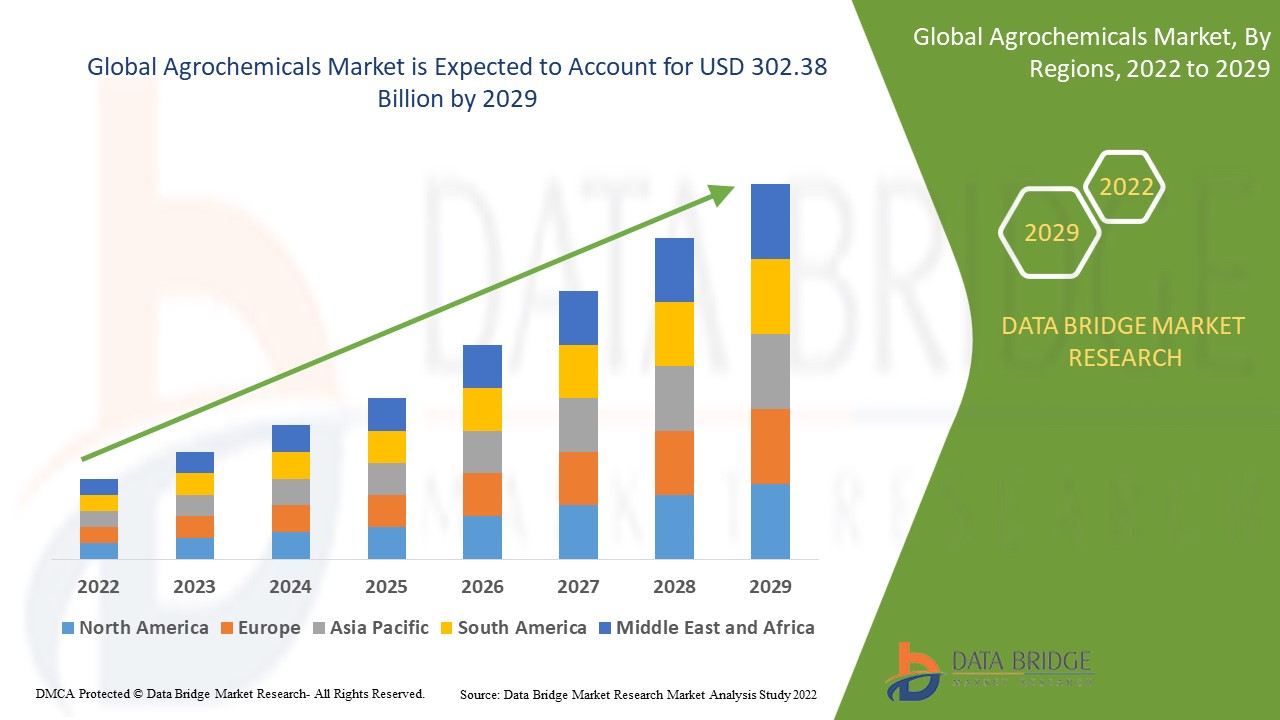
Global agrochemicals market size was valued at USD 240.33 billion in 2024 and is projected to reach USD 347.05 billion by 2032, with a CAGR of 4.70% during the forecast period of 2025 to 2032.
Report Scope and Market Segmentation
|
Attributes |
Agrochemicals Key Market Insights |
|
Segmentation |
|
|
Countries Covered |
U.S., Canada and Mexico in North America, Germany, France, U.K., Netherlands, Switzerland, Belgium, Russia, Italy, Spain, Turkey, Rest of Europe in Europe, China, Japan, India, South Korea, Singapore, Malaysia, Australia, Thailand, Indonesia, Philippines, Rest of Asia-Pacific (APAC) in the Asia-Pacific (APAC), Saudi Arabia, U.A.E, South Africa, Egypt, Israel, Rest of Middle East and Africa (MEA) as a part of Middle East and Africa (MEA), Brazil, Argentina and Rest of South America as part of South America |
|
Key Market Players |
Bayer AG (Germany), BASF SE (Germany), Yara (Norway), Compass Minerals (US), Syngenta Crop Protection AG (Switzerland), ADAMA (Israel), Sumitomo Chemicals Co. Ltd. (Japan), Nufarm (Australia), UPL (India), K+S Aktiengesellschaft (Germany), ICL (Israel) |
|
Market Opportunities |
|
Agrochemicals Market Definition
Agrochemicals are specialized chemicals and compounds that are used to protect and improve the quality of agricultural products. They are used in commercial plantation agricultural fields and units to protect produce from pests, weeds, and fungi while also increasing yield. Nitrogen, and potassic fertilizers, insecticides, herbicides, fungicides, rodenticides, phosphatic, molluscicides, nematicides, and pesticides are the most commonly used agrochemicals.
Agrochemicals Market Dynamics
Drivers
- Rising greenhouse vegetable production
Increasing greenhouse vegetable production, a scarcity of arable land, rising levels of investment in research and development activities, and the ease with which agrochemicals can be used are some of the factors that will likely boost the growing of the agrochemicals market
- Rapid product innovations and developments
Other growth-inducing factors include product innovations such as the development of sustainable bio-based agrochemicals. Compared to conventional synthetic chemicals, these alternatives are more environmentally friendly, efficient, and cost-effective. In line with this, the growing preference for natural food products among the general public also contributes to an rise in the demand for agrochemicals.
Other growth-inducing factors include product innovations such as the development of sustainable bio-based agrochemicals. Compared to conventional synthetic chemicals, these alternatives are more environmentally friendly, efficient, and cost-effective. In line with this, the growing preference for natural food products among the general public also contributes to an increase in the demand for agrochemicals.
Opportunity
The harmful elements in chemical agricultural products produce such high amounts of pollution that they have serious and, in many cases, lethal impacts on the ecosystem. Bio-based agrochemicals are being developed as viable replacements to synthetic chemicals in a number of applications as consumer awareness of environmentally friendly and sustainable products grows.
Restraints
The agrochemicals market is highly split, with a significant number of large and small firms. The bulk of market participants are based in Europe and offer a diverse range of items with the growing demand for agrochemical products, the market's leading players are focusing on R&D investments in order to produce goods that meet the needs of customers.
This agrochemicals market report provides details of new recent developments, trade regulations, import-export analysis, production analysis, value chain optimization, market share, impact of domestic and localized market players, analyses opportunities in terms of emerging revenue pockets, changes in market regulations, strategic market growth analysis, market size, category market growths, application niches and dominance, product approvals, product launches, geographic expansions, technological innovations in the market. To gain more info on the agrochemicals market contact Data Bridge Market Research for an Analyst Brief, our team will help you take an informed market decision to achieve market growth.
Agrochemicals Market Scope
The agrochemicals market is segmented on the basis of crop type, mode of application, form, and type. The growth amongst these segments will help you analyze meagre growth segments in the industries and provide the users with a valuable market overview and market insights to help them make strategic decisions for identifying core market applications.
Crop Type
- Cereals
- Pulses and oilseeds
- Fruits and vegetables
- Lawns and turfs
- Others
Mode of Application
- Foliar
- Fertigation
- Others
Form
- Paints and coatings
- Pesticides
- Chemicals
- Gasoline
- Printing
- Rubber
- Leather
Type
- Pesticides
- Fertilizers
Agrochemicals Market Regional Analysis
The agrochemicals market is analyzed and market size insights and trends are provided by country, crop type, mode of application, form, and type as referenced above.
The countries covered in the agrochemicals market report are U.S., Canada and Mexico in North America, Germany, France, U.K., Netherlands, Switzerland, Belgium, Russia, Italy, Spain, Turkey, Rest of Europe in Europe, China, Japan, India, South Korea, Singapore, Malaysia, Australia, Thailand, Indonesia, Philippines, Rest of Asia-Pacific (APAC) in the Asia-Pacific (APAC), Saudi Arabia, U.A.E, South Africa, Egypt, Israel, Rest of Middle East and Africa (MEA) as a part of Middle East and Africa (MEA), Brazil, Argentina and Rest of South America as part of South America.
Asia-Pacific dominates the agrochemicals market due to rising disposable income levels, rapid urbanization, and modernization of the food sector in the region. In contrast, Europe is expected to grow in the forecast period of 2025 to 2032 due to increased investment in agricultural sector growth and adoption of better water preservation technologies in the region.
The country section of the report also provides individual market impacting factors and changes in market regulation that impact the current and future trends of the market. Data points like down-stream and upstream value chain analysis, technical trends and porter's five forces analysis, case studies are some of the pointers used to forecast the market scenario for individual countries. Also, the presence and availability of global brands and their challenges faced due to large or scarce competition from local and domestic brands, impact of domestic tariffs and trade routes are considered while providing forecast analysis of the country data.
Agrochemicals Market Share
The agrochemicals market competitive landscape provides details by competitor. Details included are company overview, company financials, revenue generated, market potential, investment in research and development, new market initiatives, global presence, production sites and facilities, production capacities, company strengths and weaknesses, product launch, product width and breadth, application dominance. The above data points provided are only related to the companies' focus related to agrochemicals market.
Agrochemicals Market Leaders Operating in the Market Are:
- Bayer AG (Germany)
- BASF SE (Germany)
- Yara (Norway)
- Compass Minerals (US)
- Syngenta Crop Protection AG (Switzerland)
- ADAMA (Israel)
- Sumitomo Chemicals Co. Ltd. (Japan)
- Nufarm (Australia)
- UPL (India)
- K+S Aktiengesellschaft (Germany)
- ICL (Israel)
Latest Developments in Agrochemicals Market
- In February 2022, Timeline FX, an advanced cross-spectrum spring foliar herbicide for cereals, was introduced by Adama. The product is designed with three Active Ingredients with complementary modes of action and a built-in adjuvant to provide growers with the broadest application window of any herbicide for controlling broadleaf and grass weeds in cereal crops
- In January 2022, Yara and Lantmännen signed a commercial agreement to bring fossil-free fertilizers to market. The companies' collaboration resulted in a commercial contract for green fertilizers manufactured by Yara and marketed by Lantmännen in Sweden beginning in 2023
SKU-

- Interactive Data Analysis Dashboard
- Company Analysis Dashboard for high growth potential opportunities
- Research Analyst Access for customization & queries
- Competitor Analysis with Interactive dashboard
- Latest News, Updates & Trend analysis
- Harness the Power of Benchmark Analysis for Comprehensive Competitor Tracking
Data collection and base year analysis are done using data collection modules with large sample sizes. The stage includes obtaining market information or related data through various sources and strategies. It includes examining and planning all the data acquired from the past in advance. It likewise envelops the examination of information inconsistencies seen across different information sources. The market data is analysed and estimated using market statistical and coherent models. Also, market share analysis and key trend analysis are the major success factors in the market report. To know more, please request an analyst call or drop down your inquiry.
The key research methodology used by DBMR research team is data triangulation which involves data mining, analysis of the impact of data variables on the market and primary (industry expert) validation. Data models include Vendor Positioning Grid, Market Time Line Analysis, Market Overview and Guide, Company Positioning Grid, Patent Analysis, Pricing Analysis, Company Market Share Analysis, Standards of Measurement, Global versus Regional and Vendor Share Analysis. To know more about the research methodology, drop in an inquiry to speak to our industry experts.
Data Bridge Market Research is a leader in advanced formative research. We take pride in servicing our existing and new customers with data and analysis that match and suits their goal. The report can be customized to include price trend analysis of target brands understanding the market for additional countries (ask for the list of countries), clinical trial results data, literature review, refurbished market and product base analysis. Market analysis of target competitors can be analyzed from technology-based analysis to market portfolio strategies. We can add as many competitors that you require data about in the format and data style you are looking for. Our team of analysts can also provide you data in crude raw excel files pivot tables (Fact book) or can assist you in creating presentations from the data sets available in the report.












