


What is the Artificial Intelligence (AI) Governance Market Size and Overview?
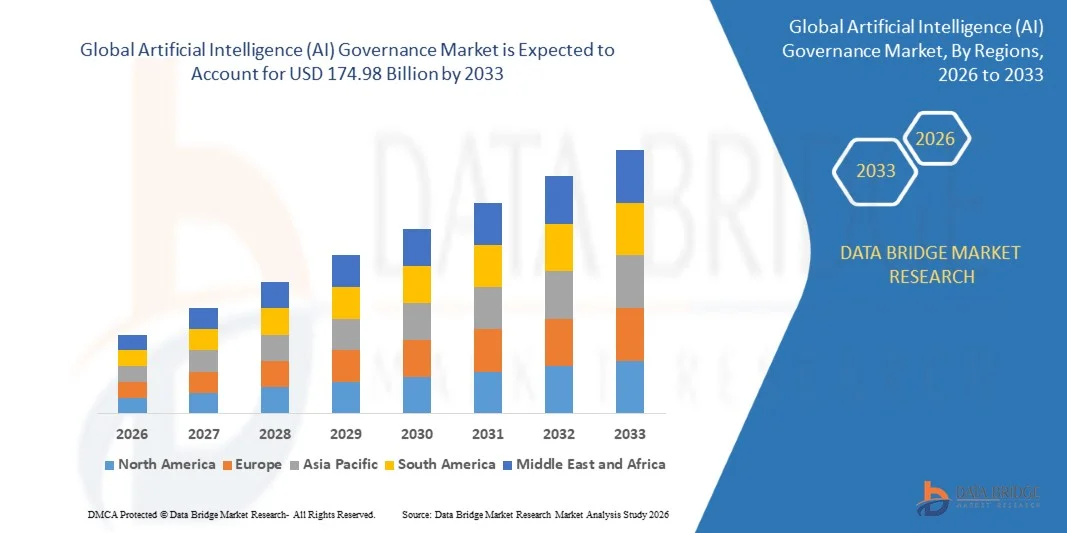
- As per Data Bridge Market Research Analysis the global artificial intelligence (AI) governance market size was valued at USD 3.82 billion in 2025 and is expected to reach USD 174.98 billion by 2033, at a CAGR of 61.30% during the forecast period
- The market growth is largely fuelled by the rapid expansion of enterprise AI adoption, increasing regulatory scrutiny surrounding ethical AI deployment, and growing demand for transparency, accountability, and compliance in AI systems
- Rising concerns regarding algorithmic bias, data privacy, cybersecurity, and responsible AI implementation are significantly accelerating investments in governance frameworks, monitoring platforms, and policy management solutions
Market Size & Forecast
- Global Market Value (2025): USD 3.82 Billion
- Expected Market Value (2033): USD 174.98 Billion
- Forecast CAGR (2026–2033): 61.30%
Artificial Intelligence (AI) Governance Market Analysis
- Artificial intelligence governance solutions are becoming essential for organizations seeking to ensure regulatory compliance, mitigate AI-related risks, and establish transparent frameworks for responsible AI development and deployment
- The market is witnessing exponential growth due to increasing enterprise reliance on AI-powered decision-making systems, evolving international regulatory standards, and rising demand for ethical governance infrastructure
- North America dominated the artificial intelligence (AI) governance market with the largest revenue share in 2025, driven by rapid enterprise AI adoption, expanding regulatory scrutiny, and strong investments in responsible AI frameworks across major industries
- Asia-Pacific region is expected to witness the highest growth rate in the global artificial intelligence (AI) governance market, driven by
- The Solutions segment held the largest market revenue share in 2025 driven by increasing enterprise demand for comprehensive governance platforms that provide model monitoring, compliance management, risk assessment, bias detection, and policy enforcement capabilities. These solutions are widely adopted for their ability to ensure responsible AI deployment, strengthen regulatory compliance, and support scalable governance across complex enterprise AI ecosystems
Report Scope and Artificial Intelligence (AI) Governance Market Segmentation
|
Attributes |
Artificial Intelligence (AI) Governance Key Market Insights |
|
Segments Covered |
|
|
Countries Covered |
North America
Europe
Asia-Pacific
Middle East and Africa
South America
|
|
Key Market Players |
|
|
Market Opportunities |
|
|
Value Added Data Infosets |
In addition to the market insights such as market value, growth rate, market segments, geographical coverage, market players, and market scenario, the market report curated by the Data Bridge Market Research team includes in-depth expert analysis, import/export analysis, pricing analysis, production consumption analysis, and pestle analysis. |
What is the Key Trend in the Artificial Intelligence (AI) Governance Market?
“Rising Demand for Ethical AI, Regulatory Compliance, and Responsible Deployment”
• The growing enterprise reliance on artificial intelligence for critical decision-making is significantly shaping the artificial intelligence (AI) governance market, as organizations increasingly prioritize frameworks that ensure transparency, accountability, fairness, and regulatory compliance. AI governance solutions are gaining substantial traction due to their ability to monitor model behavior, mitigate algorithmic bias, strengthen data privacy, and ensure ethical deployment without compromising operational efficiency. This trend is accelerating adoption across healthcare, finance, government, retail, and technology sectors, encouraging vendors to innovate with comprehensive governance platforms tailored to evolving compliance demands
• Increasing awareness surrounding responsible AI implementation, global regulatory scrutiny, and the need for explainable AI systems has accelerated demand for governance solutions across enterprises. Businesses and public institutions are actively seeking platforms that provide risk management, policy enforcement, model auditing, and lifecycle governance to strengthen trust in AI systems. This has also fostered collaborations between software providers, policymakers, and regulatory organizations to improve governance standards and support sustainable AI innovation
• Ethical AI, transparency mandates, and compliance regulations are strongly influencing enterprise purchasing decisions, with organizations emphasizing secure AI oversight, automated governance, and policy standardization. These factors are helping governance solution providers differentiate offerings in a rapidly evolving market while building long-term enterprise trust. Companies are increasingly leveraging strategic acquisitions, partnerships, and regulatory alignment to reinforce competitive positioning and strengthen governance capabilities
• For instance, in 2024, Microsoft and IBM expanded their AI governance platforms to enhance responsible AI deployment, regulatory compliance, and model risk management capabilities. These developments were introduced in response to rising enterprise demand for secure, explainable, and compliant AI systems, with deployment across regulated industries including healthcare, BFSI, and public sector operations. The solutions were also positioned as strategic tools for strengthening trust, governance maturity, and long-term digital resilience
• While demand for AI governance is accelerating rapidly, sustained market expansion depends on continuous innovation, harmonized regulatory standards, and scalable governance frameworks that can adapt to rapidly evolving AI technologies. Providers are also focusing on improving intero
Artificial Intelligence (AI) Governance Market Dynamics
Driver
“Growing Regulatory Pressure and Demand for Responsible AI Oversight”
• Rising concerns over algorithmic bias, data privacy, compliance risk, and ethical AI deployment are major drivers for the artificial intelligence governance market. Organizations are increasingly implementing governance platforms to monitor AI systems, enforce compliance policies, and strengthen oversight of AI-driven decision-making processes. This trend is also accelerating research into explainable AI, automated compliance monitoring, and governance-by-design strategies, supporting broader product diversification
• Expanding applications of AI across financial services, healthcare, defense, human resources, and customer analytics are significantly influencing market growth. AI governance solutions help organizations ensure fairness, reduce legal and reputational risks, and maintain accountability while enabling responsible innovation. The increasing deployment of generative AI and autonomous systems globally further reinforces this trend
• Technology companies, regulatory bodies, and enterprise software providers are actively promoting governance solutions through product innovation, partnerships, and compliance-focused platform expansion. These efforts are supported by growing global policy initiatives surrounding AI safety, transparency, and consumer rights, while also encouraging stronger collaboration between governments and private-sector stakeholders to establish governance best practices
• For instance, in 2023, Google and Accenture expanded responsible AI governance services to support enterprise compliance, model oversight, and ethical AI implementation. This expansion followed increasing regulatory and corporate demand for AI accountability, strengthening enterprise adoption and strategic governance investments. Both companies also emphasized transparency, security, and scalable governance frameworks to reinforce market leadership
• Although regulatory pressure strongly supports growth, broader implementation depends on standardization, governance maturity, and integration simplicity across diverse enterprise environments. Continued investment in policy automation, risk intelligence, and cross-border compliance frameworks will be essential for sustaining long-term market growth
Restraint/Challenge
“Regulatory Fragmentation and Complexity of AI Governance Implementation”
• The relatively high complexity of implementing comprehensive AI governance systems remains a significant challenge, particularly for organizations with limited regulatory expertise or fragmented AI infrastructures. Integrating governance tools across multiple AI models, data environments, and operational systems can increase deployment costs and operational burdens. In addition, rapidly evolving regulatory frameworks across jurisdictions create compliance uncertainty and implementation challenges
• Enterprise awareness and governance readiness remain uneven, particularly among small and medium-sized businesses and organizations in developing markets. Limited understanding of governance best practices, policy management, and responsible AI standards can restrict adoption. This also slows deployment in sectors where AI governance maturity is still emerging
• Data security, legal liability, and policy harmonization challenges also impact market growth, as organizations must navigate diverse regulatory environments while maintaining operational efficiency and innovation speed. Governance solution providers must invest heavily in policy intelligence, compliance adaptability, and enterprise education to strengthen market penetration
• For instance, in 2024, enterprises across Southeast Asia and Latin America reported slower adoption of advanced AI governance frameworks due to fragmented regulations, high implementation costs, and limited internal governance expertise. Cross-border compliance uncertainty and integration complexities were additional barriers. These factors also delayed governance investments for some organizations, affecting broader market expansion in emerging economies
• Overcoming these challenges will require harmonized global standards, scalable governance architectures, and stronger enterprise education initiatives. Collaboration between governments, regulatory agencies, and technology providers can help unlock the long-term growth potential of the global artificial intelligence governance market. Furthermore, improving affordability, policy clarity, and governance interoperability will be essential for widespread adoption
Artificial Intelligence (AI) Governance Market Scope
The market is segmented on the basis of component, technology, function, deployment type, and vertical.
• By Component
On the basis of component, the artificial intelligence (AI) governance market is segmented into Solutions and Services. The Solutions segment held the largest market revenue share in 2025 driven by increasing enterprise demand for comprehensive governance platforms that provide model monitoring, compliance management, risk assessment, bias detection, and policy enforcement capabilities. These solutions are widely adopted for their ability to ensure responsible AI deployment, strengthen regulatory compliance, and support scalable governance across complex enterprise AI ecosystems.
The Services segment is expected to witness the fastest growth rate from 2026 to 2033, driven by rising demand for governance consulting, compliance advisory, implementation support, and managed governance services. As organizations increasingly deploy AI technologies, the need for customized governance strategies, regulatory guidance, and operational support is expanding significantly, making professional services critical for effective governance integration.
• By Technology
On the basis of technology, the artificial intelligence (AI) governance market is segmented into Computer Vision, Machine Learning, Natural Language Processing, and Others. The Machine Learning segment dominated the market in 2025 due to its widespread enterprise adoption across predictive analytics, automation, fraud detection, and decision intelligence applications. Machine learning governance is essential for ensuring transparency, fairness, and compliance across dynamic AI models, making it a primary focus for governance investments.
The Natural Language Processing segment is expected to witness the fastest growth over the forecast period, driven by the rapid adoption of generative AI, conversational AI, large language models, and automated content systems. Governance solutions for NLP applications are increasingly prioritized to address concerns surrounding misinformation, ethical content generation, privacy, and regulatory oversight.
• By Function
On the basis of function, the artificial intelligence (AI) governance market is segmented into Training and Inference. The Training segment accounted for the largest market share in 2025 due to its critical role in ensuring data integrity, model fairness, transparency, and bias mitigation during AI development stages. Governance during training is essential for building compliant, ethical, and high-performing AI systems.
The Inference segment is projected to witness the fastest growth from 2026 to 2033, driven by increasing enterprise demand for real-time AI oversight, deployment monitoring, and continuous compliance management. As AI systems become more operationally embedded, governance at inference stages is becoming essential for maintaining transparency, reducing risks, and ensuring ongoing regulatory alignment.
• By Deployment Type
On the basis of deployment type, the artificial intelligence (AI) governance market is segmented into On-Premises, Cloud, and Hybrid. The Cloud segment held the largest market revenue share in 2025 due to its scalability, remote accessibility, lower infrastructure costs, and strong support for enterprise-wide governance integration. Cloud-based governance platforms are increasingly preferred for their flexibility, rapid deployment, and ability to support evolving AI ecosystems.
The Hybrid segment is expected to witness the fastest growth over the forecast period, driven by organizations seeking to balance regulatory compliance, operational flexibility, and data security requirements. Hybrid deployment models are becoming increasingly attractive for enterprises operating across highly regulated industries with complex governance needs.
• By Vertical
On the basis of vertical, the artificial intelligence (AI) governance market is segmented into BFSI, Healthcare and Life Sciences, Government and Defence, Media and Entertainment, Telecom, Retail, Automotive, and Others. The BFSI segment dominated the market in 2025 driven by stringent compliance requirements, high-risk AI applications, and growing reliance on AI for fraud detection, customer analytics, and financial decision-making. Financial institutions prioritize AI governance to strengthen trust, transparency, and regulatory adherence.
The Healthcare and Life Sciences segment is expected to witness the fastest growth rate from 2026 to 2033, driven by increasing deployment of AI in diagnostics, patient management, drug discovery, and personalized medicine. Governance adoption in healthcare is accelerating as organizations seek to ensure ethical decision-making, patient data privacy, regulatory compliance, and trustworthy AI implementation.
Artificial Intelligence (AI) Governance Market Regional Analysis
• North America dominated the artificial intelligence (AI) governance market with the largest revenue share in 2025, driven by rapid enterprise AI adoption, expanding regulatory scrutiny, and strong investments in responsible AI frameworks across major industries
• Organizations in the region highly value AI governance solutions for their ability to ensure transparency, ethical compliance, model accountability, and effective risk management while supporting large-scale AI deployment across business operations
• This widespread adoption is further supported by advanced digital infrastructure, strong regulatory development, a highly mature enterprise technology ecosystem, and growing concerns regarding AI bias, cybersecurity, and legal compliance, establishing AI governance as a critical strategic priority across both private and public sectors
U.S. Artificial Intelligence (AI) Governance Market Insight
The U.S. artificial intelligence (AI) governance market captured the largest revenue share in 2025 within North America, fueled by the rapid deployment of enterprise AI systems, strong regulatory initiatives, and growing corporate emphasis on ethical AI implementation. Businesses are increasingly prioritizing governance frameworks to ensure compliance, mitigate operational risks, and strengthen trust in AI-powered decision-making. The widespread adoption of generative AI, machine learning platforms, and autonomous systems, combined with strong investments from major technology providers, significantly contributes to market expansion.
Europe Artificial Intelligence (AI) Governance Market Insight
The Europe artificial intelligence (AI) governance market is expected to witness the fastest growth rate from 2026 to 2033, primarily driven by stringent regulatory frameworks such as the EU AI Act, growing demand for responsible AI oversight, and rising enterprise adoption of explainable AI systems. European organizations are increasingly focused on regulatory compliance, ethical governance, and privacy-centric AI deployment. The region is experiencing substantial growth across finance, healthcare, government, and industrial sectors, where governance solutions are becoming essential for legal compliance and operational transparency.
U.K. Artificial Intelligence (AI) Governance Market Insight
The U.K. artificial intelligence (AI) governance market is expected to witness the fastest growth rate from 2026 to 2033, driven by increasing regulatory focus, strong enterprise AI investments, and rising adoption of responsible innovation frameworks. Businesses are prioritizing governance solutions to address data privacy, transparency, and AI risk management concerns. The U.K.’s advanced digital economy, combined with growing public and private sector AI adoption, continues to stimulate significant market growth.
Germany Artificial Intelligence (AI) Governance Market Insight
The Germany artificial intelligence (AI) governance market is expected to witness the fastest growth rate from 2026 to 2033, fueled by strong industrial digitalization, increasing enterprise AI deployment, and rising emphasis on ethical technology governance. Germany’s advanced manufacturing, automotive, and enterprise software sectors are actively integrating governance platforms to ensure compliance and operational integrity. The country’s focus on data security, regulatory discipline, and technological innovation is significantly accelerating market expansion.
Asia-Pacific Artificial Intelligence (AI) Governance Market Insight
The Asia-Pacific artificial intelligence (AI) governance market is expected to witness the fastest growth rate from 2026 to 2033, driven by rapid AI adoption, digital transformation initiatives, and expanding regulatory development across countries such as China, Japan, India, South Korea, and Singapore. Governments and enterprises in the region are increasingly investing in governance solutions to manage AI risks, support innovation, and strengthen policy oversight. Growing cloud adoption, rising enterprise digitization, and increasing AI integration across multiple sectors are significantly boosting regional demand.
Japan Artificial Intelligence (AI) Governance Market Insight
The Japan artificial intelligence (AI) governance market is expected to witness the fastest growth rate from 2026 to 2033 due to the country’s advanced technological infrastructure, increasing AI innovation, and strong focus on responsible digital transformation. Japanese enterprises are increasingly adopting governance frameworks to manage regulatory compliance, ethical AI implementation, and operational trust across sectors such as robotics, healthcare, and manufacturing. Integration of AI governance into national innovation strategies is further supporting market development.
China Artificial Intelligence (AI) Governance Market Insight
The China artificial intelligence (AI) governance market accounted for the largest market revenue share in Asia-Pacific in 2025, attributed to large-scale AI deployment, aggressive digital transformation strategies, and expanding government oversight of AI technologies. China remains one of the world’s largest AI markets, driving substantial demand for governance platforms that support compliance, algorithm monitoring, and responsible deployment. Strong domestic technology innovation, national AI strategies, and increasing regulatory controls are key factors propelling market growth.
Which are the Top Companies in Artificial Intelligence (AI) Governance Market?
The Artificial Intelligence (AI) Governance industry is primarily led by well-established companies, including:
- IBM Corporation (U.S.)
- Microsoft (U.S.)
- Siemens AG (Germany)
- ANSYS, Inc. (U.S.)
- SAP SE (Germany)
- Oracle (U.S.)
- Robert Bosch GmbH (Germany)
- Swim.ai, Inc. (U.S.)
- Atos SE (France)
- ABB (Switzerland)
- Kellton Tech (India)
- AVEVA Group plc (U.K.)
- DXC Technology Company (U.S.)
- Altair Engineering, Inc. (U.S.)
- Hexaware Technologies Limited (India)
- Tata Consultancy Services Limited (India)
- Infosys Limited (India)
- NTT DATA, Inc. (Japan)
- TIBCO Software Inc. (U.S.)
Latest Developments in Global Artificial Intelligence (AI) Governance Market
• In January 2026, IBM Corporation launched IBM Sovereign Core, an AI-ready governance and security platform designed to help enterprises, governments, and service providers create secure, regionally controlled AI environments with enhanced compliance and oversight capabilities. Built on Red Hat’s open-source infrastructure, the solution offers local key management, compliance monitoring, and AI governance controls to strengthen data sovereignty and regulatory alignment. This development significantly enhances secure AI deployment for highly regulated sectors. Such innovation is expected to accelerate enterprise governance adoption and strengthen the global AI governance market
• In May 2025, Credo AI introduced a strategic integration with Microsoft Azure AI Foundry to streamline real-time collaboration between developers and governance teams for AI risk assessment, policy implementation, and compliance validation. The platform enables organizations to operationalize governance policies into technical controls while improving oversight of bias, hallucination risks, and model quality. This advancement strengthens governance automation and enterprise AI trust. The integration is anticipated to drive broader responsible AI adoption and expand governance market maturity
• In February 2024, Infosys Limited launched its Responsible AI Suite under the Infosys Topaz platform to address key ethical and operational challenges associated with generative AI deployment. The solution utilizes a Scan, Shield, and Steer framework to identify governance risks, implement security protections, and strengthen policy oversight for enterprise AI systems. This development supports organizations in deploying AI securely while reducing bias and compliance risks. Such innovation is expected to reinforce enterprise governance infrastructure and accelerate responsible AI market expansion

- Interactive Data Analysis Dashboard
- Company Analysis Dashboard for high growth potential opportunities
- Research Analyst Access for customization & queries
- Competitor Analysis with Interactive dashboard
- Latest News, Updates & Trend analysis
- Harness the Power of Benchmark Analysis for Comprehensive Competitor Tracking
Data collection and base year analysis are done using data collection modules with large sample sizes. The stage includes obtaining market information or related data through various sources and strategies. It includes examining and planning all the data acquired from the past in advance. It likewise envelops the examination of information inconsistencies seen across different information sources. The market data is analysed and estimated using market statistical and coherent models. Also, market share analysis and key trend analysis are the major success factors in the market report. To know more, please request an analyst call or drop down your inquiry.
The key research methodology used by DBMR research team is data triangulation which involves data mining, analysis of the impact of data variables on the market and primary (industry expert) validation. Data models include Vendor Positioning Grid, Market Time Line Analysis, Market Overview and Guide, Company Positioning Grid, Patent Analysis, Pricing Analysis, Company Market Share Analysis, Standards of Measurement, Global versus Regional and Vendor Share Analysis. To know more about the research methodology, drop in an inquiry to speak to our industry experts.
Data Bridge Market Research is a leader in advanced formative research. We take pride in servicing our existing and new customers with data and analysis that match and suits their goal. The report can be customized to include price trend analysis of target brands understanding the market for additional countries (ask for the list of countries), clinical trial results data, literature review, refurbished market and product base analysis. Market analysis of target competitors can be analyzed from technology-based analysis to market portfolio strategies. We can add as many competitors that you require data about in the format and data style you are looking for. Our team of analysts can also provide you data in crude raw excel files pivot tables (Fact book) or can assist you in creating presentations from the data sets available in the report.













