AI in Beauty & Cosmetics Market Size
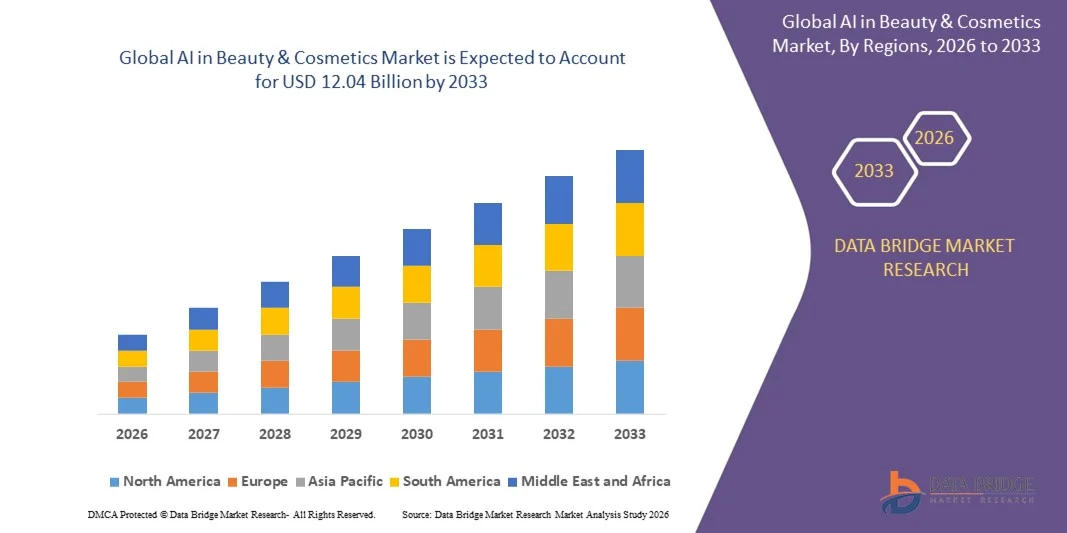
- The global AI in beauty & cosmetics market size was valued at USD 3.6 billion in 2025 and is expected to reach USD 12.04 billion by 2033, at a CAGR of 16.30% during the forecast period
- The market growth is largely fueled by the increasing adoption of artificial intelligence technologies in beauty and personal care, enabling personalized product recommendations, virtual try-ons, and predictive skincare solutions. Rapid digitalization across e-commerce platforms and mobile applications is supporting the integration of AI tools, making personalized and data-driven beauty experiences accessible to a wider consumer base
- Furthermore, rising consumer demand for customized, convenient, and technology-enhanced beauty solutions is driving brands to invest in AI-powered devices, formulation tools, and virtual consultation platforms. These converging factors are accelerating the uptake of AI solutions in the beauty industry, thereby significantly boosting market expansion
AI in Beauty & Cosmetics Market Analysis
- AI-powered tools, including personalized recommendation platforms, smart beauty devices, and predictive formulation software, are increasingly essential in modern beauty and personal care for enhancing customer engagement, optimizing product development, and delivering tailored experiences. These solutions allow brands to analyze consumer preferences, track product efficacy, and offer individualized routines across skincare, make-up, and haircare categories
- The escalating demand for AI in beauty is primarily driven by the widespread adoption of digital beauty platforms, growing consumer expectations for personalized products, and the rising trend of at-home beauty technology. In addition, brands leveraging AI can reduce development cycles, improve sustainability, and gain a competitive advantage by delivering more precise and satisfying consumer experiences
- North America dominated AI in beauty & cosmetics market with a share of 41.04% in 2025, due to the rapid adoption of AI-powered personalization tools, virtual try-ons, and smart skincare solutions
- Asia-Pacific is expected to be the fastest growing region in the AI in beauty & cosmetics market during the forecast period due to rising urbanization, increasing disposable incomes, and rapid technological adoption in countries such as China, Japan, and South Korea
- Personalized recommendation tools segment dominated the market with a market share of 39% in 2025, due to the increasing consumer demand for tailored skincare and makeup solutions. These tools leverage AI algorithms to analyze individual preferences, skin types, and past purchase behavior, allowing brands to offer highly customized product suggestions. The adoption of personalized recommendation systems enhances customer engagement and loyalty while enabling brands to optimize their inventory and marketing strategies
Report Scope and AI in Beauty & Cosmetics Market Segmentation
|
Attributes |
AI in Beauty & Cosmetics Key Market Insights |
|
Segments Covered |
|
|
Countries Covered |
North America
Europe
Asia-Pacific
Middle East and Africa
South America
|
|
Key Market Players |
|
|
Market Opportunities |
|
|
Value Added Data Infosets |
In addition to the insights on market scenarios such as market value, growth rate, segmentation, geographical coverage, and major players, the market reports curated by the Data Bridge Market Research also include in-depth expert analysis, pricing analysis, brand share analysis, consumer survey, demography analysis, supply chain analysis, value chain analysis, raw material/consumables overview, vendor selection criteria, PESTLE Analysis, Porter Analysis, and regulatory framework. |
AI in Beauty & Cosmetics Market Trends
Increasing Adoption of AI-Powered Personalized Beauty Solutions
- A key trend in the AI in beauty & cosmetics market is the rising adoption of AI-driven personalized beauty solutions, driven by growing consumer interest in customized skincare and makeup recommendations. AI technologies are enabling brands to analyze individual skin types, preferences, and environmental factors, resulting in highly tailored product suggestions and routines
- For instance, L’Oréal’s AI-powered skincare app, SkinConsult AI, uses deep learning algorithms to evaluate skin conditions and provide personalized product recommendations. This solution enhances consumer engagement and positions AI as a core enabler of data-driven beauty experiences
- The market is witnessing rapid innovation in virtual try-on technologies where AI-enabled tools allow users to visualize cosmetics and hair color in real time. This capability is improving the online shopping experience and reducing product trial uncertainties
- Retailers are increasingly integrating AI chatbots and virtual assistants to offer personalized advice, product suggestions, and routine tracking. These tools are strengthening customer relationships and supporting omnichannel engagement strategies
- Beauty companies are leveraging AI analytics to optimize formulations, predict trends, and improve inventory management. This integration is enhancing operational efficiency and aligning product offerings with evolving consumer demands
- AI solutions are supporting inclusivity in beauty by analyzing diverse skin tones and conditions, ensuring personalized recommendations are accessible to a wider audience. This trend is reinforcing AI’s role in driving both personalization and market differentiation
AI in Beauty & Cosmetics Market Dynamics
Driver
Rising Consumer Demand for Customized and Data-Driven Beauty Experiences
- Consumer preference for personalized beauty routines and data-driven insights is a major driver of AI adoption in the market. Advanced AI algorithms can assess skin type, aging patterns, and environmental effects to deliver customized product recommendations and usage plans
- For instance, Shiseido uses AI-powered imaging and predictive analytics to provide personalized skincare consultations and product solutions. This strategy enhances customer satisfaction and positions AI as a critical tool for innovation in beauty services
- The increasing reliance on mobile apps and smart devices for beauty tracking is further accelerating AI adoption. Consumers are embracing digital platforms that offer precise analysis, personalized suggestions, and routine monitoring
- AI-powered tools also enable brands to create predictive models for skincare and cosmetic trends, improving responsiveness to shifting consumer demands. These insights support targeted marketing and product development strategies
- The demand for personalized virtual experiences, such as AR makeup try-ons and skin diagnostics, is expanding across e-commerce and in-store platforms. This growth strengthens AI’s integration as a central component of consumer engagement in beauty
Restraint/Challenge
High Implementation Costs and Technical Complexity of AI Solutions
- The AI in beauty & cosmetics market faces challenges due to the significant costs and technical complexity of deploying advanced AI solutions. Developing algorithms, maintaining large datasets, and integrating AI into consumer-facing applications require substantial investment and expertise
- For instance, Proven Skincare invests heavily in machine learning infrastructure and continuous data collection to deliver personalized skincare solutions. The high operational costs limit smaller players from adopting similar AI innovations
- The need for robust data security and privacy measures increases implementation challenges, particularly in handling sensitive skin and health information. Ensuring compliance with regulations adds further complexity to AI deployment
- Integration of AI into legacy systems and physical retail operations can be technically demanding, requiring cross-functional expertise in IT, data science, and beauty product knowledge. This complexity slows adoption and scalability
- Maintenance, model updates, and algorithm optimization require ongoing investment, making it challenging to sustain long-term AI initiatives. These factors collectively act as barriers to wider market penetration and innovation in AI-driven beauty solutions
AI in Beauty & Cosmetics Market Scope
The market is segmented on the basis of type, distribution channel, and end-user.
- By Type
On the basis of type, the AI in Beauty & Cosmetics market is segmented into Personalized Recommendation Tools, Performance Marketing Measurement Platforms, Demand Forecasting and Supply Chain Tools, Real-Time Customer Service Platforms, and AI-Based Beauty Devices. The Personalized Recommendation Tools segment dominated the market with the largest revenue share of 39% in 2025, driven by the increasing consumer demand for tailored skincare and makeup solutions. These tools leverage AI algorithms to analyze individual preferences, skin types, and past purchase behavior, allowing brands to offer highly customized product suggestions. The adoption of personalized recommendation systems enhances customer engagement and loyalty while enabling brands to optimize their inventory and marketing strategies. The segment’s strong growth is also supported by integration with e-commerce platforms and mobile apps, making AI-driven personalization accessible to a wide consumer base.
The AI-Based Beauty Devices segment is anticipated to witness the fastest growth rate from 2026 to 2033, fueled by innovations in smart skincare devices, facial analyzers, and at-home beauty gadgets. These devices offer real-time monitoring and personalized beauty treatments, appealing to tech-savvy consumers who prefer automated and data-driven solutions. For instance, companies such as L’Oréal have introduced AI-powered skincare devices that recommend personalized routines based on skin analysis, driving adoption across premium and mid-range consumer segments. The combination of convenience, precision, and the rising trend of at-home beauty technology contributes to the rapid expansion of this segment.
- By Distribution Channel
On the basis of distribution channel, the AI in Beauty & Cosmetics market is segmented into Specialist Retail Stores, Supermarkets and Hypermarkets, Convenience Stores, Pharmacies, Drug Stores, Online Retail, and Others. The Online Retail segment held the largest market revenue share in 2025, driven by the convenience of AI-enabled virtual try-ons, personalized product recommendations, and doorstep delivery. Consumers increasingly rely on online platforms to access AI tools for beauty consultations and product suggestions, making online channels a preferred medium for both premium and mass-market products. Integration of AI technologies in online retail enhances shopping experiences, improves customer retention, and allows brands to collect valuable behavioral data for targeted marketing strategies.
The Specialist Retail Stores segment is expected to witness the fastest CAGR from 2026 to 2033, fueled by in-store AI applications such as smart mirrors, augmented reality try-on stations, and AI-driven customer assistance. These tools provide personalized experiences and professional guidance to shoppers, encouraging higher conversion rates and repeat purchases. For instance, Sephora has implemented AI-powered beauty advisors in its stores, enabling customers to receive customized product recommendations and tutorials, significantly enhancing in-store engagement. The combination of immersive experiences and expert guidance positions specialist retail stores for rapid adoption of AI technologies.
- By End-User
On the basis of end-user, the AI in Beauty & Cosmetics market is segmented into Skincare, Haircare, Make-up, Fragrances, and Others. The Skincare segment dominated the market with the largest revenue share in 2025, driven by widespread consumer adoption of AI-powered tools for skin analysis, personalized routines, and at-home treatments. AI applications help brands and consumers identify skin concerns, track progress, and recommend targeted solutions, thereby increasing product efficacy and satisfaction. Growing awareness of preventive skincare and technological innovations in AI-driven diagnostics further strengthen the segment’s market position.
The Make-up segment is anticipated to witness the fastest growth rate from 2026 to 2033, fueled by AI applications such as virtual try-ons, color-matching tools, and personalized product recommendations. These technologies enable consumers to experiment with products digitally before purchase, enhancing convenience and reducing trial-and-error. For instance, companies such as Estée Lauder have introduced AI-driven virtual try-on apps that allow users to visualize make-up products on their own faces, driving engagement and boosting sales across digital and physical platforms. Rising interest in digital beauty solutions and social media influence contribute to the rapid expansion of this segment.
AI in Beauty & Cosmetics Market Regional Analysis
- North America dominated the AI in beauty & cosmetics market with the largest revenue share of 41.04% in 2025, driven by the rapid adoption of AI-powered personalization tools, virtual try-ons, and smart skincare solutions
- Consumers in the region highly value personalized beauty experiences, seamless online consultations, and AI-enabled product recommendations that enhance convenience and satisfaction
- This widespread adoption is further supported by high disposable incomes, a tech-savvy population, and the growing trend of digital beauty platforms, establishing AI solutions as a preferred approach for both premium and mass-market beauty products
U.S. AI in Beauty & Cosmetics Market Insight
The U.S. market captured the largest revenue share in North America in 2025, fueled by increasing consumer demand for AI-driven personalization and predictive beauty analytics. Brands are leveraging AI to offer tailored skincare and make-up solutions, while mobile apps and e-commerce platforms enable real-time consultations and virtual try-ons. The growing preference for data-driven beauty routines, coupled with rising adoption of smart beauty devices, further accelerates market growth. Moreover, integration of AI technologies with online retail, subscription services, and social commerce is significantly contributing to expansion.
Europe AI in Beauty & Cosmetics Market Insight
The Europe market is projected to expand at a substantial CAGR throughout the forecast period, primarily driven by rising consumer interest in personalized beauty solutions and data-driven product recommendations. Stringent regulations on product safety and quality, along with increasing urbanization, are encouraging brands to adopt AI tools for predictive analytics and efficient inventory management. European consumers are also attracted to the convenience, sustainability, and innovation offered by AI solutions. The region is witnessing notable growth across retail, e-commerce, and specialty stores, with AI-driven tools integrated into both in-store and online experiences.
U.K. AI in Beauty & Cosmetics Market Insight
The U.K. market is anticipated to grow at a noteworthy CAGR during the forecast period, driven by increasing adoption of AI-powered skincare and make-up applications and rising awareness of personalized beauty experiences. Concerns regarding product efficacy, sustainability, and the desire for optimized beauty routines are prompting consumers to embrace AI solutions. The U.K.’s robust e-commerce infrastructure, coupled with widespread smartphone penetration, is further supporting market expansion. Integration with mobile apps, AR-based try-on solutions, and AI-driven customer service platforms is expected to continue stimulating growth.
Germany AI in Beauty & Cosmetics Market Insight
The Germany market is expected to expand at a considerable CAGR during the forecast period, fueled by increasing awareness of AI applications in beauty analytics and personalized product offerings. German consumers show a strong preference for technologically advanced, eco-conscious beauty solutions, which is promoting the adoption of AI tools across retail and e-commerce channels. The integration of AI with smart beauty devices and predictive recommendation systems is gaining traction, particularly among urban populations focused on efficiency and innovation. Growth is also supported by well-established retail networks and the rising trend of digital beauty consultations.
Asia-Pacific AI in Beauty & Cosmetics Market Insight
The Asia-Pacific market is poised to grow at the fastest CAGR during 2026 to 2033, driven by rising urbanization, increasing disposable incomes, and rapid technological adoption in countries such as China, Japan, and South Korea. Consumers in the region are increasingly inclined toward AI-powered skincare, virtual try-ons, and smart beauty devices, supported by government initiatives and tech-focused urban lifestyles. The affordability and accessibility of AI beauty solutions, coupled with strong domestic brands and e-commerce penetration, are expanding the consumer base.
Japan AI in Beauty & Cosmetics Market Insight
The Japan market is gaining momentum due to the country’s advanced technological ecosystem, urbanized population, and strong demand for personalized beauty experiences. AI-driven skincare analyzers, virtual make-up try-ons, and at-home smart beauty devices are being widely adopted. The integration of AI solutions with connected devices and mobile apps is enhancing user convenience, while Japan’s aging population is fueling demand for easier-to-use, personalized beauty technologies across residential and professional settings.
China AI in Beauty & Cosmetics Market Insight
The China market accounted for the largest revenue share in Asia-Pacific in 2025, attributed to high smartphone penetration, rising middle-class income, and growing awareness of AI-enabled beauty solutions. The popularity of e-commerce and social commerce platforms allows consumers to access AI-powered skincare consultations, virtual try-ons, and predictive recommendations. Government-backed digital initiatives, coupled with the presence of leading domestic AI beauty tech companies, are driving widespread adoption across retail, online, and specialty store channels.
AI in Beauty & Cosmetics Market Share
The AI in beauty & cosmetics industry is primarily led by well-established companies, including:
- Revieve (Finland)
- Procter & Gamble Company (U.S.)
- Perfect Corp. (Taiwan)
- Shiseido Co. Ltd. (Japan)
- YOUS Skincare (U.S.)
- Banuba Inc. (U.S.)
- Function of Beauty (U.S.)
- Beiersdorf AG (Germany)
- Ciaté London (U.K.)
- Perso Limited (U.S.)
- Lottie London (U.K.)
- Sephora Inc. (U.S.)
- Atolla (U.S.)
- Luna Fofo (U.K.)
- Proven Skincare (U.S.)
- L’Oréal S.A. (France)
- mySKIN (U.S.)
- Opte Wand (U.S.)
- GAN-powered solution (Global)
- Novi (U.S.)
- Skinsei (U.S.)
- Elizabeth Arden Inc. (U.S.)
- Pure & Mine (U.S.)
- Anokai (U.S.)
- My Beauty Matches (U.S.)
- Care/of (U.S.)
- EpigenCare Inc. (U.S.)
Latest Developments in Global AI in Beauty & Cosmetics Market
- In January 2026, L’Oréal announced a major investment to establish its first AI‑driven global beauty tech innovation hub in Hyderabad, India, committing approximately $383 million to advance artificial intelligence solutions across beauty research and development. This initiative is expected to accelerate the creation of next‑generation AI‑powered products and services, strengthen L’Oréal’s global innovation network, and provide faster insights into consumer preferences and product performance. By centralizing AI research, the hub will enable more efficient development of personalized skincare, make-up, and haircare solutions, reduce formulation timelines, and enhance market responsiveness. The investment also positions India as a strategic center for AI-driven beauty technology, increasing competition and inspiring other global brands to expand their AI capabilities in the region
- In April 2025, Nouryon launched its new AI-driven tool, BeautyCreations, at in-cosmetics Global in Amsterdam, Netherlands, aimed at empowering beauty formulators with predictive and creative capabilities. This platform allows brands to optimize ingredient combinations, forecast product performance, and develop innovative formulations more efficiently. BeautyCreations™ accelerates the product development cycle while reducing costs associated with trial-and-error experimentation. By harnessing AI insights, companies can meet evolving consumer expectations for personalized and high-performance beauty products, enhance time-to-market for new launches, and gain a stronger foothold in a competitive market where innovation is critical
- In January 2025, IBM and L’Oréal announced a collaboration to leverage IBM’s generative artificial intelligence (GenAI) technology to uncover new insights in cosmetic formulation data and facilitate the use of sustainable raw materials. This partnership is expected to enhance the efficiency of L’Oréal’s R&D processes by providing predictive analysis of ingredients and formulation outcomes. The AI foundation model being developed will help L’Oréal create high-performance products while reducing energy and material waste, supporting sustainability goals. By integrating advanced AI into formulation science, L’Oréal can deliver personalized, high-quality products across every cosmetic category, streamline innovation cycles, and improve consumer satisfaction globally, giving it a competitive advantage in both product efficacy and sustainability
- In June 2024, Unilever introduced new AI-powered tools to help consumers make personalized product choices, reflecting a growing emphasis on technology-driven consumer engagement. These tools analyze individual preferences, purchase history, and behavioural data to recommend products tailored to each user’s needs. By providing personalized experiences, Unilever is enhancing customer satisfaction, increasing brand loyalty, and driving higher conversion rates across its beauty and personal care portfolios. The AI tools also allow the company to collect valuable insights into consumer trends, enabling smarter marketing strategies and better inventory management, thereby strengthening its market positioning in the digital era
- In June 2024, The Estée Lauder Companies Inc. acquired DECIEM Beauty Group Inc. to expand its skincare portfolio and reach younger, tech-savvy consumers. DECIEM’s integration of AI allows for product personalization, streamlined development, inventory optimization, and improved customer experiences, which will strengthen Estée Lauder’s digital and technological capabilities. This acquisition supports faster innovation, enabling the company to respond quickly to emerging beauty trends while delivering highly tailored solutions. The combination of Estée Lauder’s global reach and DECIEM’s AI expertise positions the brand to enhance competitiveness, attract new demographics, and establish a leadership role in the AI-driven beauty market

- Interactive Data Analysis Dashboard
- Company Analysis Dashboard for high growth potential opportunities
- Research Analyst Access for customization & queries
- Competitor Analysis with Interactive dashboard
- Latest News, Updates & Trend analysis
- Harness the Power of Benchmark Analysis for Comprehensive Competitor Tracking
Data collection and base year analysis are done using data collection modules with large sample sizes. The stage includes obtaining market information or related data through various sources and strategies. It includes examining and planning all the data acquired from the past in advance. It likewise envelops the examination of information inconsistencies seen across different information sources. The market data is analysed and estimated using market statistical and coherent models. Also, market share analysis and key trend analysis are the major success factors in the market report. To know more, please request an analyst call or drop down your inquiry.
The key research methodology used by DBMR research team is data triangulation which involves data mining, analysis of the impact of data variables on the market and primary (industry expert) validation. Data models include Vendor Positioning Grid, Market Time Line Analysis, Market Overview and Guide, Company Positioning Grid, Patent Analysis, Pricing Analysis, Company Market Share Analysis, Standards of Measurement, Global versus Regional and Vendor Share Analysis. To know more about the research methodology, drop in an inquiry to speak to our industry experts.
Data Bridge Market Research is a leader in advanced formative research. We take pride in servicing our existing and new customers with data and analysis that match and suits their goal. The report can be customized to include price trend analysis of target brands understanding the market for additional countries (ask for the list of countries), clinical trial results data, literature review, refurbished market and product base analysis. Market analysis of target competitors can be analyzed from technology-based analysis to market portfolio strategies. We can add as many competitors that you require data about in the format and data style you are looking for. Our team of analysts can also provide you data in crude raw excel files pivot tables (Fact book) or can assist you in creating presentations from the data sets available in the report.