




Global Air Filters Market
Market Size in USD Billion
CAGR :
% 
 USD
18.63 Billion
USD
28.16 Billion
2025
2033
USD
18.63 Billion
USD
28.16 Billion
2025
2033
 Forecast Period Forecast Period |
2026 - 2033 |
 Market Size (Base Year) Market Size (Base Year) |
USD 18.63 Billion |
 Market Size (Forecast Year) Market Size (Forecast Year) |
USD 28.16 Billion |
 CAGR CAGR |
% |
| Major Markets Players |
|
Air Filters Market Overview
The Air Filters Market was valued at USD 18.63 billion in 2025 and is projected to reach USD 28.16 billion by 2033, growing at a CAGR of 5.30% from 2026 to 2033. The market is witnessing steady growth driven by increasing air pollution levels, rising awareness regarding indoor air quality, and stringent environmental regulations across industrial and commercial sectors.
The growing prevalence of respiratory diseases, combined with expanding industrialization and urbanization, is significantly boosting demand for advanced air filtration systems. In addition, increasing adoption of HVAC systems in residential, commercial, and industrial buildings, along with rising emphasis on energy efficient and high-performance filtration technologies, is further accelerating market expansion globally.
Key Market Trends & Insights
- North America dominated the air filters market with the largest revenue share of 37.6% in 2025, supported by strict environmental regulations, high awareness of indoor air quality, and strong adoption of advanced HVAC and industrial filtration systems.
- Asia-Pacific air filters market is expected to witness the fastest growth rate from 2026 to 2033, supported by rapid industrialization, urbanization, and increasing air pollution levels across countries such as China, India, and Japan.
- The Medium Efficiency segment held the largest market revenue share of approximately 32.4% in 2025 driven by widespread use in commercial HVAC systems, industrial ventilation, and residential air purification applications. Medium efficiency filters are widely preferred due to their balanced performance, cost effectiveness, and ability to capture common airborne particulates in large scale air handling systems.
- The HEPA segment is projected to register the fastest growth at a CAGR of 6.8% from 2026 to 2033, driven by rising demand for ultra clean air environments in healthcare facilities, pharmaceutical manufacturing, and semiconductor cleanrooms. Increasing awareness of airborne disease transmission and strict indoor air quality standards are further accelerating adoption across critical applications.
- The Intake-Cellulose and Synthetic segment held the largest market revenue share of approximately 54.1% in 2025 driven by extensive use in automotive engines, industrial air intake systems, and HVAC filtration units. These materials offer high durability, cost efficiency, and strong particulate retention capability.
- The Cabin-Particle and Activated Carbon segment is projected to register the fastest growth at a CAGR of 7.4% from 2026 to 2033, driven by increasing demand for advanced cabin air quality solutions in passenger vehicles and growing consumer preference for odor and gas removal filtration systems. Rising adoption of premium and electric vehicles is further supporting segment expansion.
- The HVAC segment held the largest market revenue share of approximately 48.7% in 2025 driven by widespread deployment across residential, commercial, and industrial buildings for air quality control and energy efficient ventilation systems. Growing urbanization and increasing construction of smart buildings are further strengthening demand.
- The Cleanroom segment is projected to register the fastest growth at a CAGR of 7.9% from 2026 to 2033, driven by rising semiconductor manufacturing, pharmaceutical production, and biotechnology research activities. Strict contamination control requirements and expansion of high precision manufacturing facilities are accelerating adoption of advanced filtration systems.
- The Passenger Cars segment held the largest market revenue share of approximately 56.3% in 2025 driven by increasing vehicle production, rising consumer demand for cabin air quality systems, and growing adoption of advanced HVAC filtration in modern automobiles.
- The Light Commercial Vehicles segment is projected to register the fastest growth at a CAGR of 6.6% from 2026 to 2033, driven by expanding logistics operations, e commerce growth, and increasing integration of cabin air filtration systems to improve driver comfort and safety during long distance operations.
- The Original Equipment Manufacturer segment held the largest market revenue share of approximately 63.9% in 2025 driven by increasing integration of advanced air filtration systems in new vehicles, HVAC units, and industrial equipment at the manufacturing stage. Strong partnerships between automakers and filtration providers are further supporting segment dominance.
- The Aftermarket segment is projected to register the fastest growth at a CAGR of 6.9% from 2026 to 2033, driven by rising replacement demand for air filters in aging vehicle fleets, HVAC maintenance cycles, and industrial filtration system upgrades. Increasing consumer awareness regarding air quality maintenance is further boosting aftermarket sales globally.
Market Size & Forecast
- Global Market Value (2025): USD 18.63 Billion
- Expected Market Value (2033): USD 28.16 Billion
- Forecast CAGR (2026–2033): 5.30%
- Leading Region in 2025: North America
- Fastest Growing Region: Asia-Pacific
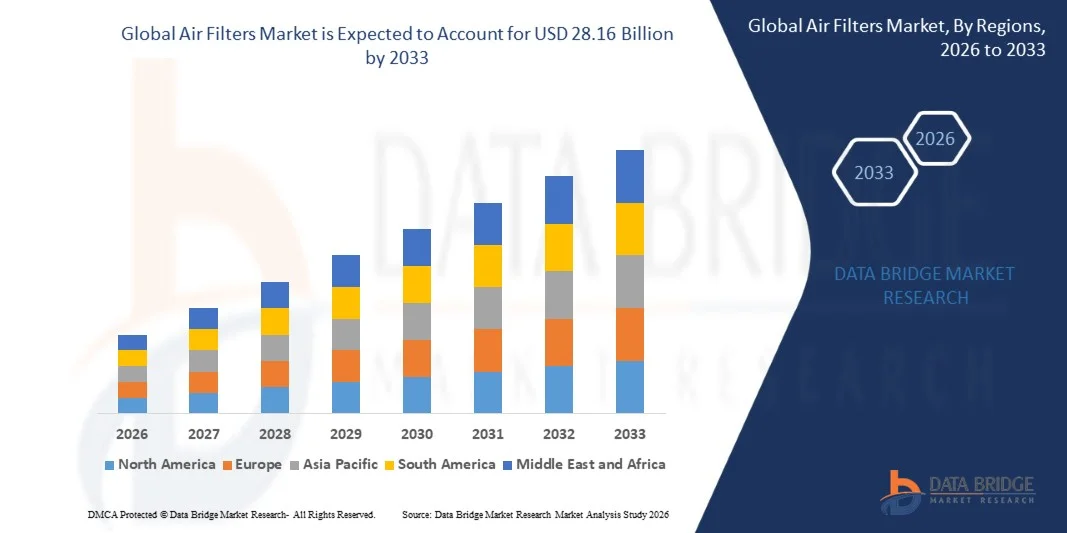
Report Scope and Air Filters Market Segmentation
|
Attributes |
Air Filters Key Market Insights |
|
Segments Covered |
· By Type: Medium Efficiency, High-Efficiency Particulate Air (HEPA), Low Efficiency, Gas Phase, and Intake and Cabin · By Filter Media: Intake-Cellulose and Synthetic, Cabin-Particle and Activated Carbon · By Application: Heating, Ventilation and Air Condition (HVAC), Bag House, Cleanroom and Gas Turbine · By Vehicle Type: Passenger Cars, Light Commercial Vehicles and Heavy Commercial Vehicles · By Market Type: Original Equipment Manufacturer and Aftermarket |
|
Countries Covered |
North America · U.S. · Canada · Mexico Europe · Germany · France · U.K. · Netherlands · Switzerland · Belgium · Russia · Italy · Spain · Turkey · Rest of Europe Asia-Pacific · China · Japan · India · South Korea · Singapore · Malaysia · Australia · Thailand · Indonesia · Philippines · Rest of Asia-Pacific Middle East and Africa · Saudi Arabia · U.A.E. · South Africa · Egypt · Israel · Rest of Middle East and Africa South America · Brazil · Argentina · Rest of South America |
|
Key Market Players |
• DENSO-Holding GmbH & Co. KG (Germany) |
|
Market Opportunities |
• Rising Adoption Of HEPA And Advanced Filtration Technologies |
|
Value Added Data Infosets |
In addition to the market insights such as market value, growth rate, market segments, geographical coverage, market players, and market scenario, the market report curated by the Data Bridge Market Research team includes in-depth expert analysis, import/export analysis, pricing analysis, production consumption analysis, and pestle analysis. |
Air Filters Market Trends
Trend: Growth In Advanced Filtration Technologies And Smart Air Quality Management Systems
Increasing demand for high efficiency air filtration systems is being driven by rising air pollution levels, stringent environmental regulations, and growing awareness of indoor air quality across residential, commercial, and industrial sectors. Conventional filtration systems often struggle to meet modern particulate and gaseous pollution standards, encouraging industries to adopt advanced HEPA, ULPA, and activated carbon based filtration solutions with improved contaminant removal efficiency and lower maintenance requirements.
In modern HVAC systems, manufacturers are increasingly integrating multi stage air filtration units, for instance in commercial office buildings and healthcare facilities, to improve indoor air quality and reduce airborne contaminants such as PM2.5, bacteria, and volatile organic compounds. In healthcare environments, high efficiency air filters are widely deployed in hospitals and laboratories to maintain sterile conditions and reduce infection risks, particularly in operating theatres and intensive care units.
In industrial applications, air filtration systems are being used in manufacturing plants, chemical processing units, and power generation facilities to control emissions and comply with environmental standards. In addition, rapid expansion of smart buildings and IoT enabled HVAC systems is enabling real time air quality monitoring and automated filter performance optimization. Growing adoption in data centers and semiconductor manufacturing facilities is further strengthening demand for ultra clean air environments, with pilot installations in 2025 across the United States and Germany demonstrating up to 30–35% improvement in airborne particle reduction efficiency through advanced multi layer filtration systems.
Air Filters Market Dynamics
Key Market Driver: Rising Air Pollution Levels And Stringent Environmental Regulations
Industries and governments worldwide are facing increasing pressure to reduce air pollution emissions and improve indoor air quality standards, driving strong demand for advanced air filtration systems. Rapid urbanization and industrial expansion are contributing to higher concentrations of particulate matter and harmful gases, creating significant health risks and increasing regulatory intervention across major economies.
Industrial sectors such as manufacturing, automotive, and energy are increasingly deploying high efficiency air filtration systems to comply with emission standards and improve workplace safety. For instance, regulatory bodies in Europe and North America have implemented strict PM2.5 and NOx emission limits, pushing industries to upgrade existing ventilation and filtration infrastructure.
Similarly, rising prevalence of respiratory diseases such as asthma and chronic obstructive pulmonary disease is accelerating demand for clean air solutions in residential and healthcare environments. Large scale urban air quality improvement initiatives in countries such as China and India have also led to widespread installation of advanced filtration systems in commercial buildings and public infrastructure, with major cities reporting measurable reductions in airborne pollutant levels following HVAC modernization programs conducted in 2024.
Key Restraint/Challenge: High Maintenance Costs And Energy Consumption Requirements
Despite strong demand, air filtration systems face challenges related to high operational and maintenance costs, particularly for advanced HEPA and industrial grade filtration units. Frequent filter replacement requirements and system upkeep increase lifecycle costs, making adoption less economical for small and medium scale enterprises.
In addition, high energy consumption associated with large HVAC and industrial ventilation systems poses a challenge for sustainability focused operations, especially in regions with high electricity costs. Integration of high efficiency filtration systems often requires system redesign or retrofit, increasing installation complexity and upfront investment.
Market assessments indicate that advanced HEPA based air filtration systems can increase HVAC energy consumption by 15–25 percent compared to conventional systems, creating cost barriers for widespread adoption in price sensitive commercial and residential segments.
Key Market Opportunity: Expansion In Smart Buildings And Energy Efficient HVAC Integration
The growing adoption of smart buildings and energy efficient infrastructure is creating significant opportunities for advanced air filtration systems integrated with IoT based monitoring and automation technologies. Building management systems are increasingly incorporating real time air quality sensors to optimize filtration performance and energy usage.
Commercial real estate developers are deploying smart HVAC systems with integrated air purification capabilities to meet rising demand for healthy indoor environments. For instance, large scale smart building projects in the United Arab Emirates and Singapore have implemented centralized air filtration systems capable of automatically adjusting airflow and filtration intensity based on occupancy and pollution levels.
In addition, advancements in nanofiber filter materials and electrostatic filtration technologies are improving particulate capture efficiency while reducing energy consumption. Expansion of data centers, healthcare infrastructure, and cleanroom manufacturing facilities across Asia Pacific and North America is further accelerating demand for ultra high efficiency air filtration solutions, with 2025 deployments showing up to 40 percent improvement in airborne contaminant removal in controlled environments.
Air Filters Market Scope
The market is segmented on the basis of type, filter media, application, vehicle type, and market type.
- By Type
On the basis of type, the air filters market is segmented into Medium Efficiency, High-Efficiency Particulate Air (HEPA), Low Efficiency, Gas Phase, and Intake and Cabin. The Medium Efficiency segment held the largest market revenue share of approximately 32.4% in 2025 driven by widespread use in commercial HVAC systems, industrial ventilation, and residential air purification applications. Medium efficiency filters are widely preferred due to their balanced performance, cost effectiveness, and ability to capture common airborne particulates in large scale air handling systems.
The HEPA segment is projected to register the fastest growth at a CAGR of 6.8% from 2026 to 2033, driven by rising demand for ultra clean air environments in healthcare facilities, pharmaceutical manufacturing, and semiconductor cleanrooms. Increasing awareness of airborne disease transmission and strict indoor air quality standards are further accelerating adoption across critical applications.
- By Filter Media
On the basis of filter media, the market is segmented into Intake-Cellulose and Synthetic, and Cabin-Particle and Activated Carbon. The Intake-Cellulose and Synthetic segment held the largest market revenue share of approximately 54.1% in 2025 driven by extensive use in automotive engines, industrial air intake systems, and HVAC filtration units. These materials offer high durability, cost efficiency, and strong particulate retention capability.
The Cabin-Particle and Activated Carbon segment is projected to register the fastest growth at a CAGR of 7.4% from 2026 to 2033, driven by increasing demand for advanced cabin air quality solutions in passenger vehicles and growing consumer preference for odor and gas removal filtration systems. Rising adoption of premium and electric vehicles is further supporting segment expansion.
- By Application
On the basis of application, the market is segmented into Heating, Ventilation and Air Condition (HVAC), Bag House, Cleanroom, and Gas Turbine. The HVAC segment held the largest market revenue share of approximately 48.7% in 2025 driven by widespread deployment across residential, commercial, and industrial buildings for air quality control and energy efficient ventilation systems. Growing urbanization and increasing construction of smart buildings are further strengthening demand.
The Cleanroom segment is projected to register the fastest growth at a CAGR of 7.9% from 2026 to 2033, driven by rising semiconductor manufacturing, pharmaceutical production, and biotechnology research activities. Strict contamination control requirements and expansion of high precision manufacturing facilities are accelerating adoption of advanced filtration systems.
- By Vehicle Type
On the basis of vehicle type, the market is segmented into Passenger Cars, Light Commercial Vehicles, and Heavy Commercial Vehicles. The Passenger Cars segment held the largest market revenue share of approximately 56.3% in 2025 driven by increasing vehicle production, rising consumer demand for cabin air quality systems, and growing adoption of advanced HVAC filtration in modern automobiles.
The Light Commercial Vehicles segment is projected to register the fastest growth at a CAGR of 6.6% from 2026 to 2033, driven by expanding logistics operations, e commerce growth, and increasing integration of cabin air filtration systems to improve driver comfort and safety during long distance operations.
- By Market Type
On the basis of market type, the market is segmented into Original Equipment Manufacturer and Aftermarket. The Original Equipment Manufacturer segment held the largest market revenue share of approximately 63.9% in 2025 driven by increasing integration of advanced air filtration systems in new vehicles, HVAC units, and industrial equipment at the manufacturing stage. Strong partnerships between automakers and filtration providers are further supporting segment dominance.
The Aftermarket segment is projected to register the fastest growth at a CAGR of 6.9% from 2026 to 2033, driven by rising replacement demand for air filters in aging vehicle fleets, HVAC maintenance cycles, and industrial filtration system upgrades. Increasing consumer awareness regarding air quality maintenance is further boosting aftermarket sales globally.
Air Filters Market Regional Analysis
North America Air Filters Market Insight
North America dominated the air filters market with the largest revenue share of 37.6% in 2025, supported by strict environmental regulations, high awareness of indoor air quality, and strong adoption of advanced HVAC and industrial filtration systems. The region benefits from widespread use of high efficiency filtration technologies across commercial buildings, healthcare facilities, and manufacturing industries. Increasing concerns regarding air pollution and respiratory health are further driving demand. In addition, strong infrastructure development and retrofit activities in existing buildings are supporting continuous market expansion.
U.S. Air Filters Market Insight
The U.S. air filters market captured the largest revenue share in 2025 within North America, driven by strong HVAC penetration, growing industrial emissions control requirements, and rising consumer focus on clean indoor environments. The country has strict air quality standards regulated by agencies such as the Environmental Protection Agency, encouraging widespread adoption of advanced filtration systems. Increasing deployment of HEPA filters in hospitals, laboratories, and commercial spaces is further strengthening demand. In addition, rapid expansion of data centers and semiconductor facilities is boosting requirement for ultra clean air systems.
Europe Air Filters Market Insight
The Europe air filters market is expected to witness the fastest growth rate from 2026 to 2033, primarily driven by stringent emission regulations, increasing sustainability initiatives, and rising demand for energy efficient HVAC systems. Growing adoption of green building standards and carbon neutrality targets is further accelerating installation of advanced air filtration solutions. Expansion of pharmaceutical and cleanroom manufacturing industries is also contributing to strong demand. In addition, increasing urban pollution levels are pushing both residential and commercial sectors toward high efficiency filtration technologies.
U.K. Air Filters Market Insight
The U.K. air filters market is expected to witness strong growth from 2026 to 2033, driven by rising awareness of indoor air quality, increasing healthcare infrastructure investments, and growing adoption of smart HVAC systems. The country’s focus on reducing urban air pollution is encouraging installation of advanced filtration systems in commercial and residential buildings. Expansion of office spaces and retail infrastructure is further supporting demand. In addition, strong penetration of energy efficient building standards is accelerating replacement of conventional air filtration units.
Germany Air Filters Market Insight
The Germany air filters market is expected to witness robust growth from 2026 to 2033, fueled by strong industrial base, strict environmental policies, and high adoption of advanced manufacturing technologies. Germany’s emphasis on sustainability and energy efficiency is driving demand for high performance air filtration systems across automotive, chemical, and industrial sectors. Increasing use of cleanroom environments in electronics and pharmaceutical production is further supporting growth. In addition, modernization of HVAC infrastructure in commercial buildings is contributing to rising adoption.
Asia-Pacific Air Filters Market Insight
The Asia-Pacific air filters market is expected to witness the fastest growth rate from 2026 to 2033, supported by rapid industrialization, urbanization, and increasing air pollution levels across countries such as China, India, and Japan. Growing construction activities and expansion of commercial infrastructure are boosting HVAC adoption across the region. Government initiatives aimed at improving air quality standards are further driving demand for advanced filtration systems. In addition, rising manufacturing activities in electronics, automotive, and chemicals industries are accelerating market expansion.
Japan Air Filters Market Insight
The Japan air filters market is expected to witness steady growth from 2026 to 2033, driven by high technological adoption, strict environmental standards, and strong focus on indoor air quality. The country’s advanced manufacturing sector requires high precision air filtration systems for semiconductor and electronics production. Increasing aging population is also driving demand for clean air solutions in residential and healthcare facilities. In addition, integration of smart HVAC systems in modern buildings is supporting adoption of energy efficient filtration technologies.
China Air Filters Market Insight
The China air filters market accounted for the largest market revenue share in Asia-Pacific in 2025, attributed to rapid industrial growth, high urbanization rates, and increasing concerns over air pollution. Strong government initiatives to control emissions and improve air quality are driving widespread adoption of advanced filtration systems. Expansion of manufacturing industries such as automotive, electronics, and chemicals is further boosting demand. In addition, large scale construction of commercial buildings and smart cities is accelerating deployment of high efficiency HVAC filtration systems.
Air Filters Market Share
The Air Filters industry is primarily led by well-established companies, including:
• DENSO-Holding GmbH & Co. KG (Germany)
• MANN+HUMMEL (Germany)
• ANAND Group (India)
• Sogefi SpA (Italy)
• Donaldson Company, Inc. (U.S.)
• Ahlstrom-Munksjö (Finland)
• General Motors (U.S.)
• Hengst SE (Germany)
• Cummins Filtration (U.S.)
• Camfil (Sweden)
• Freudenberg Filtration Technologies SE & Co. KG (Germany)
• Koch Filter (U.S.)
• American Air Filter Company, Inc. (U.S.)
• DuPont (U.S.)
• DAIKIN INDUSTRIES, Ltd. (Japan)
• PURAFIL, INC. (U.S.)
• SPX CORPORATION (U.S.)
• Absolent Air Care Group AB (publ) (Sweden)
• Lydall Gutsche GmbH & Co. KG (Germany)
• Fildex Filters Canada (Canada)
Latest Developments in Air Filters Market
- In September 2025, Camfil (SE) announced a strategic partnership with a leading HVAC company to develop integrated air filtration systems for commercial buildings. The collaboration focuses on combining advanced filtration technologies with energy efficient HVAC solutions to improve indoor air quality and system performance. This initiative is expected to enhance product integration in smart building applications and strengthen Camfil’s presence in the commercial infrastructure segment. It also supports the growing market demand for sustainable and high efficiency air management systems across developed economies, improving competitive positioning in the Air Filters Market.
- In October 2025, 3M (U.S.) expanded its manufacturing capabilities in Europe with a €50 million investment to increase production of high efficiency air filtration products. The expansion aims to strengthen regional supply capacity and meet rising demand for HEPA and advanced filtration solutions across industrial and commercial sectors. This development is expected to improve supply chain efficiency, reduce delivery lead times, and enhance 3M’s competitive advantage in the European air filtration market amid growing regulatory pressure for cleaner air systems.
- In February 2023, Samsung Electronics (South Korea) launched an advanced air filter technology capable of collecting particulate matter, decomposing volatile organic compounds, and offering up to 20 years of reusable performance through water washable functionality. This innovation enhances long term cost efficiency and sustainability in air purification systems. The development is expected to drive technological advancement in smart air filtration and strengthen demand for multifunctional, low maintenance air quality solutions in residential and commercial applications globally.
- In September 2022, AAF International (U.S.) acquired the National Air Filter Service of New Jersey, an air filtration management company, to expand its service portfolio and strengthen customer offerings. The acquisition is aimed at enhancing maintenance, replacement, and lifecycle management services for industrial and commercial filtration systems. This move is expected to improve customer retention, broaden service capabilities, and strengthen AAF International’s position in the North American air filtration market.
- In August 2022, Donaldson Company Inc. (U.S.) inaugurated a new 50,000 square feet manufacturing facility in Pune, India, to expand production capacity for air filters and related products. The facility is designed to support growing demand across automotive and industrial sectors in the Asia Pacific region. This expansion is expected to improve local supply efficiency, reduce production costs, and strengthen Donaldson’s presence in the rapidly growing Indian filtration market.
- In July 2022, Camfil (Sweden) opened a new manufacturing facility in Arkansas, U.S., to expand its filtration operations, including filter production, welding, warehousing, fabrication, and dust laboratory capabilities. The facility aims to improve production efficiency and strengthen supply capabilities across North America. This development is expected to enhance Camfil’s regional market reach and support increasing demand for industrial and commercial air filtration systems.
- In March 2022, Daikin Industries Ltd (Japan) launched a new Streamer air purifier equipped with HEPA filtration technology capable of removing 99.9 percent of dust, bacteria, allergens, and viruses. The product is designed with a long lifecycle of approximately 10 years, offering improved durability and efficiency. This launch is expected to strengthen Daikin’s position in the premium air purification segment and drive adoption of high efficiency air cleaning systems in residential and commercial markets.
- In January 2022, AVVIR (France) introduced IN-EX, a medical grade air safety solution utilizing sonochemical coating technology to convert standard air filters into virus and bacteria eliminating systems. The innovation is designed to improve indoor air safety in healthcare and commercial environments. This development is expected to enhance infection control capabilities and accelerate adoption of advanced antimicrobial air filtration technologies in critical care and public spaces.
SKU-
Get online access to the report on the World's First Market Intelligence Cloud

- Interactive Data Analysis Dashboard
- Company Analysis Dashboard for high growth potential opportunities
- Research Analyst Access for customization & queries
- Competitor Analysis with Interactive dashboard
- Latest News, Updates & Trend analysis
- Harness the Power of Benchmark Analysis for Comprehensive Competitor Tracking
Research Methodology
Data collection and base year analysis are done using data collection modules with large sample sizes. The stage includes obtaining market information or related data through various sources and strategies. It includes examining and planning all the data acquired from the past in advance. It likewise envelops the examination of information inconsistencies seen across different information sources. The market data is analysed and estimated using market statistical and coherent models. Also, market share analysis and key trend analysis are the major success factors in the market report. To know more, please request an analyst call or drop down your inquiry.
The key research methodology used by DBMR research team is data triangulation which involves data mining, analysis of the impact of data variables on the market and primary (industry expert) validation. Data models include Vendor Positioning Grid, Market Time Line Analysis, Market Overview and Guide, Company Positioning Grid, Patent Analysis, Pricing Analysis, Company Market Share Analysis, Standards of Measurement, Global versus Regional and Vendor Share Analysis. To know more about the research methodology, drop in an inquiry to speak to our industry experts.
Customization Available
Data Bridge Market Research is a leader in advanced formative research. We take pride in servicing our existing and new customers with data and analysis that match and suits their goal. The report can be customized to include price trend analysis of target brands understanding the market for additional countries (ask for the list of countries), clinical trial results data, literature review, refurbished market and product base analysis. Market analysis of target competitors can be analyzed from technology-based analysis to market portfolio strategies. We can add as many competitors that you require data about in the format and data style you are looking for. Our team of analysts can also provide you data in crude raw excel files pivot tables (Fact book) or can assist you in creating presentations from the data sets available in the report.












