Global Aircraft Lightning Protection Market
Market Size in USD Billion
CAGR :
% 
 USD
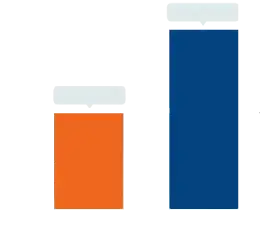
5.48 Billion
USD
8.94 Billion
2025
2033
USD
5.48 Billion
USD
8.94 Billion
2025
2033
 Forecast Period Forecast Period |
2026 –2033 |
 Market Size (Base Year) Market Size (Base Year) |
USD 5.48 Billion |
 Market Size (Forecast Year) Market Size (Forecast Year) |
USD 8.94 Billion |
 CAGR CAGR |
% |
| Major Markets Players |
|
What is the Global Aircraft Lightning Protection Market Size and Growth Rate?
- The global aircraft lightning protection market size was valued at USD 5.48 billion in 2025 and is expected to reach USD 8.94 billion by 2033, at a CAGR of 6.30% during the forecast period
- Growth in the demand for air travel among individuals has resulted in growth in the market value
- Growth and expansion of aviation industry especially in the developing economies coupled with surge in the number of passengers or travellers on daily basis will also create lucrative growth opportunities for the market
What are the Major Takeaways of Aircraft Lightning Protection Market?
- Increasing safety related regulations imposed by the government will also foster the market growth. Increased focus of the manufacturers on innovating with the lighting protection technology and surge in the use of electrical aircrafts, owing to rising environmental concerns will further carve the way for the growth of market
- However, delayed delivery of new aircrafts will pose a major challenge to the market growth rate. Also, fluctuations in the prices of raw materials will hamper the market growth rate. High costs associated with advanced lighting protection technology will further restrict the scope of growth for the market
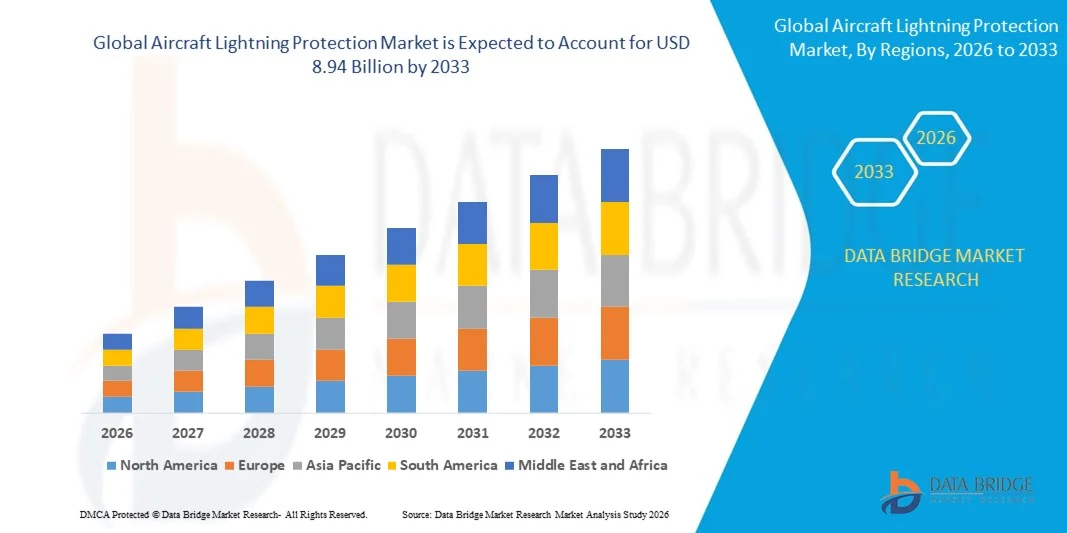
- North America dominated the aircraft lightning protection market with a 39.8% revenue share in 2025, driven by the presence of major aerospace manufacturers, robust aviation infrastructure, and high adoption of advanced lightning protection systems across commercial, business, and military aircraft in the U.S. and Canada
- Asia-Pacific is projected to register the fastest CAGR of 7.8% from 2026 to 2033, fueled by rapid expansion of commercial and regional aircraft manufacturing, increasing UAV deployments, and modernization of military aviation across China, India, Japan, South Korea, and Southeast Asia
- The Lightning Protection segment dominated the market with a 51.3% share in 2025, as it represents the core safety mechanism designed to protect aircraft structures, avionics systems, fuel tanks, and critical electronic components from lightning strike damages
Report Scope and Aircraft Lightning Protection Market Segmentation
|
Attributes |
Aircraft Lightning Protection Key Market Insights |
|
Segments Covered |
|
|
Countries Covered |
North America
Europe
Asia-Pacific
Middle East and Africa
South America
|
|
Key Market Players |
|
|
Market Opportunities |
|
|
Value Added Data Infosets |
In addition to the insights on market scenarios such as market value, growth rate, segmentation, geographical coverage, and major players, the market reports curated by the Data Bridge Market Research also include in-depth expert analysis, pricing analysis, brand share analysis, consumer survey, demography analysis, supply chain analysis, value chain analysis, raw material/consumables overview, vendor selection criteria, PESTLE Analysis, Porter Analysis, and regulatory framework. |
What is the Key Trend in the Aircraft Lightning Protection Market?
Increasing Adoption of Advanced Composite Materials and Integrated Lightning Protection Systems in Aircraft
- The aircraft lightning protection market is witnessing growing adoption of advanced composite materials, conductive meshes, and integrated lightning protection systems designed to safeguard modern aircraft structures and avionics from lightning strikes
- Manufacturers are introducing lightweight conductive coatings, expanded metal foils, and embedded lightning strike protection layers that enhance structural integrity while maintaining aircraft weight efficiency
- Growing demand for high-performance protection solutions for composite airframes, fuel systems, and sensitive electronic components is driving deployment across commercial aviation, military aircraft, and unmanned aerial vehicles
- For instance, companies such as Honeywell International Inc., Saab AB, TE Connectivity, and Parker Hannifin Corp are developing advanced lightning protection technologies, including conductive materials, grounding systems, and lightning current dissipation components
- Increasing aircraft electrification, use of carbon fiber composite structures, and integration of advanced avionics systems are accelerating the need for reliable lightning protection solutions
- As aircraft systems become more electronically complex and composite-intensive, aircraft lightning protection technologies will remain essential for ensuring flight safety, structural reliability, and regulatory compliance
What are the Key Drivers of Aircraft Lightning Protection Market?
- Rising demand for safe and reliable aircraft operations is increasing the adoption of advanced lightning protection systems designed to protect aircraft structures, fuel systems, and avionics from lightning strike damage
- For instance, in 2025, leading companies such as Honeywell International Inc., TE Connectivity, and Saab AB expanded their aerospace protection solutions to support next-generation commercial aircraft and military platforms
- Growing production of commercial aircraft, business jets, military aircraft, and unmanned aerial vehicles (UAVs) across the U.S., Europe, and Asia-Pacific is boosting demand for integrated lightning protection technologies
- Advancements in conductive composite materials, expanded metal foils, and lightning current dissipation technologies have improved aircraft structural protection and electrical safety
- Rising adoption of carbon fiber reinforced polymer (CFRP) airframes, advanced avionics systems, and electrified aircraft components is increasing the need for effective lightning protection mechanisms
- Supported by continuous investments in aerospace safety technologies, aircraft modernization programs, and next-generation aircraft development, the aircraft lightning protection market is expected to witness steady long-term growth
Which Factor is Challenging the Growth of the Aircraft Lightning Protection Market?
- High costs associated with advanced conductive materials, composite integration processes, and specialized lightning protection systems can limit adoption among smaller aircraft manufacturers and regional aviation programs
- For instance, during 2024–2025, fluctuations in aerospace-grade metal prices, composite material costs, and supply chain constraints increased production expenses for several aircraft component suppliers
- The complexity of integrating lightning protection systems into composite aircraft structures and advanced avionics architectures requires highly specialized engineering expertise and certification processes
- Stringent aviation safety regulations and compliance requirements from global aviation authorities can increase testing time and development costs for new protection technologies
- Competition among suppliers and pressure to reduce aircraft weight while maintaining structural safety creates challenges in balancing cost, performance, and durability of protection systems
- To address these challenges, manufacturers are focusing on lightweight conductive materials, improved composite integration methods, and advanced testing technologies to enhance the efficiency and global adoption of aircraft lightning protection systems
How is the Aircraft Lightning Protection Market Segmented?
The market is segmented on the basis of application, end user, aircraft type, and fit.
- By Application
On the basis of application, the Aircraft Lightning Protection market is segmented into Test Service, Lightning Detection and Warning, and Lightning Protection. The Lightning Protection segment dominated the market with a 51.3% share in 2025, as it represents the core safety mechanism designed to protect aircraft structures, avionics systems, fuel tanks, and critical electronic components from lightning strike damage. Aircraft are frequently exposed to lightning strikes during flight operations, making integrated protection systems such as conductive meshes, bonding wires, grounding systems, and shielding materials essential for ensuring structural integrity and passenger safety. These solutions are widely implemented across both commercial and military aircraft platforms.
The Lightning Detection and Warning segment is expected to grow at the fastest CAGR from 2026 to 2033, driven by increasing adoption of advanced weather monitoring systems and predictive lightning detection technologies. Airlines and aviation authorities are increasingly integrating early-warning systems to enhance flight safety, reduce operational risks, and improve route planning during severe weather conditions.
- By End User
On the basis of end user, the market is segmented into Civil and Military. The Civil segment dominated the market with a 62.7% share in 2025, supported by the large global fleet of commercial aircraft, business jets, and regional aviation platforms. Commercial aviation requires highly reliable lightning protection systems to comply with strict aviation safety standards and regulatory requirements established by global aviation authorities. As airlines continue to expand their fleets and introduce next-generation aircraft with composite airframes and advanced avionics systems, demand for reliable lightning protection technologies continues to rise. In addition, increasing passenger air travel and expansion of international flight networks further strengthen demand in the civil aviation sector.
The Military segment is expected to grow at the fastest CAGR from 2026 to 2033, driven by modernization of defense aircraft fleets, increasing deployment of advanced fighter jets, surveillance aircraft, and specialized mission platforms. Military aircraft require highly robust lightning protection solutions to ensure mission reliability, equipment protection, and operational safety in diverse environmental conditions.
- By Aircraft Type
On the basis of aircraft type, the market is segmented into Fixed Wing, Rotary Wing, and Unmanned Aerial Vehicles (UAVs). The Fixed Wing segment dominated the market with a 57.9% share in 2025, primarily due to the large number of commercial passenger aircraft, cargo aircraft, and military transport planes operating globally. Fixed-wing aircraft frequently fly through high-altitude storm systems where lightning strikes are more common, making robust lightning protection systems essential. Aircraft manufacturers integrate conductive materials, shielding layers, and bonding components into the aircraft structure to safely dissipate lightning currents and prevent damage to avionics and fuel systems.
The Unmanned Aerial Vehicles (UAVs) segment is expected to grow at the fastest CAGR from 2026 to 2033, driven by rising adoption of drones for military surveillance, logistics, mapping, agriculture, and disaster management. Increasing deployment of long-endurance UAVs operating in varying weather conditions is creating demand for compact and lightweight lightning protection technologies.
- By Fit
On the basis of fit, the market is segmented into Line-Fit and Retrofit. The Line-Fit segment dominated the market with a 64.1% share in 2025, as lightning protection systems are typically integrated into aircraft structures during the manufacturing stage. Aircraft manufacturers incorporate conductive meshes, bonding wires, shielding materials, and grounding systems into composite airframes to ensure compliance with aviation safety standards. Integrating protection systems during production ensures optimal structural integration, reliability, and long-term performance. The increasing production of new-generation commercial aircraft and military platforms further strengthens demand for line-fit lightning protection systems.
The Retrofit segment is expected to grow at the fastest CAGR from 2026 to 2033, driven by the need to upgrade aging aircraft fleets with improved lightning protection technologies. Airlines and defense operators are increasingly investing in retrofit solutions to enhance safety, improve compliance with updated aviation regulations, and extend the operational lifespan of existing aircraft.
Which Region Holds the Largest Share of the Aircraft Lightning Protection Market?
- North America dominated the aircraft lightning protection market with a 39.8% revenue share in 2025, driven by the presence of major aerospace manufacturers, robust aviation infrastructure, and high adoption of advanced lightning protection systems across commercial, business, and military aircraft in the U.S. and Canada. Increasing production of next-generation aircraft with composite airframes, advanced avionics, and integrated electronic systems continues to fuel demand for lightning protection solutions that ensure structural safety and regulatory compliance
- Leading companies in North America are introducing lightweight conductive meshes, embedded protection layers, and integrated lightning detection systems to enhance aircraft safety and reduce maintenance costs. Ongoing investments in smart avionics, electrified aircraft systems, and advanced R&D programs support technological leadership in the region
- High concentration of aerospace engineering talent, established aviation supply chains, and strong regulatory frameworks further reinforce North America’s dominance in the Aircraft Lightning Protection market
U.S. Aircraft Lightning Protection Market Insight
The U.S. is the largest contributor in North America, supported by extensive commercial and military aircraft fleets and increasing adoption of advanced lightning protection technologies in new aircraft programs. Rising use of carbon fiber composite airframes, electrically powered flight systems, and integrated avionics drives demand for lightning protection solutions that safeguard both structural and electronic components. Aircraft manufacturers and MRO service providers are investing heavily in predictive maintenance systems, grounding solutions, and conductive coatings to ensure regulatory compliance and operational reliability. The presence of leading aerospace companies, advanced R&D centers, and high investment in fleet modernization further strengthens market growth.
Canada Aircraft Lightning Protection Market Insight
Canada contributes significantly to regional growth, driven by a strong civil aviation sector, aerospace component manufacturing, and defense aircraft programs. Expansion of research centers, universities, and aviation test labs supports adoption of lightning protection technologies for both commercial aircraft and military platforms. Government initiatives promoting aerospace innovation, skilled workforce availability, and investment in advanced aircraft systems strengthen regional market adoption. The demand for retrofitted lightning protection solutions for older fleets also supports continued growth in Canada.
Asia-Pacific Aircraft Lightning Protection Market
Asia-Pacific is projected to register the fastest CAGR of 7.8% from 2026 to 2033, fueled by rapid expansion of commercial and regional aircraft manufacturing, increasing UAV deployments, and modernization of military aviation across China, India, Japan, South Korea, and Southeast Asia. Rising production of composite aircraft, advanced avionics systems, and electrified flight components is driving demand for lightweight, reliable, and integrated lightning protection solutions. Governments in the region are investing in aviation safety, infrastructure development, and aircraft fleet expansion, which further accelerates market adoption.
China Aircraft Lightning Protection Market Insight
China is the largest contributor to Asia-Pacific, supported by rapid growth in domestic aircraft manufacturing, UAV production, and aerospace R&D initiatives. The country’s increasing production of composite aircraft, electric propulsion systems, and AI-enabled avionics drives demand for integrated lightning protection technologies. Strong government support for aerospace innovation, combined with local manufacturing capabilities and competitive pricing, is expanding both domestic and export adoption.
Japan Aircraft Lightning Protection Market Insight
Japan shows steady growth due to advanced aerospace manufacturing, precision electronics, and modernization of civil and military aircraft fleets. Strong focus on safety, reliability, and regulatory compliance drives demand for premium lightning protection solutions. The adoption of UAVs, robotics-enabled aircraft systems, and low-latency avionics reinforces long-term market expansion.
India Aircraft Lightning Protection Market Insight
India is emerging as a major growth hub, driven by expanding commercial aircraft production, UAV programs, and government-supported aerospace manufacturing initiatives. Rising demand for composite airframes, embedded avionics, and electrified flight systems increases adoption of aircraft lightning protection solutions in both manufacturing and MRO services. Growing R&D investments, aviation safety programs, and infrastructure expansion further accelerate market penetration.
South Korea Aircraft Lightning Protection Market Insight
South Korea contributes significantly due to advanced aerospace manufacturing, UAV production, and development of smart avionics systems. Increasing production of high-speed, electrically powered, and AI-enabled aircraft platforms is driving adoption of lightning protection technologies with high-performance materials and embedded detection systems. Strong manufacturing capabilities and growing aerospace innovation ecosystems support sustained market growth.
Which are the Top Companies in Aircraft Lightning Protection Market?
The aircraft lightning protection industry is primarily led by well-established companies, including:
- Honeywell International Inc. (U.S.)
- Saab AB (Sweden)
- L3Harris Technologies, Inc. (U.S.)
- TE Connectivity (Switzerland)
- Parker Hannifin Corp (U.S.)
- Cobham Limited (U.K.)
- National Technical Systems (U.S.)
- Avidyne Corporation (U.S.)
- Astroseal Products Manufacturing Corp. (U.S.)
- PPG Engineered Materials (U.S.)
- Microsemi (U.S.)
- Pinnacle Lighting Group (U.S.)
- All Weather, Inc. (U.S.)
- Saywell International (U.K.)
- The Gill Corporation (U.S.)
- James Cropper plc. (U.K.)
- Hydra-Electric Company (U.S.)
What are the Recent Developments in Global Aircraft Lightning Protection Market?
- In January 2025, PPG Aerospace and its subsidiary Dexmet Corporation released a brochure highlighting that their MicroGrid precision-expanded metal foils are the preferred materials for lightning strike protection in composite aircraft structures, serving as the exclusive supplier to Boeing and a principal supplier to Embraer. This development underscores the growing reliance on high-performance materials for enhanced lightning protection in modern aircraft manufacturing
- In October 2024, an article highlighted that lightning diverter strips and conductive meshes are specified in the Boeing 737 Airport Characteristics Manual for protecting composite panels and radomes, demonstrating how OEM design standards are increasingly integrating lightning protection elements. This instance reflects the importance of regulatory and design compliance in ensuring aircraft safety against lightning strikes
- In April 2024, Socomore announced its Ultraconductive Coatings range for aerospace applications, specifically designed for lightning strike protection of composite aircraft surfaces. The coatings enhance lightning protection performance while reducing weight and improving durability. This launch emphasizes innovation in lightweight, high-efficiency protective coatings for next-generation aircraft
- In February 2024, Embraer confirmed that its E2 commercial aircraft series is delivered with fully integrated lightning strike protection systems, including conductive copper foils and grounding layers installed during manufacturing to meet both FAA and ANAC certification requirements. This initiative highlights the adoption of fully embedded protection systems in modern commercial aircraft
- In May 2022, Integument Technologies launched its FluoroGrip LS-1000 peel-and-stick lightning strike film for composite aircraft, offering a retrofit option for lightning protection on existing structures. This innovation provides an effective solution for upgrading older aircraft fleets with modern lightning protection technologies
SKU-
Get online access to the report on the World's First Market Intelligence Cloud

- Interactive Data Analysis Dashboard
- Company Analysis Dashboard for high growth potential opportunities
- Research Analyst Access for customization & queries
- Competitor Analysis with Interactive dashboard
- Latest News, Updates & Trend analysis
- Harness the Power of Benchmark Analysis for Comprehensive Competitor Tracking
Global Aircraft Lightning Protection Market, Supply Chain Analysis and Ecosystem Framework
To support market growth and help clients navigate the impact of geopolitical shifts, DBMR has integrated in-depth supply chain analysis into its Global Aircraft Lightning Protection Market research reports. This addition empowers clients to respond effectively to global changes affecting their industries. The supply chain analysis section includes detailed insights such as Global Aircraft Lightning Protection Market consumption and production by country, price trend analysis, the impact of tariffs and geopolitical developments, and import and export trends by country and HSN code. It also highlights major suppliers with data on production capacity and company profiles, as well as key importers and exporters. In addition to research, DBMR offers specialized supply chain consulting services backed by over a decade of experience, providing solutions like supplier discovery, supplier risk assessment, price trend analysis, impact evaluation of inflation and trade route changes, and comprehensive market trend analysis.
Research Methodology
Data collection and base year analysis are done using data collection modules with large sample sizes. The stage includes obtaining market information or related data through various sources and strategies. It includes examining and planning all the data acquired from the past in advance. It likewise envelops the examination of information inconsistencies seen across different information sources. The market data is analysed and estimated using market statistical and coherent models. Also, market share analysis and key trend analysis are the major success factors in the market report. To know more, please request an analyst call or drop down your inquiry.
The key research methodology used by DBMR research team is data triangulation which involves data mining, analysis of the impact of data variables on the market and primary (industry expert) validation. Data models include Vendor Positioning Grid, Market Time Line Analysis, Market Overview and Guide, Company Positioning Grid, Patent Analysis, Pricing Analysis, Company Market Share Analysis, Standards of Measurement, Global versus Regional and Vendor Share Analysis. To know more about the research methodology, drop in an inquiry to speak to our industry experts.
Customization Available
Data Bridge Market Research is a leader in advanced formative research. We take pride in servicing our existing and new customers with data and analysis that match and suits their goal. The report can be customized to include price trend analysis of target brands understanding the market for additional countries (ask for the list of countries), clinical trial results data, literature review, refurbished market and product base analysis. Market analysis of target competitors can be analyzed from technology-based analysis to market portfolio strategies. We can add as many competitors that you require data about in the format and data style you are looking for. Our team of analysts can also provide you data in crude raw excel files pivot tables (Fact book) or can assist you in creating presentations from the data sets available in the report.