


Global Airport Robots Market
Market Size in USD Billion
CAGR :
% 
 USD
1.65 Billion
USD
6.50 Billion
2025
2033
USD
1.65 Billion
USD
6.50 Billion
2025
2033
 Forecast Period Forecast Period |
2026 –2033 |
 Market Size (Base Year) Market Size (Base Year) |
USD 1.65 Billion |
 Market Size (Forecast Year) Market Size (Forecast Year) |
USD 6.50 Billion |
 CAGR CAGR |
% |
| Major Markets Players |
|
Airport Robots Market Size
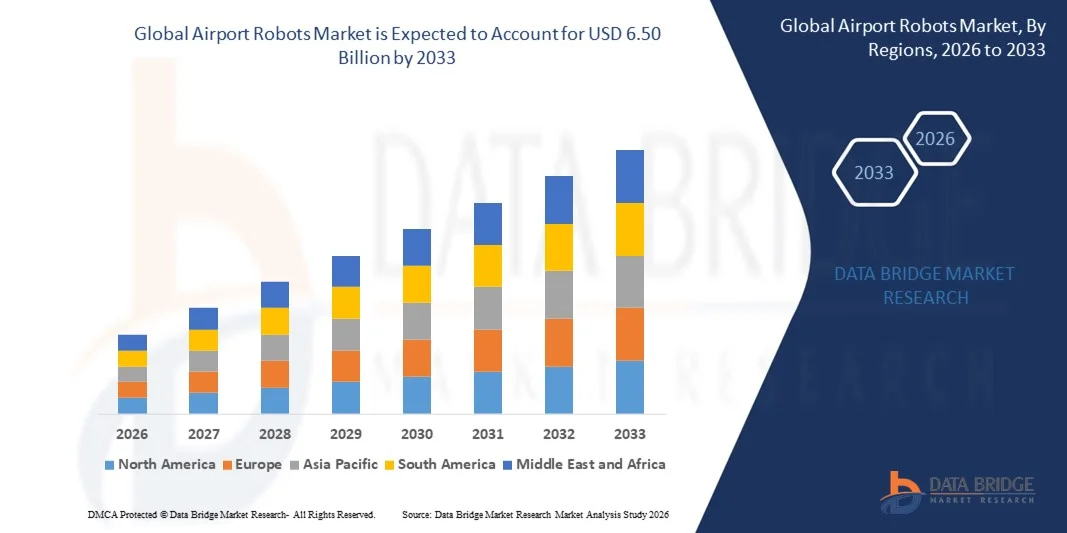
- The global airport robots market size was valued at USD 1.65 billion in 2025 and is expected to reach USD 6.50 billion by 2033, at a CAGR of 18.7% during the forecast period
- The market growth is largely fueled by increasing airport modernization initiatives and the growing adoption of automation technologies, which are driving the deployment of robots for passenger guidance, baggage handling, cleaning, and security operations across terminals
- Furthermore, rising demand for efficient, reliable, and contactless solutions in airports is establishing autonomous service robots as key operational assets. These factors are accelerating the uptake of airport robots, significantly boosting market growth
Airport Robots Market Analysis
- Airport robots, including autonomous service, cleaning, security, and guidance robots, are becoming vital components of modern airport operations due to their ability to enhance passenger experience, improve operational efficiency, and reduce human labor
- The escalating demand for airport robots is primarily fueled by increasing passenger volumes, stringent safety regulations, the need for operational efficiency, and a rising preference for automated and contactless airport services
- North America dominated the airport robots market with a share of 32.60% in 2025, due to increasing investments in airport automation, rising passenger traffic, and the adoption of intelligent robotics to improve operational efficiency
- Asia-Pacific is expected to be the fastest growing region in the airport robots market during the forecast period due to rapid urbanization, rising passenger traffic, and modernization of airports in countries such as China, Japan, and India
- Human-shaped robot segment dominated the market with a market share of 47% in 2025, due to its ability to provide intuitive interaction with passengers and deliver services in a more engaging, approachable manner. Airports prioritize human-shaped robots for passenger assistance, information provision, and crowd management due to their familiarity and social appeal. These robots are also integrated with advanced AI and voice recognition technologies, enabling personalized guidance and support
Report Scope and Airport Robots Market Segmentation
|
Attributes |
Airport Robots Key Market Insights |
|
Segments Covered |
|
|
Countries Covered |
North America
Europe
Asia-Pacific
Middle East and Africa
South America
|
|
Key Market Players |
|
|
Market Opportunities |
|
|
Value Added Data Infosets |
In addition to the market insights such as market value, growth rate, market segments, geographical coverage, market players, and market scenario, the market report curated by the Data Bridge Market Research team includes in-depth expert analysis, import/export analysis, pricing analysis, production consumption analysis, and pestle analysis. |
Airport Robots Market Trends
Rising Adoption of Autonomous Service and Security Robots
- A significant trend in the airport robots market is the increasing deployment of autonomous service and security robots to enhance operational efficiency and passenger experience. Airports are focusing on robots that can perform tasks such as cleaning, baggage handling, and surveillance, reducing reliance on manual labor and improving turnaround times
- For instance, SITA and SoftBank Robotics provide autonomous service robots deployed in airports such as Hamad International Airport and Changi Airport for customer assistance and information services. These robots support staff by managing routine passenger interactions and delivering real-time guidance
- Security applications are expanding as autonomous patrol and surveillance robots are equipped with AI-enabled cameras and sensors to detect unattended items, monitor restricted zones, and assist in crowd management. This trend is increasing the safety and security levels while streamlining monitoring processes
- Airports are integrating robots for logistics and baggage handling where automated guided vehicles and robotic carts facilitate luggage transport from check-in counters to aircraft. This reduces handling errors, improves efficiency, and optimizes overall airport workflow
- The market is witnessing growing interest in robots capable of performing multi-functional tasks, combining cleaning, delivery, and passenger interaction to maximize utilization. Such versatile systems are becoming critical as airports aim to reduce operational costs and improve service quality
- Collaborations between airports and robotics technology providers are driving innovation in autonomous systems that can adapt to dynamic airport environments. This trend is establishing airport robots as essential components for modernizing airport operations and supporting intelligent infrastructure
Airport Robots Market Dynamics
Driver
Increasing Airport Modernization and Automation Initiatives
- Rising investments in airport modernization and automation projects are driving the adoption of robotic solutions to enhance operational efficiency and passenger satisfaction. Automated systems reduce human dependency for routine tasks and support faster, safer airport operations
- For instance, Dubai International Airport has partnered with GE Aviation and AEROBOT to implement autonomous baggage handling and service robots, streamlining passenger movement and cargo handling processes. These initiatives demonstrate the value of robotics in improving airport throughput
- The push toward smart airport infrastructure is increasing the need for robots capable of real-time data collection, navigation assistance, and predictive maintenance. These technologies help airports operate more efficiently while reducing downtime and errors
- Government and private sector initiatives supporting digitalization in airports are creating a favorable environment for robotics integration. Automation programs encourage airports to adopt solutions that improve performance metrics and reduce operational costs
- The rising focus on passenger experience, operational safety, and cost efficiency continues to reinforce investments in airport robotics. These drivers collectively shape the adoption of intelligent systems as a core aspect of modern airport infrastructure
Restraint/Challenge
High Implementation and Maintenance Costs
- The airport robots market faces challenges due to significant capital expenditure and ongoing maintenance requirements for deploying autonomous systems. Advanced hardware, AI software, and integration into existing airport infrastructure increase upfront costs
- For instance, Zurich Airport faced high deployment costs while implementing autonomous cleaning and security robots from Pal Robotics, requiring additional investment in staff training and system maintenance. These expenses can slow large-scale adoption across smaller airports
- Operational costs include regular maintenance, software updates, and repairs to ensure robots function reliably in high-traffic environments. Downtime or malfunctions can disrupt airport operations, adding to operational risks
- Integration complexity with existing airport management systems poses additional financial and logistical challenges. Seamless coordination between robotics platforms and legacy infrastructure requires careful planning and resources
- Cost constraints and maintenance complexity continue to limit faster adoption of airport robots, particularly in mid-sized and regional airports. These challenges emphasize the need for cost-optimized solutions and scalable deployment models
Airport Robots Market Scope
The market is segmented on the basis of type, application, and end-user.
- By Type
On the basis of type, the airport robots market is segmented into human-shaped robots, box-shaped robots, and others. The human-shaped robot segment dominated the market with the largest revenue share of 47% in 2025, driven by its ability to provide intuitive interaction with passengers and deliver services in a more engaging, approachable manner. Airports prioritize human-shaped robots for passenger assistance, information provision, and crowd management due to their familiarity and social appeal. These robots are also integrated with advanced AI and voice recognition technologies, enabling personalized guidance and support. The market sees strong demand for human-shaped robots because of their effectiveness in enhancing passenger experience and their compatibility with multiple airport operations.
The box-shaped robot segment is anticipated to witness the fastest growth rate from 2026 to 2033, fueled by increasing deployment in luggage transport, security patrolling, and material handling within airport terminals. Box-shaped robots offer high load-carrying capacity and efficient navigation in constrained spaces, making them suitable for operational tasks that do not require direct human interaction. Their modular design allows integration with various sensors and automation technologies, providing cost-effective solutions for airport logistics and operational efficiency. The growing focus on reducing human labor for repetitive tasks further accelerates the adoption of box-shaped robots.
- By Application
On the basis of application, the airport robots market is segmented into civil airports, military/federal government airports, and private airports. The civil airports segment dominated the market in 2025, driven by the rising passenger volumes and increasing need for automated assistance in commercial terminals. Civil airports deploy robots for information guidance, crowd management, and routine patrolling, improving operational efficiency and passenger satisfaction. The integration of AI-powered navigation and real-time data analytics in these robots further enhances their effectiveness in large, high-traffic terminals. Airports increasingly rely on robots to supplement human staff in peak hours and ensure safety compliance, contributing to strong revenue share for this segment.
The military/federal government airports segment is expected to witness the fastest CAGR from 2026 to 2033, driven by the need for advanced surveillance, threat detection, and automated security operations. For instance, government airports utilize robots equipped with high-precision sensors and autonomous patrolling capabilities to monitor restricted areas and detect anomalies. These robots reduce human exposure to potential security threats and allow for continuous monitoring without fatigue. The deployment of intelligent robotic systems ensures higher reliability and operational readiness in sensitive airport environments, promoting faster adoption in this segment.
- By End User
On the basis of end user, the airport robots market is segmented into airport security, boarding pass scanning, airport baggage system, passenger guidance, and others. The airport security segment dominated the market in 2025, driven by growing concerns over passenger safety and the need for automated surveillance and threat detection. Security robots equipped with AI, machine learning, and real-time monitoring capabilities assist personnel in patrolling terminals, detecting suspicious items, and ensuring regulatory compliance. Airports increasingly prefer security robots due to their reliability, scalability, and ability to operate continuously without downtime. The integration with existing security infrastructure enhances operational efficiency, making this segment a key revenue contributor.
The airport baggage system segment is anticipated to witness the fastest growth rate from 2026 to 2033, fueled by the rising demand for automated luggage handling to improve efficiency and reduce human error. For instance, airports deploy robots that can transport, sort, and load baggage autonomously, minimizing delays and ensuring timely delivery to flights. These systems enhance the overall passenger experience while optimizing workforce utilization and reducing operational costs. The adoption of smart baggage-handling robots is expected to accelerate as airports modernize terminals and implement automation for smoother operations.
Airport Robots Market Regional Analysis
- North America dominated the airport robots market with the largest revenue share of 32.60% in 2025, driven by increasing investments in airport automation, rising passenger traffic, and the adoption of intelligent robotics to improve operational efficiency
- Airports in the region prioritize robots for passenger guidance, baggage handling, and security patrolling, enhancing both safety and service quality
- The widespread adoption is supported by high airport modernization budgets, advanced technological infrastructure, and a growing focus on AI and robotics integration in airport operations
U.S. Airport Robots Market Insight
The U.S. airport robots market captured the largest revenue share in 2025 within North America, fueled by the rapid adoption of automated systems and the need to streamline airport operations. Airports are increasingly implementing robots for security monitoring, boarding assistance, and passenger guidance to reduce manual labor and enhance efficiency. The trend of smart airports and integration with AI-based analytics, IoT sensors, and autonomous navigation systems further drives market growth. In addition, the country’s well-developed infrastructure and investment in airport modernization projects contribute to accelerating adoption of airport robots.
Europe Airport Robots Market Insight
The Europe airport robots market is projected to grow at a significant CAGR throughout the forecast period, driven by rising passenger volumes, airport expansion projects, and stringent safety regulations. Airports in the region are adopting robots for baggage handling, security operations, and passenger guidance to ensure efficient and safe operations. The presence of technologically advanced airports, focus on automation, and integration with AI and machine learning for predictive maintenance are fostering market adoption. European airports are also emphasizing enhanced passenger experience, encouraging the deployment of human-shaped and autonomous robots across terminals.
U.K. Airport Robots Market Insight
The U.K. airport robots market is expected to grow at a noteworthy CAGR during the forecast period, driven by modernization of airports, smart airport initiatives, and rising demand for efficient security and passenger services. The adoption of robots for boarding assistance, luggage transport, and security monitoring is increasing across major international airports. Integration with digital platforms, AI, and real-time monitoring systems enhances operational efficiency and passenger satisfaction. Government support for airport automation and investments in next-generation airport technology further accelerate market growth.
Germany Airport Robots Market Insight
The Germany airport robots market is anticipated to expand at a considerable CAGR, fueled by growing automation in airport operations and the need to enhance security, efficiency, and passenger convenience. German airports are deploying robots for baggage handling, boarding assistance, and security surveillance, integrating advanced AI, sensors, and autonomous navigation systems. The country’s emphasis on innovation and sustainability in airport operations supports adoption of eco-friendly and intelligent robotic solutions. Integration with existing airport IT infrastructure and smart airport initiatives is promoting steady market expansion.
Asia-Pacific Airport Robots Market Insight
The Asia-Pacific airport robots market is poised to grow at the fastest CAGR during 2026 to 2033, driven by rapid urbanization, rising passenger traffic, and modernization of airports in countries such as China, Japan, and India. Airports are increasingly deploying robots for passenger guidance, boarding assistance, and automated security operations, improving efficiency and service quality. Government initiatives supporting smart airports, airport automation, and digital infrastructure development are fostering adoption. The growing emphasis on smart cities and integration of AI and IoT in airport operations further accelerates market growth in the region.
Japan Airport Robots Market Insight
The Japan airport robots market is gaining momentum due to high-tech adoption, smart airport initiatives, and rising passenger expectations for convenient services. Airports in Japan are utilizing robots for baggage handling, boarding assistance, and passenger guidance to enhance operational efficiency. Integration with AI, autonomous navigation systems, and connected IoT devices in terminals supports intelligent and seamless airport operations. The focus on improving passenger experience and reducing human labor for routine tasks is driving strong market adoption.
China Airport Robots Market Insight
The China airport robots market accounted for the largest revenue share in Asia-Pacific in 2025, attributed to rapid airport expansion, technological advancement, and high passenger traffic. Chinese airports are increasingly deploying robots for security surveillance, baggage handling, and passenger assistance to streamline operations. The government’s push toward smart airports and investments in AI, robotics, and IoT technologies bolster adoption. Local manufacturing capabilities and the availability of cost-effective robotic solutions further support the rapid market growth in China.
Airport Robots Market Share
The airport robots industry is primarily led by well-established companies, including:
- Vecna Robotics, Inc. (U.S.)
- Swisslog Holding AG (Switzerland)
- Savioke, Inc. (U.S.)
- Omron Corporation (Japan)
- Mobile Industrial Robots A/S (Denmark)
- Locus Robotics (U.S.)
- Hi‑Tech Robotic Systemz Ltd. (India)
- Fetch Robotics, Inc. (U.S.)
- Clearpath Robotics, Inc. (Canada)
- Cimcorp Oy (Finland)
- Aviation Industry Corporation of China (China)
- Aethon, Inc. (U.S.)
Latest Developments in Global Airport Robots Market
- In April 2025, SIMPPLE Ltd. was awarded a USD 524,000 contract to supply autonomous cleaning robots to Singapore’s international airport, marking its second contract with the airport authorities within a year. This repeat engagement highlights growing confidence in robotic automation for maintaining large-scale airport terminals and reinforces the rising trend of intelligent cleaning solutions in high-traffic environments. The contract strengthens SIMPPLE Ltd.’s market position and also signals increasing adoption of autonomous service robots in Southeast Asia, reflecting the demand for labor-efficient, high-capacity cleaning systems that can operate with minimal human supervision. The deployment is expected to encourage other airports in the region to explore similar automation initiatives, boosting overall market growth
- In November 2024, SIMPPLE Ltd. secured a USD 400,000 contract to supply autonomous cleaning robots at one of Singapore’s international airport terminals. This earlier contract demonstrates the early-stage adoption of robotic solutions for operational efficiency and hygiene management, emphasizing the airport’s commitment to advanced automation. By deploying these intelligent systems, the airport can optimize maintenance schedules, reduce human workload, and maintain high standards of cleanliness for passengers. The deal also illustrates the commercial viability of airport robots for service operations, highlighting the potential for recurring contracts and expansion of the airport robots market across Asia-Pacific terminals
- In April 2024, the Sardar Vallabhbhai Patel International Airport in India deployed intelligent cleaning robots, marking a notable step toward technological innovation in Indian aviation. These robots are capable of performing all floor cleaning tasks—including scrubbing, drying, and mopping—covering an impressive 13,000 square feet per hour, which significantly enhances operational efficiency. Their deployment ensures a cleaner and safer environment for passengers while reducing dependency on manual labor. This adoption reflects the growing trend of integrating robotics into airport operations in emerging markets, highlighting India as a high-growth region for airport service robots. It also encourages further investments in automation technologies to improve hygiene and service standards in rapidly expanding airport facilities
- In April 2024, the Alaskan government deployed a robotic dog named Aurora at Fairbanks Airport to enhance safety and operational security. Designed by Andrea Deppner and financed through a federal grant, Aurora uses advanced sensors and autonomous navigation to detect and discourage wildlife, reducing the risk of animal-related incidents on the airfield. This deployment underscores the expanding role of specialized robots in airport safety management and environmental monitoring. It also demonstrates how public-sector initiatives are adopting cutting-edge robotics to address operational challenges, creating new opportunities for the airport robotics market focused on security and risk mitigation solutions
- In March 2024, Munich Airport introduced an innovative JEEVES service robot to assist passengers with shopping and food services. Originally developed for hotels and healthcare facilities, this robot’s first deployment in an airport setting as a snack-serving bot illustrates the diversification of airport robot applications beyond traditional cleaning and security roles. By offering automated, interactive services, Munich Airport enhances passenger convenience, reduces staff workload, and introduces a novel customer experience. This deployment highlights a growing market trend of multifunctional robots in airports, opening opportunities for service-oriented robotic solutions aimed at improving passenger engagement and operational efficiency
SKU-
Get online access to the report on the World's First Market Intelligence Cloud

- Interactive Data Analysis Dashboard
- Company Analysis Dashboard for high growth potential opportunities
- Research Analyst Access for customization & queries
- Competitor Analysis with Interactive dashboard
- Latest News, Updates & Trend analysis
- Harness the Power of Benchmark Analysis for Comprehensive Competitor Tracking
Research Methodology
Data collection and base year analysis are done using data collection modules with large sample sizes. The stage includes obtaining market information or related data through various sources and strategies. It includes examining and planning all the data acquired from the past in advance. It likewise envelops the examination of information inconsistencies seen across different information sources. The market data is analysed and estimated using market statistical and coherent models. Also, market share analysis and key trend analysis are the major success factors in the market report. To know more, please request an analyst call or drop down your inquiry.
The key research methodology used by DBMR research team is data triangulation which involves data mining, analysis of the impact of data variables on the market and primary (industry expert) validation. Data models include Vendor Positioning Grid, Market Time Line Analysis, Market Overview and Guide, Company Positioning Grid, Patent Analysis, Pricing Analysis, Company Market Share Analysis, Standards of Measurement, Global versus Regional and Vendor Share Analysis. To know more about the research methodology, drop in an inquiry to speak to our industry experts.
Customization Available
Data Bridge Market Research is a leader in advanced formative research. We take pride in servicing our existing and new customers with data and analysis that match and suits their goal. The report can be customized to include price trend analysis of target brands understanding the market for additional countries (ask for the list of countries), clinical trial results data, literature review, refurbished market and product base analysis. Market analysis of target competitors can be analyzed from technology-based analysis to market portfolio strategies. We can add as many competitors that you require data about in the format and data style you are looking for. Our team of analysts can also provide you data in crude raw excel files pivot tables (Fact book) or can assist you in creating presentations from the data sets available in the report.












