


What is the Almond Butter Market Size and Growth Rate?
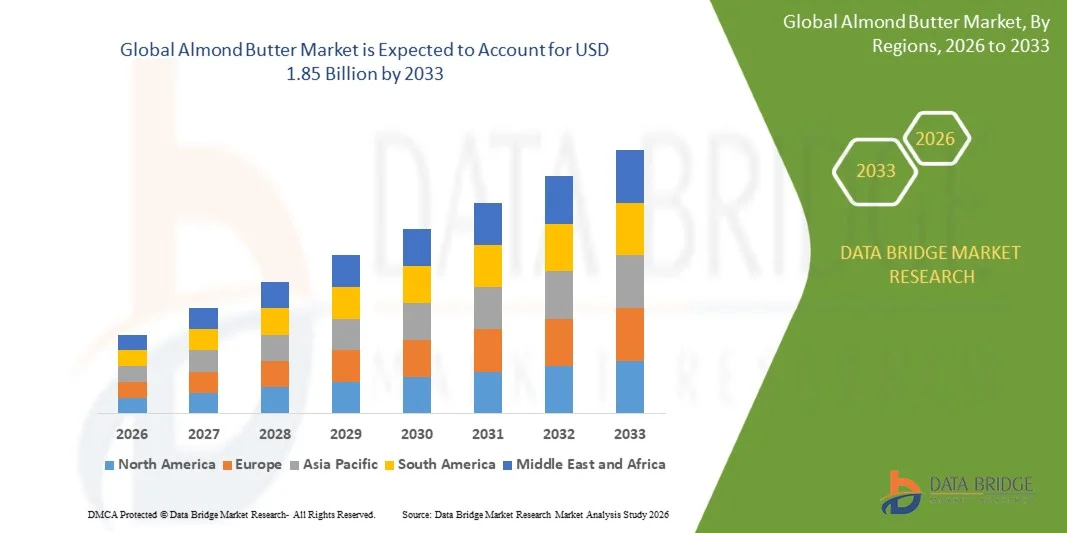
- As per Data Bridge Market Research analysis, the almond butter market was valued at USD 1.05 billion in 2025 and is projected to reach USD 1.85 billion by 2033, growing at a CAGR of 7.34% from 2026 to 2033.
- The market is experiencing consistent growth driven by the increasing consumer preference for nutritious and plant-based foods, rising demand for protein-rich and clean-label spreads, growing awareness of the health benefits associated with almonds, and the expanding availability of almond butter across supermarkets, specialty stores, and online retail channels.
- The growing demand for healthier alternatives to traditional spreads, convenient breakfast and snack products, and products with natural and functional ingredients is encouraging manufacturers to expand almond butter offerings. The increasing popularity of vegan, vegetarian, gluten-free, and low-processed diets is further supporting product innovation, while the introduction of organic, unsweetened, flavored, and premium almond butter varieties is broadening consumer choices.
Market Size & Forecast
- Global Market Value (2025): USD 1.05 Billion
- Expected Market Value (2033): USD 1.85 Billion
- Forecast CAGR (2026–2033): 7.34%
- Leading Region in 2025: North America
- Fastest Growing Region: Asia Pacific
What are the Major Takeaways of the Almond Butter Market?
- North America dominated the almond butter market with the largest revenue share of 40.2% in 2025, supported by strong consumer demand for plant-based and nutritious food products, high awareness of almond-based spreads, and the widespread availability of almond butter through supermarkets, specialty stores, and online retail channels.
- Asia-Pacific is expected to be the fastest-growing region at a CAGR of 8.1% from 2026 to 2033, fueled by rising disposable incomes, increasing health consciousness, growing adoption of plant-based diets, and expanding retail availability of premium and nutritious food products.
- The smooth almond butter segment led the product type category with a 46.5% share in 2025, driven by its creamy texture, versatility as a spread and ingredient, and widespread use in breakfast foods, smoothies, bakery products, and snacks.
- Crunchy almond butter is the fastest-growing product type, projected to register a CAGR of 8.7%, supported by increasing consumer interest in textured food products and the growing popularity of premium and minimally processed nut-based spreads.
- The conventional segment dominated the nature category with a 68.4% revenue share in 2025, supported by broader availability, competitive pricing, established production networks, and high consumption across mainstream retail channels.
- The organic segment is expected to be the fastest-growing nature category, with a CAGR of 9.2%, driven by increasing consumer preference for clean-label products, organic ingredients, natural food products, and minimally processed alternatives.
- The household segment accounted for 61.8% of the market share in 2025, supported by growing consumption of almond butter as a breakfast spread, smoothie ingredient, snack component, and nutritional food product.
- The foodservice industry segment is expected to register the fastest growth, with a CAGR of 8.9%, driven by increasing use of almond butter in cafés, restaurants, bakeries, smoothie shops, and health-oriented food establishments.
Report Scope and Almond Butter Market Segmentation
|
Attributes |
Almond Butter Key Market Insights |
|
Segments Covered |
|
|
Countries Covered |
North America
Europe
Asia-Pacific
Middle East and Africa
South America
|
|
Key Market Players |
|
|
Market Opportunities |
|
|
Value Added Data Infosets |
In addition to the insights on market scenarios such as market value, growth rate, segmentation, geographical coverage, and major players, the market reports curated by the Data Bridge Market Research also include in-depth expert analysis, pricing analysis, brand share analysis, consumer survey, demography analysis, supply chain analysis, value chain analysis, raw material/consumables overview, vendor selection criteria, PESTLE Analysis, Porter Analysis, and regulatory framework. |
What is the Key Trend in the Almond Butter Market?
- Almond butter manufacturers are increasingly focusing on clean-label formulations, minimal processing, and simple ingredient lists as consumers seek natural food products with greater ingredient transparency.
- For instance, in January 2020, Justin’s introduced its Almond Butter Protein Bar, expanding its portfolio around convenient nutrition and plant-based protein while using almond butter as a key ingredient.
- Manufacturers are increasingly developing almond butter products positioned around plant-based nutrition, protein content, and convenient consumption, expanding their use across smoothies, oats, bakery products, snacks, and breakfast foods.
- For instance, in March 2016, Justin’s launched its first cookbook, “Justin My Kitchen,” featuring recipes incorporating almond butter into oatmeal, yogurt, smoothies, snacks, and other food applications, demonstrating the versatility of almond butter beyond traditional spreading.
- The market is also witnessing product innovation through organic, unsweetened, flavored, crunchy, and functional almond butter varieties, enabling brands to address different dietary preferences and consumption occasions.
- For instance, in 2024, Justin’s expanded its product portfolio with USDA-certified organic Chocolate Candy Pieces, while continuing to offer multiple almond butter varieties, including maple, vanilla, cinnamon, and honey almond butter.
- As consumers increasingly prioritize clean ingredients, plant-based nutrition, protein-rich foods, and convenient formats, almond butter manufacturers are expanding product portfolios around organic sourcing, minimal processing, functional nutrition, and differentiated flavors and textures.
What are the Key Drivers of the Almond Butter Market?
- The growing adoption of plant-based and flexitarian diets is driving demand for almond butter as a convenient plant-based spread and ingredient for breakfast foods, snacks, smoothies, bakery products, and other food applications.
- For instance, in January 2020, Justin’s introduced Almond Butter Protein Bars containing plant-based protein, expanding the use of almond butter into convenient snack formats.
- Increasing consumer interest in clean-label and minimally processed foods is supporting demand for almond butter products with simple ingredient lists, no added preservatives, no artificial ingredients, and organic positioning.
- For instance, in 2026, Artisana Organics continued to offer Organic Raw Almond Butter made from organic almonds, alongside USDA Organic, Non-GMO Project Verified, gluten-free, and vegan-friendly certifications, supporting demand for organic and minimally processed nut butter products.
- Rising demand for convenient and nutritious food products is encouraging manufacturers to expand almond butter applications across household consumption, foodservice, bakery products, smoothies, snacks, and sports nutrition.
- With consumers increasingly seeking plant-based protein, clean-label ingredients, convenient nutrition, and differentiated food products, demand for almond butter is expected to continue expanding across retail and foodservice applications.
Which Factors are Challenging the Growth of the Almond Butter Market?
- Volatility in almond supply and prices remains a key challenge because almond butter production depends heavily on the availability and cost of almonds, while climate-related production risks can increase raw-material costs and pressure product pricing.
- For instance, in 2024, California's almond industry continued to face water-management pressures, with almond producers increasingly relying on efficient irrigation and water-management practices to maintain production in a water-constrained agricultural environment.
- The relatively high price of almond butter compared with conventional spreads can restrict adoption among price-sensitive consumers, particularly in emerging markets where peanut butter and other spreads are generally more affordable.
- For instance, in 2024, Justin’s listed its 16-ounce almond butter varieties at a substantially higher suggested retail price than its conventional peanut butter varieties, illustrating the premium pricing associated with almond-based spreads.
- Sustainability concerns associated with almond cultivation, particularly water requirements in major producing regions, can also create challenges for manufacturers seeking to maintain reliable almond sourcing while improving environmental performance.
- For instance, in 2022, Justin’s reduced the plastic used in its BPA-free jars by 30% as part of its efforts to reduce the environmental impact of its packaging, demonstrating how nut-butter manufacturers are addressing sustainability across the product value chain.
- The challenges associated with raw-material price volatility, premium pricing, supply availability, and sustainability concerns continue to influence production costs and consumer affordability, requiring manufacturers to balance product quality, pricing, sourcing, and sustainability across the almond butter value chain.
How is the Almond Butter Market Segmented?
The almond butter market is segmented on the basis of product type, nature, end user, packaging type, and distribution channel.
- By Product Type
On the basis of product type, the almond butter market is segmented into raw almond butter, roasted almond butter, crunchy almond butter, and flavored almond butter. The raw and smooth almond butter segment dominated the market with a 38.09% share in 2025, supported by strong consumer preference for smooth-textured spreads, minimally processed products, and versatile almond butter formulations used across breakfast foods, snacks, smoothies, bakery products, and cooking applications. The smooth texture also enables easier incorporation into food formulations and supports broad household consumption.
The flavored almond butter segment is projected to witness the fastest growth at a CAGR of 8.23% during the forecast period of 2026 to 2033, driven by increasing consumer interest in differentiated flavors and premium nut-butter products. Manufacturers are introducing varieties incorporating chocolate, honey, maple, cinnamon, and other flavor combinations to appeal to consumers seeking greater variety. Growing demand for premium and innovative spreads is expected to support continued expansion of flavored almond butter.
- By Nature
On the basis of nature, the almond butter market is segmented into organic and conventional. The conventional segment dominated the market with a 71.53% share in 2025, supported by established supply networks, economies of scale, competitive pricing, and broad availability across mainstream supermarkets, hypermarkets, foodservice outlets, and other retail channels. Conventional almond butter continues to serve a larger consumer base because of its accessibility and relatively lower price compared with organic alternatives.
The organic segment is projected to witness the fastest growth at a CAGR of 8.90% during the forecast period of 2026 to 2033, driven by increasing consumer preference for organic ingredients, clean-label products, minimally processed foods, and transparent sourcing. Growing health awareness and the expansion of organic products through specialty stores and online retail channels are further supporting demand for organic almond butter.
- By End User
On the basis of end user, the almond butter market is segmented into household, foodservice, and industrial. The household segment dominated the market with a 58.0% share in 2025, supported by widespread consumption of almond butter as a breakfast spread, snack ingredient, smoothie component, and cooking ingredient. Growing consumer interest in plant-based foods and nutritious alternatives to conventional spreads is supporting household adoption across developed and emerging markets.
The foodservice segment is projected to witness the fastest growth at a CAGR of 7.14% during the forecast period of 2026 to 2033, driven by increasing use of almond butter in cafés, restaurants, bakeries, smoothie outlets, and health-oriented food establishments. Foodservice operators are incorporating almond butter into smoothies, desserts, bakery products, breakfast dishes, and specialty snacks, while growing demand for plant-based menu options is creating additional opportunities for commercial consumption.
- By Packaging Type
On the basis of packaging type, the almond butter market is segmented into jars and tubs, squeeze packs and pouches, and bulk containers. The jars and tubs segment dominated the market with a 54.62% share in 2025, supported by established consumer familiarity, convenient household storage, product protection, and widespread availability across supermarkets, hypermarkets, specialty stores, and online retail channels. Traditional jars and tubs remain widely used because they are suitable for repeated household consumption and different product volumes.
The squeeze packs and pouches segment is projected to witness the fastest growth at a CAGR of 7.89% during the forecast period of 2026 to 2033, driven by increasing demand for portable, lightweight, convenient, and easy-to-use packaging formats. These formats are particularly suitable for on-the-go consumption, sports nutrition, outdoor activities, and single-serve applications. Growing consumer demand for convenience and manufacturers' focus on flexible packaging are expected to support segment expansion.
- By Distribution Channel
On the basis of distribution channel, the almond butter market is segmented into supermarkets and hypermarkets, convenience stores, specialty food stores, and direct-to-consumer channels. The supermarkets and hypermarkets segment dominated the market with a 42.18% share in 2025, supported by broad product availability, established grocery infrastructure, high consumer accessibility, and the ability to compare multiple almond butter brands, varieties, and package sizes within a single retail environment.
The direct-to-consumer and online retail segment is projected to witness the fastest growth at a CAGR of 8.6% during the forecast period of 2026 to 2033, driven by increasing e-commerce penetration, home-delivery convenience, wider product selection, and the growing availability of premium, organic, flavored, and specialty almond butter products through digital platforms. Online channels also provide smaller brands with greater access to consumers outside their traditional geographic markets
Which Region Holds the Largest Share of the Almond Butter Market?
- North America dominated the almond butter market with the largest revenue share of 37.51% in 2025, supported by strong consumer demand for nut-based spreads, established natural and specialty food retail channels, and the region’s proximity to major almond production in California.
- The region also benefits from high consumer awareness of plant-based and protein-rich foods, widespread availability of almond butter through supermarkets, specialty stores, club retailers, and online channels, and the presence of established almond and nut-butter manufacturers. These factors continue to support North America’s leading position in the global almond butter market.
U.S. Almond Butter Market Insight
The U.S. almond butter market is witnessing steady growth due to strong consumer demand for plant-based, nutritious, and convenient food products. The country's established almond processing industry, extensive retail network, and high adoption of natural and specialty food products support the consumption of almond butter across household and foodservice applications. In addition, the availability of almond butter through supermarkets, club retailers, specialty stores, and online channels is contributing to market expansion. North America's proximity to California's almond production base further strengthens the U.S. market's position in the global almond butter industry.
Asia-Pacific Almond Butter Market Insight
The Asia-Pacific almond butter market is expected to witness rapid growth, supported by rising health awareness, urbanization, increasing disposable incomes, and changing dietary preferences across countries such as China, India, Japan, and Australia. The region is identified as one of the fastest-growing markets for almond butter, with the Asia-Pacific market projected to register an 8.5% CAGR from 2023 to 2030. Growing interest in organic and plant-based foods, expanding modern retail and e-commerce channels, and increasing consumption of premium nut-based products are supporting regional market expansion.
Japan Almond Butter Market Insight
The Japan almond butter market is witnessing consistent growth due to increasing consumer interest in nutritious, natural, and premium food products. Growing awareness of healthy eating, plant-based nutrition, and convenient food options is supporting the adoption of almond butter among health-conscious consumers. In addition, the availability of premium, organic, and unsweetened almond butter varieties through supermarkets, specialty food stores, and online retail channels is contributing to market expansion.
China Almond Butter Market Insight
The China almond butter market is expanding steadily, supported by rising health awareness, changing dietary preferences, and increasing demand for nutritious and convenient food products. Growing consumer interest in plant-based foods, natural ingredients, and premium spreads is supporting almond butter consumption. Furthermore, the expansion of modern retail, e-commerce platforms, and specialty food channels is improving product availability and supporting market development across urban areas.
U.K. Almond Butter Market Insight
The U.K. almond butter market is experiencing steady growth, supported by increasing consumer preference for plant-based, natural, organic, and health-oriented food products. Growing demand for clean-label and nutritious spreads, together with the expansion of supermarkets, specialty food stores, and online retail channels, is supporting almond butter consumption. The increasing availability of premium, flavored, and unsweetened varieties is further contributing to market development.
Germany Almond Butter Market Insight
The Germany almond butter market is expanding steadily due to strong consumer interest in organic, natural, and plant-based food products. Growing demand for clean-label ingredients, nutritious nut-based spreads, and convenient food products is supporting market adoption. In addition, Germany's well-established organic food sector, extensive supermarket network, and growing availability of plant-based products through specialty and online retail channels are contributing to the expansion of the almond butter market.
Which are the Top Companies in Almond Butter Market?
The Almond Butter industry is primarily led by well-established companies, including:
- The J.M. Smucker Co. (U.S.)
- Justin's (U.S.)
- Blue Diamond Growers (U.S.)
- Barney Butter (U.S.)
- MaraNatha (U.S.)
- Once Again Nut Butter (U.S.)
- Artisana Organics (U.S.)
- NuttZo (U.S.)
- Kirkland Signature (U.S.)
- 365 by Whole Foods Market (U.S.)
- RXBAR (U.S.)
- Meridian Foods (U.K.)
- Pip & Nut (U.K.)
- Manilife (U.K.)
- Fix & Fogg (New Zealand)
- Biona Organic (U.K.)
- Nutiva (U.S.)
- MaraNatha Natural Products (U.S.)
- Stonewall Kitchen (U.S.)
What are Latest Developments in Almond Butter Market?
- In June 2024, Amoretti launched a new almond butter line featuring naturally flavored varieties, including Pumpkin Spice Almond Butter and Hot Habanero Almond Butter. The products were developed without added sugars, additives, fats, or fillers, reflecting growing demand for flavorful, clean-label, and differentiated nut-butter products. The launch demonstrates increasing product innovation within the almond butter category through new flavors and ingredient-focused formulations.
- In May 2023, Philadelphia Nut Butter Company launched a direct-to-consumer brand offering almond, peanut, and cashew butters, with products made fresh to order and sold through its online platform. The launch expanded access to almond butter through a dedicated digital sales channel and demonstrates the growing role of direct-to-consumer models in the nut-butter category.
- In August 2022, Olam's Re- brand introduced natural almond and cashew butters in Singapore, using Australian almonds and offering the products in reusable glass jars. The almond butter was positioned around natural, clean-label, and sustainable attributes and was distributed through supermarkets and e-commerce channels. The launch demonstrates the expansion of premium and sustainability-focused almond butter products in the Asia-Pacific market.
- In June 2021, Fix & Fogg announced the expansion of its U.S. retail presence through a Whole Foods Market partnership, with its portfolio including Almond Butter with Cashew and Maple and Crunchy Almond Butter. The expansion increased the availability of differentiated almond butter varieties through a major specialty grocery retailer and highlights the growing distribution of premium nut-butter products.
- In April 2021, Pretzels, Inc. announced the expansion of its product line with almond butter-filled pretzels, which had launched under the Harvest Road brand at select Walmart stores in March 2021. The product combined almond butter with a convenient snack format, demonstrating how almond butter is increasingly being incorporated into ready-to-eat and on-the-go food products beyond traditional spreads.

- Interactive Data Analysis Dashboard
- Company Analysis Dashboard for high growth potential opportunities
- Research Analyst Access for customization & queries
- Competitor Analysis with Interactive dashboard
- Latest News, Updates & Trend analysis
- Harness the Power of Benchmark Analysis for Comprehensive Competitor Tracking
Global Almond Butter Market, Supply Chain Analysis and Ecosystem Framework
To support market growth and help clients navigate the impact of geopolitical shifts, DBMR has integrated in-depth supply chain analysis into its Global Almond Butter Market research reports. This addition empowers clients to respond effectively to global changes affecting their industries. The supply chain analysis section includes detailed insights such as Global Almond Butter Market consumption and production by country, price trend analysis, the impact of tariffs and geopolitical developments, and import and export trends by country and HSN code. It also highlights major suppliers with data on production capacity and company profiles, as well as key importers and exporters. In addition to research, DBMR offers specialized supply chain consulting services backed by over a decade of experience, providing solutions like supplier discovery, supplier risk assessment, price trend analysis, impact evaluation of inflation and trade route changes, and comprehensive market trend analysis.
Data collection and base year analysis are done using data collection modules with large sample sizes. The stage includes obtaining market information or related data through various sources and strategies. It includes examining and planning all the data acquired from the past in advance. It likewise envelops the examination of information inconsistencies seen across different information sources. The market data is analysed and estimated using market statistical and coherent models. Also, market share analysis and key trend analysis are the major success factors in the market report. To know more, please request an analyst call or drop down your inquiry.
The key research methodology used by DBMR research team is data triangulation which involves data mining, analysis of the impact of data variables on the market and primary (industry expert) validation. Data models include Vendor Positioning Grid, Market Time Line Analysis, Market Overview and Guide, Company Positioning Grid, Patent Analysis, Pricing Analysis, Company Market Share Analysis, Standards of Measurement, Global versus Regional and Vendor Share Analysis. To know more about the research methodology, drop in an inquiry to speak to our industry experts.
Data Bridge Market Research is a leader in advanced formative research. We take pride in servicing our existing and new customers with data and analysis that match and suits their goal. The report can be customized to include price trend analysis of target brands understanding the market for additional countries (ask for the list of countries), clinical trial results data, literature review, refurbished market and product base analysis. Market analysis of target competitors can be analyzed from technology-based analysis to market portfolio strategies. We can add as many competitors that you require data about in the format and data style you are looking for. Our team of analysts can also provide you data in crude raw excel files pivot tables (Fact book) or can assist you in creating presentations from the data sets available in the report.













