


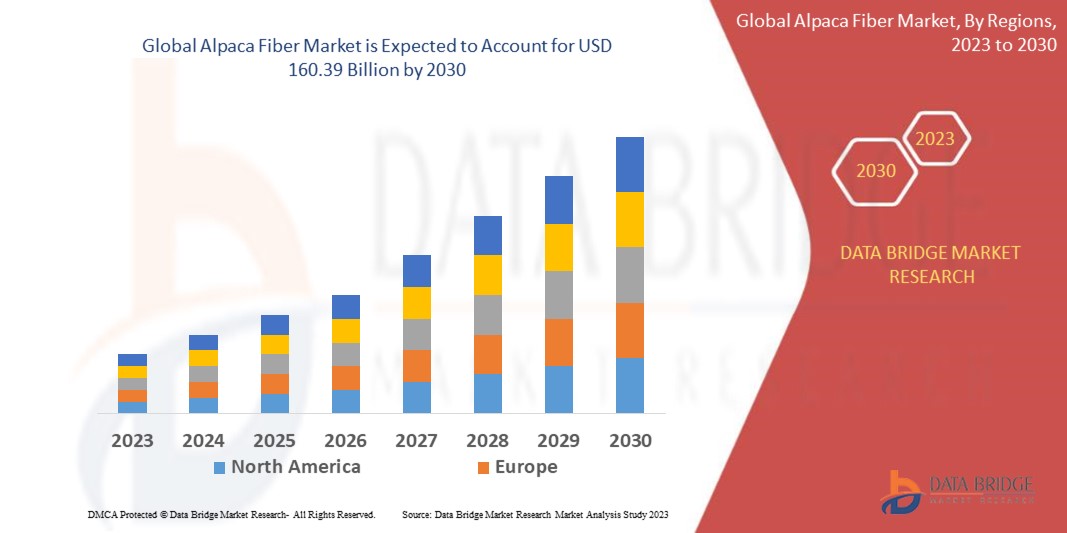
Alpaca Fiber Market Analysis and Size
The growing consumer demand for natural fashion accessories and clothing, increasing awareness amongst consumers regarding the product benefits, rapidly augmenting alpaca fiber fashion stores which offer the easy approachability of the products, increasing trends of highly sustainable and eco-friendly garments, rising standard of living of the people are some of the major as well as important factors which will likely to accelerate the growth of the alpaca fiber market. On the other hand, the increasing popularity in the fashion apparel industry and rising demand for warm and soft fiber will further contribute by generating immense opportunities that will lead to the growth of the alpaca fiber market in the forecasted period.
Data Bridge Market Research analyses that the global alpaca fiber market which was USD 119.94 Billion in 2022, would rocket up to USD 160.39 Billion by 2030, and is expected to undergo a CAGR of 3.20% during the forecast period. This indicates that the market value. The Apparels segment is expected to dominate the market due to the high demand for luxurious, soft, and warm alpaca fiber clothing products. In addition to the insights on market scenarios such as market value, growth rate, segmentation, geographical coverage, and major players, the market reports curated by the Data Bridge Market Research also include depth expert analysis, patient epidemiology, pipeline analysis, pricing analysis, and regulatory framework.
Alpaca Fiber Market Scope and Segmentation
|
Report Metric |
Details |
|
Forecast Period |
2023 to 2030 |
|
Base Year |
2023 |
|
Historic Years |
2021 (Customizable to 2015-2020) |
|
Quantitative Units |
Revenue in USD Billion, Volumes in Units, Pricing in USD |
|
Segments Covered |
Wool Type (Huacaya Fiber, Suri Fiber), Grade (Ultra Fine (Royal baby) (< 20 Microns), Superfine (Baby) (20-22.9 Microns), Fine (23-25.9 Microns), Medium (26-28.9 Microns), Intermediate (Adult) (29-32 Microns), Robust (32.1-35 Microns)), Application (Apparels, Interior Textiles, Floorings, Industrial Felting) |
|
Countries Covered |
U.S., Canada, Mexico, Brazil, Argentina, Rest of South America, Germany, France, Italy, U.K., Belgium, Spain, Russia, Turkey, Netherlands, Switzerland, Rest of Europe, Japan, China, India, South Korea, Australia, Singapore, Malaysia, Thailand, Indonesia, Philippines, Rest of Asia-Pacific, U.A.E, Saudi Arabia, Egypt, South Africa, Israel, Rest of Middle East and Africa |
|
Market Players Covered |
The Alpaca Yarn Company (United States), AHA Bolivia (Bolivia), New Era Fiber (United States), The Natural Fiber Company (United Kingdom), Coopecan (Bolivia), Zeilinger Wool Company (United States), Plymouth Yarn Company, Inc. (United States), Fil Katia (Spain), Cascade Yarns (United States), Malabrigo Yarn (Uruguay), AndeanSun Yarns (Peru), Berroco, Inc. (United States), Mary Maxim, Inc. (Canada), Laughing Hens (United Kingdom), Lion Brand Yarn (United States), Alpaca Owners Association, Inc. (United States), White Frost Farms (United States), Yarns and Fibers (YnFx) (India), Classi Alpaca (Peru), Altifibers S.A. (Peru). |
|
Market Opportunities |
|
Market Definition.
A natural fiber obtained from an alpaca is alpaca fiber. It's stronger, more hypoallergenic, lighter, warmer, and stretchable than fur. Compared to conventional wool, alpaca fiber is not scratchy, which gives the benefit of alpaca fiber so people who cannot wear sheep wool can wear alpaca fiber clothing. Alpaca fiber is considered to be one of the world's most luxurious and finest natural fiber, making it a common choice for leisure and lavish clothing.
Global Alpaca Fiber Market Dynamics
Drivers:
- Growing Demand for Sustainable and Ethical Fibers:
The global alpaca fiber market is driven by the increasing consumer preference for sustainable and ethical products. Alpaca fiber is known for its eco-friendliness, as alpacas have a low environmental impact compared to other livestock. This demand is bolstered by the rising awareness of the negative impacts of synthetic fibers on the environment.
- Increasing Awareness and Popularity of Alpaca Fiber Products:
Alpaca fiber products, such as clothing, accessories, and home textiles, are gaining popularity worldwide. The luxurious feel, exceptional softness, and natural warmth of alpaca fiber are highly appreciated by consumers. As awareness about the unique qualities of alpaca fiber grows, it drives the demand for alpaca-based products in the global market.
Opportunity:
- Expansion of Alpaca Fiber Market in Emerging Economies:
The alpaca fiber market presents significant growth opportunities in emerging economies. As disposable incomes rise and consumer preferences shift towards high-quality and sustainable products, emerging markets provide a large consumer base for alpaca fiber products. By tapping into these markets, alpaca fiber producers can expand their customer reach and boost their sales.
Restraints/Challenges:
- Limited Supply and Cost Constraints:
The global alpaca fiber market faces challenges related to the limited supply of alpaca fiber. Alpaca herds are smaller compared to other livestock, and the fiber yield per animal is relatively low. This limited supply can lead to higher prices, making alpaca fiber products more expensive for consumers. Additionally, factors such as fluctuations in alpaca population, weather conditions, and production costs can affect the availability and cost of alpaca fiber.
- Competition from Synthetic and Artificial Fibers:
The alpaca fiber market faces competition from synthetic fibers, which are often more affordable and readily available. Manufacturers of synthetic fibers continuously innovate to mimic the qualities of natural fibers, including alpaca. This poses a challenge for the alpaca fiber market in terms of maintaining its market share and highlighting the unique characteristics of alpaca fiber that set it apart from synthetic alternatives.
This alpaca fiber market report provides details of new recent developments, trade regulations, import-export analysis, production analysis, value chain optimization, market share, impact of domestic and localized market players, analyses opportunities in terms of emerging revenue pockets, changes in market regulations, strategic market growth analysis, market size, category market growths, application niches and dominance, product approvals, product launches, geographic expansions, technological innovations in the market. To gain more info on the Alpaca fiber market contact Data Bridge Market Research for an Analyst Brief, our team will help you take an informed market decision to achieve market growth.
Recent Development
- On November 2022, according to the article published by Dow Jones and Company, Inc., fallPaka is launching a new platform to include creators of sustainable products around the world which includes Alpaca fiber made products.
Global Alpaca Fiber Market Scope
The alpaca fiber market is segmented on the basis of wool type, grade and application. The growth amongst these segments will help you analyse meagre growth segments in the industries and provide the users with a valuable market overview and market insights to help them make strategic decisions for identifying core market applications.
Segments:
Type
- Huacaya fiber
- Suri fiber
Grade
- Ultra-fine (royal baby) (< 20 Microns)
- Superfine (baby) (20-22.9 Microns)
- Fine (23-25.9 Microns)
- Medium (26-28.9 Microns)
- Intermediate (adult) (29-32 Microns)
- Robust (32.1-35 Microns)
Application
- Apparels
- Interior Textiles
- Floorings
- Industrial Felting
ALPACA FIBER Market Regional Analysis/Insights
The alpaca fiber market is analysed and market size insights and trends are provided by country, wool type, grade, and application as referenced above.
The countries covered in the alpaca fiber market report are U.S., Canada and Mexico in North America, Germany, France, U.K., Netherlands, Switzerland, Belgium, Russia, Italy, Spain, Turkey, Rest of Europe in Europe, China, Japan, India, South Korea, Singapore, Malaysia, Australia, Thailand, Indonesia, Philippines, Rest of Asia-Pacific (APAC) in the Asia-Pacific (APAC), Saudi Arabia, U.A.E, Israel, Egypt, South Africa, Rest of Middle East and Africa (MEA) as a part of Middle East and Africa (MEA), Brazil, Argentina and Rest of South America as part of South America.
U.S. is expected to dominate the North America alpaca fiber market due to the increasing popularity of naturally sourced fabric, increasing the number of manufacturing activities along with rising preferences towards the usage of high quality products in the region. Asia-Pacific region is expected to hold the largest growth rate due to the adoption of groundbreaking strategies to enhance the growth of the market in the region.
The country section of the report also provides individual market impacting factors and changes in regulation in the market domestically that impacts the current and future trends of the market. Data points like down-stream and upstream value chain analysis, technical trends, and porter's five forces analysis, case studies are some of the pointers used to forecast the market scenario for individual countries. Also, the presence and availability of global brands and their challenges faced due to large or scarce competition from local and domestic brands, the impact of domestic tariffs, and trade routes are considered while providing forecast analysis of the country data.
Competitive Landscape and Global Alpaca fiber Market Share Analysis
The alpaca fiber market competitive landscape provides details by competitor. Details included are company overview, company financials, revenue generated, market potential, investment in research and development, new market initiatives, global presence, production sites and facilities, production capacities, company strengths and weaknesses, product launch, product width and breadth, application dominance. The above data points provided are only related to the companies' focus related to alpaca fiber market.
Some of the major players operating in the alpaca fiber market are:
- The Alpaca Yarn Company (United States)
- AHA Bolivia (Bolivia)
- New Era Fiber (United States)
- The Natural Fiber Company (United Kingdom)
- Coopecan (Bolivia)
- Zeilinger Wool Company (United States)
- Plymouth Yarn Company, Inc. (United States)
- Fil Katia (Spain)
- Cascade Yarns (United States)
- Malabrigo Yarn (Uruguay)
- AndeanSun Yarns (Peru)
- Berroco, Inc. (United States)
- Mary Maxim, Inc. (Canada)
- Laughing Hens (United Kingdom)
- Lion Brand Yarn (United States)
- Alpaca Owners Association, Inc. (United States)
- White Frost Farms (United States)
- Yarns and Fibers (YnFx) (India)
- Classi Alpaca (Peru)
- Altifibers S.A. (Peru)

- Interactive Data Analysis Dashboard
- Company Analysis Dashboard for high growth potential opportunities
- Research Analyst Access for customization & queries
- Competitor Analysis with Interactive dashboard
- Latest News, Updates & Trend analysis
- Harness the Power of Benchmark Analysis for Comprehensive Competitor Tracking
Table of Content
1 INTRODUCTION
1.1 OBJECTIVES OF THE STUDY
1.2 MARKET DEFINITION
1.3 OVERVIEW OF GLOBAL ALPACA FIBER MARKET
1.4 CURRENCY AND PRICING
1.5 LIMITATION
1.6 MARKETS COVERED
2 MARKET SEGMENTATION
2.1 KEY TAKEAWAYS
2.2 ARRIVING AT THE GLOBAL ALPACA FIBER MARKET SIZE
2.3 VENDOR POSITIONING GRID
2.4 MARKETS COVERED
2.5 GEOGRAPHIC SCOPE
2.6 YEARS CONSIDERED FOR THE STUDY
2.7 RESEARCH METHODOLOGY
2.8 TECHNOLOGY LIFE LINE CURVE
2.9 MULTIVARIATE MODELLING
2.1 PRIMARY INTERVIEWS WITH KEY OPINION LEADERS
2.11 DBMR MARKET POSITION GRID
2.12 MARKET APPLICATION COVERAGE GRID
2.13 DBMR MARKET CHALLENGE MATRIX
2.14 IMPORT AND EXPORT DATA
2.15 SECONDARY SOURCES
2.16 GLOBAL ALPACA FIBER MARKET : RESEARCH SNAPSHOT
2.17 ASSUMPTIONS
3 MARKET OVERVIEW
3.1 DRIVERS
3.2 RESTRAINTS
3.3 OPPORTUNITIES
3.4 CHALLENGES
4 EXECUTIVE SUMMARY
5 PREMIUM INSIGHTS
5.1 RAW MATERIAL COVERAGE
5.2 PRODUCTION CONSUMPTION ANALYSIS
5.3 IMPORT EXPORT SCENARIO
5.4 TECHNOLOGICAL ADVANCEMENT BY MANUFACTURERS
5.5 PORTER’S FIVE FORCES
5.6 VENDOR SELECTION CRITERIA
5.7 PESTEL ANALYSIS
5.8 REGULATION COVERAGE
5.8.1 PRODUCT CODES
5.8.2 CERTIFIED STANDARDS
5.8.3 SAFETY STANDARDS
5.8.3.1. MATERIAL HANDLING & STORAGE
5.8.3.2. TRANSPORT & PRECAUTIONS
5.8.3.3. HARAD IDENTIFICATION
6 PRICE INDEX
7 PRODUCTION CAPACITY OVERVIEW
8 SUPPLY CHAIN ANALYSIS
8.1 OVERVIEW
8.2 LOGISTIC COST SCENARIO
8.3 IMPORTANCE OF LOGISTICS SERVICE PROVIDERS
9 CLIMATE CHANGE SCENARIO
9.1 ENVIRONMENTAL CONCERNS
9.2 INDUSTRY RESPONSE
9.3 GOVERNMENT’S ROLE
9.4 ANALYST RECOMMENDATIONS
10 INDUSTRY INSIGHTS
11 GLOBAL ALPACA FIBER MARKET, BY WOOL TYPE, (2021-2030), (USD MILLION) (TONS)
11.1 OVERVIEW
11.2 HUACAYA FIBER
11.2.1 ASP
11.2.2 VALUE
11.2.3 VOLUME
11.2.4 BY PRODUCTS
11.2.4.1. HOME INSULATION
11.2.4.2. HIKING GEAR
11.2.4.3. SUMMER WEAR
11.2.4.4. DUVETS
11.2.4.5. THERMAL UNDERWEAR
11.2.4.6. DRYER BALLS
11.2.4.7. SOCKS
11.2.4.8. TOYS
11.2.4.9. FELTING
11.2.4.10. BABY CLOTHES
11.2.4.11. EXCLUSIVE FASHION
11.2.4.12. PONCHOS
11.2.4.13. RUANAS
11.2.4.14. COATS
11.2.4.15. KNITTING
11.2.4.16. SWEATERS
11.2.4.17. CARDIGANS
11.2.4.18. HATS
11.2.4.19. MITTENS
11.2.4.20. BLANKETS
11.2.4.21. SCARVES
11.2.4.22. COLLAR SCARVES
11.2.4.23. SHAWLS
11.3 SURI FIBER
11.3.1 ASP
11.3.2 VALUE
11.3.3 VOLUME
11.3.4 BY PRODUCTS
11.3.4.1. HOME INSULATION
11.3.4.2. HIKING GEAR
11.3.4.3. SUMMER WEAR
11.3.4.4. DUVETS
11.3.4.5. THERMAL UNDERWEAR
11.3.4.6. DRYER BALLS
11.3.4.7. SOCKS
11.3.4.8. TOYS
11.3.4.9. FELTING
11.3.4.10. BABY CLOTHES
11.3.4.11. EXCLUSIVE FASHION
11.3.4.12. PONCHOS
11.3.4.13. RUANAS
11.3.4.14. COATS
11.3.4.15. KNITTING
11.3.4.16. SWEATERS
11.3.4.17. CARDIGANS
11.3.4.18. HATS
11.3.4.19. MITTENS
11.3.4.20. BLANKETS
11.3.4.21. SCARVES
11.3.4.22. COLLAR SCARVES
11.3.4.23. SHAWLS
12 GLOBAL ALPACA FIBER MARKET, BY GRADE, (2021-2030), (USD MILLION)
12.1 OVERVIEW
12.2 ULTRA FINE (ROYAL BABY) (< 20 MICRONS)
12.3 SUPERFINE (BABY) (20-22.9 MICRONS)
12.4 FINE (23-25.9 MICRONS)
12.5 MEDIUM (26-28.9 MICRONS)
12.6 INTERMEDIATE (ADULT) (29-32 MICRONS)
12.7 ROBUST (32.1-35 MICRONS)
13 GLOBAL ALPACA FIBER MARKET, BY APPLICATION, (2021-2030), (USD MILLION)
13.1 OVERVIEW
13.2 APPARELS
13.2.1 BY WOOL TYPE
13.2.1.1. HUACAYA FIBER
13.2.1.2. SURI FIBER
13.2.2 BY GRADE
13.2.2.1. ULTRA FINE (ROYAL BABY) (< 20 MICRONS)
13.2.2.2. SUPERFINE (BABY) (20-22.9 MICRONS)
13.2.2.3. FINE (23-25.9 MICRONS)
13.2.2.4. MEDIUM (26-28.9 MICRONS)
13.2.2.5. INTERMEDIATE (ADULT) (29-32 MICRONS)
13.2.2.6. ROBUST (32.1-35 MICRONS)
13.3 INTERIOR TEXTILES
13.3.1 BY WOOL TYPE
13.3.1.1. HUACAYA FIBER
13.3.1.2. SURI FIBER
13.3.2 BY GRADE
13.3.2.1. ULTRA FINE (ROYAL BABY) (< 20 MICRONS)
13.3.2.2. SUPERFINE (BABY) (20-22.9 MICRONS)
13.3.2.3. FINE (23-25.9 MICRONS)
13.3.2.4. MEDIUM (26-28.9 MICRONS)
13.3.2.5. INTERMEDIATE (ADULT) (29-32 MICRONS)
13.3.2.6. ROBUST (32.1-35 MICRONS)
13.4 FLOORINGS
13.4.1 BY WOOL TYPE
13.4.1.1. HUACAYA FIBER
13.4.1.2. SURI FIBER
13.4.2 BY GRADE
13.4.2.1. ULTRA FINE (ROYAL BABY) (< 20 MICRONS)
13.4.2.2. SUPERFINE (BABY) (20-22.9 MICRONS)
13.4.2.3. FINE (23-25.9 MICRONS)
13.4.2.4. MEDIUM (26-28.9 MICRONS)
13.4.2.5. INTERMEDIATE (ADULT) (29-32 MICRONS)
13.4.2.6. ROBUST (32.1-35 MICRONS)
13.5 INDUSTRIAL FELTING
13.5.1 BY WOOL TYPE
13.5.1.1. HUACAYA FIBER
13.5.1.2. SURI FIBER
13.5.2 BY GRADE
13.5.2.1. ULTRA FINE (ROYAL BABY) (< 20 MICRONS)
13.5.2.2. SUPERFINE (BABY) (20-22.9 MICRONS)
13.5.2.3. FINE (23-25.9 MICRONS)
13.5.2.4. MEDIUM (26-28.9 MICRONS)
13.5.2.5. INTERMEDIATE (ADULT) (29-32 MICRONS)
13.5.2.6. ROBUST (32.1-35 MICRONS)
14 GLOBAL ALPACA FIBER MARKET , BY GEOGRAPHY
GLOBAL ALPACA FIBER MARKET , (ALL SEGMENTATION PROVIDED ABOVE IS REPRESENTED IN THIS CHAPTER BY COUNTRY)
14.1 NORTH AMERICA
14.1.1 U.S.
14.1.2 CANADA
14.1.3 MEXICO
14.2 EUROPE
14.2.1 GERMANY
14.2.2 U.K.
14.2.3 ITALY
14.2.4 FRANCE
14.2.5 SPAIN
14.2.6 SWITZERLAND
14.2.7 RUSSIA
14.2.8 TURKEY
14.2.9 BELGIUM
14.2.10 NETHERLANDS
14.2.11 REST OF EUROPE
14.3 ASIA-PACIFIC
14.3.1 JAPAN
14.3.2 CHINA
14.3.3 SOUTH KOREA
14.3.4 INDIA
14.3.5 SINGAPORE
14.3.6 THAILAND
14.3.7 INDONESIA
14.3.8 MALAYSIA
14.3.9 PHILIPPINES
14.3.10 AUSTRALIA AND NEW ZEALAND
14.3.11 HONG KONG
14.3.12 TAIWAN
14.3.13 REST OF ASIA-PACIFIC
14.4 SOUTH AMERICA
14.4.1 BRAZIL
14.4.2 ARGENTINA
14.4.3 REST OF SOUTH AMERICA
14.5 MIDDLE EAST AND AFRICA
14.5.1 SOUTH AFRICA
14.5.2 EGYPT
14.5.3 SAUDI ARABIA
14.5.4 UNITED ARAB EMIRATES
14.5.5 ISRAEL
14.5.6 REST OF MIDDLE EAST AND AMERICA
15 GLOBAL ALPACA FIBER MARKET , COMPANY LANDSCAPE
15.1 COMPANY SHARE ANALYSIS: GLOBAL
15.2 COMPANY SHARE ANALYSIS: NORTH AMERICA
15.3 COMPANY SHARE ANALYSIS: EUROPE
15.4 COMPANY SHARE ANALYSIS: ASIA-PACIFIC
15.5 MERGERS & ACQUISITIONS
15.6 NEW PRODUCT DEVELOPMENT & APPROVALS
15.7 EXPANSIONS
15.8 REGULATORY CHANGES
15.9 PARTNERSHIP AND OTHER STRATEGIC DEVELOPMENTS
16 SWOT ANALYSIS AND DATA BRIDGE MARKET RESEARCH ANALYSIS
17 GLOBAL ALPACA FIBER MARKET - COMPANY PROFILE
17.1 THE ALPACA YARN COMPANY
17.1.1 COMPANY SNAPSHOT
17.1.2 PRODUCT PORTFOLIO
17.1.3 SWOT ANALYSIS
17.1.4 REVENUE ANALYSIS
17.1.5 RECENT UPDATES
17.2 AHA BOLIVIA.
17.2.1 COMPANY SNAPSHOT
17.2.2 PRODUCT PORTFOLIO
17.2.3 SWOT ANALYSIS
17.2.4 REVENUE ANALYSIS
17.2.5 RECENT UPDATES
17.3 NEW ERA FIBER
17.3.1 COMPANY SNAPSHOT
17.3.2 PRODUCT PORTFOLIO
17.3.3 SWOT ANALYSIS
17.3.4 REVENUE ANALYSIS
17.3.5 RECENT UPDATES
17.4 THE NATURAL FIBRE COMPANY
17.4.1 COMPANY SNAPSHOT
17.4.2 PRODUCT PORTFOLIO
17.4.3 SWOT ANALYSIS
17.4.4 REVENUE ANALYSIS
17.4.5 RECENT UPDATES
17.5 COOPECAN
17.5.1 COMPANY SNAPSHOT
17.5.2 PRODUCT PORTFOLIO
17.5.3 SWOT ANALYSIS
17.5.4 REVENUE ANALYSIS
17.5.5 RECENT UPDATES
17.6 ZEILINGER WOOL COMPANY
17.6.1 COMPANY SNAPSHOT
17.6.2 PRODUCT PORTFOLIO
17.6.3 SWOT ANALYSIS
17.6.4 REVENUE ANALYSIS
17.6.5 RECENT UPDATES
17.7 PLYMOUTH YARN COMPANY, INC.
17.7.1 COMPANY SNAPSHOT
17.7.2 PRODUCT PORTFOLIO
17.7.3 SWOT ANALYSIS
17.7.4 REVENUE ANALYSIS
17.7.5 RECENT UPDATES
17.8 FIL KATIA
17.8.1 COMPANY SNAPSHOT
17.8.2 PRODUCT PORTFOLIO
17.8.3 SWOT ANALYSIS
17.8.4 REVENUE ANALYSIS
17.8.5 RECENT UPDATES
17.9 CASCADE YARNS
17.9.1 COMPANY SNAPSHOT
17.9.2 PRODUCT PORTFOLIO
17.9.3 SWOT ANALYSIS
17.9.4 REVENUE ANALYSIS
17.9.5 RECENT UPDATES
17.1 MALABRIGO YARN
17.10.1 COMPANY SNAPSHOT
17.10.2 PRODUCT PORTFOLIO
17.10.3 SWOT ANALYSIS
17.10.4 REVENUE ANALYSIS
17.10.5 RECENT UPDATES
17.11 ANDEANSUN YARNS
17.11.1 COMPANY SNAPSHOT
17.11.2 PRODUCT PORTFOLIO
17.11.3 SWOT ANALYSIS
17.11.4 REVENUE ANALYSIS
17.11.5 RECENT UPDATES
17.12 BERROCO, INC
17.12.1 COMPANY SNAPSHOT
17.12.2 PRODUCT PORTFOLIO
17.12.3 SWOT ANALYSIS
17.12.4 REVENUE ANALYSIS
17.12.5 RECENT UPDATES
17.13 MARY MAXIM, INC.
17.13.1 COMPANY SNAPSHOT
17.13.2 PRODUCT PORTFOLIO
17.13.3 SWOT ANALYSIS
17.13.4 REVENUE ANALYSIS
17.13.5 RECENT UPDATES
17.14 LAUGHING HENS
17.14.1 COMPANY SNAPSHOT
17.14.2 PRODUCT PORTFOLIO
17.14.3 SWOT ANALYSIS
17.14.4 REVENUE ANALYSIS
17.14.5 RECENT UPDATES
17.15 LION BRAND YARN
17.15.1 COMPANY SNAPSHOT
17.15.2 PRODUCT PORTFOLIO
17.15.3 SWOT ANALYSIS
17.15.4 REVENUE ANALYSIS
17.15.5 RECENT UPDATES
17.16 ALPACA OWNERS ASSOCIATION, INC.
17.16.1 COMPANY SNAPSHOT
17.16.2 PRODUCT PORTFOLIO
17.16.3 SWOT ANALYSIS
17.16.4 REVENUE ANALYSIS
17.16.5 RECENT UPDATES
17.17 WHITE FROST FARMS
17.17.1 COMPANY SNAPSHOT
17.17.2 PRODUCT PORTFOLIO
17.17.3 SWOT ANALYSIS
17.17.4 REVENUE ANALYSIS
17.17.5 RECENT UPDATES
17.18 YARNS AND FIBERS (YNFX)
17.18.1 COMPANY SNAPSHOT
17.18.2 PRODUCT PORTFOLIO
17.18.3 SWOT ANALYSIS
17.18.4 REVENUE ANALYSIS
17.18.5 RECENT UPDATES
17.19 CLASSI ALPACA.
17.19.1 COMPANY SNAPSHOT
17.19.2 PRODUCT PORTFOLIO
17.19.3 SWOT ANALYSIS
17.19.4 REVENUE ANALYSIS
17.19.5 RECENT UPDATES
17.2 ALTIFIBERS S.A.
17.20.1 COMPANY SNAPSHOT
17.20.2 PRODUCT PORTFOLIO
17.20.3 SWOT ANALYSIS
17.20.4 REVENUE ANALYSIS
17.20.5 RECENT UPDATES
18 QUESTIONNAIRE
19 CONCLUSION
20 RELATED REPORTS
21 ABOUT DATA BRIDGE MARKET RESEARCH

Global Alpaca Fiber Market, Supply Chain Analysis and Ecosystem Framework
To support market growth and help clients navigate the impact of geopolitical shifts, DBMR has integrated in-depth supply chain analysis into its Global Alpaca Fiber Market research reports. This addition empowers clients to respond effectively to global changes affecting their industries. The supply chain analysis section includes detailed insights such as Global Alpaca Fiber Market consumption and production by country, price trend analysis, the impact of tariffs and geopolitical developments, and import and export trends by country and HSN code. It also highlights major suppliers with data on production capacity and company profiles, as well as key importers and exporters. In addition to research, DBMR offers specialized supply chain consulting services backed by over a decade of experience, providing solutions like supplier discovery, supplier risk assessment, price trend analysis, impact evaluation of inflation and trade route changes, and comprehensive market trend analysis.
Data collection and base year analysis are done using data collection modules with large sample sizes. The stage includes obtaining market information or related data through various sources and strategies. It includes examining and planning all the data acquired from the past in advance. It likewise envelops the examination of information inconsistencies seen across different information sources. The market data is analysed and estimated using market statistical and coherent models. Also, market share analysis and key trend analysis are the major success factors in the market report. To know more, please request an analyst call or drop down your inquiry.
The key research methodology used by DBMR research team is data triangulation which involves data mining, analysis of the impact of data variables on the market and primary (industry expert) validation. Data models include Vendor Positioning Grid, Market Time Line Analysis, Market Overview and Guide, Company Positioning Grid, Patent Analysis, Pricing Analysis, Company Market Share Analysis, Standards of Measurement, Global versus Regional and Vendor Share Analysis. To know more about the research methodology, drop in an inquiry to speak to our industry experts.
Data Bridge Market Research is a leader in advanced formative research. We take pride in servicing our existing and new customers with data and analysis that match and suits their goal. The report can be customized to include price trend analysis of target brands understanding the market for additional countries (ask for the list of countries), clinical trial results data, literature review, refurbished market and product base analysis. Market analysis of target competitors can be analyzed from technology-based analysis to market portfolio strategies. We can add as many competitors that you require data about in the format and data style you are looking for. Our team of analysts can also provide you data in crude raw excel files pivot tables (Fact book) or can assist you in creating presentations from the data sets available in the report.













