


Global Aluminum Cans Market
Market Size in USD Billion
CAGR :
% 
 USD
56.39 Billion
USD
77.76 Billion
2025
2033
USD
56.39 Billion
USD
77.76 Billion
2025
2033
 Forecast Period Forecast Period |
2026 –2033 |
 Market Size (Base Year) Market Size (Base Year) |
USD 56.39 Billion |
 Market Size (Forecast Year) Market Size (Forecast Year) |
USD 77.76 Billion |
 CAGR CAGR |
% |
| Major Markets Players |
|
Aluminum Cans Market Size
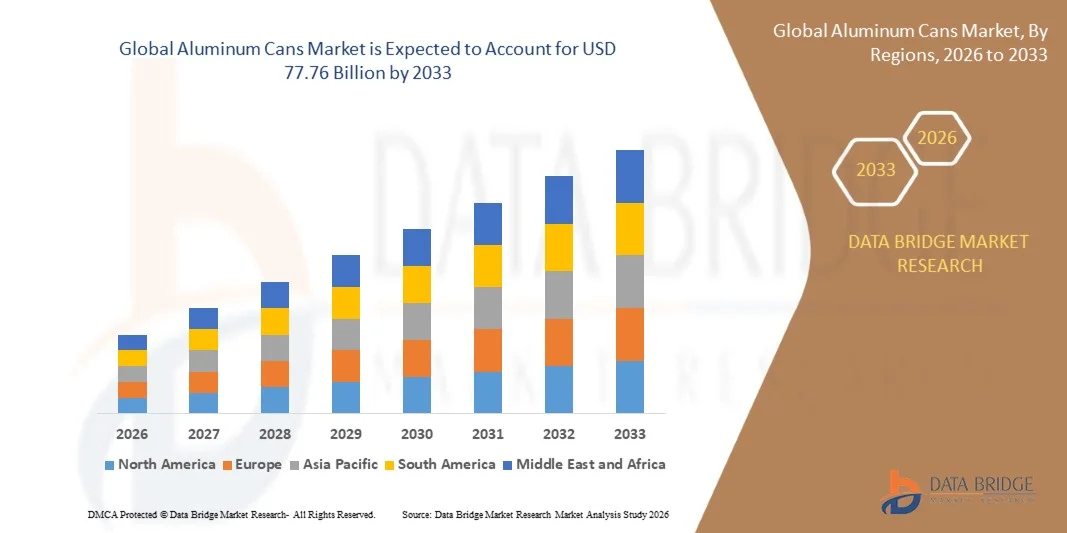
- The global aluminum cans market size was valued at USD 56.39 billion in 2025 and is expected to reach USD 77.76 billion by 2033, at a CAGR of 4.10% during the forecast period
- The market growth is largely fueled by the rising global consumption of beverages and packaged foods, driving increased adoption of aluminum cans as a preferred packaging solution for both carbonated and non-carbonated products
- Furthermore, growing consumer preference for sustainable, lightweight, and recyclable packaging is encouraging manufacturers to shift from traditional materials such as glass and plastic to aluminum, thereby accelerating the uptake of aluminum cans and significantly boosting market growth
Aluminum Cans Market Analysis
- Aluminum cans, offering lightweight, durable, and recyclable packaging for beverages, food, and personal care products, are increasingly preferred by manufacturers and consumers due to their convenience, portability, and extended shelf life
- The escalating demand for aluminum cans is primarily fueled by increasing urbanization, rising on-the-go consumption trends, and growing emphasis on eco-friendly packaging solutions, coupled with innovations in can design and manufacturing technologies
- Asia-Pacific dominated the aluminum cans market with a share of 41.73% in 2025, due to rapid growth in the beverage and food sectors, expanding manufacturing facilities, and a strong presence of packaging suppliers
- North America is expected to be the fastest growing region in the aluminum cans market during the forecast period due to increasing demand for beverages, rising awareness of recyclable packaging, and expansion of food and beverage processing units
- 2-piece cans segment dominated the market with a market share of 66.71% in 2025, due to its widespread application in beverage packaging and ease of mass production. Two-piece cans provide excellent barrier properties against light and oxygen, preserving product flavor and quality over time. Their seamless construction reduces contamination risk and supports high-speed filling lines, making them suitable for large-scale operations. Manufacturers rely on 2-piece cans for soft drinks, beers, and energy drinks as they ensure consistency and durability. The segment also enjoys strong supply chain availability and cost efficiency, contributing to its dominant position
Report Scope and Aluminum Cans Market Segmentation
|
Attributes |
Aluminum Cans Key Market Insights |
|
Segments Covered |
|
|
Countries Covered |
North America
Europe
Asia-Pacific
Middle East and Africa
South America
|
|
Key Market Players |
|
|
Market Opportunities |
|
|
Value Added Data Infosets |
In addition to the insights on market scenarios such as market value, growth rate, segmentation, geographical coverage, and major players, the market reports curated by the Data Bridge Market Research also include import export analysis, production capacity overview, production consumption analysis, price trend analysis, climate change scenario, supply chain analysis, value chain analysis, raw material/consumables overview, vendor selection criteria, PESTLE Analysis, Porter Analysis, and regulatory framework. |
Aluminum Cans Market Trends
“Rising Adoption of Sustainable and Eco-Friendly Packaging”
- A significant trend in the aluminum cans market is the increasing adoption of sustainable and eco-friendly packaging solutions, driven by growing consumer awareness of environmental impact and corporate commitments to circular economy practices. Aluminum cans are lightweight, infinitely recyclable, and require less energy to transport compared with glass or plastic alternatives, which positions them as a preferred choice across beverage, food, and personal care industries
- For instance, Ball Corporation and Crown are actively promoting 100% recyclable aluminum cans in North America and Europe, enhancing brand sustainability credentials while meeting regulatory requirements and consumer expectations. Such initiatives are encouraging beverage manufacturers to shift from PET bottles and glass containers to aluminum cans, reinforcing market growth
- The trend is further fueled by government policies and initiatives supporting sustainable packaging, such as the European Union’s Circular Economy Action Plan, which emphasizes the use of recyclable materials and reduction of packaging waste. These policies, combined with corporate sustainability commitments, are driving adoption across mass-market and premium product line
- The growing preference for canned beverages in urban and on-the-go consumption segments also supports this trend, as aluminum cans are portable, durable, and maintain product quality, carbonation, and freshness. Sustainability-focused marketing by major brands, including Coca-Cola and PepsiCo, is further elevating the perception of aluminum cans as environmentally responsible packaging
- The rise in craft beverages, energy drinks, and ready-to-drink alcoholic products packaged in aluminum cans is enhancing adoption of eco-friendly cans, as these products often target younger, environmentally conscious consumers. This demographic shift is accelerating demand for premium, recyclable packaging and encouraging manufacturers to explore innovative can designs
- In addition, technological advancements in can production, such as thinner gauge cans and lightweight manufacturing processes, are reducing material consumption without compromising durability. These developments are supporting broader sustainability goals and driving market growth
Aluminum Cans Market Dynamics
Driver
“Growing Global Demand for Packaged Beverages and Convenience Foods”
- The global rise in consumption of packaged beverages and convenience foods is a major driver for the aluminum cans market, as manufacturers increasingly rely on cans to deliver product quality, shelf life, and portability. Aluminum cans offer superior preservation of carbonation, flavor, and aroma in beverages, while being lightweight and suitable for automated filling lines, which improves operational efficiency
- For instance, Coca-Cola has expanded its use of aluminum cans across global markets to meet growing soft drink demand, while PepsiCo and Red Bull continue to introduce innovative canned beverage formats to satisfy rising on-the-go consumption trends. Such initiatives are accelerating adoption and reinforcing aluminum cans as a key packaging medium in the food and beverage sector
- Urbanization, increasing disposable incomes, and shifting consumer lifestyles are further fueling demand for ready-to-drink (RTD) beverages and snackable food items packaged in cans. Aluminum cans provide convenience, portability, and portion-controlled servings, aligning with modern consumption habits
- The expanding e-commerce and retail distribution networks are also boosting the demand for durable, transport-friendly aluminum cans that withstand logistical challenges. This is encouraging manufacturers to invest in can production capacity and design innovations
- Growth in emerging markets across Asia-Pacific and Latin America, where consumption of beverages and convenience foods is rapidly increasing, is further supporting market expansion. Rising consumer awareness of hygiene and product safety also favors aluminum cans over alternative packaging
Restraint/Challenge
“Volatility in Aluminum Raw Material Prices”
- The aluminum cans market faces challenges due to the volatility of raw aluminum prices, which are influenced by fluctuations in global commodity markets, energy costs, and supply-demand imbalances. Price instability can increase production costs for manufacturers, limiting profit margins and impacting overall market growth
- For instance, the global surge in aluminum prices during 2022–2023 affected production costs for companies such as Ball Corporation and Crown, prompting adjustments in pricing strategies and contract negotiations with beverage producers. Such volatility creates uncertainty for both producers and end users, affecting long-term planning and investment in can production capacity
- The reliance on bauxite-derived aluminum and energy-intensive production processes exposes manufacturers to additional cost pressures from regulatory changes, tariffs, and import-export dynamics. Maintaining competitiveness while managing raw material price fluctuations remains a critical challenge for the industry
- Supply chain disruptions and geopolitical factors impacting aluminum availability further exacerbate cost instability. Companies must balance the need for high-quality, sustainable cans with economic feasibility, which can constrain growth and innovation in certain markets
- The challenge of raw material price volatility continues to influence procurement strategies, pricing policies, and investment decisions, emphasizing the importance of risk management and diversification in the aluminum cans supply chain
Aluminum Cans Market Scope
The market is segmented on the basis of type, product type, capacity, and end user.
• By Type
On the basis of type, the aluminum cans market is segmented into slim, sleek, and standard. The standard cans segment dominated the market with the largest revenue share in 2025, driven by its widespread usage in beverages and food packaging due to durability and cost-effectiveness. Manufacturers prefer standard cans for their ability to maintain product quality, prevent contamination, and ensure longer shelf life. The segment also benefits from established production lines and global supply chains, making it a reliable choice for large-scale commercial operations. Standard cans are compatible with various filling and sealing technologies, enhancing operational efficiency. Slim and sleek cans are gaining attention for premium and specialty products but standard cans retain dominance due to mass-market demand and versatility.
The sleek cans segment is anticipated to witness the fastest growth rate from 2026 to 2033, fueled by rising consumer preference for aesthetically appealing packaging in beverages and personal care products. Sleek cans are often used in craft beverages, energy drinks, and limited-edition products, providing brand differentiation and shelf visibility. For instance, companies such as Coca-Cola have introduced sleek aluminum cans for select beverage lines to attract younger consumers. The lightweight nature and convenient portability of sleek cans also support on-the-go consumption trends. Increasing marketing campaigns emphasizing premium packaging further accelerate adoption in competitive markets. Sleek cans are also favored for their recyclability, aligning with sustainability initiatives across the packaging industry.
• By Product Type
On the basis of product type, the aluminum cans market is segmented into 1-piece, 2-piece, and 3-piece cans. The 2-piece cans segment dominated the market with the largest share of 66.71% in 2025 due to its widespread application in beverage packaging and ease of mass production. Two-piece cans provide excellent barrier properties against light and oxygen, preserving product flavor and quality over time. Their seamless construction reduces contamination risk and supports high-speed filling lines, making them suitable for large-scale operations. Manufacturers rely on 2-piece cans for soft drinks, beers, and energy drinks as they ensure consistency and durability. The segment also enjoys strong supply chain availability and cost efficiency, contributing to its dominant position.
The 3-piece cans segment is expected to witness the fastest growth from 2026 to 2033, driven by increasing adoption in food packaging such as canned soups, vegetables, and pet food. For instance, companies such as Nestlé use 3-piece aluminum cans for convenient, long-lasting food products. Three-piece cans offer flexibility in can dimensions and are suitable for specialized product formats. Growth is also supported by innovations in coating and lining technologies that enhance food safety. Rising demand for convenient, ready-to-eat meals in urban markets further boosts the segment. 3-piece cans also support easy customization, providing branding opportunities for manufacturers and retailers.
• By Capacity
On the basis of capacity, the aluminum cans market is segmented into up to 200ml, 201-450ml, 451-700ml, 700-1000ml, and more than 1000ml. The 201-450ml segment dominated the market in 2025, driven by its suitability for standard beverage servings, including soft drinks, beer, and energy drinks. This capacity aligns with consumer preferences for single-serve packaging while maintaining cost efficiency and production scalability. Manufacturers prioritize this segment for its balance between portability and consumption convenience. The 201-450ml cans also integrate seamlessly with automated filling and labeling lines, supporting operational efficiency. Consumer familiarity and widespread retail availability reinforce dominance in this category.
The up to 200ml segment is anticipated to witness the fastest growth from 2026 to 2033, fueled by the rising trend of on-the-go beverages and single-serve personal care products. For instance, Red Bull has popularized smaller aluminum cans for energy drinks targeting convenience-driven consumers. Compact cans reduce material usage, contributing to sustainability initiatives, and appeal to health-conscious consumers monitoring portion sizes. Growth is supported by increasing adoption in travel retail, vending machines, and premium sample packs. Packaging designers favor this capacity for product innovation and seasonal campaigns. The segment’s lightweight and portable nature make it ideal for outdoor and convenience-focused consumption trends.
• By End User
On the basis of end user, the aluminum cans market is segmented into food, beverages, personal care and cosmetics, pharmaceuticals, and paints and lubricants. The beverages segment dominated the market in 2025 due to strong global consumption of soft drinks, energy drinks, and alcoholic beverages packaged in aluminum cans. Beverage cans provide effective preservation of carbonation, flavor, and aroma, ensuring product quality for consumers. The segment also benefits from established production infrastructure, extensive distribution channels, and brand-driven marketing strategies. Companies invest heavily in aluminum cans for beverages due to their recyclability and sustainability appeal. Consumer preference for convenient, portable, and single-serve packaging reinforces the segment’s dominance.
The personal care and cosmetics segment is expected to witness the fastest growth from 2026 to 2033, driven by increasing use of aluminum cans for products such as deodorants, hairsprays, and skincare items. For instance, L’Oréal has adopted aluminum aerosol cans for select cosmetic lines to enhance premium perception and sustainability credentials. Aluminum cans provide superior product protection against contamination and extend shelf life for sensitive formulations. Rising consumer awareness about eco-friendly packaging encourages brands to shift from plastics to aluminum. The lightweight nature and customizable designs of aluminum cans support brand differentiation and marketing campaigns. Expanding urban markets and premium product launches further propel segment growth.
Aluminum Cans Market Regional Analysis
- Asia-Pacific dominated the aluminum cans market with the largest revenue share of 41.73% in 2025, driven by rapid growth in the beverage and food sectors, expanding manufacturing facilities, and a strong presence of packaging suppliers
- The region’s cost-effective production landscape, increasing foreign investments in packaging technology, and growing exports of packaged beverages are accelerating market expansion
- Availability of skilled labor, supportive government policies, and rising urbanization across developing economies are contributing to increased demand for aluminum cans in both food and beverage applications
China Aluminum Cans Market Insight
China held the largest share in the Asia-Pacific aluminum cans market in 2025, owing to its position as a leading producer of beverages and canned foods. The country’s extensive manufacturing base, investments in advanced can-making technologies, and strong export capabilities are major growth drivers. Demand is further bolstered by rapid urban consumption growth and expansion of e-commerce channels distributing packaged beverages and food products.
India Aluminum Cans Market Insight
India is witnessing the fastest growth in the Asia-Pacific region, fueled by rising consumption of soft drinks, energy drinks, and ready-to-eat food products. For instance, Coca-Cola and PepsiCo have been expanding production capacities using aluminum cans for domestic distribution. Government initiatives promoting sustainable packaging and growing investments in food and beverage manufacturing are strengthening market demand. Increasing awareness of recyclability and eco-friendly packaging solutions is also supporting robust market expansion.
Europe Aluminum Cans Market Insight
The Europe aluminum cans market is expanding steadily, supported by high demand for packaged beverages, strict sustainability regulations, and growing investments in lightweight and recyclable packaging. The region emphasizes quality, environmental compliance, and advanced design in beverage and food cans. Rising demand for craft beverages, premium drinks, and innovative packaging solutions is further enhancing market growth.
Germany Aluminum Cans Market Insight
Germany’s aluminum cans market is driven by its well-established beverage and food manufacturing industries, advanced production technologies, and strong export orientation. The country focuses on high-quality, sustainable packaging solutions, particularly in beer, energy drinks, and soft drinks. Demand is strong for premium and customized aluminum cans supporting brand differentiation and marketing campaigns.
U.K. Aluminum Cans Market Insight
The U.K. market is supported by mature beverage and food industries, increasing consumer preference for recyclable packaging, and rising adoption of premium beverage cans. For instance, Diageo and other beverage manufacturers are investing in aluminum can packaging for ready-to-drink beverages. Investments in innovative can designs, marketing campaigns, and sustainable packaging solutions are boosting market growth.
North America Aluminum Cans Market Insight
North America is projected to grow at the fastest CAGR from 2026 to 2033, driven by increasing demand for beverages, rising awareness of recyclable packaging, and expansion of food and beverage processing units. For instance, Anheuser-Busch and PepsiCo are increasing their use of aluminum cans for soft drinks, beer, and energy drinks. Growing focus on sustainability, lightweight packaging, and convenience is further boosting market adoption.
U.S. Aluminum Cans Market Insight
The U.S. accounted for the largest share in the North America aluminum cans market in 2025, underpinned by a strong beverage industry, advanced production infrastructure, and high consumer acceptance of canned beverages. Demand is supported by innovations in can design, marketing of ready-to-drink products, and expansion of premium beverage lines. Presence of key manufacturers, established distribution channels, and increasing preference for sustainable packaging solutions solidify the U.S.'s leading position in the region.
Aluminum Cans Market Share
The aluminum cans industry is primarily led by well-established companies, including:
- Ball Corporation (U.S.)
- Crown (U.K.)
- Ardagh Group S.A. (Luxembourg)
- Silgan Containers (U.S.)
- Toyo Seikan Group Holdings, Ltd. (Japan)
- Alucon (Netherlands)
- CCL Industries (Canada)
- Tubex Aluminium Tubes (Germany)
- Linhardt (Denmark)
- Montebello Packaging (Italy)
- Toyo Seikan Co., Ltd. (Japan)
- Alltub (France)
- CANPACK (Poland)
- Visy (Australia)
- Casablanca Industries Pvt Ltd. (India)
- Akshar Products (India)
Latest Developments in Global Aluminum Cans Market
- In May 2025, Crown added a high-speed production line in Ponta Grossa, Brazil, to meet the rising beverage demand across Latin America. This expansion significantly boosts the company’s manufacturing capacity, enabling faster production cycles and improved operational efficiency. The enhanced capacity allows Crown to better serve both large-scale beverage manufacturers and emerging local brands, strengthening its market presence in Latin America. This move also supports the region’s growing consumption of canned beverages, ensuring timely supply and reducing potential bottlenecks in the supply chain
- In January 2025, Ball Corporation acquired Florida Can Manufacturing, enhancing its supply chain capabilities in the southeastern United States. This acquisition enables Ball to expand its production footprint, ensuring quicker turnaround times and improved responsiveness to regional demand fluctuations. Beverage producers benefit from more reliable and localized supply, reducing dependency on distant manufacturing sites. In addition, the move strengthens Ball Corporation’s competitive edge in the U.S. aluminum cans market by increasing production flexibility, supporting both standard and specialty can formats
- In January 2025, the U.S. Alcohol and Tobacco Tax and Trade Bureau updated its standards of fill to include aluminum can sizes for wine and distilled spirits. This regulatory change opens new market opportunities for aluminum can manufacturers, allowing them to cater to premium alcoholic beverage segments with innovative can formats. Beverage companies can now explore smaller or specialty cans for ready-to-drink products, driving demand for lightweight, sustainable packaging solutions. The move is expected to stimulate growth in both premium and emerging drink categories, encouraging product differentiation and market expansion
- In November 2024, Ball Corporation completed the acquisition of Alucan, expanding its impact-extruded aerosol can capacity in Spain and Belgium. This acquisition strengthens Ball’s position in the European market, particularly for aerosol products in personal care, cosmetics, and specialty beverages. It also enhances the company’s ability to serve regional manufacturers with faster production and supply capabilities. The strategic expansion supports innovation in can designs and enables the company to meet increasing demand for high-quality, durable, and sustainable aluminum cans across multiple European markets
- In October 2024, Arnest Packaging unveiled a USD 100 million greenfield aluminum can plant to tackle regional supply shortages. This investment substantially increases local production capacity, reduces reliance on imports, and ensures steady supply for beverage and food manufacturers. The facility supports the growing demand for eco-friendly, recyclable aluminum cans while providing opportunities for regional brands to scale production. By improving supply chain efficiency and production reliability, Arnest Packaging strengthens its market position and contributes to the overall growth and stability of the regional aluminum cans industry
SKU-
Get online access to the report on the World's First Market Intelligence Cloud

- Interactive Data Analysis Dashboard
- Company Analysis Dashboard for high growth potential opportunities
- Research Analyst Access for customization & queries
- Competitor Analysis with Interactive dashboard
- Latest News, Updates & Trend analysis
- Harness the Power of Benchmark Analysis for Comprehensive Competitor Tracking
Global Aluminum Cans Market, Supply Chain Analysis and Ecosystem Framework
To support market growth and help clients navigate the impact of geopolitical shifts, DBMR has integrated in-depth supply chain analysis into its Global Aluminum Cans Market research reports. This addition empowers clients to respond effectively to global changes affecting their industries. The supply chain analysis section includes detailed insights such as Global Aluminum Cans Market consumption and production by country, price trend analysis, the impact of tariffs and geopolitical developments, and import and export trends by country and HSN code. It also highlights major suppliers with data on production capacity and company profiles, as well as key importers and exporters. In addition to research, DBMR offers specialized supply chain consulting services backed by over a decade of experience, providing solutions like supplier discovery, supplier risk assessment, price trend analysis, impact evaluation of inflation and trade route changes, and comprehensive market trend analysis.
Research Methodology
Data collection and base year analysis are done using data collection modules with large sample sizes. The stage includes obtaining market information or related data through various sources and strategies. It includes examining and planning all the data acquired from the past in advance. It likewise envelops the examination of information inconsistencies seen across different information sources. The market data is analysed and estimated using market statistical and coherent models. Also, market share analysis and key trend analysis are the major success factors in the market report. To know more, please request an analyst call or drop down your inquiry.
The key research methodology used by DBMR research team is data triangulation which involves data mining, analysis of the impact of data variables on the market and primary (industry expert) validation. Data models include Vendor Positioning Grid, Market Time Line Analysis, Market Overview and Guide, Company Positioning Grid, Patent Analysis, Pricing Analysis, Company Market Share Analysis, Standards of Measurement, Global versus Regional and Vendor Share Analysis. To know more about the research methodology, drop in an inquiry to speak to our industry experts.
Customization Available
Data Bridge Market Research is a leader in advanced formative research. We take pride in servicing our existing and new customers with data and analysis that match and suits their goal. The report can be customized to include price trend analysis of target brands understanding the market for additional countries (ask for the list of countries), clinical trial results data, literature review, refurbished market and product base analysis. Market analysis of target competitors can be analyzed from technology-based analysis to market portfolio strategies. We can add as many competitors that you require data about in the format and data style you are looking for. Our team of analysts can also provide you data in crude raw excel files pivot tables (Fact book) or can assist you in creating presentations from the data sets available in the report.












