




Global Anesthesia Co2 Absorbent Market
Market Size in USD Million
CAGR :
% 
 USD
95.62 Million
USD
194.76 Million
2025
2033
USD
95.62 Million
USD
194.76 Million
2025
2033
 Forecast Period Forecast Period |
2026 - 2033 |
 Market Size (Base Year) Market Size (Base Year) |
USD 95.62 Million |
 Market Size (Forecast Year) Market Size (Forecast Year) |
USD 194.76 Million |
 CAGR CAGR |
% |
| Major Markets Players |
|
Anesthesia CO2 Absorbent Market Overview
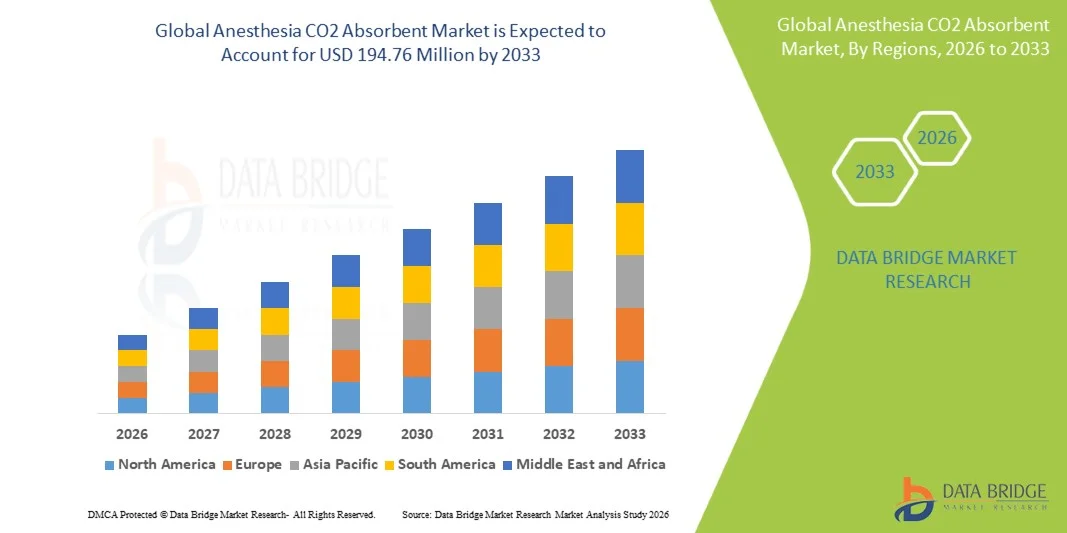
The Anesthesia CO2 Absorbent Market was valued at USD 95.62 million in 2025 and is projected to reach USD 194.76 million by 2033, growing at a CAGR of 9.30% from 2026 to 2033. The market is witnessing steady growth driven by the increasing volume of surgical procedures worldwide, rising adoption of low-flow anesthesia techniques, and growing emphasis on patient safety and operational efficiency in healthcare facilities.
The growing prevalence of chronic diseases requiring surgical intervention, along with expanding healthcare infrastructure and rising investments in advanced anesthesia delivery systems, is encouraging hospitals and ambulatory surgical centers to adopt high-performance CO2 absorbents. In addition, the shift toward environmentally safer and dust-free absorbent formulations, coupled with technological advancements aimed at reducing toxic byproduct formation during anesthesia, is further supporting market expansion across developed and emerging healthcare markets.
Key Market Trends & Insights
- North America dominated the Anesthesia CO2 Absorbent Market with the largest revenue share of 34.6% in 2025, supported by advanced healthcare infrastructure, high surgical volumes, and strong adoption of modern anesthesia delivery systems across hospitals and ambulatory surgical centers.
- The Soda Lime segment led the market with a 45.2% share in 2025, driven by its widespread clinical acceptance, cost efficiency, and proven effectiveness in absorbing carbon dioxide in anesthesia circuits.
- Asia-Pacific is expected to be the fastest-growing region with a CAGR of 5.6% from 2026 to 2033, fueled by expanding healthcare infrastructure, rising number of surgical procedures, and increasing adoption of low-flow anesthesia techniques in emerging economies such as China and India.
- Powder is the fastest-growing form type, projected to register a CAGR of 4.9%, reflecting the surge in demand for cost-effective absorbent solutions in price-sensitive healthcare markets.
- The Low-Flow Anesthesia segment dominated the application category with a 41.9% revenue share in 2025, led by increasing emphasis on reducing anesthetic gas consumption and improving cost efficiency in surgical procedures.
- Granular accounted for 598.1% of the market, preferred by its superior CO2 absorption efficiency, controlled airflow characteristics, and ease of handling in anesthesia machines.
- The Closed Circuit Anesthesia segment is the fastest-growing application category, with a CAGR of 5.5%, driven by increasing adoption in high-precision surgical environments and critical care settings.
Market Size & Forecast
- Global Market Value (2025): USD 95.62 Million
- Expected Market Value (2033): USD 194.76 Million
- Forecast CAGR (2026–2033): 9.30%
- Leading Region in 2025: North America
- Fastest Growing Region: Asia Pacific
Report Scope and Anesthesia CO2 Absorbent Market Segmentation
|
Attributes |
Anesthesia CO2 Absorbent Key Market Insights |
|
Segments Covered |
|
|
Countries Covered |
North America · U.S. · Canada · Mexico Europe · Germany · France · U.K. · Netherlands · Switzerland · Belgium · Russia · Italy · Spain · Turkey · Rest of Europe Asia-Pacific · China · Japan · India · South Korea · Singapore · Malaysia · Australia · Thailand · Indonesia · Philippines · Rest of Asia-Pacific Middle East and Africa · Saudi Arabia · U.A.E. · South Africa · Egypt · Israel · Rest of Middle East and Africa South America · Brazil · Argentina · Rest of South America |
|
Key Market Players |
· Drägerwerk AG & Co. KGaA (Germany) · GE HealthCare (U.S.) · Medtronic (Ireland) · ICU Medical, Inc. (U.S.) · Teleflex Incorporated (U.S.) · Intersurgical Ltd (U.K.) · Armstrong Medical Ltd (U.K.) · Micropore, Inc. (U.S.) · Molecular Products Group Limited (U.K.) · Löwenstein Medical SE & Co. KG (Germany) · Ambu A/S (Denmark) · Hamilton Medical AG (Switzerland) · Baxter (U.S.) · Philips Medical Systems Nederland B.V. (Netherlands) · Penlon Limited (U.K.) · Mindray Medical International Limited (China) · Beijing Aeonmed Co., Ltd. (China) · Spacelabs Healthcare (U.S.) · Allied Healthcare Products, Inc. (U.S.) · SunMED Medical (U.S.) |
|
Market Opportunities |
· Rising adoption of low-flow and closed-circuit anesthesia techniques · Growing preference for eco-friendly, non-caustic absorbents · Expansion of ambulatory surgical centers (ASCs) in emerging and developed markets |
|
Value Added Data Infosets |
In addition to the insights on market scenarios such as market value, growth rate, segmentation, geographical coverage, and major players, the market reports curated by the Data Bridge Market Research also include in-depth expert analysis, patient epidemiology, pipeline analysis, pricing analysis, and regulatory framework. |
Anesthesia CO2 Absorbent Market Trends
Trend: Shift Toward Eco-Friendly and Low-Byproduct Absorbents
Healthcare providers are increasingly adopting eco-friendly CO2 absorbents designed to minimize toxic byproduct formation and improve patient safety during anesthesia procedures. This shift is driven by growing environmental regulations, hospital sustainability goals, and rising awareness of risks associated with traditional soda lime formulations. Manufacturers are focusing on advanced formulations such as calcium hydroxide-based and dye-free absorbents that offer stable performance under low-flow anesthesia conditions, improving efficiency and reducing gas wastage in modern operating rooms, for instance increasing deployment in large tertiary hospitals adopting green anesthesia protocols.
Anesthesia CO2 Absorbent Market Dynamics
Key Market Driver: Rising Volume of Surgical Procedures Globally
The increasing global burden of chronic diseases and aging populations has led to a steady rise in surgical interventions, significantly driving demand for anesthesia CO2 absorbents across hospitals and surgical centers. Expanding healthcare infrastructure in emerging economies, coupled with improved access to elective and emergency surgeries, is further supporting market growth. In addition, the growing adoption of low-flow and closed-circuit anesthesia techniques is increasing consumption efficiency requirements for absorbents, making them essential consumables in operating rooms, for instance higher utilization in multi-specialty hospitals handling large daily surgical caseloads.
Key Restraint/Challenge: Performance Degradation and Safety Concerns
A major challenge in the anesthesia CO2 absorbent market is the performance degradation of absorbent materials over time, which can lead to reduced efficiency and potential safety risks during prolonged surgical procedures. Issues such as drying, channeling, and formation of harmful byproducts under specific anesthetic agents also limit consistent clinical performance. These concerns increase the need for frequent replacement and strict monitoring, raising operational complexity and cost for healthcare facilities, for instance hospitals managing frequent absorbent cartridge changes in high-utilization operating theaters.
Key Market Opportunity: Expansion of Low-Flow and Ambulatory Surgical Anesthesia Adoption
The increasing shift toward low-flow anesthesia techniques and the rapid expansion of ambulatory surgical centers are creating strong opportunities for advanced CO2 absorbent products with higher efficiency and longer lifespan. These settings require cost-effective, fast-acting, and safe absorbents that support quick patient turnover while maintaining clinical safety standards. In addition, rising healthcare investments in emerging markets are accelerating the adoption of modern anesthesia systems, for instance growing deployment of compact absorbent cartridges in high-volume day-care surgical facilities.
Anesthesia CO2 Absorbent Market Scope
The anesthesia CO2 absorbent market is segmented on the basis of product type, form, and application.
- By Product Type
On the basis of product type, the Anesthesia CO2 Absorbent Market is segmented into sodasorb, soda lime, and others. The Soda Lime segment dominated the market with a 45.2% share in 2025, owing to its widespread clinical acceptance, cost efficiency, and proven effectiveness in absorbing carbon dioxide in anesthesia circuits. It is extensively used across hospitals and surgical centers due to its compatibility with a wide range of anesthesia machines. The material offers reliable performance in both low-flow and semi-closed systems, making it a standard choice in routine surgical procedures. Its long-standing usage history and easy availability further strengthen its dominance globally. Continuous product improvements focusing on reduced dust formation and enhanced safety are also supporting sustained demand. The segment remains highly preferred in both developed and emerging healthcare markets.
The Others segment is expected to witness the fastest growth at a CAGR of 5.8% from 2026 to 2033, driven by rising adoption of advanced and eco-friendly absorbents such as Amsorb-type and calcium hydroxide-based formulations. These alternatives are gaining traction due to their ability to reduce toxic byproduct formation during anesthesia, improving patient safety. Increasing regulatory pressure on operating room emissions and sustainability goals is accelerating adoption. Hospitals are gradually shifting toward non-caustic and environmentally safer materials. Technological innovations in absorbent chemistry are further enhancing performance efficiency. Growing awareness among anesthesiologists regarding safety risks associated with traditional soda lime is also driving this segment’s expansion.
- By Form
On the basis of form, the Anesthesia CO2 Absorbent Market is segmented into powder and granular forms. The Granular segment dominated the market with a 58.1% share in 2025, driven by its superior CO2 absorption efficiency, controlled airflow characteristics, and ease of handling in anesthesia machines. Granular absorbents provide consistent performance during prolonged surgical procedures, making them highly suitable for hospital operating rooms. Their structural stability reduces channeling effects and improves gas contact efficiency. Widespread adoption in low-flow and closed-circuit anesthesia systems further strengthens their dominance. The form is also preferred due to lower dust generation and improved safety profile compared to powder variants. Continuous advancements in granule coating technology are further enhancing clinical usability.
The Powder segment is expected to witness the fastest growth at a CAGR of 4.9% from 2026 to 2033, driven by increasing demand for cost-effective absorbent solutions in price-sensitive healthcare markets. Powdered formulations offer faster chemical reactivity due to higher surface area exposure. They are increasingly used in smaller clinics and resource-limited settings where affordability is a key factor. Manufacturers are improving powder stability to reduce handling risks and improve safety. Growing adoption in portable anesthesia systems and emergency care applications is also supporting demand. However, concerns regarding dust inhalation and inconsistent airflow management slightly limit widespread clinical preference.
- By Application
On the basis of application, the Anesthesia CO2 Absorbent Market is segmented into closed circuit anesthesia, semi-closed circuit anesthesia, low-flow anesthesia, and high-flow anesthesia. The Low-Flow Anesthesia segment dominated the market with a 41.9% share in 2025, driven by increasing emphasis on reducing anesthetic gas consumption and improving cost efficiency in surgical procedures. This technique significantly depends on efficient CO2 absorption to maintain patient safety during prolonged operations. Hospitals prefer low-flow systems due to reduced environmental impact and lower operational costs. Rising adoption of modern anesthesia machines capable of low-flow delivery is further supporting growth. The segment also benefits from improved patient recovery outcomes and reduced exposure to volatile anesthetic agents. Continuous advancements in monitoring systems are strengthening its clinical reliability.
The Closed Circuit Anesthesia segment is expected to witness the fastest growth at a CAGR of 5.5% from 2026 to 2033, driven by increasing adoption in high-precision surgical environments and critical care settings. This system requires highly efficient CO2 absorbents to ensure complete gas recirculation and safety. It offers maximum anesthetic gas utilization efficiency, making it cost-effective in the long term. Growing awareness about sustainability and emission reduction is further accelerating adoption. Advanced surgical centers are increasingly integrating closed-circuit systems into their operating workflows. Technological improvements in absorbent longevity and performance stability are also supporting rapid market expansion.
Anesthesia CO2 Absorbent Market Regional Analysis
North America dominated the Anesthesia CO2 Absorbent Market with the largest revenue share of 34.6% in 2025, supported by advanced healthcare infrastructure, high surgical volumes, and strong adoption of modern anesthesia delivery systems across hospitals and ambulatory surgical centers. The region benefits from widespread adoption of low-flow and closed-circuit anesthesia techniques, which significantly increase demand for efficient CO2 absorbents. Strong presence of leading hospitals, ambulatory surgical centers, and well-established healthcare reimbursement systems further supports market growth. Continuous technological upgrades in operating room equipment and anesthesia monitoring systems are enhancing product utilization. Increasing prevalence of chronic diseases requiring surgical interventions is also driving demand.
U.S. Anesthesia CO2 Absorbent Market Insight
The U.S. anesthesia CO2 absorbent market is witnessing strong growth due to high surgical volumes, advanced healthcare infrastructure, and widespread adoption of modern anesthesia delivery systems. Increasing use of low-flow and closed-circuit anesthesia techniques across hospitals and ambulatory surgical centers is driving consistent demand for efficient CO2 absorbents. The country’s strong focus on patient safety, infection control, and operating room efficiency is further supporting market expansion. Rising prevalence of chronic diseases requiring surgical interventions is also boosting consumption. In addition, continuous technological advancements in anesthesia machines and absorbent formulations are improving clinical performance. Strong presence of leading healthcare providers and medical device companies continues to reinforce the U.S. market position.
Europe Anesthesia CO2 Absorbent Market Insight
The Europe anesthesia CO2 absorbent market remains a major contributor to global revenue, driven by advanced healthcare systems, strict clinical safety standards, and high adoption of low-emission anesthesia practices. The region benefits from widespread use of eco-friendly absorbents and strong regulatory focus on reducing harmful anesthetic byproducts. Hospitals and surgical centers increasingly rely on high-efficiency absorbents for cost control and sustainability goals. Growing emphasis on green healthcare initiatives is further supporting market expansion. In addition, strong clinical training infrastructure and high surgical procedure volumes are reinforcing steady demand. Continuous innovation in anesthesia technologies across Germany, France, and other major economies continues to enhance regional growth.
U.K. Anesthesia CO2 Absorbent Market Insight
The U.K. anesthesia CO2 absorbent market is experiencing steady growth, supported by rising surgical procedures, modernization of NHS infrastructure, and increasing adoption of low-flow anesthesia systems. Growing demand for cost-effective and environmentally safer absorbents is contributing to market expansion. Hospitals are increasingly focusing on reducing anesthetic gas consumption and improving operational efficiency. Integration of advanced anesthesia workstations is further enhancing absorbent utilization. In addition, strong emphasis on patient safety standards and clinical efficiency is driving adoption of high-performance products. Continuous improvements in surgical capacity and healthcare technology adoption are positioning the U.K. as a key regional market.
Germany Anesthesia CO2 Absorbent Market Insight
The Germany anesthesia CO2 absorbent market is expanding steadily due to its strong hospital infrastructure, advanced surgical capabilities, and high adoption of precision anesthesia techniques. Increasing use of eco-friendly and low-byproduct absorbents aligns with the country’s strict environmental and healthcare regulations. Hospitals and research institutions are focusing on improving anesthesia efficiency and reducing gas wastage. Strong presence of medical device manufacturers further supports product innovation and availability. Rising surgical volumes and aging population are contributing to sustained demand. Continuous advancements in operating room technologies and anesthesia systems are strengthening Germany’s position in the European market.
Asia-Pacific Anesthesia CO2 Absorbent Market Insight
The Asia-Pacific anesthesia CO2 absorbent market is expected to witness rapid growth, driven by expanding healthcare infrastructure, rising surgical volumes, and increasing access to advanced medical technologies. Growing awareness of patient safety and adoption of modern anesthesia practices are supporting regional demand. Countries such as China, India, and Japan are investing heavily in hospital expansion and surgical capacity. Increasing penetration of low-flow anesthesia systems is further boosting absorbent consumption. In addition, rising medical tourism and improving healthcare affordability are accelerating market expansion. Continuous technological adoption and growing private healthcare investments are positioning Asia-Pacific as a key growth region.
Japan Anesthesia CO2 Absorbent Market Insight
The Japan anesthesia CO2 absorbent market is witnessing consistent growth due to advanced healthcare systems, high surgical standards, and strong focus on precision medicine. Increasing adoption of low-flow anesthesia and eco-friendly absorbents is supporting market development. Hospitals and research institutes are integrating advanced anesthesia workstations for improved efficiency and safety. The country’s aging population is also contributing to higher surgical demand. Strong emphasis on innovation and healthcare quality standards is further enhancing product adoption. Continuous integration of advanced monitoring technologies and sustainable medical practices continues to support market growth in Japan.
China Anesthesia CO2 Absorbent Market Insight
The China anesthesia CO2 absorbent market is growing rapidly, driven by expanding hospital infrastructure, rising surgical volumes, and increasing government investment in healthcare modernization. Growing adoption of advanced anesthesia systems and low-flow techniques is significantly boosting demand for CO2 absorbents. Rising awareness of surgical safety and infection control is further supporting market expansion. Domestic manufacturing capabilities and cost-effective product availability are strengthening market penetration. Increasing medical tourism and healthcare access improvements are also contributing to growth. Continuous technological upgrades in hospitals and rising chronic disease burden are positioning China as one of the fastest-growing markets globally.
Anesthesia CO2 Absorbent Market Share
The anesthesia CO2 absorbent industry is primarily led by well-established companies, including:
- Drägerwerk AG & Co. KGaA (Germany)
- GE HealthCare (U.S.)
- Medtronic (Ireland)
- ICU Medical, Inc. (U.S.)
- Teleflex Incorporated (U.S.)
- Intersurgical Ltd (U.K.)
- Armstrong Medical Ltd (U.K.)
- Micropore, Inc. (U.S.)
- Molecular Products Group Limited (U.K.)
- Löwenstein Medical SE & Co. KG (Germany)
- Ambu A/S (Denmark)
- Hamilton Medical AG (Switzerland)
- Baxter (U.S.)
- Philips Medical Systems Nederland B.V. (Netherlands)
- Penlon Limited (U.K.)
- Mindray Medical International Limited (China)
- Beijing Aeonmed Co., Ltd. (China)
- Spacelabs Healthcare (U.S.)
- Allied Healthcare Products, Inc. (U.S.)
- SunMED Medical (U.S.)
Latest Developments in Anesthesia CO2 Absorbent Market
- In October 2025, the U.S. Food and Drug Administration (FDA) continued reinforcing safety communications regarding the use of desiccated CO₂ absorbents in anesthesia systems, particularly their interaction risks with volatile anesthetics such as sevoflurane. These safety guidelines emphasize proper absorbent hydration and handling to prevent harmful byproduct formation in clinical settings. This ongoing regulatory focus supports safer operating room practices globally
- In May 2024, Medtronic reinforced the role of its anesthesia breathing circuit technologies, which utilize CO₂ absorbent cartridges in low-flow anesthesia applications to improve gas efficiency and patient safety during surgical procedures. These systems are widely adopted in hospitals for maintaining stable CO₂ removal performance in high-volume operating environments. The update reflects the growing emphasis on integrated anesthesia workstation efficiency
- In June 2023, Intersurgical highlighted its Amsorb Plus CO₂ absorbent as a safer alternative to traditional soda lime, designed to eliminate strong base chemicals and reduce compound A formation during low-flow anesthesia procedures. The product is widely used in anesthesia breathing systems to improve patient safety and environmental performance in operating rooms across global hospitals. This update reinforces the industry shift toward non-caustic, eco-friendly absorbents for modern anesthesia practices
- In March 2022, Dräger updated its Drägersorb CO₂ absorbent product information, emphasizing improved performance in anesthesia circle systems and compatibility with modern low-flow anesthesia machines. The absorbent is designed to ensure efficient CO₂ removal while minimizing harmful byproduct formation during volatile anesthetic use. This update reflects ongoing improvements in absorbent safety standards within hospital anesthesia workflows
- In September 2021, GE Healthcare (now part of GE HealthCare) continued expanding its anesthesia delivery ecosystem by promoting optimized circle breathing systems that rely on efficient CO₂ absorbent canisters for enhanced gas recirculation efficiency. These systems support reduced anesthetic gas consumption and improved sustainability in operating rooms. The development highlights increasing integration between anesthesia machines and absorbent technologies for cost-efficient surgical care
SKU-
Get online access to the report on the World's First Market Intelligence Cloud

- Interactive Data Analysis Dashboard
- Company Analysis Dashboard for high growth potential opportunities
- Research Analyst Access for customization & queries
- Competitor Analysis with Interactive dashboard
- Latest News, Updates & Trend analysis
- Harness the Power of Benchmark Analysis for Comprehensive Competitor Tracking
Research Methodology
Data collection and base year analysis are done using data collection modules with large sample sizes. The stage includes obtaining market information or related data through various sources and strategies. It includes examining and planning all the data acquired from the past in advance. It likewise envelops the examination of information inconsistencies seen across different information sources. The market data is analysed and estimated using market statistical and coherent models. Also, market share analysis and key trend analysis are the major success factors in the market report. To know more, please request an analyst call or drop down your inquiry.
The key research methodology used by DBMR research team is data triangulation which involves data mining, analysis of the impact of data variables on the market and primary (industry expert) validation. Data models include Vendor Positioning Grid, Market Time Line Analysis, Market Overview and Guide, Company Positioning Grid, Patent Analysis, Pricing Analysis, Company Market Share Analysis, Standards of Measurement, Global versus Regional and Vendor Share Analysis. To know more about the research methodology, drop in an inquiry to speak to our industry experts.
Customization Available
Data Bridge Market Research is a leader in advanced formative research. We take pride in servicing our existing and new customers with data and analysis that match and suits their goal. The report can be customized to include price trend analysis of target brands understanding the market for additional countries (ask for the list of countries), clinical trial results data, literature review, refurbished market and product base analysis. Market analysis of target competitors can be analyzed from technology-based analysis to market portfolio strategies. We can add as many competitors that you require data about in the format and data style you are looking for. Our team of analysts can also provide you data in crude raw excel files pivot tables (Fact book) or can assist you in creating presentations from the data sets available in the report.












