




Global Anesthesia Delivery Systems Market
Market Size in USD Billion
CAGR :
% 
 USD
13.24 Billion
USD
23.80 Billion
2025
2033
USD
13.24 Billion
USD
23.80 Billion
2025
2033
 Forecast Period Forecast Period |
2026 –2033 |
 Market Size (Base Year) Market Size (Base Year) |
USD 13.24 Billion |
 Market Size (Forecast Year) Market Size (Forecast Year) |
USD 23.80 Billion |
 CAGR CAGR |
% |
| Major Markets Players |
|
Anesthesia Delivery Systems Market Size
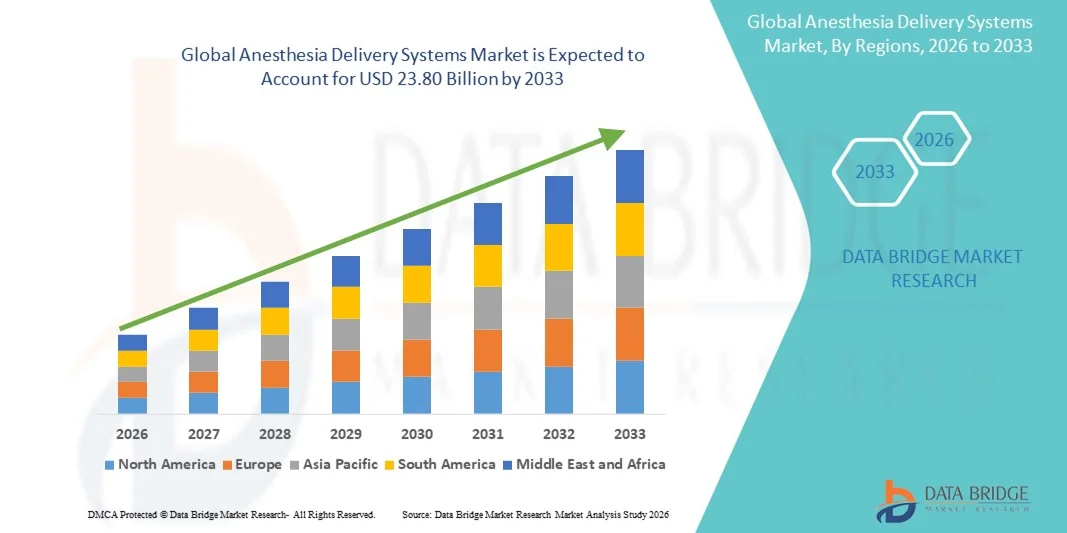
- The global anesthesia delivery systems market size was valued at USD 13.24 billion in 2025 and is expected to reach USD 23.80 billion by 2033, at a CAGR of 7.61% during the forecast period
- The market growth is largely fueled by the increasing adoption of advanced anesthesia delivery technologies, such as automated and closed-loop systems, which enhance patient safety, improve precision in drug delivery, and streamline surgical workflows across hospitals, surgical centers, and outpatient facilities. Continuous technological progress in ventilators, monitoring systems, and integrated anesthesia platforms is further driving market expansion
- Furthermore, rising demand for efficient, reliable, and easy-to-use anesthesia delivery solutions is encouraging healthcare providers to upgrade existing systems and adopt modern devices. These converging factors are accelerating the uptake of Anesthesia Delivery Systems, thereby significantly boosting the industry's growth
Anesthesia Delivery Systems Market Analysis
- Anesthesia delivery systems, encompassing advanced workstations, vaporizers, ventilators, and integrated monitoring platforms, are increasingly vital components of modern surgical and perioperative care due to their ability to enhance patient safety, facilitate precise drug administration, and streamline anesthesia workflows across hospitals, ambulatory surgical centers, and critical care units
- The escalating demand for anesthesia delivery systems is primarily fueled by the rising volume of surgical procedures, growing emphasis on patient safety and quality of care, and continuous technological advancements that improve ease of use, automation, and integration with electronic medical records
- North America dominated the anesthesia delivery systems market with the largest revenue share of approximately 42.3% in 2025, supported by advanced healthcare infrastructure, high adoption of cutting-edge medical technologies, and strong presence of leading industry players. The U.S. market leads significantly, driven by increasing procedural volumes, investments in healthcare modernization, and adoption of automated anesthesia workstations and integrated monitoring solutions
- Asia‑Pacific is expected to be the fastest‑growing region in the anesthesia delivery systems market during the forecast period, driven by increasing healthcare spending, expanding access to quality surgical care, rising procedural demand, and rapid investments in modern medical infrastructure in countries such as China, India, and Japan
- The General Anesthesia segment dominated the largest market revenue share of 56.4% in 2025, driven by the increasing volume of major surgical procedures, complex interventions, and hospital-based operations
Report Scope and Anesthesia Delivery Systems Market Segmentation
|
Attributes |
Anesthesia Delivery Systems Key Market Insights |
|
Segments Covered |
|
|
Countries Covered |
North America
Europe
Asia-Pacific
Middle East and Africa
South America
|
|
Key Market Players |
• GE Healthcare (U.S.) |
|
Market Opportunities |
|
|
Value Added Data Infosets |
In addition to the insights on market scenarios such as market value, growth rate, segmentation, geographical coverage, and major players, the market reports curated by the Data Bridge Market Research also include in-depth expert analysis, patient epidemiology, pipeline analysis, pricing analysis, and regulatory framework. |
Anesthesia Delivery Systems Market Trends
Advancements in Precision and Safety in Anesthesia Delivery
- A significant and accelerating trend in the global anesthesia delivery systems market is the focus on advanced precision, integrated monitoring, and enhanced safety mechanisms. Modern anesthesia delivery systems now incorporate features such as real-time patient monitoring, automated drug delivery controls, and fail-safe mechanisms, which collectively improve both patient safety and clinician efficiency
- For instance, several leading devices now offer closed-loop anesthesia delivery, which continuously adjusts anesthetic dosage based on patient vitals, minimizing the risk of over- or under-dosing. Similarly, systems with integrated respiratory monitoring and multi-parameter sensors allow clinicians to detect complications early and optimize anesthesia administration during surgeries
- Integration of modular components, including vaporizers, flow meters, and electronic gas mixers, enables hospitals to configure anesthesia workstations according to surgical requirements. Some systems also feature compact, portable designs suitable for operating rooms with space constraints or ambulatory surgical centers
- Enhanced data logging and connectivity allow anesthesiologists to track dosing history, ventilatory parameters, and patient response over time, supporting more precise anesthesia management and compliance with regulatory standards
- The trend towards user-friendly interfaces, automated alerts, and streamlined workflows is reshaping expectations for anesthesia delivery, improving clinical outcomes, and reducing procedural risks. Companies are increasingly developing systems that combine reliability, efficiency, and safety features to meet growing surgical demands
- The global demand for advanced, safe, and efficient anesthesia delivery systems is rising rapidly across hospitals, specialty surgical centers, and ambulatory care units, driven by increasing surgical procedures and the need for standardized anesthesia administration
Anesthesia Delivery Systems Market Dynamics
Driver
Increasing Surgical Procedures and Need for Enhanced Patient Safety
- The growing volume of surgical procedures worldwide, combined with a heightened focus on patient safety and operational efficiency, is a major driver for the Anesthesia Delivery Systems market. Hospitals and surgical centers increasingly rely on advanced systems to optimize anesthetic dosing and minimize complications
- For instance, in February 2024, GE Healthcare launched an upgraded anesthesia workstation featuring automated gas delivery and integrated patient monitoring, designed to improve safety and efficiency in high-volume operating rooms. Such advancements by key companies are expected to drive market growth over the forecast period
- Rising awareness among healthcare providers about the risks of human error in anesthesia administration is encouraging adoption of automated and intelligent delivery systems
- Increasing demand for outpatient surgeries, minimally invasive procedures, and ambulatory care facilities is further propelling market expansion
- Improved efficiency in operating rooms, shorter procedure times, and the ability to integrate multiple monitoring parameters contribute to the preference for advanced anesthesia systems
- Furthermore, technological innovations, including compact workstations, advanced ventilation control, and automated alarms for adverse events, enhance patient safety and clinician confidence, strengthening market adoption
Restraint/Challenge
High Initial Cost and Maintenance Requirements
- The high capital investment required for advanced anesthesia delivery systems remains a significant barrier, especially for smaller hospitals, clinics, and emerging markets. Premium systems with integrated monitoring, automated dosing, and safety mechanisms involve substantial procurement and maintenance costs
- For instance, some hospitals hesitate to upgrade older workstations due to budget constraints, despite the potential benefits of reduced complications and improved workflow
- Regular calibration, servicing, and technical support are essential to maintain device accuracy and patient safety, which increases operational expenditures for healthcare facilities
- Limited skilled personnel capable of operating sophisticated anesthesia systems can also hinder adoption, particularly in regions with fewer trained anesthesiologists or clinical engineers
- While prices are gradually decreasing with technological advancements and competition, the perceived premium of these systems may still slow adoption among cost-conscious institutions
- Overcoming these challenges through affordable models, streamlined maintenance services, and clinician training programs will be critical for sustained growth in the Anesthesia Delivery Systems market
Anesthesia Delivery Systems Market Scope
The market is segmented on the basis of type, product, application, and end user.
- By Type
On the basis of type, the Anesthesia Delivery Systems market is segmented into General Anesthesia and Local Anesthesia. The General Anesthesia segment dominated the largest market revenue share of 56.4% in 2025, driven by the increasing volume of major surgical procedures, complex interventions, and hospital-based operations. General anesthesia systems are widely adopted in hospitals and surgical centers due to their ability to manage patient sedation, pain control, and airway management simultaneously. The segment benefits from technological advancements such as integrated monitoring, automated drug delivery, and closed-loop ventilation, ensuring precise anesthetic control. Hospitals and specialty surgical centers prefer these systems for their reliability, safety, and regulatory compliance. Rising demand for minimally invasive surgeries, high patient throughput, and enhanced clinician efficiency further support the dominance of general anesthesia systems. Investments in training programs and advanced anesthesia workstations strengthen the segment’s adoption. Strong preference among anesthesiologists for versatile, multi-parameter anesthesia platforms contributes to sustained market leadership. Regulatory approvals for advanced anesthesia systems and growing healthcare infrastructure in emerging regions also drive adoption.
The Local Anesthesia segment is anticipated to witness the fastest CAGR of 18.9% from 2026 to 2033, fueled by the growing demand for outpatient procedures, dental surgeries, ophthalmology, and minimally invasive interventions. Local anesthesia delivery systems allow targeted pain management with reduced systemic side effects, making them preferred in clinics and specialty centers. Rising popularity of office-based surgeries, cosmetic procedures, and minimally invasive techniques accelerates segment growth. Technological enhancements, including precise infusion pumps and monitoring systems, improve treatment safety and efficiency. Increasing awareness among patients and clinicians about rapid recovery and reduced procedural risks supports adoption. Expansion of ambulatory surgical centers and dental clinics in urban and semi-urban areas drives further uptake. Compact, user-friendly devices suitable for clinic-based use contribute to the high CAGR. Cost-effectiveness compared to full general anesthesia procedures strengthens market penetration.
- By Product
On the basis of product, the Anesthesia Delivery Systems market is segmented into Anesthesia Devices, Respiratory Devices, Anesthesia Disposables and Accessories, and Anesthesia Information Management Systems (AIMS). The Anesthesia Devices segment held the largest market revenue share of 50.7% in 2025, driven by the critical need for reliable and precise delivery of anesthetic agents during surgical procedures. This segment includes anesthesia workstations, vaporizers, and infusion pumps, which are widely adopted in hospitals and specialty surgical centers. Continuous innovations in device safety, monitoring integration, and ergonomics reinforce their dominance. Hospitals prioritize devices that reduce human error and ensure patient safety. Rising number of surgeries, increasing hospital investments in advanced operating rooms, and regulatory focus on safe anesthesia administration further support the segment. Manufacturers emphasize durability, ease of use, and multi-parameter compatibility to maintain strong adoption. Global awareness about perioperative safety and expanding healthcare infrastructure also contribute to segment growth. Multi-functional anesthesia devices that support both adult and pediatric patients enhance revenue share. The segment benefits from long-term utilization, service contracts, and technological upgrades in hospitals worldwide.
The Anesthesia Information Management Systems (AIMS) segment is expected to witness the fastest CAGR of 19.5% from 2026 to 2033, fueled by increasing digitization and the need for efficient anesthesia workflow management. AIMS solutions enable real-time recording of patient vitals, drug delivery logs, and procedural data, supporting compliance and quality audits. Adoption is rising in hospitals and specialty clinics due to the emphasis on patient safety, data accuracy, and operational efficiency. Integration with electronic health records (EHRs) and interoperability with other surgical devices accelerates uptake. Growing focus on data-driven anesthesia management and post-operative outcome tracking drives the segment. Cloud-based AIMS platforms provide remote access and analytics capabilities, enhancing hospital decision-making. Regulatory encouragement for digital record-keeping further supports adoption. The segment benefits from software upgrades, training programs, and analytics services offered by solution providers. Rising awareness among healthcare professionals regarding workflow optimization and patient monitoring also boosts growth.
- By Application
On the basis of application, the Anesthesia Delivery Systems market is segmented into Cardiology, Neurology, Dental, Ophthalmology, Urology, Orthopaedics, and Others. The Orthopaedics segment accounted for the largest market revenue share of 47.8% in 2025, driven by the growing volume of joint replacement surgeries, trauma procedures, and spine surgeries globally. Orthopedic procedures require precise anesthesia delivery, advanced respiratory support, and continuous monitoring to ensure patient safety and minimize complications. Hospitals and specialty surgical centers prioritize anesthesia systems that support multiple anesthesia modalities and patient populations. Rising geriatric population, increasing prevalence of musculoskeletal disorders, and expansion of orthopedic surgical centers contribute to the segment dominance. Technological innovations, including patient-controlled analgesia and integrated monitoring, further enhance adoption. The segment benefits from higher surgical complexity and longer procedural times that necessitate robust anesthesia systems. Surgeons and anesthesiologists prefer systems with high reliability, safety features, and workflow integration. Growing awareness about post-operative pain management and faster recovery strengthens segment revenue share.
The Dental segment is expected to witness the fastest CAGR of 20.2% from 2026 to 2033, fueled by the rising adoption of sedation and anesthesia systems in dental procedures, cosmetic dentistry, and outpatient clinics. Increasing awareness among patients about painless procedures and growing investments in dental care infrastructure support rapid growth. Portable anesthesia devices and monitoring systems suitable for dental clinics enhance adoption. Rising demand for minimally invasive dental surgeries and sedation procedures drives segment expansion. Integration of patient monitoring and drug delivery tracking systems further accelerates growth. Emerging economies witnessing increased dental care access contribute to higher CAGR. Awareness campaigns highlighting patient comfort, safety, and procedure efficiency strengthen the segment. The growth is further supported by technological advances and compact, cost-effective solutions for clinic-based applications.
- By End User
On the basis of end user, the Anesthesia Delivery Systems market is segmented into Hospitals, Ambulatory Centers, Specialty Clinics/Clinics, and Others. The Hospitals segment dominated the largest market revenue share of 58.3% in 2025, driven by the high number of surgeries performed, complex patient cases, and the requirement for comprehensive anesthesia workstations. Hospitals invest heavily in advanced anesthesia delivery systems that ensure patient safety, regulatory compliance, and operational efficiency. Rising global surgical volumes, expansion of hospital infrastructure, and increasing availability of multi-functional anesthesia devices support segment leadership. Hospitals prefer integrated solutions that combine anesthesia delivery, respiratory management, and patient monitoring. Continuous technological innovations and training programs further reinforce adoption. Strong demand for perioperative safety, enhanced workflow, and standardized anesthesia management contributes to dominance. Hospitals also benefit from service contracts, after-sales support, and equipment upgrades offered by manufacturers.
The Ambulatory Centers segment is expected to witness the fastest CAGR of 21.1% from 2026 to 2033, fueled by the increasing number of outpatient procedures, minimally invasive surgeries, and same-day interventions. Ambulatory surgical centers seek compact, efficient, and reliable anesthesia systems that ensure patient safety while minimizing space requirements. Growing awareness about rapid recovery, reduced hospital stay, and cost-effectiveness drives adoption. Technological innovations such as portable anesthesia machines, simplified monitoring solutions, and modular devices enhance segment growth. The expansion of ambulatory care facilities in emerging regions and urban areas accelerates market uptake. Increasing preference for office-based and short-stay surgical procedures strengthens CAGR. Training programs and manufacturer support services for ambulatory centers further boost adoption. Rising healthcare expenditure and investments in outpatient infrastructure contribute to the rapid growth of this segment.
Anesthesia Delivery Systems Market Regional Analysis
- North America dominated the anesthesia delivery systems market with the largest revenue share of approximately 42.3% in 2025, supported by advanced healthcare infrastructure, high adoption of cutting-edge medical technologies, and strong presence of leading industry players
- The market leads significantly, driven by increasing procedural volumes, investments in healthcare modernization, and adoption of automated anesthesia workstations and integrated monitoring solutions
- Hospitals and surgical centers are increasingly investing in advanced anesthesia delivery technologies, including automated workstations, closed-loop monitoring systems, and multi-parameter integrated platforms. Growing awareness of patient safety, precision anesthesia dosing, and real-time monitoring further propels market growth
U.S. Anesthesia Delivery Systems Market Insight
The U.S. anesthesia delivery systems market captured the largest revenue share in 2025 within North America, fueled by the rising number of surgical procedures and expanding hospital networks. Adoption of automated anesthesia workstations and integrated monitoring solutions is accelerating, supported by well-established hospital infrastructure and a high level of clinical expertise. Increasing focus on perioperative efficiency and patient safety is driving further investments in advanced anesthesia technologies.
Europe Anesthesia Delivery Systems Market Insight
The Europe anesthesia delivery systems market is projected to expand at a substantial CAGR throughout the forecast period, primarily driven by increasing adoption of advanced anesthesia devices, the growing number of outpatient surgical centers, and favorable reimbursement policies. Countries such as Germany, France, and the U.K. are witnessing a rise in procedural volumes, investments in healthcare technology modernization, and increasing preference for integrated anesthesia delivery systems.
U.K. Anesthesia Delivery Systems Market Insight
The U.K. anesthesia delivery systems market is anticipated to grow at a noteworthy CAGR during the forecast period, driven by modernization of healthcare facilities, increasing surgical procedures, and a focus on patient safety and operational efficiency. Adoption of automated anesthesia workstations and integrated monitoring solutions is accelerating, supported by well-established hospital infrastructure and a high level of clinical expertise.
Germany Anesthesia Delivery Systems Market Insight
The Germany anesthesia delivery systems market is expected to expand at a considerable CAGR during the forecast period, fueled by high adoption of technologically advanced anesthesia workstations, rising procedural demand, and increasing hospital investments in patient safety and operational efficiency. Integration of anesthesia delivery systems with hospital IT networks is becoming more common, supporting real-time monitoring and improved workflow efficiency.
Asia-Pacific Anesthesia Delivery Systems Market Insight
Asia-Pacific anesthesia delivery systems market is expected to be the fastest-growing region in the Anesthesia Delivery Systems market during the forecast period, driven by increasing healthcare spending, expanding access to quality surgical care, rising procedural demand, and rapid investments in modern medical infrastructure in countries such as China, India, and Japan.
Japan Anesthesia Delivery Systems Market Insight
The Japan anesthesia delivery systems market is gaining momentum due to the country’s advanced healthcare infrastructure, growing number of surgical procedures, and increasing adoption of automated anesthesia workstations. Integration of anesthesia delivery systems with hospital IT networks and perioperative monitoring solutions is driving efficiency and improving patient safety.
China Anesthesia Delivery Systems Market Insight
The China anesthesia delivery systems market accounted for the largest market revenue share in Asia-Pacific in 2025, attributed to rapid urbanization, increasing surgical procedure volumes, and rising investments in modern healthcare facilities. Strong government initiatives to expand access to quality surgical care, combined with a growing number of hospitals upgrading to advanced anesthesia workstations, are key factors propelling market growth.
Anesthesia Delivery Systems Market Share
The Anesthesia Delivery Systems industry is primarily led by well-established companies, including:
• GE Healthcare (U.S.)
• Drägerwerk AG & Co. KGaA (Germany)
• Mindray Medical International (China)
• Philips Healthcare (Netherlands)
• Medtronic (U.S.)
• Smiths Medical (U.K.)
• B. Braun SE (Germany)
• Hospira, Inc. (U.S.)
• Spacelabs Healthcare (U.S.)
• Edwards Lifesciences (U.S.)
• Nihon Kohden Corporation (Japan)
• CareFusion Corporation (U.S.)
• Masimo Corporation (U.S.)
• Hamilton Medical AG (Switzerland)
• Shanghai Mindray (China)
• Anetic Aid Ltd. (U.K.)
• Penlon Ltd. (U.K.)
• Fisher & Paykel Healthcare (New Zealand)
• Ace Medical (China)
• Intermed (Brazil)
Latest Developments in Global Anesthesia Delivery Systems Market
- In October 2025, GE HealthCare unveiled the Carestation 850 anesthesia delivery system at ANESTHESIOLOGY 2025, designed to enhance clinical precision and operational efficiency across a wide range of surgical scenarios. The next‑generation workstation features customizable applications, advanced alerting capabilities, improved user interface, and adaptable technologies suited for patients from neonates to the elderly. With regulatory clearances in Europe and Australia, the Carestation 850 underscores GE HealthCare’s effort to support clinicians with tools that enhance safety, sustainability, and workflow optimization in perioperative care
- In April 2025, Dräger launched the Atlan A100 anesthesia workstation in India, focusing on advanced lung‑protective ventilation and low‑flow anesthesia to optimize patient outcomes and operating room efficiency. The system includes features such as adaptive piston control, integrated active warming, and enhanced infection prevention measures, aiming to streamline perioperative processes and improve operational workflows in acute care environments
- In March 2024, Medtronic received FDA clearance for its BIS Advance monitor, which assesses the anesthetic effect on a patient’s brain to help tailor dosing and avoid under‑ or over‑dosing, advancing personalized anesthesia management. This clearance reflects increased regulatory support for technologies that improve anesthesia safety and precision
- In November 2024, Mindray Medical introduced upgrades to its A7 and A5 anesthesia systems, featuring enhanced control technologies, safety checks, and smart alarm systems to support more responsive anesthesia management during complex procedures. These improvements are part of broader efforts by manufacturers to integrate sophisticated control and monitoring capabilities in anesthesia delivery equipment
- In November 2023, Getinge announced the launch of its Maquet VARIUS 3 anesthesia machine, offering clinicians greater flexibility and efficiency in anesthesia administration. The VARIUS 3 design supports a range of surgical environments and has been adopted across multiple hospitals in Europe and Asia, highlighting its clinical relevance and operational adaptability
- In October 2023, GE Healthcare introduced the Aespire 7900 anesthesia machine with enhanced patient safety features aimed at improving procedural outcomes and clinician confidence. The launch emphasized improved delivery precision and monitoring capabilities tailored for broad surgical use
SKU-
Get online access to the report on the World's First Market Intelligence Cloud

- Interactive Data Analysis Dashboard
- Company Analysis Dashboard for high growth potential opportunities
- Research Analyst Access for customization & queries
- Competitor Analysis with Interactive dashboard
- Latest News, Updates & Trend analysis
- Harness the Power of Benchmark Analysis for Comprehensive Competitor Tracking
Research Methodology
Data collection and base year analysis are done using data collection modules with large sample sizes. The stage includes obtaining market information or related data through various sources and strategies. It includes examining and planning all the data acquired from the past in advance. It likewise envelops the examination of information inconsistencies seen across different information sources. The market data is analysed and estimated using market statistical and coherent models. Also, market share analysis and key trend analysis are the major success factors in the market report. To know more, please request an analyst call or drop down your inquiry.
The key research methodology used by DBMR research team is data triangulation which involves data mining, analysis of the impact of data variables on the market and primary (industry expert) validation. Data models include Vendor Positioning Grid, Market Time Line Analysis, Market Overview and Guide, Company Positioning Grid, Patent Analysis, Pricing Analysis, Company Market Share Analysis, Standards of Measurement, Global versus Regional and Vendor Share Analysis. To know more about the research methodology, drop in an inquiry to speak to our industry experts.
Customization Available
Data Bridge Market Research is a leader in advanced formative research. We take pride in servicing our existing and new customers with data and analysis that match and suits their goal. The report can be customized to include price trend analysis of target brands understanding the market for additional countries (ask for the list of countries), clinical trial results data, literature review, refurbished market and product base analysis. Market analysis of target competitors can be analyzed from technology-based analysis to market portfolio strategies. We can add as many competitors that you require data about in the format and data style you are looking for. Our team of analysts can also provide you data in crude raw excel files pivot tables (Fact book) or can assist you in creating presentations from the data sets available in the report.












