




Global Animal Feed Protein Ingredients Market
Market Size in USD Billion
CAGR :
% 
 USD
195.70 Billion
USD
311.91 Billion
2025
2033
USD
195.70 Billion
USD
311.91 Billion
2025
2033
 Forecast Period Forecast Period |
2026 - 2033 |
 Market Size (Base Year) Market Size (Base Year) |
USD 195.70 Billion |
 Market Size (Forecast Year) Market Size (Forecast Year) |
USD 311.91 Billion |
 CAGR CAGR |
% |
| Major Markets Players |
|
Animal Feed Protein Ingredients Market Overview
The Animal Feed Protein Ingredients Market was valued at USD 195.70 billion in 2025 and is projected to reach USD 311.91 billion by 2033, growing at a CAGR of 6.00% from 2026 to 2033. The market is witnessing steady expansion driven by rising global demand for high-quality animal protein, increasing livestock production, and growing emphasis on nutritionally balanced and cost-efficient feed formulations across the poultry, swine, aquaculture, and ruminant sectors.
The growing focus on improving feed efficiency and animal health is encouraging the adoption of diverse protein ingredients such as soybean meal, fish meal, corn gluten meal, and alternative plant-based and microbial protein sources. In addition, increasing awareness regarding sustainable livestock farming practices and the need to reduce dependency on conventional protein sources are further supporting market growth. Technological advancements in feed processing and the expansion of large-scale commercial animal farming operations are also contributing to the widespread adoption of high-performance feed protein ingredients globally.
Key Market Trends & Insights
- North America dominated the animal feed protein ingredients market with the largest revenue share of approximately 32.6% in 2025, supported by advanced livestock farming systems, strong soybean processing infrastructure, and high demand for protein-rich meat and dairy products.
- Asia-Pacific is expected to be the fastest-growing region, recording a CAGR of approximately 7.2% from 2026 to 2033, driven by rapid population growth, rising disposable incomes, expanding aquaculture production, and increasing demand for protein-rich diets in countries such as China, India, Vietnam, and Indonesia.
- The Plant segment held the largest market revenue share of approximately 68.5% in 2025 driven by the extensive use of soybean meal, rapeseed meal, corn gluten meal, and other oilseed-derived proteins in livestock and poultry nutrition. Plant-based protein ingredients are widely preferred due to their cost-effectiveness, stable global supply chain, and high scalability, particularly in major producing countries such as the U.S., Brazil, China, and India where soybean processing capacity is highly developed.
- The Animal segment is projected to register the fastest growth at a CAGR of 9.6% from 2026 to 2033, driven by increasing demand for high-digestibility proteins such as fish meal, blood meal, and poultry by-products in aquaculture and premium pet food formulations. Rising aquaculture expansion in Asia-Pacific and growing demand for high-protein pet nutrition in North America and Europe are accelerating segment growth, particularly where amino acid optimization and feed efficiency are critical.
- The Oilseed Meals segment held the largest market revenue share of approximately 52.3% in 2025 supported by widespread consumption of soybean meal as the primary protein source in poultry and swine feed formulations. Strong global soybean processing infrastructure and consistent demand from intensive livestock farming systems in Brazil, China, and the U.S. continue to reinforce dominance of this segment.
- The Fishmeals segment is projected to register the fastest growth at a CAGR of 8.9% from 2026 to 2033 driven by expanding aquaculture production and rising demand for high-quality marine protein sources in salmon, shrimp, and marine fish farming. Countries such as Peru and Chile remain key suppliers, while Asia-Pacific aquaculture producers are increasingly integrating fish meal with alternative proteins to optimize feed conversion ratios and growth performance.
- The Poultry segment held the largest market revenue share of approximately 34.9% in 2025 driven by high global consumption of chicken meat and eggs, alongside intensive farming practices requiring high-protein feed formulations to maintain rapid growth rates and feed conversion efficiency.
- The Aquaculture segment is projected to register the fastest growth at a CAGR of 10.2% from 2026 to 2033 driven by rapid expansion of fish farming operations in Asia-Pacific, particularly in China, India, Vietnam, and Indonesia. Increasing demand for high-quality protein ingredients in shrimp and salmon farming, along with declining reliance on wild fish stocks, is accelerating segment growth.
Market Size & Forecast
- Global Market Value (2025): USD 195.70 Billion
- Expected Market Value (2033): USD 311.91 Billion
- Forecast CAGR (2026–2033): 6.00%
- Leading Region in 2025: North America
- Fastest Growing Region: Asia-Pacific
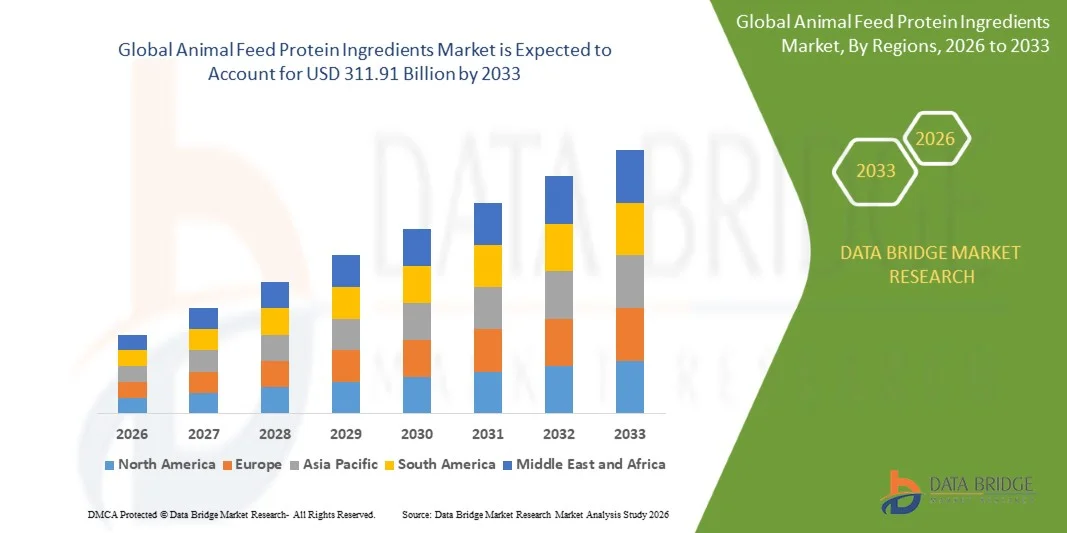
Report Scope and Animal Feed Protein Ingredients Market Segmentation
|
Attributes |
Animal Feed Protein Ingredients Key Market Insights |
|
Segments Covered |
· By Source: Plant and Animal · By Product: Oilseed Meals, Fishmeals, and Animal by-products · By Livestock: Poultry, Swine, Cattle, Aquaculture, Pet Food, Equine, and Others |
|
Countries Covered |
North America · U.S. · Canada · Mexico Europe · Germany · France · U.K. · Netherlands · Switzerland · Belgium · Russia · Italy · Spain · Turkey · Rest of Europe Asia-Pacific · China · Japan · India · South Korea · Singapore · Malaysia · Australia · Thailand · Indonesia · Philippines · Rest of Asia-Pacific Middle East and Africa · Saudi Arabia · U.A.E. · South Africa · Egypt · Israel · Rest of Middle East and Africa South America · Brazil · Argentina · Rest of South America |
|
Key Market Players |
• HAMLET PROTEIN (Denmark) |
|
Market Opportunities |
· Expansion Of Alternative Protein Sources · Growth In Aquaculture Feed Demand |
|
Value Added Data Infosets |
In addition to the insights on market scenarios such as market value, growth rate, segmentation, geographical coverage, and major players, the market reports curated by the Data Bridge Market Research also include in-depth expert analysis, pricing analysis, brand share analysis, consumer survey, demography analysis, supply chain analysis, value chain analysis, raw material/consumables overview, vendor selection criteria, PESTLE Analysis, Porter Analysis, and regulatory framework. |
Animal Feed Protein Ingredients Market Trends
Trend: Rising Demand For Sustainable And Alternative Protein Sources In Animal Feed Applications
Increasing focus on high-quality, cost-effective, and environmentally sustainable protein ingredients is reshaping the Animal Feed Protein Ingredients Market across poultry, swine, aquaculture, and ruminant sectors. Traditional protein sources such as soybean meal and fish meal continue to dominate feed formulations; however, concerns regarding land use, deforestation, price volatility, and marine resource depletion are accelerating the shift toward alternative proteins such as insect meal, single-cell proteins, and algae-based ingredients.
In modern aquaculture systems, for instance, fishmeal is increasingly being partially replaced with insect-derived protein and plant-based concentrates to reduce dependency on wild fish stocks. Large-scale salmon farming operations in Norway and Chile have already begun integrating black soldier fly larvae meal into feed trials, achieving comparable growth performance while reducing feed conversion ratio variability under controlled conditions.
The poultry and swine industries are also witnessing rapid adoption of soybean meal alternatives and co-products such as corn distillers dried grains with solubles (DDGS), particularly in regions facing soybean price fluctuations due to climate disruptions in South America and export restrictions in key producing countries. In addition, insect protein production facilities in Europe and Southeast Asia are expanding capacity, with EU regulatory approvals in recent years enabling the use of processed insect protein in poultry and pig feed, supporting commercialization at scale.
Animal Feed Protein Ingredients Market Dynamics
Key Market Driver: Rising Demand For High-Performance And Sustainable Livestock Nutrition
The growing global demand for meat, dairy, and aquaculture products is significantly increasing the need for efficient animal nutrition solutions that enhance growth rates, immunity, and feed conversion efficiency. Protein ingredients such as soybean meal, fish meal, rapeseed meal, and corn gluten meal remain essential components in feed formulations due to their high amino acid content and digestibility.
Intensive livestock production systems in countries such as China, India, Brazil, and the U.S. are increasingly adopting precision feed formulations to optimize protein utilization and reduce feeding costs. For instance, poultry producers in large integrated farming operations are reformulating feed blends to achieve improved feed conversion ratios in the range of approximately 1.5–1.8, supported by higher-quality protein inputs and enzyme supplementation.
Similarly, aquaculture expansion is a major driver, with global fish production from aquaculture surpassing capture fisheries in recent years, increasing reliance on protein-rich feed ingredients. Feed manufacturers are also investing in soybean meal processing improvements and fermentation-based protein enhancement technologies to increase digestibility and reduce anti-nutritional factors, improving livestock productivity and reducing waste output.
Key Restraint/Challenge: Price Volatility And Supply Chain Dependence On Key Raw Materials
The animal feed protein ingredients market is highly dependent on a limited number of raw materials, particularly soybean meal and fish meal, which exposes the industry to significant price fluctuations and supply chain risks. Weather variability in South America, especially in Brazil and Argentina, has historically impacted soybean yields, causing global price instability and procurement challenges for feed manufacturers.
In addition, fish meal production is constrained by seasonal catch limits and environmental regulations on marine ecosystems, particularly in Peru and Chile, where anchovy harvest variability directly affects global supply. This dependency creates uncertainty for aquaculture feed producers who require consistent protein quality and availability throughout production cycles.
Furthermore, alternative protein sources such as insect meal and microbial protein remain relatively expensive due to high production costs, limited large-scale infrastructure, and regulatory compliance requirements. Commercial-scale insect protein production still struggles to achieve cost parity with soybean meal, which remains one of the most economical protein sources globally, limiting rapid substitution in cost-sensitive markets.
Key Market Opportunity: Expansion Of Alternative Protein Technologies And Circular Feed Systems
The increasing emphasis on circular economy models in agriculture and food production is creating strong opportunities for alternative protein ingredients derived from waste streams and sustainable biological processes. Insect protein, algae-based protein, and fermentation-derived single-cell proteins are gaining traction as scalable and environmentally efficient feed ingredients that reduce dependency on conventional crops and marine resources.
Livestock and aquaculture producers are increasingly exploring insect protein integration into feed formulations, particularly black soldier fly larvae, which can convert organic waste into high-quality protein with favorable amino acid profiles. For instance, commercial insect protein facilities in Europe are expanding production capacity to supply poultry and aquaculture feed markets under newly relaxed regulatory frameworks supporting sustainable protein innovation.
In addition, advancements in precision fermentation and microbial protein production are enabling the development of high-purity protein ingredients with controlled nutrient composition, improving feed efficiency in high-value livestock systems. Emerging markets in Asia-Pacific are also witnessing rapid adoption of algae-based feed additives in aquaculture to enhance immunity and growth performance. These innovations are expected to significantly reshape the protein supply chain in animal nutrition over the coming years, particularly as sustainability regulations and carbon reduction targets intensify globally.
Animal Feed Protein Ingredients Market Scope
The market is segmented on the basis of source, product, and livestock.
- By Source
On the basis of source, the animal feed protein ingredients market is segmented into Plant and Animal. The Plant segment held the largest market revenue share of approximately 68.5% in 2025 driven by the extensive use of soybean meal, rapeseed meal, corn gluten meal, and other oilseed-derived proteins in livestock and poultry nutrition. Plant-based protein ingredients are widely preferred due to their cost-effectiveness, stable global supply chain, and high scalability, particularly in major producing countries such as the U.S., Brazil, China, and India where soybean processing capacity is highly developed.
The Animal segment is projected to register the fastest growth at a CAGR of 9.6% from 2026 to 2033, driven by increasing demand for high-digestibility proteins such as fish meal, blood meal, and poultry by-products in aquaculture and premium pet food formulations. Rising aquaculture expansion in Asia-Pacific and growing demand for high-protein pet nutrition in North America and Europe are accelerating segment growth, particularly where amino acid optimization and feed efficiency are critical.
- By Product
On the basis of product, the market is segmented into Oilseed Meals, Fishmeals, and Animal by-products. The Oilseed Meals segment held the largest market revenue share of approximately 52.3% in 2025 supported by widespread consumption of soybean meal as the primary protein source in poultry and swine feed formulations. Strong global soybean processing infrastructure and consistent demand from intensive livestock farming systems in Brazil, China, and the U.S. continue to reinforce dominance of this segment.
The Fishmeals segment is projected to register the fastest growth at a CAGR of 8.9% from 2026 to 2033 driven by expanding aquaculture production and rising demand for high-quality marine protein sources in salmon, shrimp, and marine fish farming. Countries such as Peru and Chile remain key suppliers, while Asia-Pacific aquaculture producers are increasingly integrating fish meal with alternative proteins to optimize feed conversion ratios and growth performance.
- By Livestock
On the basis of livestock, the market is segmented into Poultry, Swine, Cattle, Aquaculture, Pet Food, Equine, and Others. The Poultry segment held the largest market revenue share of approximately 34.9% in 2025 driven by high global consumption of chicken meat and eggs, alongside intensive farming practices requiring high-protein feed formulations to maintain rapid growth rates and feed conversion efficiency.
The Aquaculture segment is projected to register the fastest growth at a CAGR of 10.2% from 2026 to 2033 driven by rapid expansion of fish farming operations in Asia-Pacific, particularly in China, India, Vietnam, and Indonesia. Increasing demand for high-quality protein ingredients in shrimp and salmon farming, along with declining reliance on wild fish stocks, is accelerating segment growth.
Animal Feed Protein Ingredients Market Regional Analysis
U.S. Animal Feed Protein Ingredients Market Insight
North America dominated the animal feed protein ingredients market with the largest revenue share of approximately 32.6% in 2025, supported by large-scale livestock production systems, advanced feed manufacturing infrastructure, and strong demand for high-quality meat, dairy, and poultry products. The region benefits from a well-established soybean processing industry, extensive corn production, and strong integration between feed producers and livestock farms, ensuring stable supply of protein-rich feed ingredients. Increasing adoption of precision nutrition techniques and enzyme-enhanced feed formulations is further improving feed efficiency and supporting market expansion.
U.S. Animal Feed Protein Ingredients Market Insight
The U.S. animal feed protein ingredients market captured the largest revenue share in North America in 2025, driven by high consumption of poultry, beef, and pork products, along with a highly industrialized livestock sector. The country’s strong soybean meal production base and extensive oilseed crushing capacity support consistent availability of plant-based protein ingredients for feed applications. Growing demand for high-performance animal nutrition, combined with adoption of sustainable feed practices and alternative proteins such as distillers dried grains with solubles (DDGS), is further strengthening market growth.
Europe Animal Feed Protein Ingredients Market Insight
The Europe animal feed protein ingredients market is expected to witness steady growth from 2026 to 2033, driven by stringent feed safety regulations, increasing demand for traceable and sustainable protein sources, and rising focus on reducing dependency on imported soybean meal. The region is witnessing increased adoption of alternative proteins such as rapeseed meal, sunflower meal, and insect-based protein, particularly in poultry and aquaculture applications. Strong emphasis on circular economy practices and reduced environmental footprint in livestock production is accelerating market adoption across residential farming and commercial livestock operations.
U.K. Animal Feed Protein Ingredients Market Insight
The U.K. animal feed protein ingredients market is expected to grow steadily from 2026 to 2033, supported by increasing demand for high-quality meat and dairy products and rising focus on sustainable livestock farming practices. Concerns over supply chain disruptions and import dependency for soybean meal are encouraging feed manufacturers to diversify protein sources, including rapeseed meal and plant-based protein concentrates. In addition, the growing pet food industry in the U.K. is further contributing to demand for premium-grade animal protein ingredients.
Germany Animal Feed Protein Ingredients Market Insight
The Germany animal feed protein ingredients market is expected to witness strong growth from 2026 to 2033, driven by advanced livestock farming systems, strict environmental regulations, and high demand for sustainable protein sourcing. Germany’s emphasis on reducing carbon emissions in agriculture is encouraging adoption of alternative protein ingredients such as insect meal and fermentation-based proteins. Strong integration of feed research institutions and industrial livestock operations is further supporting innovation in protein-efficient feed formulations.
Asia-Pacific Animal Feed Protein Ingredients Market Insight
The Asia-Pacific animal feed protein ingredients market is expected to witness the fastest growth rate from 2026 to 2033, supported by rapid population growth, rising meat consumption, and expanding aquaculture and poultry industries in countries such as China, India, Vietnam, and Indonesia. Increasing urbanization and income growth are driving demand for protein-rich diets, significantly boosting feed production requirements. In addition, Asia-Pacific’s strong soybean import dependence and growing domestic feed manufacturing capacity are accelerating the adoption of diversified protein sources.
Japan Animal Feed Protein Ingredients Market Insight
The Japan animal feed protein ingredients market is expected to witness steady growth from 2026 to 2033, driven by high demand for quality livestock products, advanced aquaculture systems, and strong emphasis on food safety standards. Japan’s limited arable land and heavy reliance on imported feed ingredients are encouraging the use of high-efficiency protein formulations and alternative sources such as fish meal and microbial protein. The country’s advanced livestock monitoring systems and precision feeding practices are further improving feed efficiency and supporting market growth.
China Animal Feed Protein Ingredients Market Insight
The China animal feed protein ingredients market accounted for the largest revenue share in Asia-Pacific in 2025, supported by the country’s massive livestock population, rapid urbanization, and strong demand for pork, poultry, and aquaculture products. China remains one of the world’s largest importers of soybean meal, making it highly influential in global protein ingredient trade dynamics. Strong government support for feed industry modernization, expansion of large-scale livestock farming, and increasing investment in alternative protein sources such as insect meal and microbial protein are key factors driving market expansion.
Animal Feed Protein Ingredients Market Share
The Animal Feed Protein Ingredients industry is primarily led by well-established companies, including:
• HAMLET PROTEIN (Denmark)
• DuPont (U.S.)
• ADM (U.S.)
• CHS Inc. (U.S.)
• BRF Global (Brazil)
• Burcon (Canada)
• CropEnergies AG (Germany)
• Evershining Ingredient Co., Ltd. (China)
• Imcopa Food Ingredients B.V. (Netherlands)
• Victoria Group (Serbia)
• Calysta, Inc. (U.S.)
• Titan Biotech (India)
• Janatha Fish Meal & Oil Products (India)
• Alltech (U.S.)
• Prinova Group LLC (U.S.)
• SOPROPECHE (France)
• Bio-marine Ingredients Ireland Ltd. (Ireland)
• Haarslev (Denmark)
Latest Developments in Animal Feed Protein Ingredients Market
- In January, 2024, Sebol (ETSA Group), inaugurated a new industrial plant for producing sustainable fish feed protein hydrolysates derived from animal byproducts, aiming to enhance aquaculture nutrition and strengthen circular economy-based feed production, which is expected to improve resource utilization and reduce waste in the aquafeed industry
- In June, 2022, Cargill and Innovafeed, partnership expansion, extended their collaboration to develop and commercialize insect meal ingredients for aquaculture feed applications, aiming to support sustainable seafood production and reduce environmental impact, strengthening the adoption of alternative protein sources in global animal nutrition markets
- In November, 2021, ADM, acquisition, acquired Sojaprotein to expand its non-GMO soy protein capabilities, aiming to strengthen its alternative protein portfolio and meet rising demand for plant-based and sustainable feed ingredients, enhancing its global supply chain presence in plant-based nutrition markets
- In May, 2023, Alltech, strategic investment, invested in Agolin to explore advanced animal nutrition solutions combining essential oil blends with Alltech’s feed portfolio, aiming to improve feed efficiency and animal performance, supporting innovation in natural feed additives and functional nutrition products
- In January, 2024, Sebol (ETSA Group), infrastructure development, established a dedicated facility for fish feed protein hydrolysates production from animal byproducts, aiming to promote sustainable aquaculture feed solutions and circular economy practices, positively impacting waste valorization and reducing dependency on conventional fishmeal sources
SKU-
Get online access to the report on the World's First Market Intelligence Cloud

- Interactive Data Analysis Dashboard
- Company Analysis Dashboard for high growth potential opportunities
- Research Analyst Access for customization & queries
- Competitor Analysis with Interactive dashboard
- Latest News, Updates & Trend analysis
- Harness the Power of Benchmark Analysis for Comprehensive Competitor Tracking
Global Animal Feed Protein Ingredients Market, Supply Chain Analysis and Ecosystem Framework
To support market growth and help clients navigate the impact of geopolitical shifts, DBMR has integrated in-depth supply chain analysis into its Global Animal Feed Protein Ingredients Market research reports. This addition empowers clients to respond effectively to global changes affecting their industries. The supply chain analysis section includes detailed insights such as Global Animal Feed Protein Ingredients Market consumption and production by country, price trend analysis, the impact of tariffs and geopolitical developments, and import and export trends by country and HSN code. It also highlights major suppliers with data on production capacity and company profiles, as well as key importers and exporters. In addition to research, DBMR offers specialized supply chain consulting services backed by over a decade of experience, providing solutions like supplier discovery, supplier risk assessment, price trend analysis, impact evaluation of inflation and trade route changes, and comprehensive market trend analysis.
Research Methodology
Data collection and base year analysis are done using data collection modules with large sample sizes. The stage includes obtaining market information or related data through various sources and strategies. It includes examining and planning all the data acquired from the past in advance. It likewise envelops the examination of information inconsistencies seen across different information sources. The market data is analysed and estimated using market statistical and coherent models. Also, market share analysis and key trend analysis are the major success factors in the market report. To know more, please request an analyst call or drop down your inquiry.
The key research methodology used by DBMR research team is data triangulation which involves data mining, analysis of the impact of data variables on the market and primary (industry expert) validation. Data models include Vendor Positioning Grid, Market Time Line Analysis, Market Overview and Guide, Company Positioning Grid, Patent Analysis, Pricing Analysis, Company Market Share Analysis, Standards of Measurement, Global versus Regional and Vendor Share Analysis. To know more about the research methodology, drop in an inquiry to speak to our industry experts.
Customization Available
Data Bridge Market Research is a leader in advanced formative research. We take pride in servicing our existing and new customers with data and analysis that match and suits their goal. The report can be customized to include price trend analysis of target brands understanding the market for additional countries (ask for the list of countries), clinical trial results data, literature review, refurbished market and product base analysis. Market analysis of target competitors can be analyzed from technology-based analysis to market portfolio strategies. We can add as many competitors that you require data about in the format and data style you are looking for. Our team of analysts can also provide you data in crude raw excel files pivot tables (Fact book) or can assist you in creating presentations from the data sets available in the report.












