




Global Anti Icing Coating Market
Market Size in USD Billion
CAGR :
% 
 USD
2.75 Billion
USD
17.05 Billion
2025
2033
USD
2.75 Billion
USD
17.05 Billion
2025
2033
 Forecast Period Forecast Period |
2026 –2033 |
 Market Size (Base Year) Market Size (Base Year) |
USD 2.75 Billion |
 Market Size (Forecast Year) Market Size (Forecast Year) |
USD 17.05 Billion |
 CAGR CAGR |
% |
| Major Markets Players |
|
Anti-Icing Coating Market Size
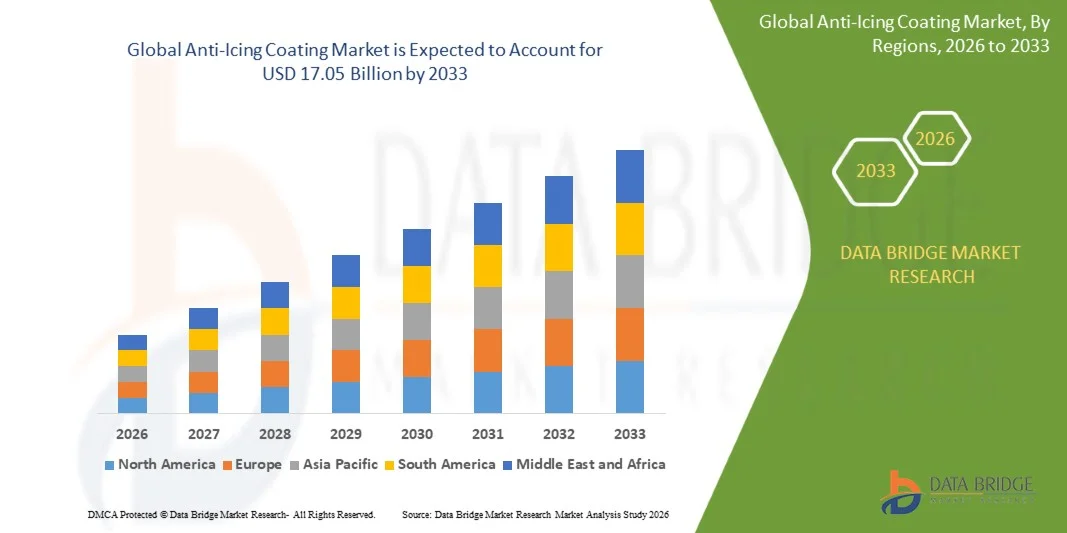
- The global anti-icing coating market size was valued at USD 2.75 billion in 2025 and is expected to reach USD 17.05 billion by 2033, at a CAGR of 25.62% during the forecast period
- The market growth is largely fueled by the increasing need for safety and operational efficiency in cold-climate environments across transportation, aerospace, and industrial sectors, driving the adoption of advanced anti-icing coatings
- Furthermore, growing investments in renewable energy infrastructure, aviation, and automotive sectors, combined with regulatory standards for ice prevention on critical surfaces, are establishing anti-icing coatings as essential solutions for minimizing downtime and maintenance costs. These converging factors are accelerating the adoption of anti-icing technologies, thereby significantly boosting the industry's growth
Anti-Icing Coating Market Analysis
- Anti-icing coatings are specialized surface treatments designed to prevent ice formation on critical surfaces such as aircraft wings, wind turbine blades, vehicles, and industrial equipment. These coatings enhance operational safety, reduce maintenance requirements, and improve energy efficiency across multiple applications
- The escalating demand for anti-icing coatings is primarily fueled by increasing safety regulations, rising awareness of operational hazards due to ice accumulation, and technological advancements in coating materials, which offer durable, environmentally compliant, and high-performance solutions for industrial, transportation, and energy sectors
- North America dominated the anti-icing coating market with a share of around 35% in 2025, due to stringent safety regulations, widespread adoption of advanced transportation systems, and the presence of leading automotive and aerospace manufacturers
- Asia-Pacific is expected to be the fastest growing region in the anti-icing coating market during the forecast period due to rapid industrialization, rising infrastructure development, and technological advancements in countries such as China, Japan, and India
- Metals segment dominated the market with a market share of 46.1% in 2025, due to its extensive application in automotive, aerospace, and industrial machinery where metal surfaces are highly susceptible to ice accumulation. Metal surfaces coated with anti-icing solutions provide enhanced operational efficiency and safety, preventing mechanical failures and reducing downtime in cold environments
Report Scope and Anti-Icing Coating Market Segmentation
|
Attributes |
Anti-Icing Coating Key Market Insights |
|
Segments Covered |
|
|
Countries Covered |
North America
Europe
Asia-Pacific
Middle East and Africa
South America
|
|
Key Market Players |
|
|
Market Opportunities |
|
|
Value Added Data Infosets |
In addition to the insights on market scenarios such as market value, growth rate, segmentation, geographical coverage, and major players, the market reports curated by the Data Bridge Market Research also include in-depth expert analysis, pricing analysis, brand share analysis, consumer survey, demography analysis, supply chain analysis, value chain analysis, raw material/consumables overview, vendor selection criteria, PESTLE Analysis, Porter Analysis, and regulatory framework. |
Anti-Icing Coating Market Trends
“Rising Adoption of Anti-Icing Coatings in Aviation and Renewable Energy Sectors”
- A significant trend in the anti-icing coating market is the increasing adoption of these coatings across aviation and renewable energy industries, driven by the need to maintain operational efficiency and safety in harsh weather conditions. These coatings are enabling aircraft, wind turbines, and critical infrastructure to operate with reduced downtime and improved durability during snow, ice, and frost events
- For instance, 3M supplies advanced anti-icing coatings for aircraft components that prevent ice accumulation on wings and engine inlets, enhancing flight safety and reducing de-icing turnaround time at airports. Such solutions are increasingly integrated into both commercial and defense aviation operations
- Wind energy companies are applying anti-icing coatings on turbine blades to prevent ice buildup, thereby maintaining energy output and reducing maintenance costs. Firms such as GE Renewable Energy are incorporating these coatings into cold-climate wind farms to ensure consistent electricity generation
- The transportation sector is exploring anti-icing solutions for railways and road infrastructure, where coatings on tracks and bridges minimize ice-related accidents and operational delays. This trend is encouraging wider acceptance of protective surface technologies across civil engineering projects
- Maritime operations are also benefiting from anti-icing coatings, especially for ship decks and offshore platforms that face extreme cold conditions. The adoption in this sector is supporting safer and more reliable marine operations in polar and subpolar regions
- Anti-icing coatings are increasingly integrated into automated maintenance strategies where predictive weather modeling informs coating application schedules. This trend is reinforcing the importance of protective surface solutions in operational planning and risk mitigation
Anti-Icing Coating Market Dynamics
Driver
“Increasing Demand for Safety and Efficiency in Extreme Weather Conditions”
- The growing need for operational safety and efficiency in industries exposed to extreme cold conditions is a major driver for the anti-icing coating market. These coatings reduce ice-related delays, enhance equipment reliability, and minimize risk to personnel and assets
- For instance, Boeing applies anti-icing coatings on its aircraft fleets to ensure safe operation under freezing temperatures, improving both flight safety and fuel efficiency. Such applications are critical in maintaining airline schedules and regulatory compliance
- Wind energy operators are leveraging anti-icing coatings to maintain turbine efficiency during winter, reducing mechanical stress and downtime caused by ice formation. This demand is fueling investments in more durable and low-maintenance coating solutions
- Industrial sectors with outdoor assets, including power transmission lines and storage tanks, are increasingly deploying anti-icing coatings to prevent operational disruption and mitigate damage from ice load. The coatings enhance safety protocols while ensuring continuity of service
- The rising expectation for uninterrupted industrial performance in cold climates is strengthening the market. Demand for coatings that combine rapid ice shedding with long-term durability is influencing product development and adoption trends
Restraint/Challenge
“High Production Costs and Technical Complexity of Coatings”
- The anti-icing coating market faces challenges due to the technical complexity involved in formulating coatings that resist ice adhesion while withstanding harsh environmental exposure. These sophisticated chemistries increase manufacturing costs and limit scalability
- For instance, PPG Industries utilizes advanced polymeric formulations for anti-icing coatings on aerospace and wind turbine applications, requiring precise control over material properties and specialized production equipment. Such requirements elevate production expenses and extend development timelines
- Ensuring long-term durability and performance under repeated freeze-thaw cycles involves extensive testing and quality assurance, which further increases operational costs. Manufacturers must balance performance requirements with cost-effectiveness to remain competitive
- The use of rare or high-performance materials, including fluoropolymers and nanocomposites, adds to the supply chain complexity and price volatility. These factors make large-scale deployment of coatings more challenging, particularly in cost-sensitive industrial applications
- The market continues to face limitations in reducing production cost without compromising coating efficiency. These challenges collectively pressure manufacturers to innovate cost-effective solutions while preserving anti-icing performance and reliability
Anti-Icing Coating Market Scope
The market is segmented on the basis of substrate and end-use industry.
• By Substrate
On the basis of substrate, the anti-icing coating market is segmented into metals, glass, concrete, and ceramics. The metals segment dominated the largest market revenue share of 46.1% in 2025, driven by its extensive application in automotive, aerospace, and industrial machinery where metal surfaces are highly susceptible to ice accumulation. Metal surfaces coated with anti-icing solutions provide enhanced operational efficiency and safety, preventing mechanical failures and reducing downtime in cold environments. Manufacturers prefer metal substrates due to their structural compatibility with various anti-icing formulations and the ability to sustain long-term durability under harsh weather conditions. The strong integration of anti-icing coatings with protective and corrosion-resistant layers further increases demand in this segment.
The glass segment is anticipated to witness the fastest growth rate from 2026 to 2033, fueled by rising applications in architectural windows, automotive windshields, and renewable energy sectors such as solar panels. Anti-icing coatings on glass surfaces prevent ice formation while maintaining optical transparency, which is critical for visibility and energy efficiency. Increasing adoption in smart building designs and energy-efficient constructions, combined with government incentives for green technologies, contributes to this growth. Glass substrates coated with hydrophobic or superhydrophobic anti-icing solutions offer both functional and aesthetic advantages, further driving market adoption.
• By End-Use Industry
On the basis of end-use industry, the anti-icing coating market is segmented into automotive and transportation, renewable energy, communication equipment, construction, and others. The automotive and transportation segment dominated the largest market revenue share in 2025, driven by the critical need to ensure vehicle safety, operational efficiency, and performance under icy and snowy conditions. Anti-icing coatings enhance road safety by preventing ice formation on windshields, sensors, mirrors, and vehicle exteriors, which reduces accidents and maintenance costs. The integration of smart vehicle technologies with anti-icing coatings further strengthens their adoption, as manufacturers seek innovative solutions to meet stringent safety regulations. Strong investments by leading automotive OEMs in cold-climate regions also contribute to the segment’s dominance.
The renewable energy segment is expected to witness the fastest CAGR from 2026 to 2033, fueled by increasing deployment of wind turbines and solar panels in regions prone to frost and ice. Ice accumulation on turbine blades or solar panels can significantly reduce energy efficiency and lead to operational downtime, making anti-icing coatings essential. For instance, companies such as 3M provide advanced coatings that prevent ice adhesion, ensuring consistent power generation and lower maintenance. Rising global focus on clean energy solutions, combined with government incentives for renewable energy infrastructure, drives the rapid adoption of anti-icing coatings in this sector.
Anti-Icing Coating Market Regional Analysis
- North America dominated the anti-icing coating market with the largest revenue share of around 35% in 2025, driven by stringent safety regulations, widespread adoption of advanced transportation systems, and the presence of leading automotive and aerospace manufacturers
- Industries in the region highly value anti-icing coatings for enhancing operational efficiency, reducing maintenance costs, and preventing ice-related hazards on vehicles, wind turbines, and industrial machinery
- This widespread adoption is further supported by high investment in cold-climate infrastructure, technological advancements, and the growing focus on reducing downtime in industrial operations, establishing anti-icing coatings as a preferred solution across multiple sectors
U.S. Anti-Icing Coating Market Insight
The U.S. anti-icing coating market captured the largest revenue share in 2025 within North America, fueled by extensive applications in automotive, aerospace, and energy sectors. Companies are increasingly prioritizing coatings that prevent ice formation on critical surfaces to ensure safety and operational continuity. Rising adoption of renewable energy infrastructure, such as wind turbines, combined with advanced coating technologies from leading manufacturers, further drives market growth. The integration of durable and environmentally compliant coatings is also contributing to the expansion of the market across industrial and transportation segments.
Europe Anti-Icing Coating Market Insight
The Europe anti-icing coating market is projected to expand at a substantial CAGR throughout the forecast period, driven by stringent aviation and transportation safety standards and increasing industrial modernization. Growing urbanization, coupled with the demand for efficient cold-weather operations, is fostering the adoption of anti-icing coatings. European industries, particularly automotive, energy, and construction, are adopting coatings that reduce ice accumulation, enhance equipment lifespan, and minimize operational interruptions.
U.K. Anti-Icing Coating Market Insight
The U.K. anti-icing coating market is anticipated to grow at a noteworthy CAGR during the forecast period, supported by the rising need for enhanced safety in transportation and industrial equipment. Concerns over icy conditions on roads, railways, and infrastructure are driving the adoption of effective anti-icing solutions. The U.K.’s focus on infrastructure resilience, combined with technological integration in industrial and transportation sectors, is expected to continue to stimulate market growth.
Germany Anti-Icing Coating Market Insight
The Germany anti-icing coating market is expected to expand at a considerable CAGR during the forecast period, fueled by increasing awareness of operational safety and environmental compliance. Germany’s advanced industrial base, emphasis on technological innovation, and cold-climate operational requirements are promoting the adoption of anti-icing coatings. Integration with industrial machinery, wind turbines, and automotive components is becoming more prevalent, with a strong preference for durable, high-performance solutions aligning with local standards.
Asia-Pacific Anti-Icing Coating Market Insight
The Asia-Pacific anti-icing coating market is poised to grow at the fastest CAGR during the forecast period of 2026 to 2033, driven by rapid industrialization, rising infrastructure development, and technological advancements in countries such as China, Japan, and India. The region’s expanding transportation and renewable energy sectors, supported by government initiatives for safety and energy efficiency, are driving adoption. In addition, Asia-Pacific emerging as a manufacturing hub for anti-icing solutions is enhancing affordability and accessibility, expanding the market to a wider industrial base.
Japan Anti-Icing Coating Market Insight
The Japan anti-icing coating market is gaining momentum due to the country’s focus on safety, advanced transportation systems, and renewable energy deployment. Japanese industries prioritize coatings that prevent ice accumulation on critical surfaces, reducing maintenance costs and ensuring uninterrupted operations. Integration with high-tech infrastructure, including wind turbines, solar panels, and automotive components, is fueling growth, while government regulations and technological innovation continue to support market expansion.
China Anti-Icing Coating Market Insight
The China anti-icing coating market accounted for the largest revenue share in Asia-Pacific in 2025, attributed to rapid industrialization, technological adoption, and the country’s cold-region infrastructure development. China is a key market for transportation, automotive, and renewable energy sectors, with anti-icing coatings ensuring safety, efficiency, and equipment longevity. Government initiatives promoting energy-efficient and safe industrial operations, along with strong domestic manufacturing capabilities, are key factors driving the market growth in China.
Anti-Icing Coating Market Share
The anti-icing coating industry is primarily led by well-established companies, including:
- Aerospace & Advanced Composites GmbH (Germany)
- CG2 Nanocoatings Inc. (U.S.)
- Cytonix LLC (U.S.)
- Fraunhofer-Gesellschaft (Germany)
- Helicity Technologies (U.S.)
- Kiss Polymers LLC (U.S.)
- NEI Corporation (U.S.)
- NeverWet (U.S.)
- Oceanit (U.S.)
- Opus Materials Technologies (U.S.)
- PPG (U.S.)
- DuPont (U.S.)
- Battelle (U.S.)
- NanoSonic (U.S.)
Latest Developments in Global Anti-Icing Coating Market
- In January 2026, PPG Industries launched a bio‑based anti‑icing coating for unmanned aerial vehicles (UAVs) that reduces component weight by up to 15% while maintaining regulatory performance standards. This innovation significantly enhances flight efficiency, reduces fuel consumption, and ensures operational uptime in harsh, cold environments. The product’s adoption is driving growth in the aerospace and defense sectors, as manufacturers increasingly prioritize lightweight, high-performance coatings that improve safety and reduce maintenance costs. The launch also highlights the growing shift toward environmentally friendly formulations in anti-icing technologies, influencing market trends toward sustainable solutions
- In 2025, AkzoNobel unveiled a next‑generation anti‑icing coating specifically designed for the automotive sector, offering superior durability and environmentally compliant performance on windshields, mirrors, and exterior bodywork. This development expanded the application of anti-icing coatings beyond traditional industrial uses into mainstream transportation, improving vehicle safety and reducing downtime in cold-weather operations. The innovation is accelerating adoption among automotive manufacturers and fleet operators, positioning anti-icing coatings as a critical component of modern vehicle maintenance and enhancing market growth in the automotive and transportation segment
- In 2025, NanoTech Solutions secured $15 million in Series B funding to scale its proprietary anti‑icing coating technology for aviation and energy infrastructure applications. This infusion of capital enables rapid commercialization and broader market penetration, allowing the company to expand production and invest in R&D for more advanced formulations. The development signals strong investor confidence in the anti-icing coating sector and underscores the market’s growth potential in critical industrial and renewable energy segments. It also encourages further innovation, fostering competitive advancements across the global market
- In 2021, Henkel AG & Co. KGaA acquired Aislantes Nacionales S.A., a Chilean insulation materials manufacturer, to expand its footprint in the Latin American market and strengthen its portfolio of insulation and protective coatings. This strategic acquisition enhances Henkel’s ability to provide integrated solutions, including anti-icing coatings, across automotive, construction, and industrial applications. It also allows the company to leverage regional market growth, meet rising demand for high-performance coatings, and reinforce its competitive positioning in emerging markets, contributing to long-term market expansion
- In 2020, NEI Corporation launched a new line of anti‑icing coatings called NANOMYTE MEND, using a nanotechnology-based approach to prevent ice buildup on critical surfaces. The product significantly improves operational safety, reduces maintenance and downtime, and enhances performance for aerospace, transportation, and industrial applications. By introducing nanotechnology-based coatings, NEI set a benchmark for high-efficiency anti-icing solutions, stimulating competition and encouraging the adoption of advanced coatings across multiple sectors, thereby shaping technological trends in the global anti-icing coating market
SKU-
Get online access to the report on the World's First Market Intelligence Cloud

- Interactive Data Analysis Dashboard
- Company Analysis Dashboard for high growth potential opportunities
- Research Analyst Access for customization & queries
- Competitor Analysis with Interactive dashboard
- Latest News, Updates & Trend analysis
- Harness the Power of Benchmark Analysis for Comprehensive Competitor Tracking
Global Anti Icing Coating Market, Supply Chain Analysis and Ecosystem Framework
To support market growth and help clients navigate the impact of geopolitical shifts, DBMR has integrated in-depth supply chain analysis into its Global Anti Icing Coating Market research reports. This addition empowers clients to respond effectively to global changes affecting their industries. The supply chain analysis section includes detailed insights such as Global Anti Icing Coating Market consumption and production by country, price trend analysis, the impact of tariffs and geopolitical developments, and import and export trends by country and HSN code. It also highlights major suppliers with data on production capacity and company profiles, as well as key importers and exporters. In addition to research, DBMR offers specialized supply chain consulting services backed by over a decade of experience, providing solutions like supplier discovery, supplier risk assessment, price trend analysis, impact evaluation of inflation and trade route changes, and comprehensive market trend analysis.
Research Methodology
Data collection and base year analysis are done using data collection modules with large sample sizes. The stage includes obtaining market information or related data through various sources and strategies. It includes examining and planning all the data acquired from the past in advance. It likewise envelops the examination of information inconsistencies seen across different information sources. The market data is analysed and estimated using market statistical and coherent models. Also, market share analysis and key trend analysis are the major success factors in the market report. To know more, please request an analyst call or drop down your inquiry.
The key research methodology used by DBMR research team is data triangulation which involves data mining, analysis of the impact of data variables on the market and primary (industry expert) validation. Data models include Vendor Positioning Grid, Market Time Line Analysis, Market Overview and Guide, Company Positioning Grid, Patent Analysis, Pricing Analysis, Company Market Share Analysis, Standards of Measurement, Global versus Regional and Vendor Share Analysis. To know more about the research methodology, drop in an inquiry to speak to our industry experts.
Customization Available
Data Bridge Market Research is a leader in advanced formative research. We take pride in servicing our existing and new customers with data and analysis that match and suits their goal. The report can be customized to include price trend analysis of target brands understanding the market for additional countries (ask for the list of countries), clinical trial results data, literature review, refurbished market and product base analysis. Market analysis of target competitors can be analyzed from technology-based analysis to market portfolio strategies. We can add as many competitors that you require data about in the format and data style you are looking for. Our team of analysts can also provide you data in crude raw excel files pivot tables (Fact book) or can assist you in creating presentations from the data sets available in the report.












