




Global Anti Pollution Mask Market
Market Size in USD Billion
CAGR :
% 
 USD
10.59 Billion
USD
21.24 Billion
2025
2033
USD
10.59 Billion
USD
21.24 Billion
2025
2033
 Forecast Period Forecast Period |
2026 - 2033 |
 Market Size (Base Year) Market Size (Base Year) |
USD 10.59 Billion |
 Market Size (Forecast Year) Market Size (Forecast Year) |
USD 21.24 Billion |
 CAGR CAGR |
% |
| Major Markets Players |
|
Anti-pollution Mask Market Overview
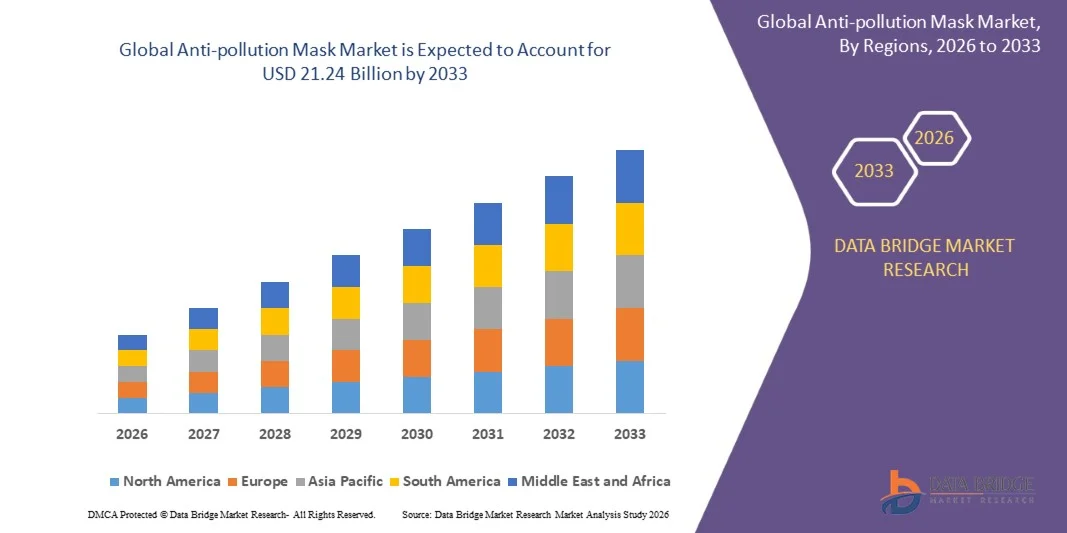
The Anti-pollution Mask Market was valued at USD 10.59 billion in 2025 and is projected to reach USD 21.24 billion by 2033, growing at a CAGR of 9.09% from 2026 to 2033. The market is experiencing strong growth driven by rising air pollution levels across urban regions, increasing public awareness regarding respiratory health protection, and growing adoption of personal protective equipment across healthcare, industrial, and consumer applications. Expanding industrialization, worsening air quality indices, and increasing exposure to airborne particulate matter are further accelerating demand for advanced anti-pollution mask solutions globally.
The increasing prevalence of respiratory disorders globally, combined with rising concerns regarding exposure to PM2.5 particles, industrial emissions, allergens, and airborne pathogens, is encouraging consumers, healthcare professionals, and industrial workers to adopt high-efficiency filtration masks for daily protection. Reusable and disposable anti-pollution masks equipped with activated carbon filters, N95-grade filtration systems, and smart air monitoring technologies are increasingly replacing conventional fabric masks in several markets, offering improved filtration efficiency, comfort, and long-term usability. In addition, growing government initiatives promoting workplace safety standards, expansion of urban commuting populations, and rising demand for sustainable and skin-friendly protective masks are supporting continuous innovation and commercialization of advanced anti-pollution mask products across Asia-Pacific, North America, and Europe.
Key Market Trends & Insights
- North America dominated the anti-pollution mask market with the largest revenue share of approximately 36.8% in 2025, supported by strong healthcare awareness, stringent workplace safety regulations, and high adoption of certified respiratory protection products across industrial and healthcare sectors.
- Asia-Pacific is expected to be the fastest-growing region, recording a CAGR of approximately 10.7% from 2026 to 2033. Growth is driven by rapid urbanization, increasing industrial emissions, worsening air quality conditions, and rising consumer awareness regarding airborne particulate exposure across countries such as China, India, and Japan.
- The Disposable segment held the largest market revenue share of approximately 61.8% in 2025 driven by its widespread use across healthcare facilities, industrial workplaces, and urban consumer applications requiring convenient and low-cost respiratory protection solutions. Disposable masks are preferred because of their easy availability, single-use hygiene benefits, and extensive deployment during periods of high air pollution and infectious disease outbreaks.
- The Reusable segment is projected to register the fastest growth at a CAGR of 10.7% from 2026 to 2033, driven by increasing consumer awareness regarding environmental sustainability and rising demand for long-term cost-effective respiratory protection solutions. Growing adoption of reusable masks equipped with replaceable filters and smart air purification technologies is accelerating segment expansion globally.
- The Offline segment held the largest market revenue share of approximately 68.5% in 2025 driven by strong sales through pharmacies, supermarkets, healthcare supply stores, and industrial safety equipment distributors. Consumers continue to prefer offline retail channels because of immediate product availability and access to certified respiratory protection products.
- The Online segment is projected to register the fastest growth at a CAGR of 11.3% from 2026 to 2033, driven by rapid expansion of e-commerce platforms, increasing smartphone penetration, and growing consumer preference for direct-to-consumer health and wellness product purchasing channels. Rising availability of customizable and premium anti-pollution masks through online marketplaces is further supporting segment growth.
- The Adults segment held the largest market revenue share of approximately 79.4% in 2025 driven by rising exposure of working professionals, industrial employees, and urban commuters to airborne pollutants and hazardous particulate matter. Increasing use of respiratory protection masks across healthcare, manufacturing, and transportation sectors is significantly contributing to segment dominance.
- The Kids segment is projected to register the fastest growth at a CAGR of 10.1% from 2026 to 2033, driven by increasing parental awareness regarding respiratory health risks associated with air pollution exposure in urban environments. Growing demand for comfortable, lightweight, and child-friendly filtration masks across Asia-Pacific and North America is accelerating market expansion.
- The Personal Use segment held the largest market revenue share of approximately 57.9% in 2025 driven by increasing consumer adoption of anti-pollution masks for daily commuting, outdoor activities, and protection against urban air pollution exposure. Rising health awareness campaigns and growing public concern regarding respiratory illnesses are supporting widespread consumer adoption globally.
- The Industrial Use segment is projected to register the fastest growth at a CAGR of 9.8% from 2026 to 2033, driven by stringent occupational safety regulations and increasing deployment of respiratory protection equipment across construction, mining, chemical processing, and manufacturing industries. Expansion of industrial workforce safety compliance programs is accelerating segment growth.
- The N-Rated segment held the largest market revenue share of approximately 66.2% in 2025 driven by its widespread use in healthcare, industrial safety, and consumer respiratory protection applications requiring efficient filtration of non-oil-based airborne particles. N95 masks remain highly preferred because of their certified filtration performance and broad regulatory acceptance across multiple industries.
- The P-Rated segment is projected to register the fastest growth at a CAGR of 9.6% from 2026 to 2033, driven by increasing use across industrial environments involving exposure to oil-based aerosols, chemical fumes, and hazardous airborne contaminants. Growing demand from petrochemical and heavy manufacturing industries is accelerating adoption of advanced P-rated respiratory protection systems.
- The Particulate Filter segment held the largest market revenue share of approximately 49.7% in 2025 driven by rising demand for protection against PM2.5 particles, dust, allergens, and airborne pathogens across urban and industrial environments. Increasing deployment of particulate filtration masks in healthcare facilities and pollution-prone cities is contributing significantly to segment growth.
- The Combination Filter segment is projected to register the fastest growth at a CAGR of 11.1% from 2026 to 2033, driven by increasing demand for multi-functional respiratory protection systems capable of filtering both particulate matter and harmful gases or odours. Rising industrial pollution levels and growing adoption of advanced filtration technologies in premium reusable masks are accelerating segment expansion globally.
Market Size & Forecast
- Global Market Value (2025): USD 10.59 Billion
- Expected Market Value (2033): USD 21.24 Billion
- Forecast CAGR (2026–2033): 9.09%
- Leading Region in 2025: North America
- Fastest Growing Region: Asia-Pacific
Report Scope and Anti-pollution Mask Market Segmentation
|
Attributes |
Anti-pollution Mask Key Market Insights |
|
Segments Covered |
· By Product: Disposable and Reusable · By Distribution Channel: Online and Offline · By Application: Kids and Adults · By End-Users: Personal Use and Industrial Use · By Type: P-Rated and N-Rated · By Filter Type: Particulate Filter, Gas and Odour Filter, and Combination Filter |
|
Countries Covered |
North America · U.S. · Canada · Mexico Europe · Germany · France · U.K. · Netherlands · Switzerland · Belgium · Russia · Italy · Spain · Turkey · Rest of Europe Asia-Pacific · China · Japan · India · South Korea · Singapore · Malaysia · Australia · Thailand · Indonesia · Philippines · Rest of Asia-Pacific Middle East and Africa · Saudi Arabia · U.A.E. · South Africa · Egypt · Israel · Rest of Middle East and Africa South America · Brazil · Argentina · Rest of South America |
|
Key Market Players |
• 3M (U.S.) |
|
Market Opportunities |
• Expansion Of Smart Wearable Respiratory Protection Technologies • Rising Demand For Sustainable And Reusable Filtration Masks |
|
Value Added Data Infosets |
In addition to the insights on market scenarios such as market value, growth rate, segmentation, geographical coverage, and major players, the market reports curated by the Data Bridge Market Research also include in-depth expert analysis, pricing analysis, brand share analysis, consumer survey, demography analysis, supply chain analysis, value chain analysis, raw material/consumables overview, vendor selection criteria, PESTLE Analysis, Porter Analysis, and regulatory framework. |
Anti-pollution Mask Market Trends
Trend: Rising Adoption Of Advanced Filtration Technologies And Smart Respiratory Protection Solutions
Increasing demand for high-efficiency, lightweight, and reusable respiratory protection products across healthcare, industrial, transportation, and consumer sectors. Conventional fabric masks provide limited protection against fine particulate matter, toxic pollutants, and airborne pathogens, encouraging consumers and industries to adopt advanced anti-pollution masks equipped with multi-layer filtration systems and activated carbon technologies for enhanced respiratory safety.
In urban environments with severe air pollution exposure, manufacturers are increasingly integrating advanced filtration materials, For instance Xiaomi and AirPOP launching anti-pollution masks equipped with PM2.5 filtration and activated carbon layers to improve respiratory protection in densely populated cities across Asia-Pacific and Europe. In industrial and healthcare applications, anti-pollution masks are being widely used, For instance by construction workers, healthcare professionals, and manufacturing employees, to minimize exposure to dust particles, chemical fumes, allergens, and airborne contaminants while improving workplace safety compliance.
The rapid expansion of urban commuting populations and increasing awareness regarding respiratory health risks are also increasing demand for ergonomic and reusable mask solutions capable of supporting long-duration daily usage. Additionally, healthcare and emergency response sectors continue to rely on high-performance respiratory masks, such as N95 and FFP2 filtration systems, because of their ability to provide superior airborne particle protection in high-risk operating environments. Growing industry validation through public health initiatives in 2025 promoting certified reusable filtration masks demonstrated reductions of nearly 20–30% in particulate exposure levels among daily urban commuters in heavily polluted metropolitan regions.
Anti-pollution Mask Market Dynamics
Key Market Driver: Rising Air Pollution Levels And Increasing Respiratory Health Awareness
Governments, industries, and consumers worldwide are facing increasing health and environmental concerns associated with deteriorating air quality, industrial emissions, and airborne particulate matter exposure. Rising concentrations of PM2.5 particles, vehicle exhaust emissions, construction dust, and industrial pollutants are creating strong demand for advanced respiratory protection products capable of minimizing inhalation of harmful airborne contaminants.
Industries such as healthcare, construction, mining, manufacturing, and transportation are increasingly deploying certified anti-pollution masks to improve worker safety and comply with occupational health regulations. Healthcare organizations are actively promoting use of advanced respiratory protection systems, For instance N95 and KN95 masks in hospitals and high-density public environments, to reduce respiratory health risks associated with airborne infections and environmental pollution exposure.
Similarly, urban populations and public transportation users are increasing adoption of reusable filtration masks to manage growing pollution exposure while improving daily respiratory protection. Real-world air quality management programs implemented across cities in India and China during 2024 promoting certified anti-pollution mask usage demonstrated reductions of around 18–26% in exposure to harmful airborne particulate matter among frequent outdoor commuters.
Key Restraint/Challenge: High Product Costs And Environmental Waste Concerns
Advanced anti-pollution masks equipped with high-efficiency filtration systems and smart monitoring technologies often involve higher manufacturing and retail costs compared to conventional disposable masks, limiting affordability across price-sensitive consumer markets. Reusable masks with replaceable filters and smart respiratory monitoring features also require regular maintenance and filter replacement, increasing long-term ownership costs for consumers and industrial users.
In addition, growing environmental concerns regarding disposal of single-use masks and synthetic filtration materials are creating pressure on manufacturers to develop recyclable and biodegradable alternatives. Strict regulatory certification requirements for medical-grade and industrial respiratory masks further increase production complexity and compliance costs across the industry. Limited consumer awareness regarding proper mask usage and filtration replacement schedules also restricts effective product utilization in several developing regions.
Commercial environmental assessments indicate that billions of disposable masks entered global waste streams during 2024, significantly increasing plastic-based environmental pollution and creating additional waste management challenges across urban municipalities and healthcare systems.
Key Market Opportunity: Expansion Of Smart Wearable Respiratory Protection And Sustainable Filtration Solutions
Modern consumers, industrial workers, and healthcare professionals increasingly require lightweight, reusable, and highly efficient respiratory protection solutions capable of improving comfort, safety, and long-term usability. Conventional disposable masks often provide inconsistent filtration performance and limited comfort during extended usage, creating demand for advanced anti-pollution masks with smart airflow management and sustainable material technologies.
Manufacturers and technology companies are increasingly exploring smart respiratory protection systems, For instance LG and Philips developing wearable air purification masks equipped with rechargeable filtration and airflow control technologies, to improve respiratory safety and user comfort in polluted urban environments. In healthcare and industrial sectors, rising demand for reusable and certified respiratory protection equipment is accelerating adoption of advanced filtration masks with antibacterial coatings, replaceable filters, and ergonomic designs.
Additionally, advancements in nanofiber filtration materials, biodegradable mask fabrics, and sensor-integrated air quality monitoring technologies are improving product efficiency and sustainability, opening opportunities across healthcare, industrial safety, and smart wearable technology markets globally. Product innovation programs conducted in 2025 across Japan, South Korea, and the U.S. reported filtration efficiency improvements of around 15–22% after integrating advanced nanofiber-based filtration systems into next-generation reusable anti-pollution masks.
Anti-pollution Mask Market Scope
The market is segmented on the basis of product, distribution channel, application, end-users, type, and filter type.
- By Product
On the basis of product, the Anti-pollution Mask Market is segmented into Disposable and Reusable. The Disposable segment held the largest market revenue share of approximately 61.8% in 2025 driven by its widespread use across healthcare facilities, industrial workplaces, and urban consumer applications requiring convenient and low-cost respiratory protection solutions. Disposable masks are preferred because of their easy availability, single-use hygiene benefits, and extensive deployment during periods of high air pollution and infectious disease outbreaks.
The Reusable segment is projected to register the fastest growth at a CAGR of 10.7% from 2026 to 2033, driven by increasing consumer awareness regarding environmental sustainability and rising demand for long-term cost-effective respiratory protection solutions. Growing adoption of reusable masks equipped with replaceable filters and smart air purification technologies is accelerating segment expansion globally.
- By Distribution Channel
On the basis of distribution channel, the Anti-pollution Mask Market is segmented into Online and Offline. The Offline segment held the largest market revenue share of approximately 68.5% in 2025 driven by strong sales through pharmacies, supermarkets, healthcare supply stores, and industrial safety equipment distributors. Consumers continue to prefer offline retail channels because of immediate product availability and access to certified respiratory protection products.
The Online segment is projected to register the fastest growth at a CAGR of 11.3% from 2026 to 2033, driven by rapid expansion of e-commerce platforms, increasing smartphone penetration, and growing consumer preference for direct-to-consumer health and wellness product purchasing channels. Rising availability of customizable and premium anti-pollution masks through online marketplaces is further supporting segment growth.
- By Application
On the basis of application, the Anti-pollution Mask Market is segmented into Kids and Adults. The Adults segment held the largest market revenue share of approximately 79.4% in 2025 driven by rising exposure of working professionals, industrial employees, and urban commuters to airborne pollutants and hazardous particulate matter. Increasing use of respiratory protection masks across healthcare, manufacturing, and transportation sectors is significantly contributing to segment dominance.
The Kids segment is projected to register the fastest growth at a CAGR of 10.1% from 2026 to 2033, driven by increasing parental awareness regarding respiratory health risks associated with air pollution exposure in urban environments. Growing demand for comfortable, lightweight, and child-friendly filtration masks across Asia-Pacific and North America is accelerating market expansion.
- By End-Users
On the basis of end-users, the Anti-pollution Mask Market is segmented into Personal Use and Industrial Use. The Personal Use segment held the largest market revenue share of approximately 57.9% in 2025 driven by increasing consumer adoption of anti-pollution masks for daily commuting, outdoor activities, and protection against urban air pollution exposure. Rising health awareness campaigns and growing public concern regarding respiratory illnesses are supporting widespread consumer adoption globally.
The Industrial Use segment is projected to register the fastest growth at a CAGR of 9.8% from 2026 to 2033, driven by stringent occupational safety regulations and increasing deployment of respiratory protection equipment across construction, mining, chemical processing, and manufacturing industries. Expansion of industrial workforce safety compliance programs is accelerating segment growth.
- By Type
On the basis of type, the Anti-pollution Mask Market is segmented into P-Rated and N-Rated. The N-Rated segment held the largest market revenue share of approximately 66.2% in 2025 driven by its widespread use in healthcare, industrial safety, and consumer respiratory protection applications requiring efficient filtration of non-oil-based airborne particles. N95 masks remain highly preferred because of their certified filtration performance and broad regulatory acceptance across multiple industries.
The P-Rated segment is projected to register the fastest growth at a CAGR of 9.6% from 2026 to 2033, driven by increasing use across industrial environments involving exposure to oil-based aerosols, chemical fumes, and hazardous airborne contaminants. Growing demand from petrochemical and heavy manufacturing industries is accelerating adoption of advanced P-rated respiratory protection systems.
- By Filter Type
On the basis of filter type, the Anti-pollution Mask Market is segmented into Particulate Filter, Gas and Odour Filter, and Combination Filter. The Particulate Filter segment held the largest market revenue share of approximately 49.7% in 2025 driven by rising demand for protection against PM2.5 particles, dust, allergens, and airborne pathogens across urban and industrial environments. Increasing deployment of particulate filtration masks in healthcare facilities and pollution-prone cities is contributing significantly to segment growth.
The Combination Filter segment is projected to register the fastest growth at a CAGR of 11.1% from 2026 to 2033, driven by increasing demand for multi-functional respiratory protection systems capable of filtering both particulate matter and harmful gases or odours. Rising industrial pollution levels and growing adoption of advanced filtration technologies in premium reusable masks are accelerating segment expansion globally.
Anti-pollution Mask Market Regional Analysis
North America Anti-pollution Mask Market Insight
North America dominated the anti-pollution mask market with the largest revenue share of approximately 36.8% in 2025, supported by rising awareness regarding respiratory health protection, increasing industrial safety regulations, and strong adoption of certified filtration masks across healthcare and industrial sectors. Consumers in the region highly prioritize protection against airborne pollutants, allergens, and infectious particles, driving widespread use of reusable and disposable anti-pollution masks equipped with advanced filtration technologies. This growing adoption is further supported by high healthcare awareness, stringent occupational safety standards, and increasing demand for premium respiratory protection products across residential, commercial, and healthcare environments.
U.S. Anti-pollution Mask Market Insight
The U.S. anti-pollution mask market captured the largest revenue share in 2025 within North America, fueled by increasing concerns regarding air quality, rising prevalence of respiratory disorders, and strong demand for advanced respiratory protection products across healthcare and industrial applications. Consumers are increasingly prioritizing personal health protection through certified filtration masks equipped with N95-grade and activated carbon filtration systems. The growing preference for reusable and ergonomic mask solutions, combined with strong adoption of smart wearable respiratory protection technologies, further propels the market. Moreover, increasing integration of advanced filtration technologies and growing public awareness regarding airborne health risks are significantly contributing to market expansion across the country.
Europe Anti-pollution Mask Market Insight
The Europe anti-pollution mask market is expected to witness the fastest growth rate from 2026 to 2033, primarily driven by stringent workplace safety regulations and increasing public concern regarding urban air pollution and respiratory health protection. The increase in industrial activities, coupled with growing awareness regarding airborne particulate exposure, is fostering adoption of certified anti-pollution masks across healthcare, transportation, and industrial sectors. European consumers are also drawn to reusable and environmentally sustainable mask solutions offering improved comfort and long-term usability. The region is experiencing significant growth across personal use, healthcare, and industrial safety applications, with advanced filtration masks increasingly integrated into workplace protection programs and public health initiatives.
U.K. Anti-pollution Mask Market Insight
The U.K. anti-pollution mask market is expected to witness the fastest growth rate from 2026 to 2033, driven by increasing concerns regarding respiratory health, rising urban pollution exposure, and growing awareness regarding personal protective equipment usage. Additionally, concerns regarding allergens, airborne particulate matter, and seasonal respiratory illnesses are encouraging consumers and workers to adopt reusable and high-filtration respiratory masks. The U.K.’s increasing focus on workplace safety compliance, alongside expansion of healthcare and industrial protection infrastructure, is expected to continue stimulating market growth.
Germany Anti-pollution Mask Market Insight
The Germany anti-pollution mask market is expected to witness the fastest growth rate from 2026 to 2033, fueled by increasing awareness regarding occupational respiratory safety and growing demand for technologically advanced filtration products across industrial and healthcare sectors. Germany’s advanced manufacturing infrastructure, combined with its emphasis on industrial worker protection and environmental sustainability, promotes adoption of certified respiratory masks in construction, chemical processing, and automotive industries. The integration of advanced filtration technologies and ergonomic reusable mask designs is also becoming increasingly prevalent, with strong preference for high-quality and regulation-compliant respiratory protection solutions aligning with local consumer and industrial expectations.
Asia-Pacific Anti-pollution Mask Market Insight
The Asia-Pacific anti-pollution mask market is expected to witness the fastest growth rate from 2026 to 2033, supported by increasing urbanization, deteriorating air quality levels, and rising disposable incomes across countries such as China, India, and Japan. The region’s growing concern regarding exposure to PM2.5 particles and industrial emissions, supported by government air pollution awareness initiatives, is driving adoption of anti-pollution masks across urban and industrial populations. Furthermore, as Asia-Pacific emerges as a major manufacturing hub for filtration materials and respiratory protection equipment, the affordability and accessibility of advanced anti-pollution masks are expanding to a wider consumer base.
Japan Anti-pollution Mask Market Insight
The Japan anti-pollution mask market is expected to witness the fastest growth rate from 2026 to 2033 due to the country’s strong health-conscious consumer culture, rising demand for advanced wearable respiratory protection, and increasing adoption of smart healthcare technologies. The Japanese market places significant emphasis on personal hygiene and respiratory safety, and adoption of anti-pollution masks is driven by growing urban commuting populations and increasing concerns regarding seasonal allergies and airborne infections. The integration of advanced filtration technologies with ergonomic and lightweight mask designs is fueling growth. Moreover, Japan’s aging population is increasingly supporting demand for comfortable and high-performance respiratory protection solutions across residential and healthcare sectors.
China Anti-pollution Mask Market Insight
The China anti-pollution mask market accounted for the largest market revenue share in Asia-Pacific in 2025, attributed to the country’s rapid urbanization, rising industrial pollution levels, and strong adoption of personal respiratory protection products across densely populated metropolitan regions. China stands as one of the largest markets for anti-pollution masks, with increasing usage across residential, industrial, healthcare, and transportation applications. The push toward air quality improvement initiatives and the availability of affordable filtration mask products, alongside strong domestic manufacturing capabilities, are key factors propelling the market across China.
Anti-pollution Mask Market Share
The Anti-pollution Mask industry is primarily led by well-established companies, including:
• 3M (U.S.)
• Honeywell International Inc. (U.S.)
• Totobobo Pte. Ltd. (Singapore)
• MSA (U.S.)
• PollutionAirMask (India)
• idMASK Co., Ltd. (South Korea)
• nirvanabeing (India)
• Reckitt Benckiser (U.K.)
• Wiggle Ltd. (U.K.)
• Ohlone Press LLC (U.S.)
• RESPILON Ltd (Czech Republic)
• RZ Mask (U.S.)
• PureLogic Labs (U.S.)
• Xiaomi (China)
• O2TODAY (South Korea)
• Cambridge Mask Co (U.K.)
Latest Developments in Anti-pollution Mask Market
- In February 2026, 3M announced expansion of its advanced respiratory protection manufacturing capabilities across North America to strengthen supply chain resilience and meet rising demand for high-performance anti-pollution and healthcare masks. The development is expected to improve production efficiency, support rapid distribution during air quality emergencies, and enhance availability of certified filtration masks across healthcare and industrial sectors. The expansion is anticipated to strengthen competitive intensity and accelerate innovation in premium respiratory protection products globally.
- In May 2025, The U.S. Medical Glove Company (USMGC) commenced operations at its new face mask manufacturing facility in the U.S., equipped with six high-speed production lines for manufacturing 3-ply disposable face masks. The facility is expected to strengthen domestic healthcare supply chains, reduce dependency on imported protective equipment, and improve product availability during public health emergencies. The expansion is also supporting growth of local manufacturing capabilities within the North America respiratory protection market.
- In August 2024, Cambridge Mask Co. launched a large-scale sustainability awareness initiative promoting reusable anti-pollution masks as environmentally responsible alternatives to disposable respiratory products. The campaign focused on educating consumers regarding waste reduction, long-term cost efficiency, and sustainable respiratory protection practices. The initiative is expected to improve consumer adoption of reusable filtration masks and encourage sustainability-focused product innovation across the industry.
- In June 2024, Honeywell International Inc. expanded its certified N95 respiratory protection portfolio for industrial and healthcare applications to address increasing demand for advanced airborne protection solutions. The company introduced upgraded filtration technologies and ergonomic mask designs aimed at improving comfort and long-duration usability in high-exposure environments. The expansion is anticipated to strengthen market competition and accelerate development of high-performance filtration products globally.
- In September 2023, Xiaomi introduced upgraded smart air filtration masks integrated with rechargeable airflow systems and enhanced PM2.5 filtration technologies targeting urban consumers across Asia-Pacific markets. The product launch focused on improving wearable comfort, real-time respiratory protection, and smart connectivity features for daily commuters exposed to severe urban pollution. The innovation is expected to increase adoption of smart wearable respiratory protection technologies and support premiumization trends within the anti-pollution mask market.
- In November 2022, RESPILON Ltd expanded commercialization of its nanofiber filtration technology for reusable anti-pollution masks across Europe and North America. The development focused on improving ultra-fine particle filtration efficiency while maintaining lightweight and breathable mask structures suitable for long-duration use. The expansion is expected to accelerate adoption of advanced nanotechnology-based respiratory protection products and strengthen innovation in sustainable filtration solutions globally.
SKU-
Get online access to the report on the World's First Market Intelligence Cloud

- Interactive Data Analysis Dashboard
- Company Analysis Dashboard for high growth potential opportunities
- Research Analyst Access for customization & queries
- Competitor Analysis with Interactive dashboard
- Latest News, Updates & Trend analysis
- Harness the Power of Benchmark Analysis for Comprehensive Competitor Tracking
Research Methodology
Data collection and base year analysis are done using data collection modules with large sample sizes. The stage includes obtaining market information or related data through various sources and strategies. It includes examining and planning all the data acquired from the past in advance. It likewise envelops the examination of information inconsistencies seen across different information sources. The market data is analysed and estimated using market statistical and coherent models. Also, market share analysis and key trend analysis are the major success factors in the market report. To know more, please request an analyst call or drop down your inquiry.
The key research methodology used by DBMR research team is data triangulation which involves data mining, analysis of the impact of data variables on the market and primary (industry expert) validation. Data models include Vendor Positioning Grid, Market Time Line Analysis, Market Overview and Guide, Company Positioning Grid, Patent Analysis, Pricing Analysis, Company Market Share Analysis, Standards of Measurement, Global versus Regional and Vendor Share Analysis. To know more about the research methodology, drop in an inquiry to speak to our industry experts.
Customization Available
Data Bridge Market Research is a leader in advanced formative research. We take pride in servicing our existing and new customers with data and analysis that match and suits their goal. The report can be customized to include price trend analysis of target brands understanding the market for additional countries (ask for the list of countries), clinical trial results data, literature review, refurbished market and product base analysis. Market analysis of target competitors can be analyzed from technology-based analysis to market portfolio strategies. We can add as many competitors that you require data about in the format and data style you are looking for. Our team of analysts can also provide you data in crude raw excel files pivot tables (Fact book) or can assist you in creating presentations from the data sets available in the report.












