Global Antidepressants Market
Market Size in USD Billion
CAGR :
% 
 USD
22.56 Billion
USD
41.44 Billion
2025
2033
USD
22.56 Billion
USD
41.44 Billion
2025
2033
 Forecast Period Forecast Period |
2026 –2033 |
 Market Size (Base Year) Market Size (Base Year) |
USD 22.56 Billion |
 Market Size (Forecast Year) Market Size (Forecast Year) |
USD 41.44 Billion |
 CAGR CAGR |
% |
| Major Markets Players |
|
Antidepressants Market Size
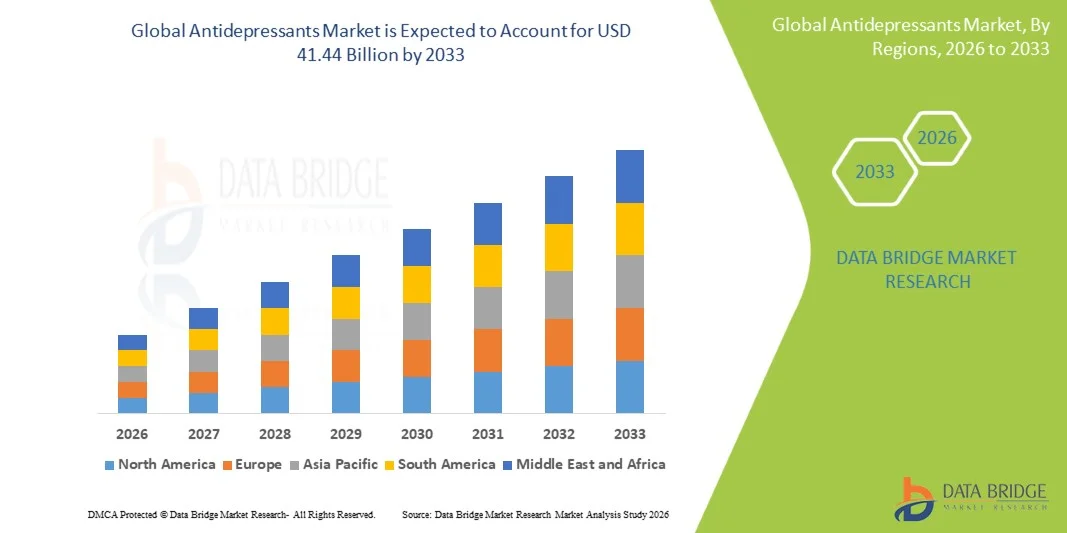
- The global antidepressants market size was valued at USD 22.56 billion in 2025 and is expected to reach USD 41.44 billion by 2033, at a CAGR of 7.90% during the forecast period
- The market growth is largely fueled by the increasing prevalence of mental health disorders such as depression and anxiety, along with growing awareness and diagnosis rates, leading to higher demand for effective treatment options across both developed and emerging regions
- Furthermore, rising consumer demand for safe, effective, and well-tolerated treatment solutions, along with advancements in drug development and personalized medicine, is establishing antidepressants as a primary line of therapy. These converging factors are accelerating the adoption of antidepressant therapies, thereby significantly boosting the market’s growth
Antidepressants Market Analysis
- Antidepressants, used for the treatment of mental health disorders such as depression, anxiety, and related conditions, are increasingly vital components of modern healthcare systems across both developed and emerging regions due to their proven efficacy, improved safety profiles, and expanding role in long-term disease management
- The escalating demand for antidepressants is primarily fueled by the rising global prevalence of depression and anxiety disorders, increasing awareness and diagnosis rates, and a growing acceptance of mental health treatment, along with improved access to healthcare services
- North America dominated the antidepressants market with the largest revenue share of 41.8% in 2025, characterized by high awareness of mental health, strong healthcare infrastructure, and a significant presence of leading pharmaceutical companies, with the U.S. experiencing substantial growth in antidepressant prescriptions driven by increasing stress-related disorders and better access to treatment
- Asia-Pacific is expected to be the fastest growing region in the antidepressants market during the forecast period due to increasing urbanization, improving healthcare infrastructure, rising disposable incomes, and growing mental health awareness initiatives across countries such as China and India
- The oral segment dominated the market with a revenue share of 72.8% in 2025, primarily due to its ease of use, convenience, and high patient compliance
Report Scope and Antidepressants Market Segmentation
|
Attributes |
Antidepressants Key Market Insights |
|
Segments Covered |
|
|
Countries Covered |
North America
Europe
Asia-Pacific
Middle East and Africa
South America
|
|
Key Market Players |
|
|
Market Opportunities |
|
|
Value Added Data Infosets |
In addition to the insights on market scenarios such as market value, growth rate, segmentation, geographical coverage, and major players, the market reports curated by the Data Bridge Market Research also include in-depth expert analysis, patient epidemiology, pipeline analysis, pricing analysis, and regulatory framework. |
Antidepressants Market Trends
“Enhanced Convenience Through AI and Voice Integration”
- A significant and accelerating trend in the global Antidepressants market is the growing emphasis on the development of novel therapies and personalized treatment strategies to improve patient outcomes
- Pharmaceutical companies are increasingly investing in innovative mechanisms of action beyond traditional monoamine-based therapies, including glutamate modulators and rapid-acting antidepressants, to address unmet clinical needs
- For instance, the introduction of esketamine-based therapies has marked a shift toward fast-acting treatment options for patients with treatment-resistant depression, offering relief within hours rather than weeks
- In addition, advancements in pharmacogenomics are enabling healthcare providers to tailor antidepressant treatments based on individual genetic profiles, improving efficacy and reducing adverse effects
- The integration of digital health tools and real-world data is further supporting personalized medicine by allowing continuous monitoring of patient responses and optimizing treatment regimens
- This trend toward more targeted, effective, and patient-centric therapies is reshaping treatment paradigms and increasing demand for advanced antidepressant solutions across global healthcare systems
Antidepressants Market Dynamics
Driver
“Rising Prevalence of Mental Health Disorders and Increasing Awareness”
- The growing global burden of mental health disorders, including depression and anxiety, is a major driver for the antidepressants market. Increasing awareness and diagnosis rates are leading to higher treatment adoption
- For instance, according to global health organizations, depression remains one of the leading causes of disability worldwide, significantly increasing the demand for effective pharmacological treatments
- Government initiatives, mental health campaigns, and reduced social stigma are encouraging more individuals to seek medical help, thereby boosting prescription rates for antidepressants
- Furthermore, improved access to healthcare services, especially in developing regions, and the expansion of telemedicine platforms are making mental health treatments more accessible to a wider population
- The availability of a wide range of antidepressant classes, including SSRIs, SNRIs, tricyclic antidepressants, and atypical antidepressants, provides clinicians with multiple treatment options, supporting market growth
Restraint/Challenge
“Side Effects, Delayed Onset of Action, and Treatment Resistance”
- The presence of side effects associated with antidepressant medications, such as weight gain, sexual dysfunction, nausea, and sleep disturbances, remains a key challenge limiting patient adherence
- For instance, patients prescribed commonly used antidepressants such as SSRIs (e.g., fluoxetine or sertraline) are often required to wait 4–6 weeks before experiencing significant improvement in depressive symptoms, which can lead to frustration and early discontinuation of treatment. Clinical evidence suggests that while some minor improvements may appear earlier, full therapeutic effects typically take several weeks to manifest, delaying relief for patients suffering from severe depression
- Many conventional antidepressants require several weeks to show therapeutic effects, which can discourage patients and lead to discontinuation of treatment
- In addition, a significant proportion of patients suffer from treatment-resistant depression, where standard therapies fail to provide adequate relief, highlighting a major unmet need in the market
- Concerns regarding long-term dependency and withdrawal symptoms further contribute to hesitancy among patients when initiating or continuing antidepressant therapy
- The high cost of newer and advanced antidepressant treatments can also act as a barrier, particularly in low- and middle-income countries with limited healthcare reimbursement frameworks
- Addressing these challenges through the development of faster-acting drugs, improved safety profiles, and enhanced patient education will be critical for sustaining long-term market growth
Antidepressants Market Scope
The market is segmented on the basis of drug class, indication, route of administration, end-users, and distribution channel.
• By Drug Class
On the basis of drug class, the Antidepressants market is segmented into tricyclic antidepressants (TCAs), selective serotonin reuptake inhibitors (SSRIs), serotonin-norepinephrine reuptake inhibitors (SNRIs), monoamine oxidase inhibitors (MAOIs), serotonin antagonist and reuptake inhibitors (SARIs), and others. The SSRIs segment dominated the largest market revenue share of 38.6% in 2025, driven by their strong clinical efficacy, improved safety profile, and widespread use as first-line therapy for depression and anxiety disorders. These drugs are highly preferred due to fewer side effects compared to older antidepressants such as TCAs and MAOIs. Increasing awareness about mental health, growing diagnosis rates, and strong physician preference are further supporting segment growth. In addition, the availability of cost-effective generic SSRIs has significantly improved patient accessibility across both developed and developing regions. Pharmaceutical companies continue to invest in enhancing formulations and improving patient adherence, further strengthening demand. The segment also benefits from long-term prescription patterns, as patients often remain on SSRIs for extended durations.
The SNRIs segment is expected to witness the fastest CAGR of 8.9% from 2026 to 2033, driven by their dual-action mechanism that targets both serotonin and norepinephrine neurotransmitters. This dual benefit makes them particularly effective for patients who do not respond adequately to SSRIs. Increasing prevalence of treatment-resistant depression is a key factor accelerating demand for SNRIs globally. In addition, these drugs are gaining traction in managing chronic pain conditions such as fibromyalgia and neuropathic pain, further expanding their application scope. Continuous research and development efforts and rising physician confidence in SNRIs are also contributing to growth. Improved healthcare access and increasing mental health awareness in emerging economies are expected to further boost adoption. The segment is also benefiting from new product approvals and expanded clinical indications, making it one of the fastest-growing drug classes in the market.
• By Indication
On the basis of indication, the Antidepressants market is segmented into major depressive disorder (MDD), anxiety disorders, attention deficit hyperactivity disorder (ADHD), and others. The major depressive disorder segment dominated with a market share of 41.3% in 2025, driven by the high global burden of depression and its classification as a leading cause of disability worldwide. Increasing awareness, improved screening programs, and rising acceptance of mental health treatments have significantly contributed to the dominance of this segment. Patients diagnosed with MDD often require long-term pharmacological treatment, which sustains consistent demand for antidepressants. Government initiatives and public health campaigns promoting mental well-being have also enhanced diagnosis and treatment rates. In addition, advancements in treatment options and the availability of combination therapies are improving patient outcomes. The increasing prevalence of depression due to lifestyle changes, stress, and socio-economic factors further supports growth.
The anxiety disorders segment is projected to grow at the fastest CAGR of 9.4% from 2026 to 2033, fueled by rising stress levels, urbanization, and increasing awareness of anxiety-related conditions. Disorders such as generalized anxiety disorder, panic disorder, and social anxiety are becoming more commonly diagnosed, contributing to increased demand for antidepressants. Growing acceptance of mental health treatments and reduced stigma around seeking care are key drivers of this segment. In addition, the integration of pharmacotherapy with counseling and behavioral therapy is improving treatment outcomes. Increasing digital health platforms and telemedicine services are making treatment more accessible, particularly in remote areas. Pharmaceutical advancements and expanded therapeutic indications are also supporting segment growth. This segment is expected to see strong momentum as awareness and diagnosis rates continue to rise globally.
• By Route of Administration
On the basis of route of administration, the Antidepressants market is segmented into oral, injectable, and others. The oral segment dominated the market with a revenue share of 72.8% in 2025, primarily due to its ease of use, convenience, and high patient compliance. Oral antidepressants are widely prescribed for both short-term and long-term treatment of depression and anxiety disorders. The availability of various formulations such as tablets, capsules, and extended-release versions enhances patient adherence. In addition, oral medications are cost-effective and easily accessible through retail and online pharmacies, making them the preferred choice among patients and healthcare providers. The dominance of this segment is further supported by the widespread use of SSRIs and SNRIs, which are primarily administered orally. Continuous product innovations and generic drug availability further strengthen this segment’s position in the market.
The injectable segment is expected to register the fastest CAGR of 10.2% from 2026 to 2033, driven by the increasing adoption of rapid-acting antidepressants such as ketamine and esketamine. These treatments are particularly effective for patients with severe or treatment-resistant depression, offering faster symptom relief compared to traditional oral medications. The growing number of clinical studies supporting the efficacy of injectable therapies is boosting physician confidence and adoption rates. In addition, the expansion of hospital-based treatment settings and specialized mental health clinics is contributing to segment growth. Technological advancements in drug delivery systems are also improving patient outcomes. Increasing investments in innovative therapies and rising demand for quick-acting treatments are expected to drive significant growth in this segment.
• By End-Users
On the basis of end-users, the Antidepressants market is segmented into hospitals, homecare, specialty centres, and others. The hospitals segment dominated the market with a share of 46.5% in 2025, as hospitals serve as the primary centers for diagnosis, treatment initiation, and management of severe mental health conditions. Hospitals provide access to trained healthcare professionals, advanced diagnostic tools, and specialized treatment options, making them the preferred choice for patients with complex conditions. The segment also benefits from the administration of injectable antidepressants and management of patients with co-morbid psychiatric disorders. Increasing hospital admissions for mental health conditions and rising awareness about professional treatment are key factors supporting growth. In addition, favorable reimbursement policies in developed regions further strengthen this segment’s dominance.
The homecare segment is anticipated to grow at the fastest CAGR of 9.7% from 2026 to 2033, driven by the increasing preference for outpatient care and long-term treatment at home. Patients with mild to moderate depression often prefer home-based treatment due to convenience and comfort. The rise of telemedicine, digital health platforms, and remote monitoring solutions is enabling effective management of mental health conditions outside hospital settings. In addition, the growing availability of prescription medications through online channels is supporting this trend. Cost-effectiveness and reduced hospital visits are further encouraging patients to opt for homecare solutions. Increasing awareness and improved access to mental health services are expected to significantly boost this segment.
• By Distribution Channel
On the basis of distribution channel, the Antidepressants market is segmented into hospital pharmacy, online pharmacy, and retail pharmacy. The retail pharmacy segment dominated the market with a share of 49.2% in 2025, driven by widespread accessibility and consumer preference for purchasing medications from nearby pharmacies. Retail pharmacies play a crucial role in ensuring continuous availability of antidepressants for long-term treatment. The expansion of pharmacy chains and improved supply chain networks have further enhanced accessibility. In addition, pharmacists play an important role in patient guidance and medication adherence. The convenience and reliability offered by retail pharmacies continue to support their dominance in the market.
The online pharmacy segment is expected to witness the fastest CAGR of 11.5% from 2026 to 2033, fueled by the rapid growth of e-commerce and digital healthcare platforms. Online pharmacies offer benefits such as home delivery, privacy, and competitive pricing, which are particularly important for patients seeking mental health treatments. The increasing adoption of smartphones and internet penetration is further driving segment growth. In addition, the COVID-19 pandemic accelerated the shift toward online healthcare services, a trend that continues to persist. Regulatory support and improvements in digital infrastructure are also contributing to the expansion of online pharmacy services globally.
Antidepressants Market Regional Analysis
- North America dominated the antidepressants market with the largest revenue share of 41.8% in 2025, characterized by high awareness of mental health, a well-established healthcare infrastructure, and the strong presence of leading pharmaceutical companies
- The region benefits from widespread diagnosis and treatment of depression and anxiety disorders, supported by favorable reimbursement policies and advanced medical facilities
- In addition, increasing stress-related disorders, rising cases of clinical depression, and growing acceptance of mental health treatment are significantly contributing to market growth, establishing antidepressants as a critical component of healthcare systems across the region
U.S. Antidepressants Market Insight
The U.S. antidepressants market captured the largest revenue share in 2025 within North America, driven by the rising prevalence of depression, anxiety, and other mood disorders. The country is witnessing a steady increase in antidepressant prescriptions due to heightened awareness, improved access to mental healthcare services, and expanding telehealth platforms. Furthermore, the presence of major pharmaceutical companies, continuous drug development, and strong insurance coverage are key factors propelling market growth.
Europe Antidepressants Market Insight
The Europe antidepressants market is projected to expand at a substantial CAGR throughout the forecast period, primarily driven by increasing awareness of mental health and supportive government initiatives. The rising burden of depression and anxiety disorders, along with improved access to psychiatric care, is fostering demand for antidepressant medications. In addition, public health campaigns and reduced stigma associated with mental illness are encouraging more individuals to seek treatment across the region.
U.K. Antidepressants Market Insight
The U.K. antidepressants market is anticipated to grow at a noteworthy CAGR during the forecast period, driven by increasing cases of mental health disorders and strong support from national healthcare programs. The growing demand for effective treatment options, coupled with rising awareness and early diagnosis, is boosting antidepressant usage. Moreover, government-backed mental health initiatives and improved accessibility to therapy and medications are expected to further stimulate market growth.
Germany Antidepressants Market Insight
The Germany antidepressants market is expected to expand at a considerable CAGR during the forecast period, fueled by increasing recognition of mental health conditions and access to advanced healthcare services. The country’s strong healthcare infrastructure and emphasis on psychiatric care contribute to higher diagnosis and treatment rates. In addition, the adoption of newer and more effective antidepressant therapies is supporting sustained market growth.
Asia-Pacific Antidepressants Market Insight
The Asia-Pacific antidepressants market is expected to grow at the fastest CAGR during the forecast period, driven by increasing urbanization, improving healthcare infrastructure, and rising disposable incomes. Growing awareness regarding mental health, along with government initiatives and public health campaigns in countries such as China and India, is significantly boosting demand. Furthermore, expanding access to healthcare services and a large patient population are key factors accelerating market growth in the region.
Japan Antidepressants Market Insight
The Japan antidepressants market is gaining momentum due to rising awareness of mental health issues and increasing diagnosis rates of depression and anxiety disorders. The country’s advanced healthcare system and aging population contribute to higher demand for antidepressant medications. In addition, growing acceptance of mental health treatment and availability of innovative therapies are supporting market expansion.
China Antidepressants Market Insight
The China antidepressants market accounted for the largest market revenue share in Asia-Pacific in 2025, attributed to rapid urbanization, increasing stress levels, and a growing middle-class population. Rising awareness of mental health, along with improving healthcare access and government initiatives, is driving the demand for antidepressant drugs. Furthermore, the expansion of domestic pharmaceutical companies and increased availability of affordable medications are key factors propelling market growth in China.
Antidepressants Market Share
The Antidepressants industry is primarily led by well-established companies, including:
- Pfizer Inc. (U.S.)
- Eli Lilly and Company (U.S.)
- Johnson & Johnson (U.S.)
- GSK plc (U.K.)
- AstraZeneca plc (U.K.)
- Merck & Co., Inc. (U.S.)
- Bristol-Myers Squibb Company (U.S.)
- AbbVie Inc. (U.S.)
- Teva Pharmaceutical Industries Ltd. (Israel)
- Sun Pharmaceutical Industries Ltd. (India)
- Cipla Ltd. (India)
- Lupin Limited (India)
- Dr. Reddy’s Laboratories Ltd. (India)
- Aurobindo Pharma Ltd. (India)
- Hikma Pharmaceuticals plc (U.K.)
- Sanofi S.A. (France)
- Takeda Pharmaceutical Company Limited (Japan)
- Otsuka Pharmaceutical Co., Ltd. (Japan)
- Lundbeck A/S (Denmark)
- Viatris Inc. (U.S.)
Latest Developments in Global Antidepressants Market
- In August 2022, Axsome Therapeutics announced that the U.S. FDA approved Auvelity (dextromethorphan-bupropion), a novel oral antidepressant for major depressive disorder (MDD), offering a faster onset of action by modulating glutamate pathways rather than traditional monoamine neurotransmitters, marking a significant shift in depression treatment innovation
- In September 2023, Fabre-Kramer Pharmaceuticals received U.S. FDA approval for Exxua (gepirone), the first oral selective 5-HT1A receptor agonist for major depressive disorder, introducing a new mechanism of action with improved tolerability and representing a major breakthrough after nearly two decades of development
- In January 2024, Exxua (gepirone) was commercially launched in the U.S., expanding treatment options for MDD patients and strengthening the pipeline of next-generation antidepressants targeting serotonin receptors with fewer side effects
- In 2024, Otsuka and Click Therapeutics introduced Rejoyn, an FDA-approved prescription digital therapeutic for depression, designed as an adjunct to antidepressant medication using cognitive behavioral therapy (CBT) techniques and digital interventions, highlighting the integration of digital health into antidepressant treatment
- In January 2025, Johnson & Johnson announced that the U.S. FDA approved SPRAVATO (esketamine) as a standalone monotherapy for adults with treatment-resistant depression, eliminating the need for concurrent oral antidepressants and offering rapid symptom relief within 24 hours
- In October 2025, a comprehensive review published in BMC Psychiatry highlighted that the U.S. FDA had approved multiple antidepressants with novel mechanisms (including NMDA, GABA-A, and opioid receptor modulation), with 18 additional candidates in Phase III trials, indicating a strong innovation pipeline in the antidepressants market
- In November 2025, Johnson & Johnson announced that the U.S. FDA expanded the indication of CAPLYTA (lumateperone) to include adjunctive treatment for major depressive disorder, based on positive late-stage clinical trials demonstrating improved efficacy and favorable safety profile
- In December 2025, the U.S. FDA approved Flow Neuroscience’s home-use transcranial direct current stimulation (tDCS) device for treating moderate-to-severe major depressive disorder, marking the first non-invasive, at-home brain stimulation therapy approved for depression management
SKU-
Get online access to the report on the World's First Market Intelligence Cloud

- Interactive Data Analysis Dashboard
- Company Analysis Dashboard for high growth potential opportunities
- Research Analyst Access for customization & queries
- Competitor Analysis with Interactive dashboard
- Latest News, Updates & Trend analysis
- Harness the Power of Benchmark Analysis for Comprehensive Competitor Tracking
Research Methodology
Data collection and base year analysis are done using data collection modules with large sample sizes. The stage includes obtaining market information or related data through various sources and strategies. It includes examining and planning all the data acquired from the past in advance. It likewise envelops the examination of information inconsistencies seen across different information sources. The market data is analysed and estimated using market statistical and coherent models. Also, market share analysis and key trend analysis are the major success factors in the market report. To know more, please request an analyst call or drop down your inquiry.
The key research methodology used by DBMR research team is data triangulation which involves data mining, analysis of the impact of data variables on the market and primary (industry expert) validation. Data models include Vendor Positioning Grid, Market Time Line Analysis, Market Overview and Guide, Company Positioning Grid, Patent Analysis, Pricing Analysis, Company Market Share Analysis, Standards of Measurement, Global versus Regional and Vendor Share Analysis. To know more about the research methodology, drop in an inquiry to speak to our industry experts.
Customization Available
Data Bridge Market Research is a leader in advanced formative research. We take pride in servicing our existing and new customers with data and analysis that match and suits their goal. The report can be customized to include price trend analysis of target brands understanding the market for additional countries (ask for the list of countries), clinical trial results data, literature review, refurbished market and product base analysis. Market analysis of target competitors can be analyzed from technology-based analysis to market portfolio strategies. We can add as many competitors that you require data about in the format and data style you are looking for. Our team of analysts can also provide you data in crude raw excel files pivot tables (Fact book) or can assist you in creating presentations from the data sets available in the report.