




Global Antifreeze Proteins Market
Market Size in USD Billion
CAGR :
% 
 USD
5.19 Billion
USD
43.65 Billion
2025
2033
USD
5.19 Billion
USD
43.65 Billion
2025
2033
 Forecast Period Forecast Period |
2026 –2033 |
 Market Size (Base Year) Market Size (Base Year) |
USD 5.19 Billion |
 Market Size (Forecast Year) Market Size (Forecast Year) |
USD 43.65 Billion |
 CAGR CAGR |
% |
| Major Markets Players |
|
Antifreeze Proteins Market Size
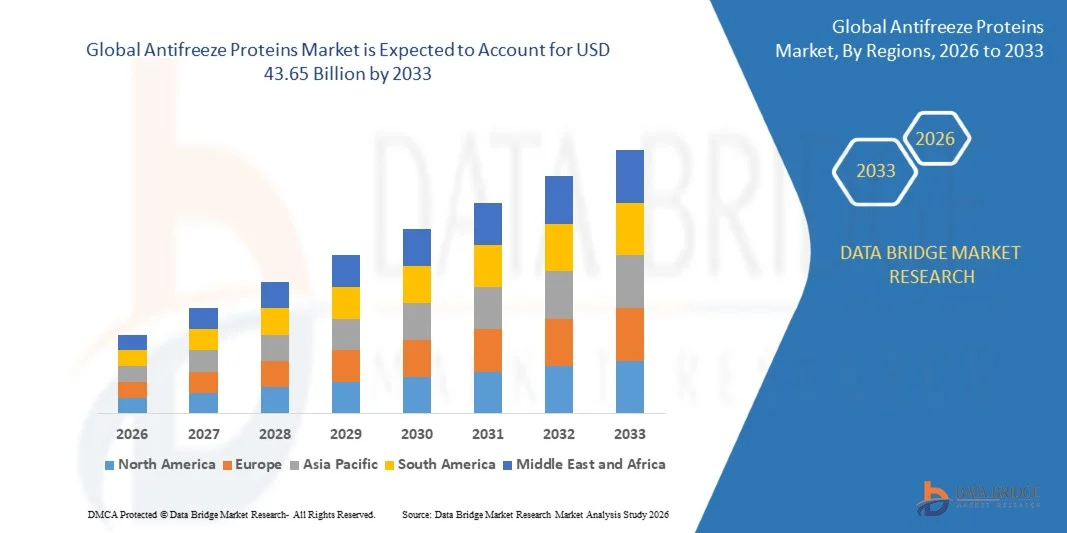
- The global antifreeze proteins market size was valued at USD 5.19 billion in 2025 and is expected to reach USD 43.65 billion by 2033, at a CAGR of 30.50% during the forecast period
- The market growth is largely fuelled by the increasing demand for antifreeze proteins in food preservation, medical applications, and cryopreservation technologies, along with rising adoption in biotechnology and agriculture sectors
- Growing advancements in protein engineering, expanding use in frozen food products to improve texture and shelf life, and increasing investment in life sciences research are further supporting market expansion
Antifreeze Proteins Market Analysis
- The market is witnessing strong momentum driven by increasing demand for cryopreservation solutions in pharmaceuticals and biotechnology, where antifreeze proteins play a critical role in preserving cells, tissues, and vaccines by preventing ice crystal formation and enhancing biological stability
- Rising adoption in the food industry is significantly supporting market growth, as antifreeze proteins are increasingly used to improve texture, extend shelf life, and maintain quality in frozen products such as ice creams, meat, and seafood
- North America dominated the antifreeze proteins market with the largest revenue share in 2025, driven by strong demand from the biotechnology and pharmaceutical sectors, along with increasing adoption of advanced cryopreservation techniques
- Asia-Pacific region is expected to witness the highest growth rate in the global antifreeze proteins market, driven by rapid industrialization, growing food processing sector, increasing adoption of advanced preservation technologies, and rising demand for high-quality frozen and processed food products
- The fish segment held the largest market revenue share in 2025 driven by its natural abundance and proven effectiveness in inhibiting ice crystal formation, making it widely utilized across food preservation and cryobiology applications. Fish-derived antifreeze proteins are extensively studied and commercially used due to their strong thermal hysteresis properties and reliability in maintaining product stability during freezing conditions
Report Scope and Antifreeze Proteins Market Segmentation
|
Attributes |
Antifreeze Proteins Key Market Insights |
|
Segments Covered |
|
|
Countries Covered |
North America
Europe
Asia-Pacific
Middle East and Africa
South America
|
|
Key Market Players |
• A/F Protein Inc. (U.S.) |
|
Market Opportunities |
|
|
Value Added Data Infosets |
In addition to the insights on market scenarios such as market value, growth rate, segmentation, geographical coverage, and major players, the market reports curated by the Data Bridge Market Research also include in-depth expert analysis, pricing analysis, brand share analysis, consumer survey, demography analysis, supply chain analysis, value chain analysis, raw material/consumables overview, vendor selection criteria, PESTLE Analysis, Porter Analysis, and regulatory framework. |
Antifreeze Proteins Market Trends
“Rising Demand for Cryopreservation and Biopharmaceutical Applications”
• The increasing reliance on advanced preservation techniques in the pharmaceutical and biotechnology industries is significantly shaping the antifreeze proteins market, as these proteins are widely used to prevent ice crystal formation and maintain the structural integrity of biological samples. Antifreeze proteins are gaining traction due to their ability to enhance the viability of cells, tissues, and vaccines during freezing and thawing processes, supporting their adoption in drug development, regenerative medicine, and biobanking applications
• Growing investments in biopharmaceutical research and the expansion of cold chain logistics are accelerating the use of antifreeze proteins in preserving temperature-sensitive products. With the rising demand for biologics, vaccines, and cell-based therapies, manufacturers are increasingly integrating antifreeze proteins into preservation systems to improve stability, reduce product loss, and ensure consistent quality across transportation and storage stages
• Technological advancements in protein engineering and recombinant production are further supporting market growth, enabling the development of highly efficient and scalable antifreeze protein variants. These innovations are improving functional performance while reducing dependency on natural extraction sources, allowing companies to expand production capacity and meet increasing global demand
• For instance, in 2024, biotechnology firms in the U.S. and Japan expanded their research initiatives to incorporate antifreeze proteins in cryopreservation solutions for stem cells and organ transplants. These developments were introduced to address the growing need for long-term biological storage and improved transplant success rates, with applications across healthcare institutions and research laboratories
• While demand for antifreeze proteins is increasing, sustained market growth depends on advancements in cost-effective production, regulatory approvals, and ensuring consistent functional performance across diverse applications. Companies are also focusing on improving scalability, optimizing supply chains, and enhancing product formulations to support broader commercial adoption
Antifreeze Proteins Market Dynamics
Driver
“Increasing Demand for Cryopreservation and Cold Chain Efficiency”
• The growing need for effective cryopreservation solutions in pharmaceuticals, biotechnology, and healthcare is a major driver for the antifreeze proteins market. These proteins play a crucial role in protecting biological materials from freezing damage, enabling improved storage, transport, and utilization of cells, tissues, and vaccines. This demand is further supported by the expansion of regenerative medicine and personalized healthcare applications
• Expanding use of antifreeze proteins in food preservation and frozen product quality enhancement is also influencing market growth. These proteins help maintain texture, prevent ice recrystallization, and extend shelf life, making them valuable in applications such as frozen desserts, meat, and seafood. Increasing consumer demand for high-quality frozen foods is reinforcing this trend globally
• Companies are actively investing in research and product innovation to improve the efficiency and applicability of antifreeze proteins across multiple industries. Strategic collaborations between biotechnology firms, research institutes, and food manufacturers are accelerating the development of advanced formulations, supporting market expansion and improving product performance
• For instance, in 2023, leading food and biotech companies in Europe and North America increased the incorporation of antifreeze proteins in frozen food formulations and medical preservation systems. This expansion was driven by the need to enhance product quality and ensure stability during extended storage and distribution, contributing to higher consumer satisfaction and reduced waste
• Although demand is rising, long-term growth depends on improving production efficiency, reducing costs, and addressing regulatory challenges associated with biological materials. Continuous investment in innovation, supply chain optimization, and commercialization strategies will be essential to sustain market momentum
Restraint/Challenge
“High Production Costs and Complex Manufacturing Processes”
• The high cost associated with the production and purification of antifreeze proteins remains a significant challenge, limiting their widespread adoption across cost-sensitive industries. Complex extraction methods and the need for advanced biotechnological processes contribute to elevated manufacturing expenses, making these proteins less competitive compared to conventional alternatives
• Limited awareness and technical understanding in certain industries also restrict market penetration, particularly in developing regions where adoption of advanced preservation technologies is still evolving. This lack of awareness slows down the integration of antifreeze proteins into mainstream applications and reduces potential growth opportunities
• Supply chain constraints and scalability issues further impact market development, as consistent sourcing of raw materials and maintaining product quality require stringent controls. The need for specialized storage, handling, and transportation conditions adds to operational complexity and increases overall costs for manufacturers and distributors
• For instance, in 2024, suppliers and distributors in Southeast Asia reported slower adoption of antifreeze protein-based solutions due to higher pricing and limited familiarity with their functional benefits. Challenges related to storage conditions and regulatory compliance also affected product availability and market expansion in these regions
• Addressing these challenges will require advancements in cost-effective production technologies, increased awareness initiatives, and stronger collaboration across industry stakeholders. Companies must focus on improving scalability, optimizing distribution networks, and enhancing product education to unlock the full potential of the antifreeze proteins market
Antifreeze Proteins Market Scope
The market is segmented on the basis of source, end-use, type, and form.
• By Source
On the basis of source, the antifreeze proteins market is segmented into Plant, Fish, Recombinant, and Insects. The fish segment held the largest market revenue share in 2025 driven by its natural abundance and proven effectiveness in inhibiting ice crystal formation, making it widely utilized across food preservation and cryobiology applications. Fish-derived antifreeze proteins are extensively studied and commercially used due to their strong thermal hysteresis properties and reliability in maintaining product stability during freezing conditions.
The recombinant segment is expected to witness the fastest growth rate from 2026 to 2033, driven by advancements in biotechnology and increasing demand for scalable and sustainable production methods. Recombinant antifreeze proteins offer consistent quality, reduced dependency on natural sources, and improved customization for specific industrial applications, making them highly suitable for pharmaceuticals and advanced preservation technologies.
• By End-Use
On the basis of end-use, the antifreeze proteins market is segmented into Healthcare Industry, Cosmetics, Food and Beverages, and Others. The healthcare industry segment held the largest market revenue share in 2025 driven by the increasing use of antifreeze proteins in cryopreservation of cells, tissues, and organs. These proteins play a crucial role in improving viability and reducing damage during freezing and thawing, supporting their adoption in regenerative medicine, biobanking, and vaccine storage.
The food and beverages segment is expected to witness the fastest growth rate from 2026 to 2033, driven by rising demand for high-quality frozen products and improved texture retention. Antifreeze proteins are increasingly used to prevent ice recrystallization in products such as ice cream, meat, and seafood, enhancing shelf life and consumer experience.
• By Type
On the basis of type, the antifreeze proteins market is segmented into Type I, Type II, Type III Glycoproteins, Non-glycoproteins, and Others. The Type I segment held the largest market revenue share in 2025 driven by its widespread availability and effectiveness in controlling ice crystal growth. These proteins are commonly used in both food and biomedical applications due to their relatively simple structure and functional efficiency.
The Type III glycoproteins segment is expected to witness the fastest growth rate from 2026 to 2033, driven by their superior activity and increasing application in advanced medical and biotechnological fields. Their enhanced ability to bind ice crystals and provide stability under extreme conditions makes them suitable for specialized preservation solutions.
• By Form
On the basis of form, the antifreeze proteins market is segmented into Solid and Liquid. The solid segment held the largest market revenue share in 2025 driven by its longer shelf life, ease of storage, and stability during transportation. Solid antifreeze proteins are widely preferred in industrial and research applications where controlled usage and extended preservation are required.
The liquid segment is expected to witness the fastest growth rate from 2026 to 2033, driven by its ease of application and rapid integration into formulations. Liquid forms are particularly useful in real-time preservation processes and ready-to-use solutions, supporting their growing adoption in healthcare and food processing industries.
Antifreeze Proteins Market Regional Analysis
• North America dominated the antifreeze proteins market with the largest revenue share in 2025, driven by strong demand from the biotechnology and pharmaceutical sectors, along with increasing adoption of advanced cryopreservation techniques
• End users in the region highly value the efficiency of antifreeze proteins in preserving biological samples, improving stability in frozen food products, and supporting innovation in regenerative medicine and drug development
• This widespread adoption is further supported by advanced research infrastructure, high healthcare spending, and the presence of leading biotechnology companies, establishing antifreeze proteins as a critical component across healthcare and food industries
U.S. Antifreeze Proteins Market Insight
The U.S. antifreeze proteins market captured the largest revenue share in 2025 within North America, fueled by increasing investments in biotechnology research and the rising use of cryopreservation in medical and pharmaceutical applications. The growing focus on personalized medicine, stem cell research, and vaccine storage is driving demand for antifreeze proteins. Moreover, strong collaboration between research institutions and industry players, along with advancements in protein engineering, is significantly contributing to market growth.
Europe Antifreeze Proteins Market Insight
The Europe antifreeze proteins market is expected to witness the fastest growth rate from 2026 to 2033, primarily driven by increasing demand for sustainable and high-quality food preservation solutions along with advancements in life sciences research. The region’s strong regulatory framework and emphasis on innovation are encouraging the adoption of antifreeze proteins in both food and healthcare applications. Growing investments in biotechnology and rising consumer preference for premium frozen products are further supporting market expansion.
U.K. Antifreeze Proteins Market Insight
The U.K. antifreeze proteins market is expected to witness the fastest growth rate from 2026 to 2033, driven by increasing research activities in biotechnology and rising demand for advanced preservation technologies. In addition, the focus on improving food quality and reducing waste is encouraging the adoption of antifreeze proteins in frozen food applications. The country’s strong academic and research ecosystem is also contributing to continuous innovation and market development.
Germany Antifreeze Proteins Market Insight
The Germany antifreeze proteins market is expected to witness the fastest growth rate from 2026 to 2033, fueled by strong emphasis on scientific research, technological innovation, and sustainable food processing solutions. Germany’s well-established pharmaceutical and food industries are promoting the adoption of antifreeze proteins, particularly in applications requiring high efficiency and quality standards. Increasing integration of advanced preservation technologies is further driving market growth.
Asia-Pacific Antifreeze Proteins Market Insight
The Asia-Pacific antifreeze proteins market is expected to witness the fastest growth rate from 2026 to 2033, driven by rapid expansion of the food processing industry, increasing healthcare investments, and growing biotechnology research activities in countries such as China, Japan, and India. The rising demand for frozen foods and improved cold chain infrastructure is accelerating adoption. Furthermore, the region’s growing manufacturing capabilities and cost advantages are enhancing accessibility and supporting market expansion.
Japan Antifreeze Proteins Market Insight
The Japan antifreeze proteins market is expected to witness the fastest growth rate from 2026 to 2033 due to the country’s strong focus on technological innovation and advanced healthcare solutions. The increasing use of antifreeze proteins in cryopreservation and food applications is supporting market growth. Moreover, Japan’s emphasis on high-quality food products and efficient preservation techniques is driving adoption across multiple industries.
China Antifreeze Proteins Market Insight
The China antifreeze proteins market accounted for the largest market revenue share in Asia Pacific in 2025, attributed to rapid industrialization, expanding food processing sector, and growing biotechnology capabilities. China is emerging as a key market for antifreeze proteins due to increasing demand for frozen food products and advancements in healthcare research. The availability of cost-effective production and strong domestic manufacturing are key factors propelling market growth.
Antifreeze Proteins Market Share
The Antifreeze Proteins industry is primarily led by well-established companies, including:
• A/F Protein Inc. (U.S.)
• cPanel, L.L.C. (U.S.)
• Sirona Biochem (Canada)
• BASF SE (Germany)
• ProtoKinetix, Inc. (U.S.)
• Unilever (U.K.)
• Roquette Frères (France)
• INVIVO (France)
• KANEKA CORPORATION (Japan)
• SunOpta (Canada)
• Cargill Incorporated (U.S.)
• DSM (Netherlands)
• AquaBounty Technologies Inc. (U.S.)
• Omega Protein Corporation (U.S.)
• ADM (U.S.)
• Shanghai Yu Tao Industrial Co. Ltd (China)
• Ingredion (U.S.)
• Kodera Herb Garden Co. Ltd (Japan)
• Huacheng Jinke Technology Co. Ltd (China)
Latest Developments in Global Antifreeze Proteins Market
- In September 2026, Unilever (U.K.), product launch, introduced a new range of frozen food products incorporating naturally derived antifreeze proteins to enhance texture, stability, and shelf life of frozen items. This initiative focuses on improving product quality while maintaining clean-label and sustainability standards, aligning with evolving consumer preferences. The development enables Unilever to differentiate its offerings in the competitive frozen food segment and strengthen brand positioning. It is expected to attract environmentally conscious consumers and drive higher adoption of premium frozen products. In addition, the move reinforces the integration of biotechnology in food innovation, positively influencing overall market growth
- In August 2025, Aker BioMarine (Norway), partnership, collaborated with a biotechnology firm to develop advanced antifreeze proteins aimed at improving cold storage capabilities of seafood products. This partnership is designed to enhance preservation efficiency, maintain product freshness, and reduce spoilage during transportation and storage. The collaboration also facilitates access to advanced research and production technologies, improving overall product performance. It is likely to strengthen Aker BioMarine’s position in the aquaculture and seafood processing industries. Furthermore, the initiative supports sustainability trends and is expected to accelerate the adoption of antifreeze proteins in marine-based applications
- In July 2024, Cargill (U.S.), capacity expansion, expanded its production facilities in North America to increase the output of antifreeze proteins for food industry applications. This expansion is aimed at meeting the growing demand for innovative food preservation solutions and improving supply chain efficiency. By scaling up production, Cargill enhances its ability to cater to large-scale food manufacturers and maintain consistent product availability. The move is expected to strengthen its market share and competitive advantage in the global market. In addition, increased production capacity supports wider commercialization and adoption of antifreeze proteins across various food processing segments
SKU-
Get online access to the report on the World's First Market Intelligence Cloud

- Interactive Data Analysis Dashboard
- Company Analysis Dashboard for high growth potential opportunities
- Research Analyst Access for customization & queries
- Competitor Analysis with Interactive dashboard
- Latest News, Updates & Trend analysis
- Harness the Power of Benchmark Analysis for Comprehensive Competitor Tracking
Global Antifreeze Proteins Market, Supply Chain Analysis and Ecosystem Framework
To support market growth and help clients navigate the impact of geopolitical shifts, DBMR has integrated in-depth supply chain analysis into its Global Antifreeze Proteins Market research reports. This addition empowers clients to respond effectively to global changes affecting their industries. The supply chain analysis section includes detailed insights such as Global Antifreeze Proteins Market consumption and production by country, price trend analysis, the impact of tariffs and geopolitical developments, and import and export trends by country and HSN code. It also highlights major suppliers with data on production capacity and company profiles, as well as key importers and exporters. In addition to research, DBMR offers specialized supply chain consulting services backed by over a decade of experience, providing solutions like supplier discovery, supplier risk assessment, price trend analysis, impact evaluation of inflation and trade route changes, and comprehensive market trend analysis.
Research Methodology
Data collection and base year analysis are done using data collection modules with large sample sizes. The stage includes obtaining market information or related data through various sources and strategies. It includes examining and planning all the data acquired from the past in advance. It likewise envelops the examination of information inconsistencies seen across different information sources. The market data is analysed and estimated using market statistical and coherent models. Also, market share analysis and key trend analysis are the major success factors in the market report. To know more, please request an analyst call or drop down your inquiry.
The key research methodology used by DBMR research team is data triangulation which involves data mining, analysis of the impact of data variables on the market and primary (industry expert) validation. Data models include Vendor Positioning Grid, Market Time Line Analysis, Market Overview and Guide, Company Positioning Grid, Patent Analysis, Pricing Analysis, Company Market Share Analysis, Standards of Measurement, Global versus Regional and Vendor Share Analysis. To know more about the research methodology, drop in an inquiry to speak to our industry experts.
Customization Available
Data Bridge Market Research is a leader in advanced formative research. We take pride in servicing our existing and new customers with data and analysis that match and suits their goal. The report can be customized to include price trend analysis of target brands understanding the market for additional countries (ask for the list of countries), clinical trial results data, literature review, refurbished market and product base analysis. Market analysis of target competitors can be analyzed from technology-based analysis to market portfolio strategies. We can add as many competitors that you require data about in the format and data style you are looking for. Our team of analysts can also provide you data in crude raw excel files pivot tables (Fact book) or can assist you in creating presentations from the data sets available in the report.












