


Global Antiperspirants And Deodorants Market
Market Size in USD Billion
CAGR :
% 
 USD
24.00 Billion
USD
33.81 Billion
2025
2033
USD
24.00 Billion
USD
33.81 Billion
2025
2033
 Forecast Period Forecast Period |
2026 - 2033 |
 Market Size (Base Year) Market Size (Base Year) |
USD 24.00 Billion |
 Market Size (Forecast Year) Market Size (Forecast Year) |
USD 33.81 Billion |
 CAGR CAGR |
% |
| Major Markets Players |
|
Antiperspirants and Deodorants Market Overview
The Antiperspirants and Deodorants Market was valued at USD 24.00 billion in 2025 and is projected to reach USD 33.81 billion by 2033, growing at a CAGR of 4.38% from 2026 to 2033. The market is witnessing steady expansion driven by rising personal grooming awareness, increasing urbanization, and growing demand for long-lasting body odor protection across both developed and emerging economies.
The growth is further supported by shifting consumer preferences toward premium, natural, and aluminum-free formulations, along with expanding product availability through e-commerce and modern retail channels. In addition, increasing participation in outdoor activities, rising workforce population, and heightened focus on hygiene and personal care are encouraging consistent product adoption across diverse demographic groups.
Key Market Trends & Insights
- North America dominated the antiperspirants and deodorants market with the largest revenue share in 2025, supported by high consumer spending on personal care products, strong presence of leading FMCG brands, and widespread adoption of daily grooming routines across urban populations.
- Asia-Pacific is expected to be the fastest-growing region, recording a strong CAGR during 2026 to 2033. Growth is driven by rapid urbanization, rising disposable incomes, increasing awareness of personal hygiene, and expanding penetration of branded personal care products in emerging economies such as India and China.
- The Aerosol Spray segment held the largest market revenue share of approximately 38.5% in 2025 driven by its wide consumer acceptance, ease of application, quick-drying properties, and strong penetration in mass-market personal care products. Aerosol formats are extensively used across both male and female grooming categories due to their convenience, wide fragrance variety, and strong brand marketing presence from leading FMCG companies.
- The Roll-On segment is projected to register the fastest growth at a CAGR of 6.9% from 2026 to 2033, driven by increasing demand for precise application, longer-lasting protection, and rising preference for travel-friendly and skin-sensitive formulations. Growing adoption in emerging markets such as India and Southeast Asia is further supporting segment expansion.
- The Fragrances segment held the largest market revenue share of approximately 41.2% in 2025 driven by strong consumer preference for long-lasting scent protection and premium fragrance-infused personal care products. Fragrance-based formulations are widely used across deodorants and antiperspirants as they enhance perceived freshness and brand differentiation in highly competitive retail environments.
- The Conditioner and Moisturizer segment is projected to register the fastest growth at a CAGR of 7.4% from 2026 to 2033, driven by rising demand for skin-friendly, hydrating, and sensitive-skin formulations. Increasing consumer awareness regarding skin irritation and dryness caused by traditional formulations is accelerating adoption of moisturizing and dermatologically tested ingredients.
- The Store Based segment held the largest market revenue share of approximately 72.6% in 2025 driven by strong penetration of supermarkets, hypermarkets, pharmacies, and convenience stores, which allow consumers to physically evaluate products before purchase. Established retail networks and promotional in-store branding activities further strengthen segment dominance across developed and emerging economies.
- The Non-Store Based segment is projected to register the fastest growth at a CAGR of 9.1% from 2026 to 2033, driven by rapid expansion of e-commerce platforms, direct-to-consumer brands, and increasing digital adoption among younger consumers. Rising smartphone penetration and availability of subscription-based personal care delivery models are further accelerating online sales growth in this segment.
Market Size & Forecast
- Global Market Value (2025): USD 24.00 Billion
- Expected Market Value (2033): USD 33.81 Billion
- Forecast CAGR (2026–2033): 4.38%
- Leading Region in 2025: North America
- Fastest Growing Region: Asia-Pacific
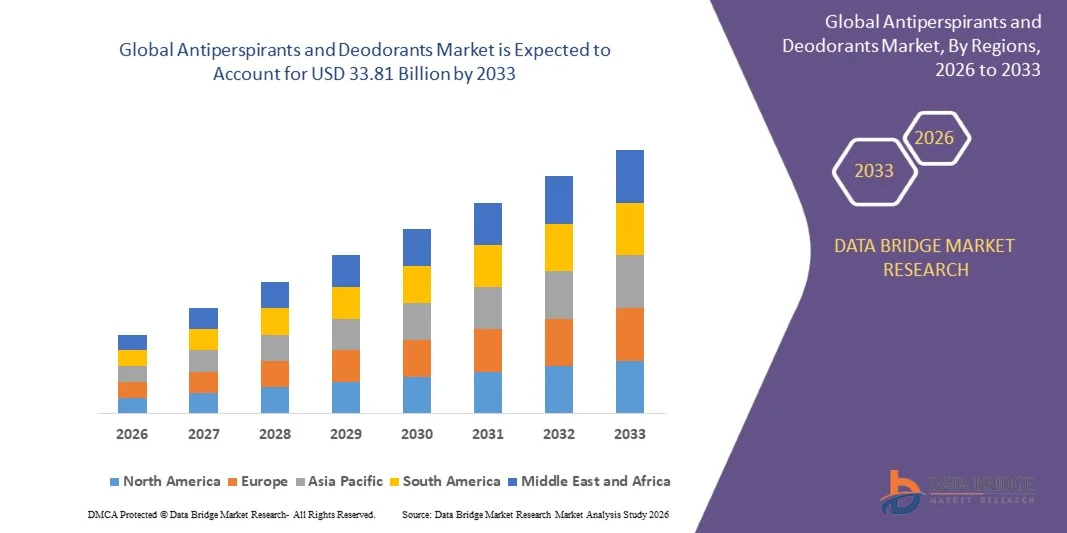
Report Scope and Antiperspirants and Deodorants Market Segmentation
|
Attributes |
Antiperspirants and Deodorants Key Market Insights |
|
Segments Covered |
· By Function: Aerosol Spray, Cream, Roll-On, and Gel, and Others · By Ingredient: Alcohol, Antimicrobials, Conditioner and Moisturizer, Fragrances, Paraben and Propellants, and Others · By Distribution Channel: Store Based and Non-Store Based |
|
Countries Covered |
North America · U.S. · Canada · Mexico Europe · Germany · France · U.K. · Netherlands · Switzerland · Belgium · Russia · Italy · Spain · Turkey · Rest of Europe Asia-Pacific · China · Japan · India · South Korea · Singapore · Malaysia · Australia · Thailand · Indonesia · Philippines · Rest of Asia-Pacific Middle East and Africa · Saudi Arabia · U.A.E. · South Africa · Egypt · Israel · Rest of Middle East and Africa South America · Brazil · Argentina · Rest of South America |
|
Key Market Players |
• AVON PRODUCTS (U.K.) |
|
Market Opportunities |
|
|
Value Added Data Infosets |
In addition to the insights on market scenarios such as market value, growth rate, segmentation, geographical coverage, and major players, the market reports curated by the Data Bridge Market Research also include in-depth expert analysis, pricing analysis, brand share analysis, consumer survey, demography analysis, supply chain analysis, value chain analysis, raw material/consumables overview, vendor selection criteria, PESTLE Analysis, Porter Analysis, and regulatory framework. |
Antiperspirants and Deodorants Market Trends
Trend: Rising Demand For Natural, Aluminum-Free, And Skin-Friendly Personal Care Formulations
The Antiperspirants and Deodorants Market is witnessing a strong shift toward natural, aluminum-free, and skin-friendly formulations driven by increasing consumer awareness regarding ingredient safety and long-term skin health. Traditional antiperspirant formulations containing aluminum compounds are facing scrutiny due to perceived health concerns, pushing brands to reformulate products with plant-based extracts, essential oils, and dermatologically tested ingredients.
In modern personal care consumption patterns, leading brands are increasingly launching clean-label deodorants with probiotic and baking soda alternatives to cater to sensitive skin consumers. For instance, in 2024, several global personal care manufacturers expanded aluminum-free product lines in response to growing demand from Gen Z and millennial consumers prioritizing transparency and sustainability in personal care choices.
The rapid expansion of organic and vegan-certified personal care segments is also influencing product innovation, with companies focusing on eco-friendly packaging and cruelty-free certifications to enhance brand positioning. In addition, rising retail penetration in supermarkets, pharmacies, and online platforms is improving accessibility of premium natural deodorants across emerging markets such as India and Brazil, where urban consumers are increasingly shifting toward premium hygiene products.
Antiperspirants and Deodorants Market Dynamics
Key Market Driver: Rising Focus On Personal Hygiene And Urban Lifestyle Adoption
Increasing urbanization, changing lifestyle patterns, and rising disposable income levels are significantly driving demand for antiperspirants and deodorants across global markets. Growing workforce participation and longer working hours in urban economies are increasing the need for long-lasting odor protection and daily grooming products.
In developed markets such as the U.S. and U.K., deodorant usage remains a daily necessity with penetration rates exceeding 85–90%, while emerging economies are witnessing rapid adoption due to increasing awareness campaigns and brand penetration. For instance, in India, rising urban middle-class population and increased retail availability have significantly boosted deodorant consumption, with major FMCG players reporting double-digit growth in personal care segments in recent years.
In addition, aggressive marketing campaigns, celebrity endorsements, and expansion of men’s grooming products are strengthening category penetration across younger demographics and expanding usage frequency among both male and female consumers.
Key Restraint/Challenge: Rising Concerns Over Chemical Ingredients And Regulatory Scrutiny
Growing consumer concerns regarding synthetic chemicals, aluminum salts, parabens, and artificial fragrances are creating challenges for conventional antiperspirant manufacturers. Increasing awareness about skin sensitivity, allergies, and long-term health effects is encouraging consumers to shift toward alternative deodorant formats, reducing reliance on traditional antiperspirant formulations.
Regulatory bodies in regions such as the European Union are tightening cosmetic ingredient regulations, requiring stricter compliance, transparent labeling, and safety testing for personal care products. This increases formulation costs and slows down product launches for manufacturers operating in highly regulated markets.
For instance, dermatological studies have reported that a significant share of consumers with sensitive skin experience irritation or discomfort from aluminum-based antiperspirants, leading to higher product switching rates toward natural deodorant alternatives and limiting long-term brand loyalty in the conventional segment.
Key Market Opportunity: Expansion Of Premium, Sustainable, And E-Commerce Driven Product Lines
The growing demand for premium, sustainable, and digitally accessible personal care products is creating strong growth opportunities for market players. Consumers are increasingly willing to pay higher prices for eco-friendly packaging, refillable deodorant formats, and clean-label ingredient transparency, particularly in urban markets.
E-commerce platforms and direct-to-consumer brands are accelerating product discovery and trial through subscription models and influencer-driven marketing strategies. For instance, online personal care sales in markets such as the U.S., India, and Southeast Asia have grown significantly post-2020, with deodorant and body care categories benefiting from higher digital adoption and doorstep delivery convenience.
In addition, innovation in long-lasting odor protection technologies, sweat-activated fragrance release systems, and hybrid skincare-deodorant formulations is expanding application scope across both mass and premium segments, particularly in Asia-Pacific and North America where consumer experimentation with new formats is rapidly increasing.
Antiperspirants and Deodorants Market Scope
The market is segmented on the basis of function, ingredient, and distribution channel.
- By Function
On the basis of function, the antiperspirants and deodorants market is segmented into Aerosol Spray, Cream, Roll-On, Gel, and Others. The Aerosol Spray segment held the largest market revenue share of approximately 38.5% in 2025 driven by its wide consumer acceptance, ease of application, quick-drying properties, and strong penetration in mass-market personal care products. Aerosol formats are extensively used across both male and female grooming categories due to their convenience, wide fragrance variety, and strong brand marketing presence from leading FMCG companies.
The Roll-On segment is projected to register the fastest growth at a CAGR of 6.9% from 2026 to 2033, driven by increasing demand for precise application, longer-lasting protection, and rising preference for travel-friendly and skin-sensitive formulations. Growing adoption in emerging markets such as India and Southeast Asia is further supporting segment expansion.
- By Ingredient
On the basis of ingredient, the market is segmented into Alcohol, Antimicrobials, Conditioner and Moisturizer, Fragrances, Paraben and Propellants, and Others. The Fragrances segment held the largest market revenue share of approximately 41.2% in 2025 driven by strong consumer preference for long-lasting scent protection and premium fragrance-infused personal care products. Fragrance-based formulations are widely used across deodorants and antiperspirants as they enhance perceived freshness and brand differentiation in highly competitive retail environments.
The Conditioner and Moisturizer segment is projected to register the fastest growth at a CAGR of 7.4% from 2026 to 2033, driven by rising demand for skin-friendly, hydrating, and sensitive-skin formulations. Increasing consumer awareness regarding skin irritation and dryness caused by traditional formulations is accelerating adoption of moisturizing and dermatologically tested ingredients.
- By Distribution Channel
On the basis of distribution channel, the market is segmented into Store Based and Non-Store Based. The Store Based segment held the largest market revenue share of approximately 72.6% in 2025 driven by strong penetration of supermarkets, hypermarkets, pharmacies, and convenience stores, which allow consumers to physically evaluate products before purchase. Established retail networks and promotional in-store branding activities further strengthen segment dominance across developed and emerging economies.
The Non-Store Based segment is projected to register the fastest growth at a CAGR of 9.1% from 2026 to 2033, driven by rapid expansion of e-commerce platforms, direct-to-consumer brands, and increasing digital adoption among younger consumers. Rising smartphone penetration and availability of subscription-based personal care delivery models are further accelerating online sales growth in this segment.
Antiperspirants and Deodorants Market Regional Analysis
North America Antiperspirants And Deodorants Market Insight
North America dominated the antiperspirants and deodorants market with the largest revenue share of approximately 36.4% in 2025, supported by high personal grooming awareness, strong presence of leading FMCG brands, and widespread daily usage of deodorant products across both male and female consumers. The region benefits from high disposable income levels, a well-established retail infrastructure, and strong consumer preference for long-lasting, premium, and fragrance-rich personal care products. In addition, increasing demand for aluminum-free and skin-friendly formulations is further strengthening product innovation and category expansion across supermarkets, pharmacies, and online channels.
U.S. Antiperspirants And Deodorants Market Insight
The U.S. antiperspirants and deodorants market captured the largest revenue share in North America in 2025, driven by high product penetration, strong grooming culture, and continuous innovation in deodorant formats such as sprays, roll-ons, and clinical-strength antiperspirants. Consumers are increasingly shifting toward natural, organic, and dermatologically tested products, particularly in urban populations. For instance, major personal care companies have expanded aluminum-free deodorant portfolios in response to rising consumer demand for clean-label formulations and sensitive-skin solutions. In addition, strong e-commerce adoption and subscription-based personal care delivery models are further accelerating market growth.
Europe Antiperspirants And Deodorants Market Insight
The Europe antiperspirants and deodorants market is expected to witness steady growth from 2026 to 2033, primarily driven by rising demand for sustainable, eco-friendly, and natural personal care products. Strict cosmetic regulations and increasing consumer awareness regarding ingredient safety are encouraging manufacturers to adopt transparent labeling and cleaner formulations. The region is also experiencing strong demand for premium deodorants with organic certifications, particularly across urban populations in countries such as Germany, France, and the U.K., where personal hygiene and skincare routines are highly prioritized.
U.K. Antiperspirants And Deodorants Market Insight
The U.K. antiperspirants and deodorants market is expected to witness strong growth from 2026 to 2033, driven by increasing focus on personal grooming, rising adoption of premium deodorant products, and growing awareness regarding hygiene and skin health. Concerns over synthetic chemicals and skin irritation are encouraging consumers to shift toward natural and aluminum-free alternatives. For instance, several U.K.-based retailers have reported increasing sales of natural deodorant brands across online and specialty stores, supported by strong demand from younger consumers and working professionals.
Germany Antiperspirants And Deodorants Market Insight
The Germany antiperspirants and deodorants market is expected to witness steady expansion from 2026 to 2033, supported by strong demand for high-quality, dermatologically tested, and environmentally sustainable personal care products. German consumers demonstrate a strong preference for scientifically formulated and skin-safe deodorants with minimal chemical additives. For instance, increasing adoption of organic-certified personal care products across pharmacy chains and organic retail stores is driving market growth. In addition, sustainability-focused packaging innovations are gaining traction in response to strict environmental standards.
Asia-Pacific Antiperspirants And Deodorants Market Insight
The Asia-Pacific antiperspirants and deodorants market is expected to witness the fastest growth rate from 2026 to 2033, supported by rapid urbanization, rising disposable incomes, and increasing awareness of personal hygiene in countries such as China, India, Japan, and South Korea. Expanding middle-class populations and growing influence of Western grooming habits are significantly boosting product adoption. For instance, rising demand for affordable deodorant sprays and roll-ons in India and Southeast Asia has led major FMCG brands to expand localized product portfolios and distribution networks.
Japan Antiperspirants And Deodorants Market Insight
The Japan antiperspirants and deodorants market is expected to witness steady growth from 2026 to 2033, driven by high hygiene standards, strong preference for odor-control products, and increasing demand for mild, skin-friendly formulations. Japanese consumers prefer compact, long-lasting, and low-fragrance deodorant products suited for daily commuting and humid climate conditions. For instance, leading domestic manufacturers have introduced advanced sweat-control sprays and portable deodorant wipes tailored for office workers and urban commuters, further supporting market expansion.
China Antiperspirants And Deodorants Market Insight
The China antiperspirants and deodorants market accounted for the largest revenue share in Asia-Pacific in 2025, attributed to rapid urbanization, expanding middle-class population, and increasing awareness of personal grooming products. The market is witnessing strong demand for both mass-market and premium deodorants, supported by rising e-commerce penetration and aggressive digital marketing strategies. For instance, leading FMCG brands are leveraging livestream commerce and influencer-driven campaigns to boost deodorant sales across online platforms, while domestic manufacturers are expanding affordable product offerings to reach wider consumer segments.
Antiperspirants and Deodorants Market Share
The Antiperspirants and Deodorants industry is primarily led by well-established companies, including:
• AVON PRODUCTS (U.K.)
• Colgate-Palmolive Company (U.S.)
• Beiersdorf (Germany)
• Henkel Adhesives Technologies India Private Limited (India)
• Procter & Gamble (U.S.)
• Unilever (U.K. / Netherlands)
• adidas India Marketing Pvt. Ltd. (India)
• CHANEL (France)
• Christian Dior SE (France)
• Church & Dwight Co., Inc. (U.S.)
• CavinKare (India)
• The Estée Lauder Companies (U.S.)
• L'Oréal (France)
• McNROE Consumer Products Private Limited (India)
• Shiseido Co., Ltd. (Japan)
• needl (India)
• Tom's of Maine, Inc. (U.S.)
• TTK (India)
• Revlon Consumer Products Corporation (U.S.)
• Yardley London (U.K.)
Latest Developments in Antiperspirants and Deodorants Market
- In November 2025, Unilever (U.K. / Netherlands) announced a partnership with a leading biotechnology firm to develop a new line of biodegradable deodorants, aiming to integrate advanced biotechnological processes that reduce environmental impact while strengthening its sustainability-led personal care portfolio and enhancing its position in the eco-friendly deodorants segment.
- In October 2025, Procter & Gamble (U.S.) launched a marketing campaign promoting its aluminum-free antiperspirant range, focusing on health-conscious consumers and ingredient transparency, which is expected to strengthen brand loyalty, accelerate adoption of natural formulations, and align the company with the growing shift toward clean-label personal care products.
- In September 2025, Reckitt Benckiser (U.K.) expanded its portfolio through the acquisition of a niche natural deodorant brand, a strategic move designed to diversify its personal care offerings, strengthen its presence in the natural deodorant segment, and capitalize on rising consumer demand for sustainable and chemical-free hygiene solutions.
SKU-
Get online access to the report on the World's First Market Intelligence Cloud

- Interactive Data Analysis Dashboard
- Company Analysis Dashboard for high growth potential opportunities
- Research Analyst Access for customization & queries
- Competitor Analysis with Interactive dashboard
- Latest News, Updates & Trend analysis
- Harness the Power of Benchmark Analysis for Comprehensive Competitor Tracking
Research Methodology
Data collection and base year analysis are done using data collection modules with large sample sizes. The stage includes obtaining market information or related data through various sources and strategies. It includes examining and planning all the data acquired from the past in advance. It likewise envelops the examination of information inconsistencies seen across different information sources. The market data is analysed and estimated using market statistical and coherent models. Also, market share analysis and key trend analysis are the major success factors in the market report. To know more, please request an analyst call or drop down your inquiry.
The key research methodology used by DBMR research team is data triangulation which involves data mining, analysis of the impact of data variables on the market and primary (industry expert) validation. Data models include Vendor Positioning Grid, Market Time Line Analysis, Market Overview and Guide, Company Positioning Grid, Patent Analysis, Pricing Analysis, Company Market Share Analysis, Standards of Measurement, Global versus Regional and Vendor Share Analysis. To know more about the research methodology, drop in an inquiry to speak to our industry experts.
Customization Available
Data Bridge Market Research is a leader in advanced formative research. We take pride in servicing our existing and new customers with data and analysis that match and suits their goal. The report can be customized to include price trend analysis of target brands understanding the market for additional countries (ask for the list of countries), clinical trial results data, literature review, refurbished market and product base analysis. Market analysis of target competitors can be analyzed from technology-based analysis to market portfolio strategies. We can add as many competitors that you require data about in the format and data style you are looking for. Our team of analysts can also provide you data in crude raw excel files pivot tables (Fact book) or can assist you in creating presentations from the data sets available in the report.












