




Global Application Release Automation Ara Market
Market Size in USD Billion
CAGR :
% 
 USD
6.21 Billion
USD
26.19 Billion
2025
2033
USD
6.21 Billion
USD
26.19 Billion
2025
2033
 Forecast Period Forecast Period |
2026 –2033 |
 Market Size (Base Year) Market Size (Base Year) |
USD 6.21 Billion |
 Market Size (Forecast Year) Market Size (Forecast Year) |
USD 26.19 Billion |
 CAGR CAGR |
% |
| Major Markets Players |
|
What is the Global Application Release Automation (ARA) Market Size and Growth Rate?
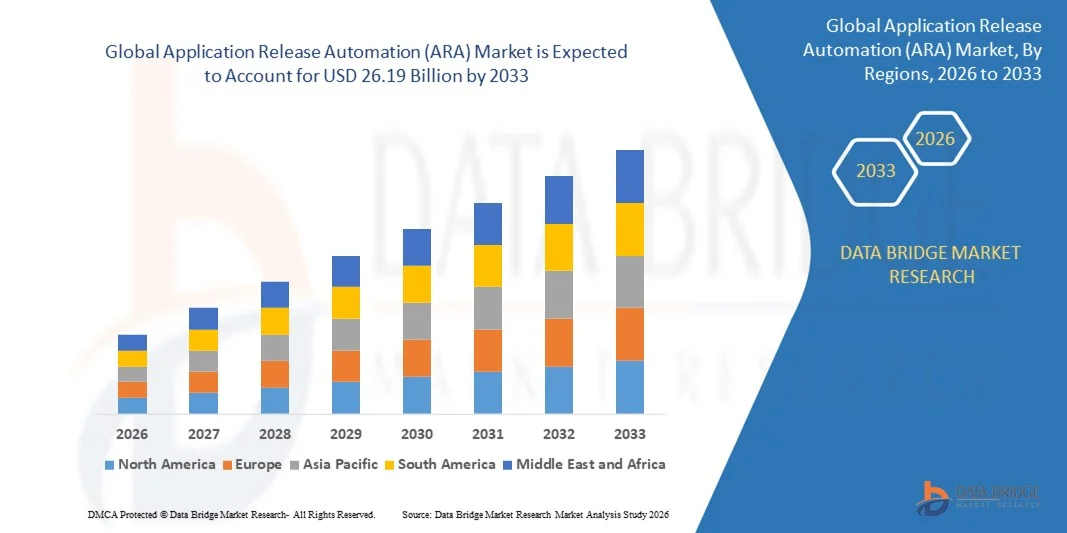
- The global application release automation (ARA) market size was valued at USD 6.21 billion in 2025 and is expected to reach USD 26.19 billion by 2033, at a CAGR of 19.70% during the forecast period
- Rise in the numerous applications running in dynamic It environment is a crucial factor accelerating the market growth, also rise in the optimized resource utilization, increase in the demand for application release automation market, increase in the user engagement over digital platforms, growing focus on competitive intelligence, together and rise in the need to improve the audience experience are the major factors among others boosting the application release automation (ARA) market
What are the Major Takeaways of Application Release Automation (ARA) Market?
- Rise in the advancements in AI and its use in application development and cloud-based platforms creating a favourable environment for application development will further create new opportunities for application release automation (ARA) market
- However, heavy dependence on legacy processes acts as the major factors among others restraining the market growth, and will further challenge the application release automation (ARA) market
- North America dominated the application release automation (ARA) market with a 41.6% revenue share in 2025, driven by rapid adoption of DevOps practices, cloud-native development, and large-scale digital transformation initiatives across the U.S. and Canada
- Asia-Pacific is projected to register the fastest CAGR of 9.62% from 2026 to 2033, fueled by expanding IT services industries, rapid cloud adoption, and strong growth in digital banking, e-commerce, and telecom infrastructure across China, Japan, India, South Korea, and Southeast Asia
- The Solutions segment dominated the market with a 68.5% share in 2025, as enterprises increasingly adopt integrated ARA platforms to automate deployment pipelines, manage release workflows, and ensure compliance across hybrid IT environments
Report Scope and Application Release Automation (ARA) Market Segmentation
|
Attributes |
Application Release Automation (ARA) Key Market Insights |
|
Segments Covered |
|
|
Countries Covered |
North America
Europe
Asia-Pacific
Middle East and Africa
South America
|
|
Key Market Players |
|
|
Market Opportunities |
|
|
Value Added Data Infosets |
In addition to the insights on market scenarios such as market value, growth rate, segmentation, geographical coverage, and major players, the market reports curated by the Data Bridge Market Research also include in-depth expert analysis, pricing analysis, brand share analysis, consumer survey, demography analysis, supply chain analysis, value chain analysis, raw material/consumables overview, vendor selection criteria, PESTLE Analysis, Porter Analysis, and regulatory framework. |
What is the Key Trend in the Application Release Automation (ARA) Market?
Accelerating Adoption of Cloud-Native, DevOps-Integrated, and AI-Driven Release Automation Platforms
- The application release automation (ARA) market is witnessing strong adoption of cloud-native, containerized, and microservices-based deployment platforms designed to support DevOps pipelines, Kubernetes environments, and hybrid IT infrastructures
- Vendors are introducing AI-powered orchestration, policy-driven automation, and low-code workflow capabilities that enhance deployment speed, reduce manual intervention, and improve release consistency across multi-cloud ecosystems
- Growing demand for faster time-to-market, continuous integration/continuous deployment (CI/CD), and zero-downtime releases is accelerating enterprise transition from manual release management to automated solutions
- For instance, companies such as IBM, Microsoft, Red Hat, Inc., and CloudBees, Inc. are enhancing their ARA platforms with Kubernetes integration, GitOps workflows, and advanced analytics
- Increasing complexity of distributed applications, API-driven architectures, and multi-environment deployments is driving demand for scalable and centralized automation frameworks
- As enterprises prioritize digital transformation, ARA platforms will remain essential for streamlined software delivery, compliance enforcement, and operational agility
What are the Key Drivers of Application Release Automation (ARA) Market?
- Rising adoption of DevOps practices, agile development methodologies, and CI/CD pipelines is significantly boosting demand for automated release management solutions
- For instance, in 2025, leading companies such as VMware, Inc., Digital.ai, and Progress Software Corporation expanded their automation capabilities with enhanced security controls, multi-cloud deployment support, and real-time monitoring tools
- Growing deployment of hybrid cloud, SaaS platforms, and enterprise applications across banking, telecom, healthcare, and retail sectors is accelerating ARA adoption globally
- Advancements in AI-driven testing, automated rollback mechanisms, configuration management, and compliance tracking have strengthened release reliability and reduced operational risks
- Increasing focus on application modernization, container orchestration, and infrastructure-as-code (IaC) is creating strong demand for integrated automation tools
- Supported by steady enterprise IT spending, digital innovation initiatives, and cybersecurity compliance requirements, the ARA market is expected to witness sustained long-term growth
Which Factor is Challenging the Growth of the Application Release Automation (ARA) Market?
- High implementation and integration costs associated with enterprise-grade ARA platforms limit adoption among small and mid-sized organizations
- For instance, during 2024–2025, enterprises reported increased spending on cloud infrastructure, cybersecurity compliance, and DevOps tooling, impacting overall IT budget allocation for automation solutions
- Complexity in integrating ARA platforms with legacy systems, multi-cloud environments, and diverse toolchains increases deployment challenges
- Shortage of skilled DevOps engineers and automation specialists slows effective implementation and optimization
- Competition from open-source CI/CD tools and native cloud deployment services creates pricing pressure and reduces differentiation among vendors
- To address these challenges, companies are focusing on subscription-based pricing models, simplified user interfaces, AI-assisted deployment workflows, and enhanced interoperability, thereby improving accessibility and global adoption of Application Release Automation (ARA) solutions
How is the Application Release Automation (ARA) Market Segmented?
The market is segmented on the basis of component, organization size, deployment type, vertical, and model.
- By Component
On the basis of component, the application release automation (ARA) market is segmented into Solutions and Services. The Solutions segment dominated the market with a 68.5% share in 2025, as enterprises increasingly adopt integrated ARA platforms to automate deployment pipelines, manage release workflows, and ensure compliance across hybrid IT environments. These solutions provide centralized dashboards, automated rollback capabilities, environment provisioning, and DevOps toolchain integration, making them essential for large-scale digital transformation initiatives. Strong demand for CI/CD orchestration, Kubernetes deployment automation, and multi-cloud release management further strengthens segment leadership.
The Services segment is projected to grow at the fastest CAGR from 2026 to 2033, driven by rising demand for consulting, implementation, managed services, and training support. As organizations modernize legacy systems and migrate to cloud-native architectures, service providers play a critical role in customization, integration, and ongoing optimization of ARA platforms.
- By Organization Size
On the basis of organization size, the market is segmented into Large Enterprises and SMEs. The Large Enterprises segment dominated the market with a 61.2% share in 2025, supported by complex IT infrastructures, multi-region deployment environments, and high software release frequency. Large organizations require advanced automation tools to manage microservices, ensure governance compliance, and reduce downtime risks. Strong investments in DevOps transformation and cybersecurity compliance further drive ARA adoption among global enterprises.
The SMEs segment is expected to grow at the fastest CAGR from 2026 to 2033, fueled by increasing availability of subscription-based, cloud-hosted ARA platforms. Growing awareness of automation benefits, cost-efficient SaaS deployment models, and rising digital adoption among mid-sized firms are accelerating market penetration within this segment.
- By Deployment Mode
On the basis of deployment mode, the application release automation (ARA) market is segmented into Cloud and On-Premises. The Cloud segment dominated the market with a 57.8% share in 2025, driven by rapid adoption of SaaS-based DevOps tools, scalability advantages, lower upfront costs, and seamless integration with public and hybrid cloud infrastructures. Cloud deployment enables faster implementation, automated updates, and remote accessibility, making it the preferred option for modern enterprises.
The On-Premises segment is projected to grow at a steady pace, particularly among regulated industries requiring strict data control and security compliance. However, cloud-based ARA platforms are expected to register the fastest growth from 2026 to 2033 due to accelerating enterprise cloud migration strategies.
- By Vertical
On the basis of vertical, the market is segmented into Healthcare; Media and Entertainment; Manufacturing; Retail & Consumer Goods; ITES and Telecommunications; Banking, Financial Services, and Insurance (BFSI); and Others. The ITES and Telecommunications segment dominated the market with a 29.6% share in 2025, supported by continuous software updates, network virtualization, and rapid service deployment requirements. Telecom operators and IT service providers rely heavily on automated release pipelines to maintain uptime and manage large-scale distributed applications.
The Banking, Financial Services, and Insurance (BFSI) segment is expected to grow at the fastest CAGR from 2026 to 2033, driven by digital banking transformation, regulatory compliance mandates, cybersecurity requirements, and high transaction-based application updates.
- By Model
On the basis of model, the application release automation (ARA) market is segmented into Software Prototyping, Incremental Model, Agile Model, Waterfall Model, and Spiral Model. The Agile Model segment dominated the market with a 46.4% share in 2025, as organizations increasingly adopt agile and DevOps practices to enable continuous integration and rapid release cycles. Agile methodologies require automated testing, deployment, and rollback mechanisms, making ARA tools indispensable for iterative development.
The Incremental Model segment is projected to grow at the fastest CAGR from 2026 to 2033, supported by enterprises transitioning from traditional waterfall structures to phased, modular software delivery approaches. Increasing emphasis on flexibility, reduced risk, and faster feature rollouts continues to accelerate adoption across development teams globally.
Which Region Holds the Largest Share of the Application Release Automation (ARA) Market?
- North America dominated the application release automation (ARA) market with a 41.6% revenue share in 2025, driven by rapid adoption of DevOps practices, cloud-native development, and large-scale digital transformation initiatives across the U.S. and Canada. High concentration of enterprise IT firms, SaaS providers, fintech companies, and telecom operators continues to fuel demand for automated release orchestration and CI/CD pipeline optimization
- Leading companies such as IBM, Microsoft, and Red Hat, Inc. are expanding AI-driven deployment automation, Kubernetes-native release tools, and multi-cloud integration capabilities, strengthening the region’s technological leadership
- Strong venture capital funding, high enterprise IT spending, mature cloud infrastructure, and advanced cybersecurity frameworks further reinforce North America’s market dominance
U.S. Application Release Automation (ARA) Market Insight
The U.S. represents the largest contributor within North America, supported by widespread implementation of DevOps pipelines, hybrid cloud environments, and microservices architectures across BFSI, healthcare, retail, and telecom sectors. Increasing adoption of AI-enabled monitoring, automated rollback systems, and infrastructure-as-code practices intensifies demand for advanced ARA platforms. Presence of major cloud service providers, enterprise software innovators, and strong startup ecosystems accelerates continuous innovation and large-scale deployment automation adoption.
Canada Application Release Automation (ARA) Market Insight
Canada contributes significantly to regional growth, driven by rising investment in digital government services, fintech platforms, and telecom modernization. Growing focus on secure software deployment, compliance management, and automated testing strengthens demand for ARA solutions. Supportive regulatory frameworks, skilled DevOps professionals, and expanding cloud adoption further enhance market penetration across enterprises and public-sector organizations.
Asia-Pacific Application Release Automation (ARA) Market
Asia-Pacific is projected to register the fastest CAGR of 9.62% from 2026 to 2033, fueled by expanding IT services industries, rapid cloud adoption, and strong growth in digital banking, e-commerce, and telecom infrastructure across China, Japan, India, South Korea, and Southeast Asia. Rising demand for faster application delivery cycles and scalable multi-cloud deployment environments accelerates ARA adoption across the region.
China Application Release Automation (ARA) Market Insight
China leads the Asia-Pacific market due to rapid expansion of domestic cloud platforms, fintech ecosystems, and large-scale enterprise software modernization. Government-backed digital transformation initiatives and strong investment in AI-driven development platforms drive demand for advanced release automation solutions. Growing SaaS adoption and high-volume enterprise deployments further strengthen market growth.
Japan Application Release Automation (ARA) Market Insight
Japan demonstrates steady growth supported by enterprise modernization, cloud migration strategies, and increasing adoption of agile methodologies. Strong focus on operational efficiency, regulatory compliance, and cybersecurity encourages integration of automated release management platforms across financial services, manufacturing, and telecom sectors.
India Application Release Automation (ARA) Market Insight
India is emerging as a high-growth market driven by expanding ITES industry, startup ecosystems, and rapid digitalization of banking and retail sectors. Increasing adoption of DevOps frameworks, SaaS platforms, and cloud-native development environments accelerates ARA implementation across enterprises.
South Korea Application Release Automation (ARA) Market Insight
South Korea contributes significantly due to strong telecom infrastructure, advanced IT services capabilities, and rapid deployment of enterprise cloud solutions. Growing focus on digital innovation, AI-based software development, and automation-driven efficiency continues to support sustained market expansion.
Which are the Top Companies in Application Release Automation (ARA) Market?
The application release automation (ARA) industry is primarily led by well-established companies, including:
- IBM (U.S.)
- Microsoft (U.S.)
- FUJITSU (Japan)
- Red Hat, Inc. (U.S.)
- VMware, Inc. (U.S.)
- BMC Software, Inc. (U.S.)
- CA Technologies (U.S.)
- Micro Focus (U.K.)
- Coforge (India)
- Attunity (U.S.)
- ARCAD Software (France)
- Progress Software Corporation (U.S.)
- Clarive (Spain)
- CloudBees, Inc. (U.S.)
- CollabNet (U.S.)
- Datical (U.S.)
- Flexagon LLC (U.S.)
- Inedo (U.S.)
- MidVision Ltd (U.K.)
- Octopus Deploy (Australia)
- Plutora (U.S.)
- Puppet (U.S.)
- Rocket Software, Inc. (U.S.)
- Digital.ai (U.S.)
SKU-
Get online access to the report on the World's First Market Intelligence Cloud

- Interactive Data Analysis Dashboard
- Company Analysis Dashboard for high growth potential opportunities
- Research Analyst Access for customization & queries
- Competitor Analysis with Interactive dashboard
- Latest News, Updates & Trend analysis
- Harness the Power of Benchmark Analysis for Comprehensive Competitor Tracking
Research Methodology
Data collection and base year analysis are done using data collection modules with large sample sizes. The stage includes obtaining market information or related data through various sources and strategies. It includes examining and planning all the data acquired from the past in advance. It likewise envelops the examination of information inconsistencies seen across different information sources. The market data is analysed and estimated using market statistical and coherent models. Also, market share analysis and key trend analysis are the major success factors in the market report. To know more, please request an analyst call or drop down your inquiry.
The key research methodology used by DBMR research team is data triangulation which involves data mining, analysis of the impact of data variables on the market and primary (industry expert) validation. Data models include Vendor Positioning Grid, Market Time Line Analysis, Market Overview and Guide, Company Positioning Grid, Patent Analysis, Pricing Analysis, Company Market Share Analysis, Standards of Measurement, Global versus Regional and Vendor Share Analysis. To know more about the research methodology, drop in an inquiry to speak to our industry experts.
Customization Available
Data Bridge Market Research is a leader in advanced formative research. We take pride in servicing our existing and new customers with data and analysis that match and suits their goal. The report can be customized to include price trend analysis of target brands understanding the market for additional countries (ask for the list of countries), clinical trial results data, literature review, refurbished market and product base analysis. Market analysis of target competitors can be analyzed from technology-based analysis to market portfolio strategies. We can add as many competitors that you require data about in the format and data style you are looking for. Our team of analysts can also provide you data in crude raw excel files pivot tables (Fact book) or can assist you in creating presentations from the data sets available in the report.












