




Global Artificial Intelligence Ai Platform Service Market
Market Size in USD Billion
CAGR :
% 
 USD
4.44 Billion
USD
38.51 Billion
2025
2033
USD
4.44 Billion
USD
38.51 Billion
2025
2033
 Forecast Period Forecast Period |
2026 –2033 |
 Market Size (Base Year) Market Size (Base Year) |
USD 4.44 Billion |
 Market Size (Forecast Year) Market Size (Forecast Year) |
USD 38.51 Billion |
 CAGR CAGR |
% |
| Major Markets Players |
|
Artificial Intelligence (AI) Platform Service Market Size
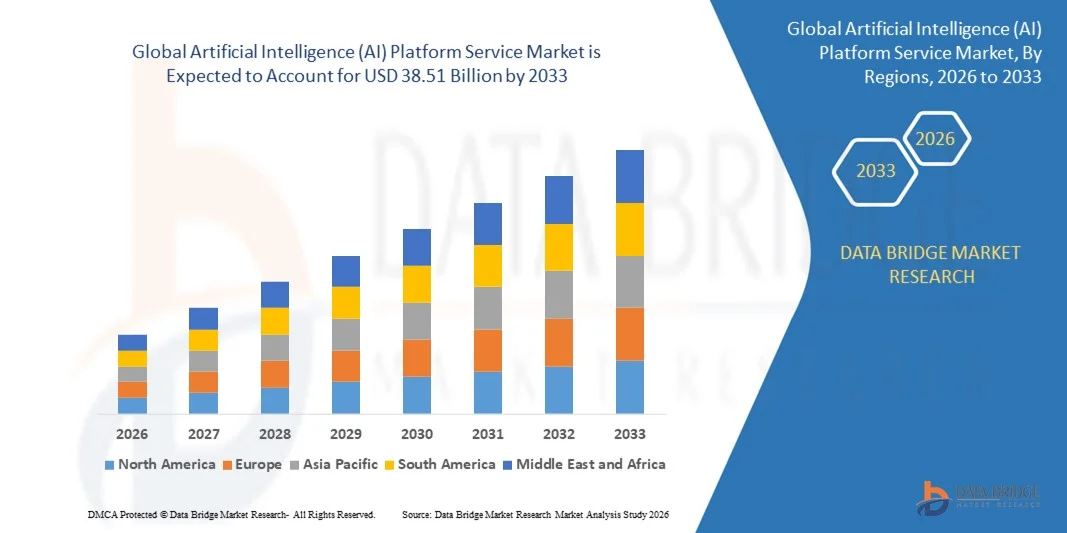
- The global Artificial Intelligence (AI) platform service market size was valued at USD 4.44 billion in 2025 and is expected to reach USD 38.51 billion by 2033, at a CAGR of 31% during the forecast period
- The market growth is largely fueled by the accelerating adoption of cloud computing, big data analytics, and enterprise digital transformation initiatives, leading to increased deployment of scalable and integrated AI platform services across industries such as healthcare, BFSI, retail, manufacturing, and telecommunications
- Furthermore, rising enterprise demand for advanced automation, predictive analytics, and intelligent decision-making solutions is positioning AI platform services as essential components of modern digital ecosystems. These converging factors are accelerating the integration of machine learning, natural language processing, and computer vision capabilities into business workflows, thereby significantly boosting overall market expansion
Artificial Intelligence (AI) Platform Service Market Analysis
- Artificial Intelligence (AI) platform services, providing end-to-end environments for developing, training, deploying, and managing machine learning and deep learning models, are becoming critical to enterprise innovation strategies due to their scalability, flexibility, and ability to process large volumes of structured and unstructured data
- The escalating demand for Artificial Intelligence (AI) platform services is primarily driven by the rapid growth of data generation, increasing need for real-time insights, and strong focus on operational efficiency, cost optimization, and enhanced customer experience across global enterprises
- North America dominated the Artificial Intelligence (AI) platform service market with a share of 46.7% in 2025, due to strong investments in advanced analytics, cloud computing infrastructure, and enterprise AI adoption across multiple industries
- Asia-Pacific is expected to be the fastest growing region in the Artificial Intelligence (AI) platform service market during the forecast period due to rapid digital transformation, expanding cloud adoption, and increasing government-led AI initiatives in major economies such as China, Japan, and India
- Software segment dominated the market with a market share of 45.5% in 2025, due to the widespread deployment of AI algorithms, analytics platforms, and model management systems across enterprises. AI software solutions enable seamless integration with existing enterprise systems and support scalable data processing, making them essential for digital transformation initiatives. Increasing subscription-based and platform-as-a-service models are also contributing to strong software adoption
Report Scope and Artificial Intelligence (AI) Platform Service Market Segmentation
|
Attributes |
Artificial Intelligence (AI) Platform Service Key Market Insights |
|
Segments Covered |
|
|
Countries Covered |
North America
Europe
Asia-Pacific
Middle East and Africa
South America
|
|
Key Market Players |
|
|
Market Opportunities |
|
|
Value Added Data Infosets |
In addition to the market insights such as market value, growth rate, market segments, geographical coverage, market players, and market scenario, the market report curated by the Data Bridge Market Research team includes in-depth expert analysis, import/export analysis, pricing analysis, production consumption analysis, and pestle analysis. |
Artificial Intelligence (AI) Platform Service Market Trends
Increasing Adoption of Generative AI and Foundation Model Integration
- A significant trend in the Artificial Intelligence (AI) Platform Service market is the rapid integration of generative AI and large foundation models into enterprise-grade development and deployment platforms, driven by the need for advanced automation, content generation, and intelligent decision support across industries. This integration is elevating AI platforms from traditional machine learning environments to comprehensive ecosystems capable of supporting complex multimodal applications
- For instance, Microsoft Corporation has integrated OpenAI models into its Azure AI platform, enabling enterprises to build and deploy generative AI applications at scale within secure cloud infrastructures. This integration strengthens enterprise innovation capacity and accelerates commercialization of AI-driven solutions across global markets
- AI platform providers are increasingly embedding pretrained large language models and APIs into their service portfolios to simplify model customization and reduce development timelines. This is enhancing accessibility for organizations seeking to deploy AI solutions without extensive in-house expertise
- Enterprises across sectors such as healthcare, finance, and retail are adopting foundation model capabilities to support advanced analytics, automated customer interaction, and intelligent document processing. This shift is positioning AI platform services as central components of digital transformation strategies
- The rise of multimodal AI models capable of processing text, images, and structured data within unified environments is expanding the functional scope of AI platform services. This advancement is reinforcing the value proposition of integrated, scalable AI infrastructures
- The market is witnessing sustained investment in high-performance computing resources and optimized AI frameworks to support large-scale generative workloads. This growing incorporation of foundation models is reinforcing the transition toward more autonomous, adaptive, and innovation-driven enterprise systems
Artificial Intelligence (AI) Platform Service Market Dynamics
Driver
Accelerating Enterprise Digital Transformation and Cloud Migration
- The increasing pace of enterprise digital transformation initiatives is driving strong demand for AI platform services that enable data-driven decision-making, automation, and operational optimization. Organizations are migrating workloads to cloud-based environments where scalable AI tools can be deployed more efficiently and cost-effectively
- For instance, Amazon Web Services, Inc. offers AI and machine learning services through its cloud infrastructure, enabling enterprises to build, train, and deploy models without managing underlying hardware. This capability supports rapid experimentation, flexible scaling, and streamlined AI adoption across diverse industry verticals
- Businesses are leveraging AI platforms to modernize legacy systems, enhance predictive maintenance, optimize supply chains, and improve customer personalization strategies. This reliance on intelligent cloud-based platforms is strengthening long-term investment in AI infrastructure
- The exponential growth of enterprise data generated from digital channels, IoT devices, and connected systems is further intensifying the need for centralized AI development environments. These platforms facilitate structured data management, analytics integration, and cross-functional collaboration
- The sustained focus on agility, scalability, and innovation across global enterprises continues to amplify this driver. The convergence of digital transformation and cloud migration is positioning AI platform services as indispensable enablers of modern enterprise growth
Restraint/Challenge
Data Privacy Concerns and Regulatory Compliance Complexity
- The Artificial Intelligence (AI) Platform Service market faces challenges related to stringent data protection regulations and increasing scrutiny over the ethical use of AI technologies. Organizations must navigate complex compliance frameworks when handling sensitive customer and enterprise data within AI systems
- For instance, the implementation of the European Commission Artificial Intelligence Act has introduced comprehensive regulatory requirements governing AI deployment, transparency, and risk management across member states. Such regulations require AI platform providers to incorporate governance controls, audit mechanisms, and documentation processes into their services
- Data sovereignty requirements and cross-border data transfer restrictions add further complexity to global AI deployments. Enterprises must ensure secure storage, encrypted processing, and adherence to region-specific standards when operating AI models
- Concerns related to bias, explainability, and algorithmic accountability are increasing the compliance burden on AI platform vendors. Providers are required to invest in responsible AI frameworks and validation tools to meet evolving legal and ethical expectations
- These compliance obligations collectively increase operational costs and extend deployment timelines, presenting a notable constraint for market participants. Managing privacy risks and regulatory complexity remains a critical challenge influencing the pace of AI platform service adoption
Artificial Intelligence (AI) Platform Service Market Scope
The market is segmented on the basis of component, tools, solution, service, deployment mode, technology, application, and end user.
- By Component
On the basis of component, the Artificial Intelligence (AI) Platform Service market is segmented into tools and services. The tools segment dominated the market with the largest revenue share in 2025, driven by the rising demand for AI development frameworks, model training environments, and data analytics platforms that enable enterprises to build and deploy AI solutions efficiently. Organizations increasingly invest in AI tools to accelerate digital transformation, automate workflows, and enhance decision-making capabilities across departments. The availability of integrated development environments, pre-trained models, and scalable cloud-based toolkits further strengthens the adoption of AI tools across industries.
The services segment is anticipated to witness the fastest growth rate from 2026 to 2033, fueled by the growing need for consulting, integration, deployment, and support services to manage complex AI infrastructures. Enterprises often require specialized expertise to customize AI models, ensure regulatory compliance, and optimize performance in real-world environments. The increasing shortage of in-house AI talent and the rising demand for end-to-end managed AI solutions are expected to significantly boost the services segment during the forecast period.
- By Tools
On the basis of tools, the market is segmented into NLP and ML. The ML segment held the largest market revenue share in 2025, supported by its extensive application in predictive analytics, fraud detection, recommendation engines, and operational optimization across industries. Machine learning platforms enable organizations to analyze large volumes of structured and unstructured data, uncover patterns, and improve business forecasting accuracy. Continuous advancements in automated machine learning and scalable computing infrastructure further strengthen the dominance of the ML segment.
The NLP segment is projected to witness the fastest CAGR from 2026 to 2033, driven by the increasing adoption of conversational AI, sentiment analysis, and language translation tools in customer engagement and enterprise communication. Growing demand for intelligent virtual assistants and automated document processing solutions across sectors such as healthcare and BFSI is accelerating NLP deployment. The rapid expansion of multilingual digital content and voice-enabled interfaces is expected to further propel segment growth.
- By Solution
On the basis of solution, the Artificial Intelligence (AI) Platform Service market is segmented into hardware, software, and services. The software segment dominated the market with the largest share of 45.5% in 2025 due to the widespread deployment of AI algorithms, analytics platforms, and model management systems across enterprises. AI software solutions enable seamless integration with existing enterprise systems and support scalable data processing, making them essential for digital transformation initiatives. Increasing subscription-based and platform-as-a-service models are also contributing to strong software adoption.
The services segment is anticipated to register the fastest growth rate during the forecast period, supported by rising demand for implementation, training, and lifecycle management of AI platforms. As AI systems become more sophisticated, organizations seek continuous monitoring, model retraining, and performance optimization services. The need for tailored AI strategies aligned with specific business objectives is expected to accelerate services growth.
- By Service
On the basis of service, the market is segmented into managed and professional services. The professional services segment accounted for the largest revenue share in 2025, driven by high demand for consulting, system integration, and customization services during AI deployment phases. Enterprises often rely on professional service providers to design AI roadmaps, develop proof-of-concept models, and ensure seamless integration with legacy IT systems. The complexity of AI architectures supports sustained demand for specialized professional expertise.
The managed services segment is projected to witness the fastest growth from 2026 to 2033, fueled by increasing preference for outsourced AI management and monitoring solutions. Managed service providers offer continuous model optimization, data governance, and security management, reducing operational burden on enterprises. Growing adoption of AI-as-a-service models is expected to significantly drive this segment’s expansion.
- By Deployment Mode
On the basis of deployment mode, the market is segmented into cloud and on-premises. The cloud segment held the largest revenue share in 2025, supported by its scalability, flexibility, and cost-effectiveness in handling large-scale AI workloads. Cloud-based AI platforms enable rapid deployment, real-time collaboration, and integration with big data analytics tools, making them attractive for enterprises of all sizes. The expansion of hybrid and multi-cloud strategies further reinforces cloud dominance.
The on-premises segment is expected to witness the fastest growth rate during the forecast period, driven by rising concerns over data privacy, regulatory compliance, and security in highly sensitive industries. Organizations in sectors such as healthcare and BFSI prefer on-premises AI solutions to maintain full control over critical data assets. Increasing investments in private AI infrastructure are anticipated to accelerate this segment’s growth.
- By Technology
On the basis of technology, the market is segmented into deep learning, machine learning, natural language processing (NLP), and machine vision. The machine learning segment dominated the market in 2025 due to its broad applicability in predictive analytics, customer behavior analysis, and process automation across industries. Machine learning algorithms support continuous improvement through data-driven insights, enhancing operational efficiency and strategic planning. The integration of ML with cloud platforms and edge computing solutions further strengthens its leading position.
The deep learning segment is projected to register the fastest CAGR from 2026 to 2033, fueled by increasing use in advanced image recognition, autonomous systems, and complex pattern detection applications. Deep learning models enable high accuracy in processing large-scale unstructured data, supporting innovations in healthcare diagnostics and intelligent automation. Growing investments in GPU infrastructure and neural network research are expected to drive rapid segment expansion.
- By Application
On the basis of application, the Artificial Intelligence (AI) Platform Service market is segmented into forecasts and prescriptive models, chatbots, speech recognition, text recognition, and others. The forecasts and prescriptive models segment accounted for the largest revenue share in 2025, driven by strong demand for predictive analytics in supply chain optimization, risk assessment, and financial forecasting. Enterprises increasingly rely on AI-driven models to enhance decision-making accuracy and improve operational resilience. The ability to deliver real-time insights and scenario-based analysis further supports segment dominance.
The chatbots segment is anticipated to witness the fastest growth rate during the forecast period, fueled by rising adoption of conversational AI in customer service, banking, and e-commerce platforms. Chatbots improve customer engagement, reduce response times, and lower operational costs through automated interactions. Continuous advancements in NLP and voice-based AI interfaces are expected to accelerate chatbot deployment across industries.
- By End User
On the basis of end user, the market is segmented into manufacturing, healthcare, BFSI, research and academia, transportation, retail and ecommerce, and others. The BFSI segment dominated the market in 2025, supported by extensive use of AI platforms for fraud detection, risk management, credit scoring, and personalized banking services. Financial institutions invest heavily in AI to enhance security, improve customer experience, and streamline back-office operations. The growing volume of digital transactions further strengthens AI adoption in this sector.
The healthcare segment is projected to witness the fastest CAGR from 2026 to 2033, driven by increasing application of AI in medical imaging, drug discovery, patient monitoring, and clinical decision support systems. AI platforms enable faster diagnostics, improved treatment planning, and efficient hospital resource management. Rising investments in digital health infrastructure and precision medicine initiatives are expected to significantly boost healthcare adoption of AI platform services.
Artificial Intelligence (AI) Platform Service Market Regional Analysis
- North America dominated the Artificial Intelligence (AI) platform service market with the largest revenue share of 46.7% in 2025, driven by strong investments in advanced analytics, cloud computing infrastructure, and enterprise AI adoption across multiple industries
- Organizations in the region highly prioritize automation, predictive analytics, and real-time decision-making capabilities enabled by AI platforms to enhance operational efficiency and competitive advantage
- This widespread adoption is further supported by the presence of leading AI technology providers, high R&D spending, and early integration of AI across sectors such as BFSI, healthcare, retail, and IT, establishing AI platform services as a core component of digital transformation strategies
U.S. Artificial Intelligence (AI) Platform Service Market Insight
The U.S. Artificial Intelligence (AI) Platform Service market captured the largest revenue share within North America in 2025, fueled by rapid enterprise digital transformation and extensive integration of AI across sectors such as finance, healthcare, defense, and e-commerce. Businesses are increasingly deploying AI platforms to enhance predictive analytics, automate workflows, and improve customer engagement strategies. The strong presence of AI pioneers such as Google Cloud and IBM, combined with supportive government initiatives and venture capital funding, continues to accelerate market expansion across the country.
Europe Artificial Intelligence (AI) Platform Service Market Insight
The Europe Artificial Intelligence (AI) Platform Service market is projected to expand at a substantial CAGR throughout the forecast period, primarily driven by increasing regulatory focus on ethical AI usage and growing enterprise adoption of AI-powered analytics solutions. Rising digitalization across industrial automation, automotive, and financial services sectors is strengthening demand for robust AI development and deployment platforms. European organizations are emphasizing data privacy, compliance, and explainable AI models, encouraging the adoption of secure and transparent AI platform services across both public and private sectors.
U.K. Artificial Intelligence (AI) Platform Service Market Insight
The U.K. Artificial Intelligence (AI) Platform Service market is anticipated to grow at a noteworthy CAGR during the forecast period, driven by strong government support for AI innovation and increasing startup activity in fintech and healthtech domains. Enterprises are investing in AI platforms to optimize business intelligence, fraud detection, and customer personalization strategies. The country’s advanced research ecosystem and collaboration between academia and industry are further strengthening the development and commercialization of AI-based platform services.
Germany Artificial Intelligence (AI) Platform Service Market Insight
The Germany Artificial Intelligence (AI) Platform Service market is expected to expand at a considerable CAGR during the forecast period, fueled by growing adoption of AI in industrial automation, automotive engineering, and smart manufacturing initiatives aligned with Industry 4.0 strategies. German enterprises are increasingly integrating AI platforms to enhance predictive maintenance, quality control, and supply chain optimization. Strong emphasis on engineering excellence, data security standards, and enterprise-grade AI deployment is supporting steady growth in the region.
Asia-Pacific Artificial Intelligence (AI) Platform Service Market Insight
The Asia-Pacific Artificial Intelligence (AI) Platform Service market is poised to grow at the fastest CAGR during the forecast period of 2026 to 2033, driven by rapid digital transformation, expanding cloud adoption, and increasing government-led AI initiatives in major economies such as China, Japan, and India. The region’s expanding startup ecosystem and rising investments in AI research and smart city projects are accelerating demand for flexible and scalable AI platforms. Growing availability of cost-effective cloud infrastructure and increasing enterprise awareness of AI-driven automation are broadening market penetration across diverse industry verticals.
Japan Artificial Intelligence (AI) Platform Service Market Insight
The Japan Artificial Intelligence (AI) Platform Service market is gaining momentum due to the country’s strong robotics industry, advanced technological infrastructure, and rising demand for AI-driven automation in manufacturing and healthcare sectors. Organizations are leveraging AI platforms to enhance operational efficiency, workforce productivity, and intelligent decision-making systems. Continuous investments in AI research and collaboration between technology firms and industrial players are supporting sustained market growth.
China Artificial Intelligence (AI) Platform Service Market Insight
The China Artificial Intelligence (AI) Platform Service market accounted for the largest market revenue share in Asia Pacific in 2025, attributed to extensive government support for AI development, rapid industrial digitalization, and widespread adoption of cloud-based technologies. The country’s strong domestic technology ecosystem, supported by companies such as Alibaba Cloud and Tencent Cloud, is accelerating the deployment of AI platforms across sectors including e-commerce, finance, transportation, and smart city infrastructure. Increasing investments in AI research and large-scale data generation capabilities are further propelling market expansion in China.
Artificial Intelligence (AI) Platform Service Market Share
The Artificial Intelligence (AI) platform service industry is primarily led by well-established companies, including:
- Microsoft Corporation (U.S.)
- Google LLC (U.S.)
- Salesforce, Inc. (U.S.)
- IBM (U.S.)
- Amazon Web Services, Inc. (U.S.)
- Intel Corporation (U.S.)
- Hewlett Packard Enterprise (U.S.)
- Qualcomm Technologies, Inc. (U.S.)
- General Vision, Inc. (U.S.)
- Enlitic, Inc. (U.S.)
- Next IT Corporation (U.S.)
- iCarbonX (China)
- Apple Inc. (U.S.)
- Meta Platforms, Inc. (U.S.)
- Siemens AG (Germany)
- General Electric Company (U.S.)
- Samsung Electronics (South Korea)
- NVIDIA Corporation (U.S.)
Latest Developments in Global Artificial Intelligence (AI) Platform Service Market
- In January 2025, CoreWeave completed its acquisition of Weights & Biases to integrate advanced experiment tracking, model management, and MLOps capabilities directly into its high-performance AI cloud infrastructure. This strategic move strengthens CoreWeave’s position as a full-stack AI platform service provider by combining scalable GPU infrastructure with developer-centric AI tooling. The acquisition enhances enterprise efficiency in training and deploying large models while intensifying competition among specialized AI cloud providers
- In December 2024, Amazon Web Services entered into a multi-year strategic collaboration with OpenAI to expand access to advanced foundation models and generative AI capabilities through AWS infrastructure. By deepening integration between OpenAI models and AWS cloud services, the partnership strengthens enterprise adoption of AI platform services for large-scale deployments. This development reinforces AWS’s leadership in hyperscale AI infrastructure and accelerates commercialization of generative AI solutions across global enterprises
- In November 2024, Salesforce announced the acquisition of Convergence.ai to enhance autonomous AI agent capabilities within its enterprise platform ecosystem. The acquisition enables Salesforce to embed intelligent agents capable of executing multi-step digital tasks across business applications, strengthening its AI-driven automation portfolio. This move advances the shift toward agentic AI platforms and increases competitive pressure in enterprise workflow automation markets
- In October 2024, Google expanded its enterprise AI portfolio by launching the Gemini Enterprise mobile application under Google Cloud, enabling businesses to integrate generative AI assistance into daily productivity operations. The launch enhances accessibility to AI tools for enterprise users, supporting real-time insights, automation, and content generation within secure cloud environments. This strengthens Google’s competitive positioning in AI platform services by accelerating enterprise-wide AI integration and improving user engagement
- In September 2024, Brillio introduced the ADAM agentic data management platform designed to automate governance, analytics, and operational workflows through AI-driven agents. The platform supports end-to-end data lifecycle optimization, enabling enterprises to improve data accuracy, compliance, and decision intelligence. This product launch expands the scope of AI platform services into intelligent data operations, increasing innovation intensity and broadening enterprise adoption across industry verticals
SKU-
Get online access to the report on the World's First Market Intelligence Cloud

- Interactive Data Analysis Dashboard
- Company Analysis Dashboard for high growth potential opportunities
- Research Analyst Access for customization & queries
- Competitor Analysis with Interactive dashboard
- Latest News, Updates & Trend analysis
- Harness the Power of Benchmark Analysis for Comprehensive Competitor Tracking
Research Methodology
Data collection and base year analysis are done using data collection modules with large sample sizes. The stage includes obtaining market information or related data through various sources and strategies. It includes examining and planning all the data acquired from the past in advance. It likewise envelops the examination of information inconsistencies seen across different information sources. The market data is analysed and estimated using market statistical and coherent models. Also, market share analysis and key trend analysis are the major success factors in the market report. To know more, please request an analyst call or drop down your inquiry.
The key research methodology used by DBMR research team is data triangulation which involves data mining, analysis of the impact of data variables on the market and primary (industry expert) validation. Data models include Vendor Positioning Grid, Market Time Line Analysis, Market Overview and Guide, Company Positioning Grid, Patent Analysis, Pricing Analysis, Company Market Share Analysis, Standards of Measurement, Global versus Regional and Vendor Share Analysis. To know more about the research methodology, drop in an inquiry to speak to our industry experts.
Customization Available
Data Bridge Market Research is a leader in advanced formative research. We take pride in servicing our existing and new customers with data and analysis that match and suits their goal. The report can be customized to include price trend analysis of target brands understanding the market for additional countries (ask for the list of countries), clinical trial results data, literature review, refurbished market and product base analysis. Market analysis of target competitors can be analyzed from technology-based analysis to market portfolio strategies. We can add as many competitors that you require data about in the format and data style you are looking for. Our team of analysts can also provide you data in crude raw excel files pivot tables (Fact book) or can assist you in creating presentations from the data sets available in the report.












