




Global Artificial Intelligence In Supply Chain Market
Market Size in USD Million
CAGR :
% 
 USD
39.18 Million
USD
75.82 Million
2025
2033
USD
39.18 Million
USD
75.82 Million
2025
2033
 Forecast Period Forecast Period |
2026 –2033 |
 Market Size (Base Year) Market Size (Base Year) |
USD 39.18 Million |
 Market Size (Forecast Year) Market Size (Forecast Year) |
USD 75.82 Million |
 CAGR CAGR |
% |
| Major Markets Players |
|
What is the Global Artificial Intelligence in Supply Chain Market Size and Growth Rate?
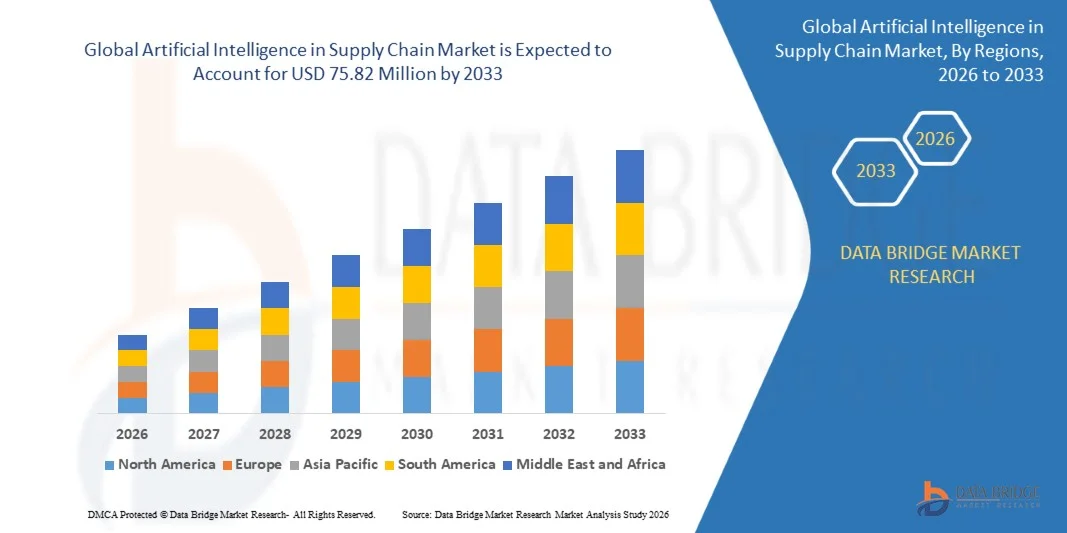
- The global artificial intelligence in supply chain market size was valued at USD 39.18 million in 2025 and is expected to reach USD 75.82 million by 2033, at a CAGR of8.60% during the forecast period
- Rising digitization of the economies especially the emerging ones will emerge as the major market growth driving factor. Surging demand for greater visibility and transparency in the supply chain and logistics data, growing generation of high amount of data and information, rising adoption by small and medium scale enterprises and strengthening IT industry in developing economies such as India and China will further aggravate the growth of the market
What are the Major Takeaways of Artificial Intelligence in Supply Chain Market?
- Rising proliferation of cloud based services and ever-growing set of favourable government regulations are some other factors bolstering the growth of the market
- However, lack of technological expertise in underdeveloped and developing economies will act as growth restraints for the market. Also, lack of workforce and the increasing cost for the same will yet again hamper the market growth rate
- North America dominated the artificial intelligence in supply chain market with a 41.9% revenue share in 2025, driven by rapid adoption of AI-powered logistics platforms, advanced warehouse automation systems, and strong digital transformation initiatives across the U.S. and Canada
- Asia-Pacific is projected to register the fastest CAGR of 7.24% from 2026 to 2033, driven by rapid expansion of e-commerce, manufacturing digitization, and smart logistics infrastructure across China, Japan, India, South Korea, and Southeast Asia
- The Software segment dominated the market with a 46.8% share in 2025, driven by rising deployment of AI-powered analytics platforms, predictive demand forecasting tools, route optimization engines, and intelligent warehouse management systems
Report Scope and Artificial Intelligence in Supply Chain Market Segmentation
|
Attributes |
Artificial Intelligence in Supply Chain Key Market Insights |
|
Segments Covered |
|
|
Countries Covered |
North America
Europe
Asia-Pacific
Middle East and Africa
South America
|
|
Key Market Players |
|
|
Market Opportunities |
|
|
Value Added Data Infosets |
In addition to the insights on market scenarios such as market value, growth rate, segmentation, geographical coverage, and major players, the market reports curated by the Data Bridge Market Research also include in-depth expert analysis, pricing analysis, brand share analysis, consumer survey, demography analysis, supply chain analysis, value chain analysis, raw material/consumables overview, vendor selection criteria, PESTLE Analysis, Porter Analysis, and regulatory framework. |
What is the Key Trend in the Artificial Intelligence in Supply Chain Market?
“Increasing Shift Toward Predictive Analytics, Autonomous Decision-Making, and Real-Time Supply Chain Visibility”
- The artificial intelligence in supply chain market is witnessing strong adoption of AI-powered predictive analytics, machine learning models, and automation platforms designed to improve demand forecasting, route optimization, and inventory management
- Companies are increasingly deploying AI-driven control towers, digital twins, and real-time monitoring solutions that enhance end-to-end supply chain visibility and enable faster decision-making
- Growing demand for cost-efficient logistics operations, reduced delivery lead times, and optimized warehouse performance is accelerating AI adoption across retail, manufacturing, and transportation sectors
- For instance, major companies such as Amazon Web Services, Microsoft, SAP, Oracle, and IBM are expanding their AI-enabled supply chain platforms with advanced analytics, predictive maintenance, and intelligent workflow automation
- Increasing need for risk management, supplier performance tracking, and disruption forecasting is driving the shift toward intelligent and autonomous supply chain ecosystems
- As global supply chains become more digitally interconnected and complex, AI-driven solutions will remain essential for real-time visibility, operational efficiency, and proactive decision-making
What are the Key Drivers of Artificial Intelligence in Supply Chain Market?
- Rising demand for accurate demand forecasting, inventory optimization, and logistics efficiency is one of the major factors driving market growth
- For instance, in 2025, leading companies such as SAP, Oracle, Microsoft, and AWS enhanced their AI-based supply chain suites with predictive insights, warehouse automation, and intelligent planning tools
- Growing adoption of e-commerce, omnichannel retail, IoT-connected warehouses, and smart manufacturing is boosting the demand for AI-powered supply chain solutions across the U.S., Europe, and Asia-Pacific
- Advancements in machine learning, computer vision, robotic process automation, and cloud computing have significantly strengthened supply chain agility and performance
- Rising use of AI for fraud detection, route optimization, demand sensing, and supplier risk analysis is further accelerating adoption
- Supported by continuous investments in digital transformation, logistics modernization, and industrial automation, the market is expected to witness strong long-term growth
Which Factor is Challenging the Growth of the Artificial Intelligence in Supply Chain Market?
- High implementation costs associated with advanced AI platforms, cloud integration, and infrastructure upgrades restrict adoption among SMEs and traditional logistics operators
- For instance, during 2024–2025, rising data integration complexity and system migration costs increased deployment challenges for several enterprises
- Complexity in integrating AI tools with legacy ERP systems, warehouse management software, and supplier networks increases operational challenges
- Limited awareness and lack of skilled professionals in emerging markets slow down adoption of AI-driven supply chain solutions
- Data privacy concerns, cybersecurity risks, and dependency on accurate real-time data create additional barriers to market expansion
- To address these issues, companies are focusing on scalable cloud-based deployment models, AI training programs, and improved interoperability solutions to increase global adoption of AI in supply chain systems
How is the Artificial Intelligence in Supply Chain Market Segmented?
The market is segmented on the basis of offering, technology, application, and industry.
• By Offering
On the basis of offering, the artificial intelligence in supply chain market is segmented into Hardware, Software, and Services. The Software segment dominated the market with a 46.8% share in 2025, driven by rising deployment of AI-powered analytics platforms, predictive demand forecasting tools, route optimization engines, and intelligent warehouse management systems. Software solutions are widely adopted across supply chain operations as they enable real-time data analysis, automation, and decision-making support. Their scalability, cloud integration, and compatibility with ERP and logistics systems continue to strengthen segment leadership across large enterprises and third-party logistics providers.
The Services segment is expected to grow at the fastest CAGR from 2026 to 2033, supported by increasing demand for AI integration, consulting, managed services, deployment support, and continuous model optimization. As organizations accelerate digital transformation, the need for implementation and maintenance services is expected to rise significantly.
• By Technology
On the basis of technology, the market is segmented into Machine Learning, Natural Language Processing, Context-Aware Computing, and Computer Vision. The Machine Learning segment dominated the market with a 41.5% share in 2025, owing to its extensive use in demand forecasting, inventory optimization, predictive maintenance, and supplier risk assessment. Machine learning models help organizations analyze historical and real-time data to improve planning accuracy and reduce operational inefficiencies. The growing availability of structured logistics data and cloud-based AI platforms is further supporting adoption.
The Computer Vision segment is projected to grow at the fastest CAGR from 2026 to 2033, driven by rising use in warehouse automation, quality inspection, package tracking, robotics, and visual inventory monitoring. Increasing adoption of smart cameras and AI-enabled warehouse systems is accelerating segment growth globally.
• By Application
On the basis of application, the market is segmented into Fleet Management, Supply Chain Planning, Warehouse Management, Virtual Assistant, Risk Management, Freight Brokerage, and Others. The Supply Chain Planning segment dominated the market with a 29.7% share in 2025, driven by strong demand for AI-based demand sensing, sales forecasting, procurement optimization, and production scheduling. Organizations are increasingly using AI to reduce disruptions, improve visibility, and optimize end-to-end logistics performance.
The Warehouse Management segment is expected to grow at the fastest CAGR from 2026 to 2033, propelled by increasing warehouse automation, smart inventory systems, robotic picking solutions, and real-time asset tracking. The growth of e-commerce and omnichannel retail is significantly boosting adoption across global fulfillment centers.
• By Industry
On the basis of industry, the artificial intelligence in supply chain market is segmented into Automotive, Aerospace, Retail, Manufacturing, Healthcare, Consumer-Packaged Goods, and Food and Beverages. The Retail segment dominated the market with a 32.4% share in 2025, supported by rapid expansion of e-commerce, real-time inventory visibility needs, and growing demand for predictive consumer demand analysis. AI solutions are widely used in retail supply chains for replenishment planning, delivery route optimization, and warehouse automation.
The Manufacturing segment is projected to grow at the fastest CAGR from 2026 to 2033, driven by rising adoption of Industry 4.0, smart factories, digital twins, and predictive supply planning systems. Increasing need for production continuity and supplier coordination is expected to accelerate segment growth.
Which Region Holds the Largest Share of the Artificial Intelligence in Supply Chain Market?
- North America dominated the artificial intelligence in supply chain market with a 41.9% revenue share in 2025, driven by rapid adoption of AI-powered logistics platforms, advanced warehouse automation systems, and strong digital transformation initiatives across the U.S. and Canada. The region benefits from high deployment of predictive analytics, machine learning-based demand forecasting, intelligent route optimization, and cloud-based supply chain management solutions across retail, manufacturing, and transportation sectors
- Leading companies in North America are continuously expanding AI-driven supply chain platforms with real-time visibility tools, digital twin solutions, risk monitoring dashboards, and autonomous decision-support systems, strengthening the region’s technological leadership
- Strong presence of technology providers, advanced cloud infrastructure, and high investment in AI innovation further reinforce North America’s market dominance
U.S. Artificial Intelligence in Supply Chain Market Insight
The U.S. is the largest contributor in North America, supported by rapid growth in e-commerce, logistics digitization, and AI adoption across warehouse operations, demand planning, and freight management. Major enterprises are increasingly integrating AI into supply chain ecosystems for predictive maintenance, inventory optimization, and delivery route intelligence. Presence of major cloud and enterprise software providers such as AWS, Microsoft, Oracle, and IBM significantly strengthens market growth.
Canada Artificial Intelligence in Supply Chain Market Insight
Canada contributes significantly to regional growth, driven by increasing digitalization of retail logistics, transportation networks, and industrial supply chains. Rising investments in AI-based planning systems, smart warehousing, and demand sensing solutions across manufacturing and healthcare sectors continue to support adoption.
Asia-Pacific Artificial Intelligence in Supply Chain Market
Asia-Pacific is projected to register the fastest CAGR of 7.24% from 2026 to 2033, driven by rapid expansion of e-commerce, manufacturing digitization, and smart logistics infrastructure across China, Japan, India, South Korea, and Southeast Asia. Growing use of AI for warehouse robotics, inventory automation, and route optimization is accelerating regional growth.
China Artificial Intelligence in Supply Chain Market Insight
China is the largest contributor to Asia-Pacific due to its strong manufacturing ecosystem, world-leading e-commerce sector, and significant investments in smart logistics and AI-enabled warehouse networks. Rapid deployment of intelligent supply chain platforms is driving large-scale market adoption.
Japan Artificial Intelligence in Supply Chain Market Insight
Japan shows steady growth supported by advanced automation systems, robotics leadership, and strong focus on supply chain resilience. AI adoption in precision manufacturing and automotive logistics continues to drive expansion.
India Artificial Intelligence in Supply Chain Market Insight
India is emerging as a major growth hub, driven by rapid expansion of e-commerce, retail logistics, and government-led digital infrastructure initiatives. Increasing adoption of AI in warehouse management, last-mile delivery, and demand planning is accelerating market penetration.
South Korea Artificial Intelligence in Supply Chain Market Insight
South Korea contributes significantly due to strong demand for AI-powered manufacturing logistics, semiconductor supply chain visibility, and high-tech warehouse automation. Continued innovation in industrial AI platforms and smart logistics infrastructure supports sustained market growth.
Which are the Top Companies in Artificial Intelligence in Supply Chain Market?
The artificial intelligence in supply chain industry is primarily led by well-established companies, including:
- Amazon Web Services, Inc. (U.S.)
- project44 (U.S.)
- Deutsche Post AG (Germany)
- FedEx (U.S.)
- General Electric (U.S.)
- Google LLC (U.S.)
- IBM (U.S.)
- Intel Corporation (U.S.)
- Coupa Software Inc. (U.S.)
- Micron Technology, Inc. (U.S.)
- Microsoft (U.S.)
- NVIDIA Corporation (U.S.)
- Oracle (U.S.)
- SAP SE (Germany)
- Samsung (South Korea)
- Xilinx (U.S.)
- Fraight AI (U.S.)
- C.H. Robinson Worldwide, Inc. (U.S.)
- E2open, LLC. (U.S.)
- RELEX Solutions (Finland)
- SKF Group (Sweden)
- Cainiao Network (China)
- Splice Machine (U.S.)
- American Software, Inc. (U.S.)
What are the Recent Developments in Global Artificial Intelligence in Supply Chain Market?
- In December 2025, Anaplan, Inc. launched a new suite of role-based AI agents centered around the Anaplan CoModeler, aimed at embedding predictive, generative, and agentic intelligence across enterprise planning workflows. The platform enabled users to transform natural language inputs into structured planning models, allowing faster model development, scenario simulation, and governance-led decision-making. This development is expected to strengthen AI-driven planning capabilities and improve enterprise-wide operational resilience
- In November 2025, SAP SE and HCL Technologies Limited entered into a strategic collaboration to advance physical AI applications by integrating intelligent, AI-powered capabilities into real-world industrial environments. The initiative focused on warehouse automation, fleet optimization through multi-agent AI models, and embodied AI-enabled 3D reality capture solutions. This partnership is such asly to accelerate smart supply chain transformation and next-generation industrial automation adoption
- In November 2025, SAP SE and Microsoft partnered to develop SAP Business Data Cloud (BDC) Connect for Microsoft Fabric, enabling bi-directional, zero-copy data exchange between both platforms. This integration simplified access to semantically rich SAP datasets and enabled enterprises to derive trusted, AI-ready insights without the need for data duplication. This collaboration is expected to enhance data interoperability and strengthen AI-led decision intelligence across supply chain operations
- In November 2025, Pacsun collaborated with Manhattan Associates to deploy Manhattan Active Point of Sale across more than 300 stores, integrating unified commerce capabilities with mobile checkout and RFID-based inventory visibility. The deployment improved fulfillment efficiency across online and offline channels, reduced logistics costs by 25%, and streamlined in-store return and endless aisle experiences. This rollout is anticipated to improve omnichannel supply chain efficiency and elevate retail operational performance
SKU-
Get online access to the report on the World's First Market Intelligence Cloud

- Interactive Data Analysis Dashboard
- Company Analysis Dashboard for high growth potential opportunities
- Research Analyst Access for customization & queries
- Competitor Analysis with Interactive dashboard
- Latest News, Updates & Trend analysis
- Harness the Power of Benchmark Analysis for Comprehensive Competitor Tracking
Research Methodology
Data collection and base year analysis are done using data collection modules with large sample sizes. The stage includes obtaining market information or related data through various sources and strategies. It includes examining and planning all the data acquired from the past in advance. It likewise envelops the examination of information inconsistencies seen across different information sources. The market data is analysed and estimated using market statistical and coherent models. Also, market share analysis and key trend analysis are the major success factors in the market report. To know more, please request an analyst call or drop down your inquiry.
The key research methodology used by DBMR research team is data triangulation which involves data mining, analysis of the impact of data variables on the market and primary (industry expert) validation. Data models include Vendor Positioning Grid, Market Time Line Analysis, Market Overview and Guide, Company Positioning Grid, Patent Analysis, Pricing Analysis, Company Market Share Analysis, Standards of Measurement, Global versus Regional and Vendor Share Analysis. To know more about the research methodology, drop in an inquiry to speak to our industry experts.
Customization Available
Data Bridge Market Research is a leader in advanced formative research. We take pride in servicing our existing and new customers with data and analysis that match and suits their goal. The report can be customized to include price trend analysis of target brands understanding the market for additional countries (ask for the list of countries), clinical trial results data, literature review, refurbished market and product base analysis. Market analysis of target competitors can be analyzed from technology-based analysis to market portfolio strategies. We can add as many competitors that you require data about in the format and data style you are looking for. Our team of analysts can also provide you data in crude raw excel files pivot tables (Fact book) or can assist you in creating presentations from the data sets available in the report.












