




Global Asset Integrity Management Market
Market Size in USD Billion
CAGR :
% 
 USD
25.78 Billion
USD
192.84 Billion
2025
2033
USD
25.78 Billion
USD
192.84 Billion
2025
2033
 Forecast Period Forecast Period |
2026 - 2033 |
 Market Size (Base Year) Market Size (Base Year) |
USD 25.78 Billion |
 Market Size (Forecast Year) Market Size (Forecast Year) |
USD 192.84 Billion |
 CAGR CAGR |
% |
| Major Markets Players |
|
Asset Integrity Management Market Size
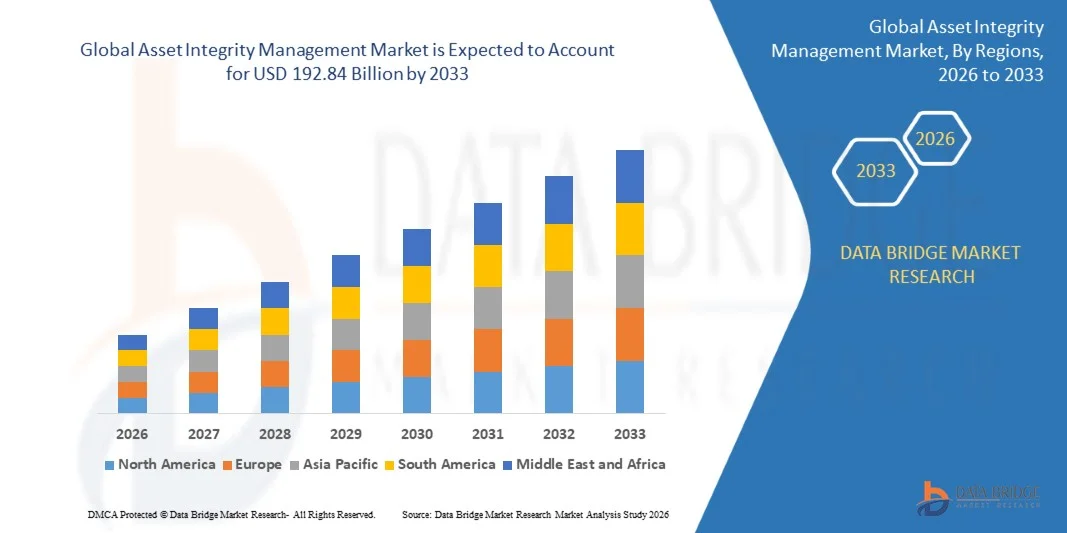
- The global asset integrity management market size was valued at USD 25.78 billion in 2025 and is expected to reach USD 192.84 billion by 2033, at a CAGR of 28.60% during the forecast period
- The market growth is largely fueled by the increasing need for operational safety, regulatory compliance, and risk mitigation across asset-intensive industries such as oil and gas, power, and mining, leading to the widespread adoption of advanced asset integrity management solutions
- Furthermore, rising investments in digital technologies such as predictive analytics, IoT-based monitoring, and AI-driven inspection systems are establishing asset integrity management as a critical approach for ensuring asset reliability and lifecycle optimization. These converging factors are accelerating the adoption of integrity solutions, thereby significantly boosting the market growth
Asset Integrity Management Market Analysis
- Asset integrity management refers to a systematic approach used to ensure that industrial assets perform their required functions effectively and safely throughout their lifecycle. These solutions include inspection, maintenance, risk assessment, and monitoring technologies that help prevent failures and enhance operational efficiency across critical infrastructure
- The escalating demand for asset integrity management is primarily driven by aging infrastructure, increasing industrial complexity, and stringent safety regulations, along with the growing focus on minimizing downtime and optimizing maintenance costs across industries
- North America dominated the asset integrity management market with a share of 28.56% in 2025, due to the strong presence of oil and gas infrastructure, stringent regulatory frameworks, and high adoption of advanced inspection technologies
- Asia-Pacific is expected to be the fastest growing region in the asset integrity management market during the forecast period due to rapid industrialization, expanding energy demand, and increasing infrastructure development in countries such as China, India, and Japan
- RBI segment dominated the market with a market share of 35.1% in 2025, due to its critical role in prioritizing inspection activities based on risk assessment and failure probability. Organizations increasingly adopt RBI to optimize maintenance schedules, reduce operational downtime, and ensure regulatory compliance across high-risk industrial assets. Its ability to enhance safety while minimizing inspection costs makes it a preferred approach in asset-intensive industries
Report Scope and Asset Integrity Management Market Segmentation
|
Attributes |
Asset Integrity Management Key Market Insights |
|
Segments Covered |
|
|
Countries Covered |
North America
Europe
Asia-Pacific
Middle East and Africa
South America
|
|
Key Market Players |
|
|
Market Opportunities |
|
|
Value Added Data Infosets |
In addition to the insights on market scenarios such as market value, growth rate, segmentation, geographical coverage, and major players, the market reports curated by the Data Bridge Market Research also include in-depth expert analysis, geographically represented company-wise production and capacity, network layouts of distributors and partners, detailed and updated price trend analysis and deficit analysis of supply chain and demand. |
Asset Integrity Management Market Trends
“Increasing Adoption of Digital and AI-Driven Asset Integrity Solutions”
- A significant trend in the asset integrity management market is the increasing adoption of digital technologies such as artificial intelligence, IoT, and advanced analytics to enhance asset monitoring and predictive maintenance capabilities across industries. These technologies are transforming traditional inspection processes into real-time, data-driven systems that improve operational efficiency and reduce the risk of unexpected failures
- For instance, Siemens provides digital asset integrity and predictive maintenance solutions through its industrial IoT platforms, enabling continuous monitoring and performance optimization across critical infrastructure. Such solutions enhance reliability and support informed decision-making for asset lifecycle management
- The integration of AI-driven inspection tools and digital twins is enabling organizations to simulate asset performance and identify potential issues before they occur, significantly improving maintenance planning and cost efficiency. This is strengthening the shift toward proactive integrity management strategies across asset-intensive sectors
- Industries such as oil and gas and power are increasingly deploying remote monitoring systems to ensure continuous asset performance in hazardous and geographically dispersed environments. This is reducing the need for manual inspections and enhancing worker safety while maintaining operational continuity
- The adoption of cloud-based integrity management platforms is further supporting scalability and centralized data access, allowing organizations to manage multiple assets efficiently across different locations. This is contributing to improved collaboration and streamlined asset management processes
- The market is witnessing accelerated digital transformation as companies prioritize intelligent asset monitoring and predictive maintenance solutions. This trend is reinforcing the role of advanced technologies in improving asset reliability, minimizing downtime, and supporting long-term operational sustainability across industries
Asset Integrity Management Market Dynamics
Driver
“Rising Demand for Safety Compliance and Risk-Based Maintenance”
- The increasing emphasis on safety regulations and risk-based maintenance practices across industries is driving the demand for asset integrity management solutions that ensure operational reliability and compliance with stringent standards. Organizations are focusing on minimizing risks associated with equipment failure and environmental hazards through structured integrity programs
- For instance, DNV provides risk-based inspection and integrity management services that help industries comply with international safety standards and optimize maintenance strategies. These solutions support industries in reducing operational risks and maintaining regulatory compliance effectively
- The presence of aging infrastructure in sectors such as oil and gas and power generation is increasing the need for continuous monitoring and maintenance to prevent failures and extend asset life. This is encouraging companies to adopt comprehensive integrity management frameworks
- Growing awareness regarding environmental safety and the consequences of industrial accidents is further strengthening the adoption of integrity solutions. Organizations are investing in advanced inspection technologies to detect early signs of wear, corrosion, and structural weaknesses
- The rising need to maintain safe and efficient industrial operations continues to reinforce this driver. The demand for reliable and compliant asset management practices is playing a crucial role in accelerating the growth of the asset integrity management market
Restraint/Challenge
“High Implementation Costs and Integration Complexity”
- The asset integrity management market faces challenges due to the high costs associated with implementing advanced inspection technologies, digital monitoring systems, and integrated software platforms. These investments can be significant, particularly for small and medium-sized enterprises with limited budgets
- For instance, General Electric deploys advanced asset performance and integrity solutions that require substantial infrastructure, integration efforts, and technical expertise. The complexity of deploying such systems increases initial costs and creates barriers for widespread adoption
- Integrating new digital solutions with existing legacy systems can be complex and time-consuming, requiring specialized skills and careful planning to ensure compatibility and seamless data flow. This increases operational challenges and delays implementation timelines
- The need for skilled professionals to manage and interpret data from advanced integrity systems adds to the overall cost burden for organizations. Training and workforce development become essential for effective utilization of these technologies
- The market continues to face pressure from high upfront costs and integration challenges, which may limit adoption rates among certain industry segments. Addressing these issues remains essential for enabling broader deployment of asset integrity management solutions across diverse industries
Asset Integrity Management Market Scope
The market is segmented on the basis of services and industry.
• By Services
On the basis of services, the asset integrity management market is segmented into RBI, RAM study, corrosion management, pipeline integrity management, HAZID study, structural integrity management, and NDT. The RBI segment dominated the largest market revenue share of 35.1% in 2025, driven by its critical role in prioritizing inspection activities based on risk assessment and failure probability. Organizations increasingly adopt RBI to optimize maintenance schedules, reduce operational downtime, and ensure regulatory compliance across high-risk industrial assets. Its ability to enhance safety while minimizing inspection costs makes it a preferred approach in asset-intensive industries. In addition, integration of digital tools and predictive analytics into RBI frameworks further strengthens its adoption, enabling real-time monitoring and informed decision-making for asset performance and lifecycle management.
The corrosion management segment is anticipated to witness the fastest growth rate from 2026 to 2033, fueled by the increasing need to prevent material degradation in harsh operating environments. Industries such as oil and gas and marine infrastructure are focusing on advanced corrosion monitoring solutions to extend asset life and reduce maintenance costs. The adoption of innovative coatings, cathodic protection systems, and real-time corrosion sensors is accelerating demand for these services. Furthermore, stringent safety regulations and rising awareness regarding asset failure risks are driving investments in proactive corrosion management strategies, ensuring long-term operational reliability and safety compliance.
• By Industry
On the basis of industry, the asset integrity management market is segmented into oil and gas, power, mining, aerospace, and others. The oil and gas segment dominated the largest market revenue share in 2025, driven by the extensive presence of aging infrastructure and the high-risk nature of upstream, midstream, and downstream operations. Companies in this sector prioritize asset integrity solutions to prevent leaks, failures, and environmental hazards while ensuring compliance with strict regulatory standards. The complexity of operations and the need for continuous monitoring of pipelines, refineries, and offshore platforms significantly contribute to the dominance of this segment. In addition, digitalization and the adoption of predictive maintenance technologies are further enhancing asset reliability and operational efficiency in the oil and gas industry.
The power segment is expected to witness the fastest growth rate from 2026 to 2033, driven by the increasing demand for reliable electricity generation and the modernization of aging grid infrastructure. Utilities are investing in asset integrity solutions to enhance the performance and lifespan of critical components such as turbines, transformers, and transmission networks. The transition toward renewable energy sources and smart grid technologies is also creating new requirements for continuous monitoring and maintenance. Furthermore, regulatory mandates for safety and efficiency, along with the need to minimize unplanned outages, are accelerating the adoption of advanced asset integrity management practices across the power sector.
Asset Integrity Management Market Regional Analysis
- North America dominated the asset integrity management market with the largest revenue share of 28.56% in 2025, driven by the strong presence of oil and gas infrastructure, stringent regulatory frameworks, and high adoption of advanced inspection technologies
- Industries in the region prioritize operational safety, predictive maintenance, and regulatory compliance, leading to increased deployment of asset integrity solutions across critical infrastructure
- This widespread adoption is further supported by technological advancements, early digitalization, and significant investments in infrastructure maintenance, establishing asset integrity management as a key operational strategy across industries
U.S. Asset Integrity Management Market Insight
The U.S. asset integrity management market captured the largest revenue share in 2025 within North America, fueled by extensive pipeline networks, aging infrastructure, and strict safety regulations. Companies are increasingly focusing on minimizing operational risks and ensuring compliance through advanced inspection and monitoring solutions. The integration of digital technologies such as AI and IoT in asset monitoring further enhances efficiency and reliability. Moreover, growing investments in energy and industrial sectors continue to strengthen the demand for asset integrity management solutions.
Europe Asset Integrity Management Market Insight
The Europe asset integrity management market is projected to expand at a substantial CAGR throughout the forecast period, primarily driven by strict environmental and safety regulations across industrial sectors. Increasing focus on sustainable operations and asset lifecycle management is encouraging companies to adopt advanced integrity solutions. The region is witnessing rising demand for predictive maintenance and digital inspection technologies. In addition, the modernization of aging infrastructure across industries is further accelerating market growth.
U.K. Asset Integrity Management Market Insight
The U.K. asset integrity management market is anticipated to grow at a noteworthy CAGR during the forecast period, driven by the presence of mature oil and gas operations and increasing investments in renewable energy infrastructure. Companies are focusing on enhancing asset reliability and minimizing downtime through proactive maintenance strategies. Regulatory compliance and safety concerns are also major factors influencing adoption. The growing integration of digital monitoring systems further supports market expansion.
Germany Asset Integrity Management Market Insight
The Germany asset integrity management market is expected to expand at a considerable CAGR during the forecast period, fueled by strong industrial manufacturing and energy sectors. The country emphasizes operational efficiency, safety, and sustainability, driving the adoption of advanced integrity management solutions. Increasing investments in smart manufacturing and Industry 4.0 initiatives are also contributing to market growth. Furthermore, the need to maintain aging industrial assets is supporting continuous demand for these solutions.
Asia-Pacific Asset Integrity Management Market Insight
The Asia-Pacific asset integrity management market is poised to grow at the fastest CAGR during the forecast period of 2026 to 2033, driven by rapid industrialization, expanding energy demand, and increasing infrastructure development in countries such as China, India, and Japan. Governments are focusing on improving safety standards and operational efficiency across industries. The growing adoption of digital technologies and predictive maintenance solutions is further accelerating market growth. In addition, rising investments in oil and gas, power, and mining sectors are boosting demand for asset integrity management.
Japan Asset Integrity Management Market Insight
The Japan asset integrity management market is gaining momentum due to advanced industrial infrastructure and a strong focus on operational safety and efficiency. The country’s emphasis on technological innovation is driving the adoption of digital asset monitoring solutions. Increasing investments in energy and manufacturing sectors are also supporting growth. Moreover, the need to maintain aging infrastructure is encouraging the use of advanced inspection and maintenance strategies.
China Asset Integrity Management Market Insight
The China asset integrity management market accounted for the largest market revenue share in Asia Pacific in 2025, attributed to rapid industrial expansion and significant investments in energy and infrastructure projects. The country’s strong manufacturing base and growing focus on safety compliance are driving demand for integrity management solutions. Increasing adoption of advanced technologies and digital monitoring systems is further enhancing market growth. In addition, government initiatives supporting industrial safety and efficiency continue to boost the market in China.
Asset Integrity Management Market Share
The asset integrity management industry is primarily led by well-established companies, including:
- Aker Solutions (Norway)
- Bureau Veritas (France)
- Fluor Corporation (U.S.)
- Intertek Group plc (U.K.)
- SGS SA (Switzerland)
- DNV GL AS (Norway)
- John Wood Group PLC (U.K.)
- Oceaneering International, Inc. (U.S.)
- ROSEN Group (Switzerland)
- TechnipFMC plc (U.K.)
- LifeTech Engineering Ltd (U.K.)
- Metegrity Inc (Canada)
- General Electric (U.S.)
- ABB (Switzerland)
- Siemens (Germany)
- FORCE Technology (Denmark)
- TWI Ltd. (U.K.)
Latest Developments in Global Asset Integrity Management Market
- In February 2025, Intertek completed a comprehensive risk assessment for offshore wind export cables in collaboration with Energinet, significantly strengthening the role of asset integrity management in renewable energy infrastructure. The delivery of a detailed Burial Assessment Study enhanced cable safety, installation efficiency, and long-term operational reliability, reinforcing the growing importance of integrity solutions in offshore wind projects and supporting the market’s expansion within the renewable energy sector
- In December 2024, TÜV SÜD partnered with SustainCERT to advance digital verification capabilities, driving innovation in asset integrity management through AI and data science. This collaboration improves transparency, efficiency, and accuracy in validation processes, strengthening trust in carbon markets and accelerating the adoption of digital integrity solutions across environmental and industrial applications
- In January 2024, Emerson Electric Company introduced its AMS Trellis Asset Performance Management software, expanding its capabilities by integrating Asset Integrity Management Systems with its existing APM portfolio. This development strengthens end-to-end asset lifecycle management by combining performance optimization with risk mitigation, enabling organizations to improve operational efficiency, enhance reliability, and accelerate the adoption of integrated digital solutions within the asset integrity management market
- In October 2023, Aker Solutions, SLB, and Subsea7 established the joint venture OneSubsea, enhancing subsea production capabilities and asset lifecycle management. This development drives innovation in subsea integrity solutions by integrating advanced technologies, digital expertise, and large-scale manufacturing, thereby improving efficiency, reducing project timelines, and strengthening the market’s focus on complex offshore asset management
- In July 2020, SGS launched a state-of-the-art geochemistry laboratory in Tarkwa, Ghana, significantly expanding its sample processing capacity and analytical capabilities. This investment enhances the company’s ability to support mining and exploration activities with faster and more accurate testing, thereby reinforcing the importance of integrity and quality assurance services in resource-intensive industries and contributing to market growth
SKU-
Get online access to the report on the World's First Market Intelligence Cloud

- Interactive Data Analysis Dashboard
- Company Analysis Dashboard for high growth potential opportunities
- Research Analyst Access for customization & queries
- Competitor Analysis with Interactive dashboard
- Latest News, Updates & Trend analysis
- Harness the Power of Benchmark Analysis for Comprehensive Competitor Tracking
Global Asset Integrity Management Market, Supply Chain Analysis and Ecosystem Framework
To support market growth and help clients navigate the impact of geopolitical shifts, DBMR has integrated in-depth supply chain analysis into its Global Asset Integrity Management Market research reports. This addition empowers clients to respond effectively to global changes affecting their industries. The supply chain analysis section includes detailed insights such as Global Asset Integrity Management Market consumption and production by country, price trend analysis, the impact of tariffs and geopolitical developments, and import and export trends by country and HSN code. It also highlights major suppliers with data on production capacity and company profiles, as well as key importers and exporters. In addition to research, DBMR offers specialized supply chain consulting services backed by over a decade of experience, providing solutions like supplier discovery, supplier risk assessment, price trend analysis, impact evaluation of inflation and trade route changes, and comprehensive market trend analysis.
Research Methodology
Data collection and base year analysis are done using data collection modules with large sample sizes. The stage includes obtaining market information or related data through various sources and strategies. It includes examining and planning all the data acquired from the past in advance. It likewise envelops the examination of information inconsistencies seen across different information sources. The market data is analysed and estimated using market statistical and coherent models. Also, market share analysis and key trend analysis are the major success factors in the market report. To know more, please request an analyst call or drop down your inquiry.
The key research methodology used by DBMR research team is data triangulation which involves data mining, analysis of the impact of data variables on the market and primary (industry expert) validation. Data models include Vendor Positioning Grid, Market Time Line Analysis, Market Overview and Guide, Company Positioning Grid, Patent Analysis, Pricing Analysis, Company Market Share Analysis, Standards of Measurement, Global versus Regional and Vendor Share Analysis. To know more about the research methodology, drop in an inquiry to speak to our industry experts.
Customization Available
Data Bridge Market Research is a leader in advanced formative research. We take pride in servicing our existing and new customers with data and analysis that match and suits their goal. The report can be customized to include price trend analysis of target brands understanding the market for additional countries (ask for the list of countries), clinical trial results data, literature review, refurbished market and product base analysis. Market analysis of target competitors can be analyzed from technology-based analysis to market portfolio strategies. We can add as many competitors that you require data about in the format and data style you are looking for. Our team of analysts can also provide you data in crude raw excel files pivot tables (Fact book) or can assist you in creating presentations from the data sets available in the report.












