


Global Automated Parking System Market
Market Size in USD Billion
CAGR :
% 
 USD
3.18 Billion
USD
9.03 Billion
2025
2033
USD
3.18 Billion
USD
9.03 Billion
2025
2033
 Forecast Period Forecast Period |
2026 –2033 |
 Market Size (Base Year) Market Size (Base Year) |
USD 3.18 Billion |
 Market Size (Forecast Year) Market Size (Forecast Year) |
USD 9.03 Billion |
 CAGR CAGR |
% |
| Major Markets Players |
|
Automated Parking System Market Size
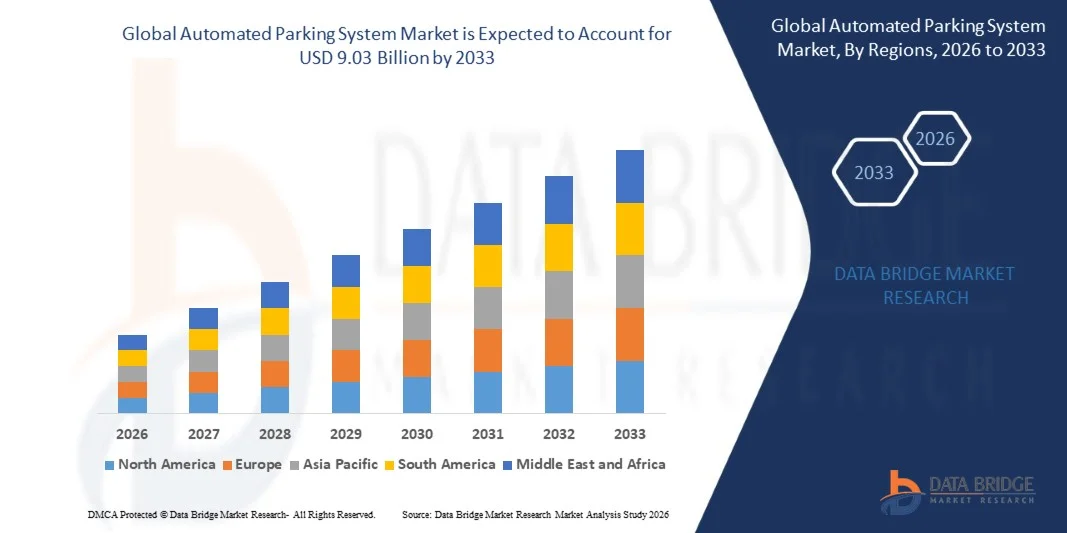
- The global automated parking system market size was valued at USD 3.18 billion in 2025 and is expected to reach USD 9.03 billion by 2033, at a CAGR of 13.95% during the forecast period
- The market growth is largely fueled by rapid urbanization and increasing vehicle ownership, which are creating severe parking space constraints in densely populated cities. The rising need for efficient space utilization and traffic management in commercial and residential infrastructure is accelerating the adoption of automated parking systems across global urban centers
- Furthermore, growing investments in smart city projects, advanced infrastructure development, and sustainable urban mobility solutions are strengthening demand for automated parking technologies. The integration of IoT, AI-based control systems, and robotics is improving operational efficiency, safety, and user convenience, thereby significantly boosting market expansion
Automated Parking System Market Analysis
- Automated parking systems are mechanized infrastructure solutions designed to park and retrieve vehicles with minimal human intervention using robotics, sensors, and control software. These systems optimize vertical and horizontal space utilization, reduce parking time, and enhance safety in high-density urban environments across residential, commercial, and mixed-use developments
- The escalating demand for automated parking systems is primarily driven by increasing urban congestion, limited land availability for conventional parking, and the growing shift toward smart infrastructure solutions. Rising focus on reducing carbon emissions, improving traffic flow, and enhancing user convenience is further supporting widespread adoption of these systems globally
- Asia-Pacific dominated the automated parking system market with a share of 34.4% in 2025, due to rapid urbanization, increasing vehicle ownership, and growing demand for efficient space utilization in densely populated cities
- North America is expected to be the fastest growing region in the automated parking system market during the forecast period due to increasing adoption of smart parking solutions and rising demand for efficient space utilization in urban areas
- Hardware segment dominated the market with a market share of 82.4% in 2025, due to the extensive requirement for mechanical structures, lifts, conveyors, and robotic systems in automated parking installations. Hardware components form the core infrastructure enabling vehicle movement and storage. High capital investment in physical systems contributes significantly to overall market revenue
Report Scope and Automated Parking System Market Segmentation
|
Attributes |
Automated Parking System Key Market Insights |
|
Segments Covered |
|
|
Countries Covered |
North America
Europe
Asia-Pacific
Middle East and Africa
South America
|
|
Key Market Players |
|
|
Market Opportunities |
|
|
Value Added Data Infosets |
In addition to the market insights such as market value, growth rate, market segments, geographical coverage, market players, and market scenario, the market report curated by the Data Bridge Market Research team includes in-depth expert analysis, import/export analysis, pricing analysis, production consumption analysis, and pestle analysis. |
Automated Parking System Market Trends
“Growing Smart City and IoT Parking Adoption”
- A significant trend in the automated parking system market is the increasing integration of smart city frameworks and IoT-enabled infrastructure to enhance urban mobility and parking efficiency. This integration is improving real-time monitoring, automated vehicle handling, and seamless space optimization across high-density urban developments
- For instance, Bosch and Mercedes-Benz have implemented automated parking technology at Stuttgart Airport, enabling vehicles to park autonomously within a connected infrastructure environment. Such deployments demonstrate how integrated systems are improving parking precision, safety, and user convenience in real-world settings
- The adoption of automated parking systems within smart city projects is expanding as governments focus on reducing traffic congestion and improving land utilization efficiency. Cities are increasingly incorporating intelligent parking solutions into urban planning to support sustainable mobility ecosystems
- Advanced connectivity technologies are enabling centralized control of parking operations, allowing facility managers to monitor availability, vehicle movement, and system performance in real time. This is improving operational efficiency and reducing manual intervention in large-scale parking facilities
- The growing use of digital platforms and mobile-based access systems is enhancing user experience by enabling remote reservation, automated entry, and contactless parking services. This is strengthening the shift toward fully digitalized parking ecosystems across commercial and residential infrastructure
- The market is witnessing strong expansion of integrated smart mobility solutions where automated parking systems function as part of broader urban transport networks. This rising convergence of IoT, automation, and smart infrastructure is reinforcing the transition toward highly efficient and technology-driven parking environments
Automated Parking System Market Dynamics
Driver
“Rising Urbanization and Parking Space Constraints”
- The increasing pace of urbanization and rapid growth in vehicle ownership are creating significant pressure on limited urban land availability, driving demand for space-efficient automated parking solutions. This is encouraging the adoption of vertically structured and mechanized parking systems in metropolitan areas
- For instance, Lödige Industries deployed an automated parking system at the “210 South 12th” residential tower in Philadelphia, enabling high-density vehicle storage within a constrained urban footprint. Such implementations highlight how automation is addressing space shortages in modern cities while improving parking efficiency
- The expansion of commercial complexes, airports, and residential high-rise developments is increasing the need for optimized parking infrastructure capable of handling large vehicle volumes. Automated systems are being widely adopted to reduce congestion and improve turnaround times in high-traffic environments
- Growing urban congestion is pushing city planners and developers to adopt advanced parking technologies that minimize surface parking requirements and maximize land use efficiency. This is supporting the integration of compact and multi-level automated systems in new infrastructure projects
- The continuous growth of urban populations and vehicle density is strengthening the requirement for intelligent parking infrastructure. This sustained pressure is positioning automated parking systems as a critical solution for modern urban development challenges
Restraint/Challenge
“High Installation and Infrastructure Costs”
- The automated parking system market faces challenges due to high initial installation costs and significant infrastructure investment requirements, which limit widespread adoption across cost-sensitive regions. The complexity of system design and integration further increases overall project expenses
- For instance, Robotic Parking Systems Inc. develops large-scale automated parking structures that require advanced mechanical systems, sensors, and software integration, resulting in substantial upfront capital investment. Such high-cost installations restrict adoption to premium or large-scale developments
- The requirement for specialized construction, advanced robotics, and precision engineering significantly increases development costs compared to conventional parking facilities. This creates financial barriers for small and mid-sized real estate projects
- Maintenance and operational costs associated with automated systems also contribute to long-term expenditure concerns for end users. Regular servicing of mechanical components and software systems adds to the total cost of ownership
- The overall high capital intensity of automated parking projects continues to restrain market penetration despite growing demand for space-efficient solutions. This cost challenge remains a key barrier for large-scale commercialization of advanced parking systems
Automated Parking System Market Scope
The market is segmented on the basis of automation level, platform, end user, design model type, system type, parking level, and structure type.
• By Automation Level
On the basis of automation level, the automated parking system market is segmented into fully-automated and semi-automated. The fully-automated segment dominated the largest market revenue share in 2025, driven by its ability to maximize space utilization and eliminate human intervention, leading to higher operational efficiency and reduced parking time. These systems are widely adopted in high-density urban areas where land availability is limited and the need for optimized parking solutions is critical. In addition, enhanced safety, reduced vehicle damage risks, and integration with smart city infrastructure further support the dominance of fully-automated systems. Their capability to handle high vehicle volumes with minimal manpower makes them a preferred choice for large-scale projects.
The semi-automated segment is anticipated to witness the fastest growth rate from 2026 to 2033, fueled by lower installation costs and easier deployment compared to fully-automated systems. These systems require partial driver involvement, which reduces complexity while still improving parking efficiency. Growing adoption in mid-sized commercial and residential projects supports segment expansion. In addition, flexibility in retrofitting existing parking structures and lower maintenance requirements make semi-automated solutions increasingly attractive for cost-sensitive developments.
• By Platform
On the basis of platform, the automated parking system market is segmented into palleted and non-palleted. The palleted segment dominated the largest market revenue share in 2025, driven by its structured vehicle handling and reduced risk of vehicle damage during parking operations. Palleted systems ensure consistent alignment and positioning, making them highly reliable in high-capacity installations. These systems are commonly used in premium residential and commercial buildings where safety and precision are critical. In addition, ease of integration with fully automated technologies enhances their adoption across advanced infrastructure projects. Their ability to support diverse vehicle types further strengthens market preference.
The non-palleted segment is anticipated to witness the fastest growth rate from 2026 to 2033, fueled by reduced system costs and faster vehicle handling capabilities. These systems eliminate the need for pallets, improving operational speed and reducing mechanical components. Increasing demand for efficient and cost-effective parking solutions in urban environments accelerates adoption. In addition, advancements in sensor and control technologies enhance the accuracy of non-palleted systems. Their scalability and lower maintenance requirements contribute to growing deployment across commercial facilities.
• By End User
On the basis of end user, the automated parking system market is segmented into residential, commercial, and mixed use. The commercial segment dominated the largest market revenue share in 2025, driven by high demand from shopping malls, office complexes, airports, and hospitals requiring efficient parking management. Commercial establishments prioritize automated systems to handle large vehicle volumes and reduce congestion. In addition, improved customer experience and optimized space utilization support widespread adoption. Integration with digital payment and access control systems further enhances operational efficiency. These factors collectively strengthen the dominance of the commercial segment.
The mixed use segment is anticipated to witness the fastest growth rate from 2026 to 2033, fueled by rapid urbanization and the rise of integrated developments combining residential, retail, and office spaces. These projects require versatile parking solutions capable of managing diverse user groups. Increasing investments in smart city initiatives drive adoption of advanced automated systems in mixed use developments. In addition, the need for efficient land utilization in densely populated areas supports segment growth. Enhanced convenience and centralized parking management further contribute to rising demand.
• By Design Model Type
On the basis of design model type, the automated parking system market is segmented into hydraulic and electro-mechanical. The electro-mechanical segment dominated the largest market revenue share in 2025, driven by its higher efficiency, precision control, and lower energy consumption compared to hydraulic systems. These systems offer better performance in high-rise and high-capacity installations, making them suitable for modern infrastructure projects. In addition, reduced maintenance requirements and improved durability enhance their adoption. Compatibility with advanced automation technologies further strengthens their market position. Their ability to support complex parking designs contributes to widespread usage.
The hydraulic segment is anticipated to witness the fastest growth rate from 2026 to 2033, fueled by its cost-effectiveness and suitability for low to mid-rise parking applications. Hydraulic systems are widely used in smaller installations due to their simpler design and lower upfront costs. Increasing demand from residential and small commercial projects supports segment expansion. In addition, ease of installation and reliable load-handling capabilities drive adoption. Continuous improvements in hydraulic technology further enhance performance and efficiency.
• By System Type
On the basis of system type, the automated parking system market is segmented into hardware and software. The hardware segment dominated the largest market revenue share of 82.4% in 2025, driven by the extensive requirement for mechanical structures, lifts, conveyors, and robotic systems in automated parking installations. Hardware components form the core infrastructure enabling vehicle movement and storage. High capital investment in physical systems contributes significantly to overall market revenue. In addition, continuous advancements in robotics and machinery improve system efficiency and reliability. These factors collectively support the dominance of the hardware segment.
The software segment is anticipated to witness the fastest growth rate from 2026 to 2033, fueled by increasing integration of smart technologies, IoT, and AI-driven parking management solutions. Software enables real-time monitoring, automation control, and user interface functionalities. Growing demand for data-driven insights and remote system management accelerates adoption. In addition, advancements in cloud computing and mobile applications enhance user convenience. The shift toward smart infrastructure significantly boosts the growth of the software segment.
• By Parking Level
On the basis of parking level, the automated parking system market is segmented into less than level 5, level 5–level 10, and more than level 10. The level 5–level 10 segment dominated the largest market revenue share in 2025, driven by its optimal balance between capacity and cost, making it suitable for a wide range of commercial and residential applications. These systems efficiently address urban parking challenges without requiring extremely high structural investments. In addition, their adaptability to medium-density areas supports widespread adoption. Enhanced operational efficiency and scalability further strengthen their market position. This segment continues to be preferred for mid-rise developments.
The more than level 10 segment is anticipated to witness the fastest growth rate from 2026 to 2033, fueled by increasing demand for high-capacity parking solutions in densely populated metropolitan areas. Vertical expansion allows maximum utilization of limited land space. Rising investments in smart city infrastructure and large-scale commercial projects support segment growth. In addition, technological advancements enable safe and efficient high-rise parking operations. These factors collectively drive the adoption of multi-level automated systems.
• By Structure Type
On the basis of structure type, the automated parking system market is segmented into AGV system, silo system, tower system, rail guided cart system, puzzle system, and shuttle system. The tower system segment dominated the largest market revenue share in 2025, driven by its high space efficiency and ability to accommodate a large number of vehicles in a compact footprint. Tower systems are widely used in urban centers where land availability is highly constrained. In addition, their vertical design enables efficient vehicle stacking and retrieval. Growing demand for high-density parking solutions supports their dominance. Integration with advanced automation technologies further enhances system performance.
The AGV system segment is anticipated to witness the fastest growth rate from 2026 to 2033, fueled by its flexibility, scalability, and advanced automation capabilities. AGV systems use autonomous vehicles to transport cars, reducing the need for fixed mechanical structures. Increasing adoption of robotics and AI technologies supports segment expansion. In addition, improved operational efficiency and adaptability to various layouts drive demand. These systems are gaining traction in modern smart parking infrastructure due to their innovative approach and reduced structural constraints.
Automated Parking System Market Regional Analysis
- Asia-Pacific dominated the automated parking system market with the largest revenue share of 34.4% in 2025, driven by rapid urbanization, increasing vehicle ownership, and growing demand for efficient space utilization in densely populated cities
- The region benefits from large-scale infrastructure development, rising smart city initiatives, and strong government focus on urban mobility solutions supporting automated parking adoption
- Increasing investments in commercial complexes, residential high-rise buildings, and transportation hubs are accelerating the deployment of advanced parking technologies across the region
China Automated Parking System Market Insight
China held the largest share in the Asia-Pacific automated parking system market in 2025, supported by extensive urban infrastructure development and high vehicle density in major cities. The country has strong adoption of smart city technologies, enabling large-scale implementation of automated parking systems. Government initiatives promoting efficient land utilization and traffic management are further strengthening market growth. In addition, rapid construction of commercial and residential complexes is driving continuous demand for advanced parking solutions.
India Automated Parking System Market Insight
India is witnessing the fastest growth in the Asia-Pacific region, driven by rising urban congestion, increasing car ownership, and growing need for efficient parking infrastructure. Government initiatives focused on smart cities and urban modernization are significantly boosting system adoption. Expanding real estate developments and commercial spaces are further contributing to demand. In addition, increasing awareness of automated solutions and investments in infrastructure modernization are accelerating long-term market expansion.
Europe Automated Parking System Market Insight
The Europe automated parking system market is expanding steadily, supported by strong demand from urban mobility projects, commercial infrastructure, and smart building developments. The region emphasizes sustainable urban planning and efficient land utilization, encouraging adoption of automated parking solutions. Strict environmental regulations and focus on reducing traffic congestion are driving innovation in parking technologies. In addition, integration of automation with smart city ecosystems is enhancing system deployment across major cities.
Germany Automated Parking System Market Insight
Germany accounted for the largest share in the Europe automated parking system market in 2025, driven by its advanced automotive industry and strong infrastructure development. The country has high adoption of automation technologies across commercial and residential projects. Engineering expertise and focus on precision systems support innovation in automated parking solutions. In addition, increasing investments in smart mobility and urban planning are reinforcing Germany’s leadership in the regional market.
U.K. Automated Parking System Market Insight
The U.K. market is supported by growing demand for efficient parking solutions in urban centers and commercial developments. Increasing focus on smart infrastructure and digital integration is driving adoption of automated systems. The country’s emphasis on reducing congestion and improving urban mobility supports market expansion. In addition, rising investments in real estate and mixed-use developments are further strengthening demand for advanced parking technologies.
North America Automated Parking System Market Insight
North America is projected to grow at the fastest CAGR from 2026 to 2033, driven by increasing adoption of smart parking solutions and rising demand for efficient space utilization in urban areas. Strong technological advancements and integration of IoT and AI in parking systems are supporting market growth. Increasing investments in commercial infrastructure and smart city projects are further accelerating adoption. In addition, growing focus on enhancing user convenience and operational efficiency is boosting regional expansion.
U.S. Automated Parking System Market Insight
The U.S. accounted for the largest share in the North America automated parking system market in 2025, supported by strong demand from commercial complexes, airports, and residential developments. The country benefits from advanced technological infrastructure and early adoption of automation solutions. Increasing integration of smart technologies and digital platforms is enhancing system efficiency. In addition, rising investments in urban development and smart mobility initiatives are reinforcing the U.S. leadership position in the regional market.
Automated Parking System Market Share
The automated parking system industry is primarily led by well-established companies, including:
- Unitronics Corporation (Israel)
- CityLift Parking (U.S.)
- Westfalia Parking (U.S.)
- Robotic Parking Systems Inc. (U.S.)
- FATA Automation (Italy)
- Park Plus Inc. (Canada)
- Wohr Parking Systems Pvt. Ltd. (India)
- EITO & GLOBAL INC. (Japan)
- IHI Corporation (Japan)
- Simmatec GmbH (Germany)
- Watry Design Inc. (U.S.)
- Skyline Parking AG (Switzerland)
- Klaus Multiparking GmbH (Germany)
- Automotion Parking Systems (U.S.)
- Parkmatic (U.S.)
Latest Developments in Global Automated Parking System Market
- In February 2025, Lödige Industries announced the launch of operations for a fully automated parking system at the “210 South 12th” residential tower in Philadelphia. The project represents the city’s first automated parking facility equipped with 100% electric vehicle charging for all parked vehicles, aligning with sustainability goals. The system incorporates the company’s proprietary RESPACE algorithm along with pallet-based technology to enable efficient high-density vehicle storage within a limited footprint. Residents can conveniently retrieve their vehicles using RFID-based access systems, ensuring seamless user experience. In addition, the installation reflects increasing demand for advanced, space-efficient, and technology-driven parking solutions in dense urban environments
- In March 2024, Applied Intuition, a provider of vehicle software, introduced an automated parking development solution tailored for automated driving (AD) and advanced driver-assistance systems (ADAS). The platform enables development teams to design, test, and deploy machine learning-based as well as conventional automated parking systems up to 12 times faster while improving safety and system reliability. The solution supports simulation-driven development, allowing engineers to validate parking scenarios in virtual environments before real-world deployment. In addition, it enhances scalability and reduces development timelines, making it highly valuable for automotive manufacturers focusing on advanced automation capabilities
- In February 2023, BMW and Valeo entered into a strategic partnership to co-develop next-generation Level 4 autonomous parking technology. The solution spans capabilities from automated parking assistance to fully automated valet parking, leveraging in-vehicle sensors and technologies for seamless operation. The collaboration also extends to infrastructure-based services that enable fully automated parking and charging within equipped public facilities. This partnership aims to accelerate innovation in autonomous mobility while improving user convenience and operational efficiency. In addition, it reflects increasing industry focus on integrated vehicle and infrastructure ecosystems
- In January 2023, Thiruvananthapuram International Airport in India implemented a fully automated parking system to enhance operational efficiency and passenger convenience. The system enables seamless vehicle parking and retrieval without human intervention, reducing congestion and wait times within the airport premises. According to airport authorities, the deployment significantly improves passenger safety and strengthens vehicle security measures. It also optimizes space utilization within the parking area, accommodating more vehicles in limited space. In addition, the project highlights growing adoption of smart infrastructure solutions in transportation hubs across emerging economies
- In November 2022, Mercedes-Benz, in partnership with Bosch, received approval for its fully automated self-parking software designed for real-world deployment. The system allows vehicles to autonomously navigate through parking facilities and park in designated spaces without driver involvement. It utilizes advanced sensors, cameras, and communication technologies to ensure precise and safe vehicle movement. The approval marks a major milestone in regulatory acceptance of autonomous parking solutions. In addition, the deployment at Stuttgart Airport demonstrates the practicality of integrating automated parking systems into existing infrastructure
SKU-
Get online access to the report on the World's First Market Intelligence Cloud

- Interactive Data Analysis Dashboard
- Company Analysis Dashboard for high growth potential opportunities
- Research Analyst Access for customization & queries
- Competitor Analysis with Interactive dashboard
- Latest News, Updates & Trend analysis
- Harness the Power of Benchmark Analysis for Comprehensive Competitor Tracking
Research Methodology
Data collection and base year analysis are done using data collection modules with large sample sizes. The stage includes obtaining market information or related data through various sources and strategies. It includes examining and planning all the data acquired from the past in advance. It likewise envelops the examination of information inconsistencies seen across different information sources. The market data is analysed and estimated using market statistical and coherent models. Also, market share analysis and key trend analysis are the major success factors in the market report. To know more, please request an analyst call or drop down your inquiry.
The key research methodology used by DBMR research team is data triangulation which involves data mining, analysis of the impact of data variables on the market and primary (industry expert) validation. Data models include Vendor Positioning Grid, Market Time Line Analysis, Market Overview and Guide, Company Positioning Grid, Patent Analysis, Pricing Analysis, Company Market Share Analysis, Standards of Measurement, Global versus Regional and Vendor Share Analysis. To know more about the research methodology, drop in an inquiry to speak to our industry experts.
Customization Available
Data Bridge Market Research is a leader in advanced formative research. We take pride in servicing our existing and new customers with data and analysis that match and suits their goal. The report can be customized to include price trend analysis of target brands understanding the market for additional countries (ask for the list of countries), clinical trial results data, literature review, refurbished market and product base analysis. Market analysis of target competitors can be analyzed from technology-based analysis to market portfolio strategies. We can add as many competitors that you require data about in the format and data style you are looking for. Our team of analysts can also provide you data in crude raw excel files pivot tables (Fact book) or can assist you in creating presentations from the data sets available in the report.












