


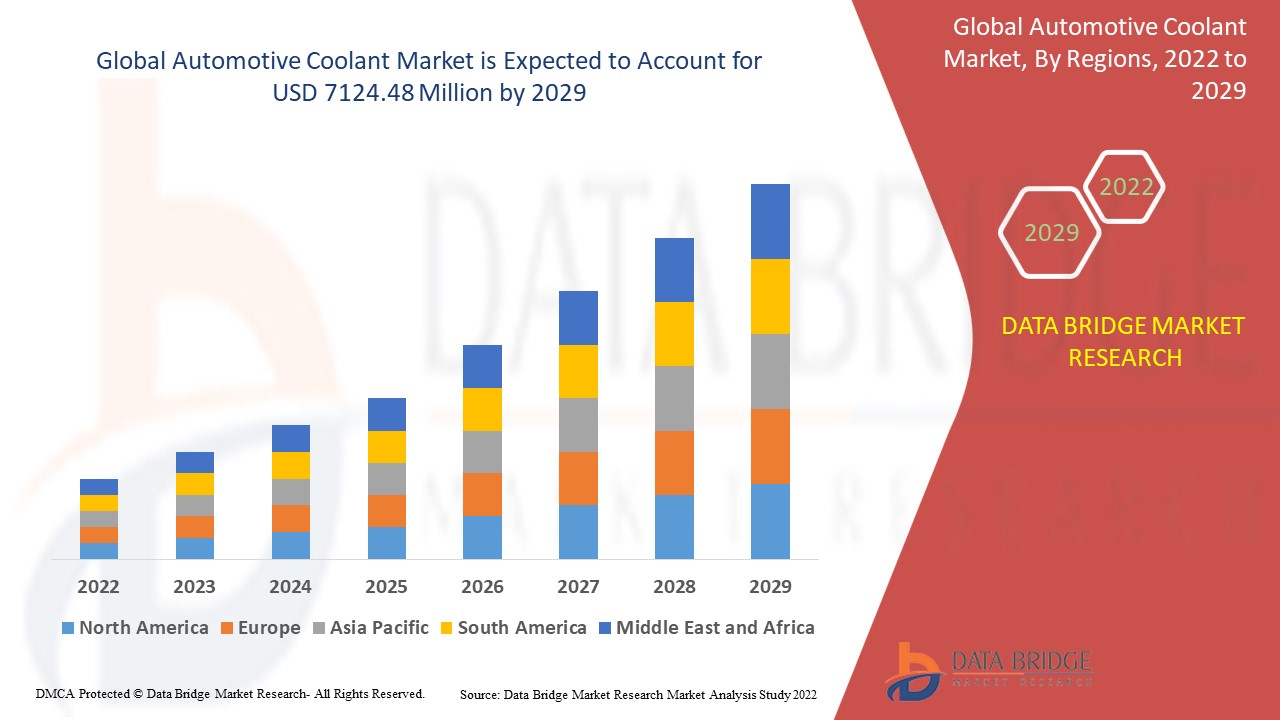
Automotive Coolant Market Analysis and Size
The automotive coolant market is projected to grow rapidly during the projected period, propelled by increasing vehicle sales and rising demand for automobiles' maintenance and services. Furthermore, automobile manufacturers are engaged in introducing newer products and brands to offer their consumers customized coolant solutions, thereby increasing the automotive coolant market share.
Data Bridge Market Research analyses that the automotive coolant market was valued at USD 4642.30 million in 2021 and is expected to reach USD 7124.48 million by 2029, registering a CAGR of 5.50% during the forecast period of 2022 to 2029. In addition to the insights on market scenarios such as market value, growth rate, segmentation, geographical coverage, and major players, the market reports curated by the Data Bridge Market Research also include in-depth expert analysis, geographically represented company-wise production and capacity, network layouts of distributors and partners, detailed and updated price trend analysis and deficit analysis of supply chain and demand.
Automotive Coolant Market Scope and Segmentation
|
Report Metric |
Details |
|
Forecast Period |
2022 to 2029 |
|
Base Year |
2021 |
|
Historic Years |
2020 (Customizable to 2014 - 2019) |
|
Quantitative Units |
Revenue in USD Million, Volumes in Units, Pricing in USD |
|
Segments Covered |
Technology (Inorganic Acid Technology (IAT), Organic Acid Technology (OAT), Hybrid Organic Acid Technology (HOAT)), Product (Ethylene Glycol, Propylene Glycol, Glycerine), Vehicle Type (Passenger Cars, Heavy Commercial Vehicles, Light Commercial Vehicles), End User (Original Equipment Manufacturer (OEM), Automotive Aftermarket) |
|
Countries Covered |
U.S., Canada and Mexico in North America, Germany, France, U.K., Netherlands, Switzerland, Belgium, Russia, Italy, Spain, Turkey, Rest of Europe in Europe, China, Japan, India, South Korea, Singapore, Malaysia, Australia, Thailand, Indonesia, Philippines, Rest of Asia-Pacific (APAC) in the Asia-Pacific (APAC), Saudi Arabia, U.A.E, South Africa, Egypt, Israel, Rest of Middle East and Africa (MEA) as a part of Middle East and Africa (MEA), Brazil, Argentina and Rest of South America as part of South America |
|
Market Players Covered |
Valvoline (U.S.), Exxon Mobil Corporation (U.S.), BASF SE (Germany), TotalEnergies (France), Chevron Corporation (U.S.), Shell Plc (U.K.), OLD WORLD INDUSTRIES (U.S.), Prestone Products Corporation (U.S.), Arteco (U.S.), Recochem Corporation (Canada), MOTUL (France), BP PLC (U.K.), Chevron Corporation (U.S.), Valvoline Inc. (U.S.), Sinopec (China), Castrol Limited (U.K.) |
|
Market Opportunities |
|
Market Definition
Automotive coolant is an antifreeze or engine coolant, a coloured liquid. When mixed with the antifreeze, it helps water to help regulate the vehicle engine during extreme temperatures. It protects engines from overheating. Automotive coolant also lubricates the moving parts of the vehicles and protects them from damage when it comes into contact with the head gasket, water pump, cylinder and piston timing.
Automotive Coolant Market Dynamics
Drivers
- Growing demand for propylene glycol
Propylene glycol is used in hydraulic fluids and fire-resistant brake as a coolant in the transportation sector for engine cooling. This is widely used as a raw material for de-icing planes and as a heat transfer fluid for high-temperature applications. The rising demand of propylene glycol is expected to boost the growth of the automotive coolant market.
- Development of automotive sector
Growing production of vehicles both in emerging and developed economies is one of the major factors recognized to the growth of the automotive coolant market globally. For instance, according to the International Organization of Motor Vehicle production, the total number of vehicles manufactured in 2016 was 95 million units, which augmented to 97 million units in 2017, globally. Therefore, growing number of vehicles on road is leading the demand for automotive coolant which is anticipated to increase the market growth rate during the forecast period of 2022-2029.
Opportunities
- Growing usage of ethylene glycol in automotive industry
The rising demand for ethylene glycol in the automotive industry is anticipated to increase the growth of the global automotive coolant market. Ethylene glycol has a significantly lower melting point than water, which keeps engines of ethylene from freezing in the winter and works as a coolant to avoid overheating in the summer. Also, ethylene glycol is used in vehicles to absorb combustion heat which is expected to generate lucrative opportunities for the global automotive coolant market.
Furthermore, the growing sales and production of vehicles in developing nations and the flourishing automotive industry all over the globe will foster several new opportunities that will boost the growth of the automotive coolant market during the forecast period.
Restraints/ Challenges
- Side effects associated with automotive coolants
The toxicity of the ethylene glycol which is used as the basic fluid and used as antifreeze poses a risk to both the environment and human health. Heavy metals such as lead, chromium cadmium and others are present in high concentrations in waste antifreeze, which is also harmful for the environment. Thus, providers and OEMs face many challenges regarding recycling coolant which will also hamper the market's growth rate during the forecast period.
This automotive coolant market report provides details of new recent developments, trade regulations, import-export analysis, production analysis, value chain optimization, market share, impact of domestic and localized market players, analyses opportunities in terms of emerging revenue pockets, changes in market regulations, strategic market growth analysis, market size, category market growths, application niches and dominance, product approvals, product launches, geographic expansions, technological innovations in the market. To gain more info on the automotive coolant market contact Data Bridge Market Research for an Analyst Brief, our team will help you take an informed market decision to achieve market growth.
Impact and Current Market Scenario of Raw Material Shortage and Shipping Delays
Data Bridge Market Research offers a high-level analysis of the market and delivers information by keeping in account the impact and current market environment of raw material shortage and shipping delays. This translates into assessing strategic possibilities, creating effective action plans, and assisting businesses in making important decisions.
Apart from the standard report, we also offer in-depth analysis of the procurement level from forecasted shipping delays, distributor mapping by region, commodity analysis, production analysis, price mapping trends, sourcing, category performance analysis, supply chain risk management solutions, advanced benchmarking, and other services for procurement and strategic support.
COVID-19 Impact on Automotive Coolant Market
The outbreak of covid-19 had an adverse impact on the automotive coolant market. The severe disruptions in many manufacturing processes and supply-chain operations has majorly affected the market growth rate. Several precautionary lockdowns imposed by governments to curb the spread of disease led to massive financial setbacks for the market. Moreover, people are now more focused on removing non-essential expenses from their budgets, which has decreased the demand for the automotive coolant. Moreover, with the ongoing lifting up of the lockdown and the novel coronavirus under control, the global automotive coolant market can pick up speed in upcoming years.
Expected Impact of Economic Slowdown on the Pricing and Availability of Products
When economic activity slows, industries begin to suffer. The forecasted effects of the economic downturn on the pricing and accessibility of the products are taken into account in the market insight reports and intelligence services provided by DBMR. With this, our clients can typically keep one step ahead of their competitors, project their sales and revenue, and estimate their profit and loss expenditures.
Recent Development
- In October 2021, Gulf Oil launched a new series of e-fluids for Electric and Hybrid passenger cars. These fluids were found in several markets, including China, the Middle East, and Europe earlier in 2022, whereas Hinduja will launch this series in the Indian market. One of the major products, the eLEC Coolant, aids in cooling electric vehicles' batteries and supports keeping them cool even under adverse situations.
- In November 2021, Redline Detection, the famous developer of diagnostic leak detection technology in the global industry, approved manufacturing a new diagnostic leak detection technology that works mainly in battery electric vehicles.
- December 2020, Recochem, a well-known manufacturer and distributor of automotive aftermarket fluids has recently acquired KOST USA Inc. This company is the third biggest manufacturer of auto coolants in the U.S. KOST is known for its light-duty coolants as well as various functional fluids across the automotive aftermarket channels.
Global Automotive Coolant Market Scope
The automotive coolant market is segmented on the basis of technology, product, vehicle type and end user. The growth amongst these segments will help you analyze meagre growth segments in the industries and provide the users with a valuable market overview and market insights to help them make strategic decisions for identifying core market applications.
Technology
- Inorganic Acid Technology (IAT)
- Organic Acid Technology (OAT)
- Hybrid Organic Acid Technology (HOAT)
Product
- Ethylene Glycol
- Propylene Glycol
- Glycerine
Vehicle Type
- Passenger Cars
- Heavy Commercial Vehicles
- Light Commercial Vehicles
End User
- Original Equipment Manufacturer (OEM)
- Automotive Aftermarket
Automotive Coolant Market Regional Analysis/Insights
The automotive coolant market is analyzed and market size insights and trends are provided by country, technology, product, vehicle type and end user as referenced above.
The countries covered in the automotive coolant market report are U.S., Canada and Mexico in North America, Germany, France, U.K., Netherlands, Switzerland, Belgium, Russia, Italy, Spain, Turkey, Rest of Europe in Europe, China, Japan, India, South Korea, Singapore, Malaysia, Australia, Thailand, Indonesia, Philippines, Rest of Asia-Pacific (APAC) in the Asia-Pacific (APAC), Saudi Arabia, U.A.E, South Africa, Egypt, Israel, Rest of Middle East and Africa (MEA) as a part of Middle East and Africa (MEA), Brazil, Argentina and Rest of South America as part of South America.
Asia-Pacific dominates the automotive coolant market in terms of market share and revenue. This is due to the easy availability of the basic resources such as raw materials and labour and high number of vehicles on road in this region.
Europe is anticipated to be the fastest developing region during the forecast period of 2022-2029 due to the high production associated with the high application of vehicles in this region. Furthermore, increasing consumer awareness regarding the advantages of recycled resources with sustainability will likely boost the market growth in this region.
The country section of the report also provides individual market impacting factors and changes in market regulation that impact the current and future trends of the market. Data points like down-stream and upstream value chain analysis, technical trends and porter's five forces analysis, case studies are some of the pointers used to forecast the market scenario for individual countries. Also, the presence and availability of global brands and their challenges faced due to large or scarce competition from local and domestic brands, impact of domestic tariffs and trade routes are considered while providing forecast analysis of the country data.
Competitive Landscape and Automotive Coolant Market Share Analysis
The automotive coolant market competitive landscape provides details by competitor. Details included are company overview, company financials, revenue generated, market potential, investment in research and development, new market initiatives, global presence, production sites and facilities, production capacities, company strengths and weaknesses, product launch, product width and breadth, application dominance. The above data points provided are only related to the companies' focus related to automotive coolant market.
Some of the major players operating in the automotive coolant market are:
- Valvoline (U.S.)
- Exxon Mobil Corporation (U.S.)
- BASF SE (Germany)
- TotalEnergies (France)
- Chevron Corporation (U.S.)
- Shell Plc (U.K.)
- OLD WORLD INDUSTRIES (U.S.)
- Prestone Products Corporation (U.S.)
- Arteco (U.S.)
- Recochem Corporation (Canada)
- MOTUL (France)
- BP PLC (U.K.)
- Chevron Corporation (U.S.)
- Valvoline Inc. (U.S.)
- Sinopec (China)
- Castrol Limited (U.K.)

- Interactive Data Analysis Dashboard
- Company Analysis Dashboard for high growth potential opportunities
- Research Analyst Access for customization & queries
- Competitor Analysis with Interactive dashboard
- Latest News, Updates & Trend analysis
- Harness the Power of Benchmark Analysis for Comprehensive Competitor Tracking
Table of Content
1 INTRODUCTION
1.1 OBJECTIVES OF THE STUDY
1.2 MARKET DEFINITION
1.3 OVERVIEW OF GLOBAL AUTOMOTIVE COOLANT MARKET
1.4 CURRENCY AND PRICING
1.5 LIMITATION
1.6 MARKETS COVERED
2 MARKET SEGMENTATION
2.1 KEY TAKEAWAYS
2.2 ARRIVING AT THE GLOBAL AUTOMOTIVE COOLANT MARKET
2.2.1 VENDOR POSITIONING GRID
2.2.2 TECHNOLOGY LIFE LINE CURVE
2.2.3 MARKET GUIDE
2.2.4 COMPANY POSITIONING GRID
2.2.5 MULTIVARIATE MODELLING
2.2.6 STANDARDS OF MEASUREMENT
2.2.7 TOP TO BOTTOM ANALYSIS
2.2.8 VENDOR SHARE ANALYSIS
2.2.9 DATA POINTS FROM KEY PRIMARY INTERVIEWS
2.2.10 DATA POINTS FROM KEY SECONDARY DATABASES
2.3 GLOBAL AUTOMOTIVE COOLANT MARKET: RESEARCH SNAPSHOT
2.4 ASSUMPTIONS
3 MARKET OVERVIEW
3.1 DRIVERS
3.2 RESTRAINTS
3.3 OPPORTUNITIES
3.4 CHALLENGES
4 EXECUTIVE SUMMARY
5 PREMIUM INSIGHTS
5.1 RAW MATERIAL COVERAGE
5.2 PRODUCTION CONSUMPTION ANALYSIS
5.3 IMPORT EXPORT SCENARIO
5.4 TECHNOLOGICAL ADVANCEMENT BY MANUFACTURERS
5.5 PORTER’S FIVE FORCES
5.6 VENDOR SELECTION CRITERIA
5.7 PESTEL ANALYSIS
5.8 REGULATION COVERAGE
5.8.1 PRODUCT CODES
5.8.2 CERTIFIED STANDARDS
5.8.3 SAFETY STANDARDS
5.8.3.1. MATERIAL HANDLING & STORAGE
5.8.3.2. TRANSPORT & PRECAUTIONS
5.8.3.3. HARAD IDENTIFICATION
6 PRICING ANALYSIS
7 PRODUCTION CAPACITY OVERVIEW
8 INTEGRATION OF POND DYES & POOL CLARIFIERS INSIGHTS
9 DYESTUFF MANUFACTURERS INSIGHTS
9.1 APPLICATION
9.2 SUPPLY CHAIN
9.3 GEOGRAPHIC CONCENTRATION
10 SUPPLY CHAIN ANALYSIS
10.1 OVERVIEW
10.2 LOGISTIC COST SCENARIO
10.3 IMPORTANCE OF LOGISTICS SERVICE PROVIDERS
11 CLIMATE CHANGE SCENARIO
11.1 ENVIRONMENTAL CONCERNS
11.2 INDUSTRY RESPONSE
11.3 GOVERNMENT’S ROLE
11.4 ANALYST RECOMMENDATIONS
12 GLOBAL AUTOMOTIVE COOLANT MARKET, BY PRODUCT, 2018-2032 (USD MILLION) (VOLUME)
12.1 OVERVIEW
12.2 PROPYLENE GLYCOL
12.3 ETHYLENE GLYCOL
12.4 GLYCERINE
12.5 OTHERS
13 GLOBAL AUTOMOTIVE COOLANT MARKET, BY TECHNOLOGY, 2018-2032 (USD MILLION)
13.1 OVERVIEW
13.2 INORGANIC ADDITIVE TECHNOLOGY
13.3 ORGANIC ADDITIVE TECHNOLOGY
13.4 HYBRID ORGANIC ACID TECHNOLOGY
14 GLOBAL AUTOMOTIVE COOLANT MARKET, BY SALES CHANNEL, 2018-2032 (USD MILLION)
14.1 OVERVIEW
14.2 OEM
14.3 AFTERMARKET
14.3.1 INDEPENDENT GARAGES
14.3.2 VEHICLE SERVICE STATIONS
14.3.3 AUTHORISED DEALERS
14.3.4 ONLINE SALES
14.3.5 MULTI-BRAND DEALERS
15 GLOBAL AUTOMOTIVE COOLANT MARKET, BY END-USE, 2018-2032 (USD MILLION)
15.1 OVERVIEW
15.2 ON-ROAD VEHICLES
15.2.1 PASSENGER CARS
15.2.1.1. BY PRODUCT
15.2.1.1.1. PROPYLENE GLYCOL
15.2.1.1.2. ETHYLENE GLYCOL
15.2.1.1.3. GLYCERINE
15.2.1.1.4. OTHERS
15.2.2 COMMERCIAL VEHICLES
15.2.2.1. BY TYPE
15.2.2.1.1. HEAVY COMMERCIAL VEHICLES
15.2.2.1.2. LIGHT COMMERCIAL VEHICLES
15.2.2.2. BY PRODUCT
15.2.2.2.1. PROPYLENE GLYCOL
15.2.2.2.2. ETHYLENE GLYCOL
15.2.2.2.3. GLYCERINE
15.2.2.2.4. OTHERS
15.2.3 MOTORCYCLES & SCOOTERS
15.2.3.1. BY PRODUCT
15.2.3.1.1. PROPYLENE GLYCOL
15.2.3.1.2. ETHYLENE GLYCOL
15.2.3.1.3. GLYCERINE
15.2.3.1.4. OTHERS
15.3 OFF-ROAD VEHICLES
15.3.1 AGRICULTURAL VEHICLES
15.3.1.1. BY PRODUCT
15.3.1.1.1. PROPYLENE GLYCOL
15.3.1.1.2. ETHYLENE GLYCOL
15.3.1.1.3. GLYCERINE
15.3.1.1.4. OTHERS
15.3.2 CONSTRUCTION VEHICLES
15.3.2.1. BY PRODUCT
15.3.2.1.1. PROPYLENE GLYCOL
15.3.2.1.2. ETHYLENE GLYCOL
15.3.2.1.3. GLYCERINE
15.3.2.1.4. OTHERS
15.3.3 INDUSTRIAL VEHICLES
15.3.3.1. BY PRODUCT
15.3.3.1.1. PROPYLENE GLYCOL
15.3.3.1.2. ETHYLENE GLYCOL
15.3.3.1.3. GLYCERINE
15.3.3.1.4. OTHERS
16 GLOBAL AUTOMOTIVE COOLANT MARKET, BY REGION, 2018-2032 (USD MILLION) (VOLUME)
GLOBAL AUTOMOTIVE COOLANT MARKET, (ALL SEGMENTATION PROVIDED ABOVE IS REPRESENTED IN THIS CHAPTER BY COUNTRY)
16.1 NORTH AMERICA
16.1.1 U.S.
16.1.2 CANADA
16.1.3 MEXICO
16.2 EUROPE
16.2.1 GERMANY
16.2.2 U.K.
16.2.3 ITALY
16.2.4 FRANCE
16.2.5 SPAIN
16.2.6 SWITZERLAND
16.2.7 NETHERLANDS
16.2.8 BELGIUM
16.2.9 RUSSIA
16.2.10 DENMARK
16.2.11 SWEDEN
16.2.12 POLAND
16.2.13 TURKEY
16.2.14 REST OF EUROPE
16.3 ASIA-PACIFIC
16.3.1 JAPAN
16.3.2 CHINA
16.3.3 SOUTH KOREA
16.3.4 INDIA
16.3.5 AUSTRALIA
16.3.6 SINGAPORE
16.3.7 THAILAND
16.3.8 INDONESIA
16.3.9 MALAYSIA
16.3.10 PHILIPPINES
16.3.11 NEW ZEALAND
16.3.12 VIETNAM
16.3.13 REST OF ASIA-PACIFIC
16.4 SOUTH AMERICA
16.4.1 BRAZIL
16.4.2 ARGENTINA
16.4.3 REST OF SOUTH AMERICA
16.5 MIDDLE EAST AND AFRICA
16.5.1 SOUTH AFRICA
16.5.2 UAE
16.5.3 SAUDI ARABIA
16.5.4 OMAN
16.5.5 QATAR
16.5.6 KUWAIT
16.5.7 REST OF MIDDLE EAST AND AFRICA
17 GLOBAL AUTOMOTIVE COOLANT MARKET, COMPANY LANDSCAPE
17.1 COMPANY SHARE ANALYSIS: GLOBAL
17.2 COMPANY SHARE ANALYSIS: NORTH AMERICA
17.3 COMPANY SHARE ANALYSIS: EUROPE
17.4 COMPANY SHARE ANALYSIS: ASIA-PACIFIC
17.5 COMPANY SHARE ANALYSIS: MIDDLE EAST AND AFRICA
17.6 MERGERS & ACQUISITIONS
17.7 NEW PRODUCT DEVELOPMENT & APPROVALS
17.8 EXPANSIONS & PARTNERSHIP
17.9 REGULATORY CHANGES
18 GLOBAL AUTOMOTIVE COOLANT MARKET – SWOT ANALYSIS
19 GLOBAL AUTOMOTIVE COOLANT MARKET, COMPANY PROFILES
19.1 VALVOLINE, INC
19.1.1 COMPANY SNAPSHOT
19.1.2 REVENUE ANALYSIS
19.1.3 PRODUCT PORTFOLIO
19.1.4 RECENT DEVELOPMENTS
19.2 EXXONMOBIL CORPORATION
19.2.1 COMPANY SNAPSHOT
19.2.2 REVENUE ANALYSIS
19.2.3 PRODUCT PORTFOLIO
19.2.4 RECENT DEVELOPMENTS
19.3 TOTAL ENERGIES
19.3.1 COMPANY SNAPSHOT
19.3.2 REVENUE ANALYSIS
19.3.3 PRODUCT PORTFOLIO
19.3.4 RECENT DEVELOPMENTS
19.4 SAUDI ARAMCO GROUP
19.4.1 COMPANY SNAPSHOT
19.4.2 REVENUE ANALYSIS
19.4.3 PRODUCT PORTFOLIO
19.4.4 RECENT DEVELOPMENTS
19.5 INDIAN OIL CORP. LTD
19.5.1 COMPANY SNAPSHOT
19.5.2 REVENUE ANALYSIS
19.5.3 PRODUCT PORTFOLIO
19.5.4 RECENT DEVELOPMENTS
19.6 JXTG HOLDINGS LTD
19.6.1 COMPANY SNAPSHOT
19.6.2 REVENUE ANALYSIS
19.6.3 PRODUCT PORTFOLIO
19.6.4 RECENT DEVELOPMENTS
19.7 VOLTRONIC GMBH
19.7.1 COMPANY SNAPSHOT
19.7.2 REVENUE ANALYSIS
19.7.3 PRODUCT PORTFOLIO
19.7.4 RECENT DEVELOPMENTS
19.8 AMERICAN MFG CO. (RUDSON)
19.8.1 COMPANY SNAPSHOT
19.8.2 REVENUE ANALYSIS
19.8.3 PRODUCT PORTFOLIO
19.8.4 RECENT DEVELOPMENTS
19.9 BASF SE
19.9.1 COMPANY SNAPSHOT
19.9.2 REVENUE ANALYSIS
19.9.3 PRODUCT PORTFOLIO
19.9.4 RECENT DEVELOPMENTS
19.1 SHELL PLC
19.10.1 COMPANY SNAPSHOT
19.10.2 REVENUE ANALYSIS
19.10.3 PRODUCT PORTFOLIO
19.10.4 RECENT DEVELOPMENTS
19.11 CHEVRON CORPORATION
19.11.1 COMPANY SNAPSHOT
19.11.2 REVENUE ANALYSIS
19.11.3 PRODUCT PORTFOLIO
19.11.4 RECENT DEVELOPMENTS
19.12 AMSOIL, INC
19.12.1 COMPANY SNAPSHOT
19.12.2 REVENUE ANALYSIS
19.12.3 PRODUCT PORTFOLIO
19.12.4 RECENT DEVELOPMENTS
19.13 PRESTONE PRODUCTS CORPORATION
19.13.1 COMPANY SNAPSHOT
19.13.2 REVENUE ANALYSIS
19.13.3 PRODUCT PORTFOLIO
19.13.4 RECENT DEVELOPMENTS
19.14 MOTUL
19.14.1 COMPANY SNAPSHOT
19.14.2 REVENUE ANALYSIS
19.14.3 PRODUCT PORTFOLIO
19.14.4 RECENT DEVELOPMENTS
19.15 SINOPEC
19.15.1 COMPANY SNAPSHOT
19.15.2 REVENUE ANALYSIS
19.15.3 PRODUCT PORTFOLIO
19.15.4 RECENT DEVELOPMENTS
19.16 CUMMINS, INC
19.16.1 COMPANY SNAPSHOT
19.16.2 REVENUE ANALYSIS
19.16.3 PRODUCT PORTFOLIO
19.16.4 RECENT DEVELOPMENTS
19.17 CCI CORPORATION
19.17.1 COMPANY SNAPSHOT
19.17.2 REVENUE ANALYSIS
19.17.3 PRODUCT PORTFOLIO
19.17.4 RECENT DEVELOPMENTS
19.18 BP PLC
19.18.1 COMPANY SNAPSHOT
19.18.2 REVENUE ANALYSIS
19.18.3 PRODUCT PORTFOLIO
19.18.4 RECENT DEVELOPMENTS
19.19 PRIMAX
19.19.1 COMPANY SNAPSHOT
19.19.2 REVENUE ANALYSIS
19.19.3 PRODUCT PORTFOLIO
19.19.4 RECENT DEVELOPMENTS
19.2 GENERAL MOTORS (ACDELO)
19.20.1 COMPANY SNAPSHOT
19.20.2 REVENUE ANALYSIS
19.20.3 PRODUCT PORTFOLIO
19.20.4 RECENT DEVELOPMENTS
19.21 BIZOL
19.21.1 COMPANY SNAPSHOT
19.21.2 REVENUE ANALYSIS
19.21.3 PRODUCT PORTFOLIO
19.21.4 RECENT DEVELOPMENTS
19.22 VOLGA OIL CORPORATION
19.22.1 COMPANY SNAPSHOT
19.22.2 REVENUE ANALYSIS
19.22.3 PRODUCT PORTFOLIO
19.22.4 RECENT DEVELOPMENTS
19.23 PTT CORPORATION
19.23.1 COMPANY SNAPSHOT
19.23.2 REVENUE ANALYSIS
19.23.3 PRODUCT PORTFOLIO
19.23.4 RECENT DEVELOPMENTS
19.24 PRIMAL ENTERPRISES CORPORATION
19.24.1 COMPANY SNAPSHOT
19.24.2 REVENUE ANALYSIS
19.24.3 PRODUCT PORTFOLIO
19.24.4 RECENT DEVELOPMENTS
19.25 TOYOTA MOTOR CORPORATION
19.25.1 COMPANY SNAPSHOT
19.25.2 REVENUE ANALYSIS
19.25.3 PRODUCT PORTFOLIO
19.25.4 RECENT DEVELOPMENTS
19.26 HONDA MOTOR CO., LTD.
19.26.1 COMPANY SNAPSHOT
19.26.2 REVENUE ANALYSIS
19.26.3 PRODUCT PORTFOLIO
19.26.4 RECENT DEVELOPMENTS
19.27 CYCLON PLC
19.27.1 COMPANY SNAPSHOT
19.27.2 REVENUE ANALYSIS
19.27.3 PRODUCT PORTFOLIO
19.27.4 RECENT DEVELOPMENTS
19.28 KOBY
19.28.1 COMPANY SNAPSHOT
19.28.2 REVENUE ANALYSIS
19.28.3 PRODUCT PORTFOLIO
19.28.4 RECENT DEVELOPMENTS
19.29 AISIN CORPORATION
19.29.1 COMPANY SNAPSHOT
19.29.2 REVENUE ANALYSIS
19.29.3 PRODUCT PORTFOLIO
19.29.4 RECENT DEVELOPMENTS
NOTE: THE COMPANIES PROFILED IS NOT EXHAUSTIVE LIST AND IS AS PER OUR PREVIOUS CLIENT REQUIREMENT. WE PROFILE MORE THAN 100 COMPANIES IN OUR STUDIES AND HENCE THE LIST OF COMPANIES CAN BE MODIFIED OR REPLACED ON REQUEST.
20 CONCLUSION
21 QUESTIONNAIRE
22 RELATED REPORTS
23 ABOUT DATA BRIDGE MARKET RESEARCH

Global Automotive Coolant Market, Supply Chain Analysis and Ecosystem Framework
To support market growth and help clients navigate the impact of geopolitical shifts, DBMR has integrated in-depth supply chain analysis into its Global Automotive Coolant Market research reports. This addition empowers clients to respond effectively to global changes affecting their industries. The supply chain analysis section includes detailed insights such as Global Automotive Coolant Market consumption and production by country, price trend analysis, the impact of tariffs and geopolitical developments, and import and export trends by country and HSN code. It also highlights major suppliers with data on production capacity and company profiles, as well as key importers and exporters. In addition to research, DBMR offers specialized supply chain consulting services backed by over a decade of experience, providing solutions like supplier discovery, supplier risk assessment, price trend analysis, impact evaluation of inflation and trade route changes, and comprehensive market trend analysis.
Data collection and base year analysis are done using data collection modules with large sample sizes. The stage includes obtaining market information or related data through various sources and strategies. It includes examining and planning all the data acquired from the past in advance. It likewise envelops the examination of information inconsistencies seen across different information sources. The market data is analysed and estimated using market statistical and coherent models. Also, market share analysis and key trend analysis are the major success factors in the market report. To know more, please request an analyst call or drop down your inquiry.
The key research methodology used by DBMR research team is data triangulation which involves data mining, analysis of the impact of data variables on the market and primary (industry expert) validation. Data models include Vendor Positioning Grid, Market Time Line Analysis, Market Overview and Guide, Company Positioning Grid, Patent Analysis, Pricing Analysis, Company Market Share Analysis, Standards of Measurement, Global versus Regional and Vendor Share Analysis. To know more about the research methodology, drop in an inquiry to speak to our industry experts.
Data Bridge Market Research is a leader in advanced formative research. We take pride in servicing our existing and new customers with data and analysis that match and suits their goal. The report can be customized to include price trend analysis of target brands understanding the market for additional countries (ask for the list of countries), clinical trial results data, literature review, refurbished market and product base analysis. Market analysis of target competitors can be analyzed from technology-based analysis to market portfolio strategies. We can add as many competitors that you require data about in the format and data style you are looking for. Our team of analysts can also provide you data in crude raw excel files pivot tables (Fact book) or can assist you in creating presentations from the data sets available in the report.













