




Global Automotive Electric Scooter Market
Market Size in USD Billion
CAGR :
% 
 USD
47.92 Billion
USD
112.03 Billion
2025
2033
USD
47.92 Billion
USD
112.03 Billion
2025
2033
 Forecast Period Forecast Period |
2026 - 2033 |
 Market Size (Base Year) Market Size (Base Year) |
USD 47.92 Billion |
 Market Size (Forecast Year) Market Size (Forecast Year) |
USD 112.03 Billion |
 CAGR CAGR |
% |
| Major Markets Players |
|
Automotive Electric Scooter Market Overview
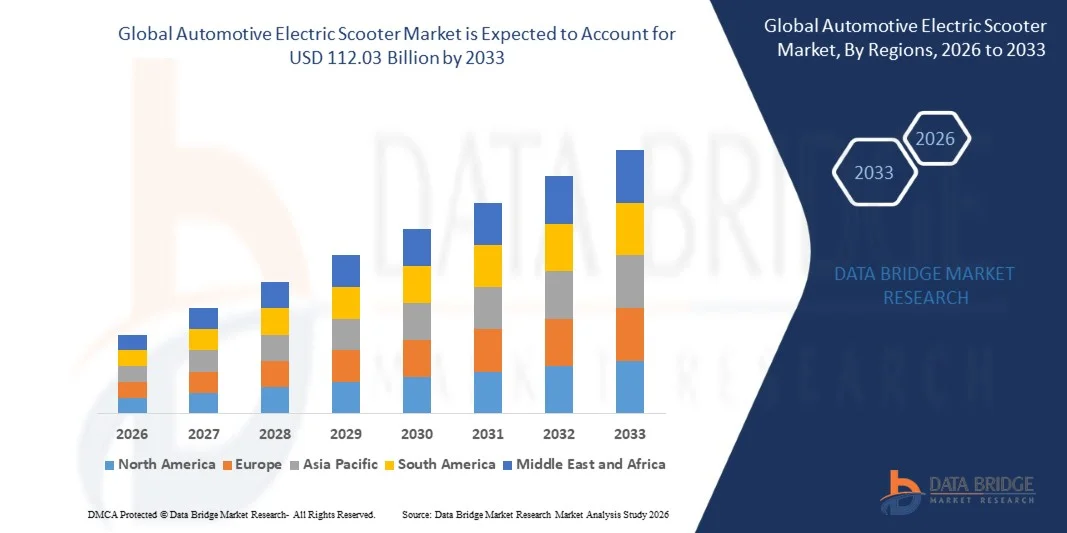
The Automotive Electric Scooter Market was valued at USD 47.92 Billion in 2025 and is projected to reach USD 112.03 Billion by 2033, growing at a CAGR of 11.20% from 2026 to 2033. The market is experiencing consistent growth driven by rising urbanization, increasing demand for cost-efficient last-mile mobility solutions, and rapid adoption of electric two-wheelers across shared and personal transportation segments. Growing investments in battery technology, expanding charging infrastructure, and supportive government EV incentives are further accelerating market growth across major regions.
The increasing global shift toward sustainable urban mobility, combined with rising fuel prices and stringent emission regulations, is encouraging consumers and fleet operators to adopt electric scooters as a practical alternative to conventional vehicles. Continuous advancements in lithium-ion battery performance, vehicle connectivity features, and lightweight vehicle design are enhancing product efficiency and user experience, thereby strengthening market penetration across both developed and emerging economies.
Key Market Trends & Insights
- Asia-Pacific dominated the Automotive Electric Scooter Market with the largest revenue share of 75.1% in 2025, supported by high urban population density, strong two-wheeler adoption culture, and rapid expansion of shared micromobility services across major cities
- The Li-Ion segment led the market with a 78% share in 2025, driven by its superior energy density, lightweight structure, and faster charging capabilities
- North America is expected to be the fastest-growing region at a CAGR of 11.6% from 2026 to 2033, fueled by increasing adoption of shared mobility services, rising fuel efficiency awareness, and strong demand for last-mile delivery solutions
- Greater than 48V are the fastest-growing voltage type, projected to register a CAGR of 16% from 2026 to 2033, supported by rising demand for high-performance scooters with extended range and higher speed capabilities
- The battery segment dominated the technology category with a 70% revenue share in 2025, led by widespread reliance on rechargeable battery-powered systems for electric scooters
- L1e accounted for 62% of the market in 2025, preferred by its classification for low-speed electric scooters widely used in urban commuting and shared mobility services
- The folding segment is the fastest-growing product type category, with a CAGR of 15% from 2026 to 2033, driven by increasing demand for compact and portable mobility solutions among daily commuters
Market Size & Forecast
- Global Market Value (2025): USD 47.92 Billion
- Expected Market Value (2033): USD 112.03 Billion
- Forecast CAGR (2026–2033): 11.20%
- Leading Region in 2025: Asia-Pacific
- Fastest Growing Region: North America
Report Scope and Automotive Electric Scooter Market Segmentation
|
Attributes |
Automotive Electric Scooter Key Market Insights |
|
Segments Covered |
|
|
Countries Covered |
North America · U.S. · Canada · Mexico Europe · Germany · France · U.K. · Netherlands · Switzerland · Belgium · Russia · Italy · Spain · Turkey · Rest of Europe Asia-Pacific · China · Japan · India · South Korea · Singapore · Malaysia · Australia · Thailand · Indonesia · Philippines · Rest of Asia-Pacific Middle East and Africa · Saudi Arabia · U.A.E. · South Africa · Egypt · Israel · Rest of Middle East and Africa South America · Brazil · Argentina · Rest of South America |
|
Key Market Players |
· Gogoro (Taiwan) · Terra Motors (Japan) · Mahindra & Mahindra Ltd. (India) · Vmoto Limited (Australia) · Jiangsu Xinri E-Vehicle Co., Ltd (China) · Honda Motor Co., Ltd (Japan) · AllCell Technologies LLC (U.S.) · Yamaha Motor Co., Ltd. (Japan) · KTM Sportmotorcycle GmbH (Austria) · Yadea Group Holdings (China) · Suzhou Eagle Electric Vehicle Manufacturing Co., Ltd (China) · Niu International (China) · Energica Motor Company (Italy) · SPIN Global (U.S.) · Lime (U.S.) |
|
Market Opportunities |
· Expansion of Battery Swapping Networks · Growth in Shared Scooter Fleets · Rising Adoption in Emerging Urban Markets |
|
Value Added Data Infosets |
In addition to the market insights such as market value, growth rate, market segments, geographical coverage, market players, and market scenario, the market report curated by the Data Bridge Market Research team includes in-depth expert analysis, import/export analysis, pricing analysis, production consumption analysis, and pestle analysis. |
Automotive Electric Scooter Market Trends
Trend: Increasing Shared Micromobility Adoption
The Automotive Electric Scooter Market is witnessing strong growth in shared micromobility adoption, driven by rising urban congestion, demand for flexible transportation, and increasing preference for app-based mobility services. Electric scooters are becoming a core part of dockless rental ecosystems in major cities, improving first-mile and last-mile connectivity across public transport networks. Fleet expansion by operators, improved GPS-enabled tracking systems, and integration with mobility-as-a-service platforms are further accelerating adoption. Cities across Europe, Asia, and North America are rapidly deploying shared electric scooter programs to reduce traffic pressure and emissions.
Companies such as Lime and Bird Global have deployed large-scale shared electric scooter fleets across cities like Paris, Los Angeles, and Berlin, enabling millions of short-distance urban trips annually and reinforcing the global shift toward shared micromobility solutions.
Automotive Electric Scooter Market Dynamics
Key Market Driver: Rising Demand for Affordable Last-Mile Mobility
The growing need for cost-effective and efficient last-mile transportation is significantly driving the adoption of automotive electric scooters across urban populations. Rising fuel prices, increasing traffic congestion, and limited parking infrastructure are encouraging consumers to shift toward compact electric mobility solutions. Electric scooters offer low operating costs and high convenience, making them highly suitable for short-distance commuting and daily travel needs. Governments are also promoting electric two-wheelers through subsidies and EV-friendly policies, further strengthening market growth.
Companies such as Yadea Group Holdings and Honda Motor Co., Ltd are expanding affordable electric scooter portfolios in Asia and global markets, targeting urban commuters and delivery service operators with cost-efficient and high-range models.
Key Restraint/Challenge: Limited Charging Infrastructure and Standardization Issues
A key challenge in the Automotive Electric Scooter market is the limited availability of widespread charging infrastructure and lack of standardized battery systems across regions. This creates operational inefficiencies for users, particularly in high-density urban areas where fast and accessible charging is critical for daily mobility. The absence of uniform charging and battery-swapping standards also restricts interoperability between different scooter brands and fleet operators. Infrastructure gaps remain a major barrier in emerging markets where EV ecosystems are still developing.
For instance, shared mobility operators such as Bird Global and Lime have faced operational constraints in certain cities due to uneven charging network availability, leading to higher fleet maintenance and battery replacement logistics costs.
Key Market Opportunity: Expansion of Battery Swapping Networks
The expansion of battery-swapping networks presents a major growth opportunity in the Automotive Electric Scooter market, enabling faster energy replenishment and reducing downtime for both personal and fleet users. Battery swapping eliminates long charging wait times and improves operational efficiency for shared mobility providers. Increasing investment in modular battery infrastructure and standardized battery formats is accelerating scalability across urban centers. Governments and private players are actively supporting swap station deployment to strengthen EV adoption.
Companies such as Niu International and Gogoro are leading large-scale battery-swapping ecosystems across Asia, particularly in Taiwan and China, significantly improving scooter utilization rates and enabling rapid expansion of electric mobility services.
Automotive Electric Scooter Market Scope
The automotive electric scooter market is segmented on the basis of product type, battery type, voltage type, technology, and category.
- By Product Type
On the basis of product type, the Automotive Electric Scooter Market is segmented into Retro, Standing/Self Balancing, Folding, and Kick. The Standing/Self Balancing segment dominated the market with the largest share of 48% in 2025, driven by strong adoption in shared mobility fleets and urban last-mile connectivity solutions. These scooters offer operational simplicity, higher utilization rates, and lower maintenance requirements, making them highly suitable for commercial deployment. Growing demand from ride-hailing operators and micromobility service providers further strengthens segment leadership. Expanding urban congestion management initiatives continues to reinforce its dominant position in major metropolitan areas.
The Folding segment is projected to register the fastest growth at a CAGR of 15% from 2026 to 2033, driven by increasing demand for compact and portable mobility solutions among daily commuters. Rising preference for easy storage in small apartments and integration with public transport systems is accelerating adoption. Advancements in lightweight materials and foldable frame engineering are improving durability and convenience. Increasing focus on flexible urban mobility solutions across dense cities is significantly supporting segment expansion.
- By Battery Type
On the basis of battery type, the market is segmented into Sealed Lead Acid, NiMH, and Li-Ion. The Li-Ion segment dominated the market with a share of 78% in 2025, supported by its superior energy density, lightweight structure, and faster charging capabilities. Manufacturers increasingly prefer Li-Ion batteries due to longer lifecycle performance and improved efficiency in electric scooters. Strong integration in both premium and mass-market models further supports widespread adoption. Continuous cost reduction in lithium-based technologies strengthens its leading position in the global market.
The NiMH segment is projected to register the fastest growth at a CAGR of 12% from 2026 to 2033, driven by its cost-effectiveness and stable performance in moderate-range applications. Increasing adoption in price-sensitive emerging markets is supporting demand growth. Improved safety characteristics compared to traditional battery chemistries are enhancing its acceptance in entry-level scooter models. Expanding production capacity and gradual technological improvements are further accelerating segment development.
- By Voltage Type
On the basis of voltage type, the market is segmented into 24V, 36V, 48V, and Greater than 48V. The 48V segment dominated the market with a share of 46% in 2025, driven by its optimal balance between power output, range efficiency, and cost-effectiveness. This voltage range is widely used in mainstream electric scooters catering to urban commuting needs. Manufacturers prefer 48V systems due to compatibility with Li-Ion battery packs and standardized motor configurations. Strong demand from shared mobility operators further reinforces segment dominance.
The Greater than 48V segment is projected to register the fastest growth at a CAGR of 16% from 2026 to 2033, driven by rising demand for high-performance scooters with extended range and higher speed capabilities. Increasing consumer preference for premium electric mobility solutions is accelerating adoption. Technological advancements in power electronics and battery management systems are enabling safer high-voltage integration. Expanding use in performance-oriented and long-distance commuting scooters is strengthening segment growth.
- By Technology
On the basis of technology, the market is segmented into Plug In and Battery. The Battery segment dominated the market with a share of 70% in 2025, driven by widespread reliance on rechargeable battery-powered systems for electric scooters. Strong adoption across shared mobility fleets and personal transportation applications supports segment leadership. Continuous improvements in battery efficiency and charging cycles enhance operational reliability. Expanding urban electrification initiatives further reinforce dominance in the global market.
The Plug In segment is projected to register the fastest growth at a CAGR of 13% from 2026 to 2033, driven by expanding charging infrastructure and increasing standardization of home and public charging systems. Rising consumer preference for convenient and fast charging access is accelerating adoption. Integration of smart charging stations and grid-connected systems is improving usability. Government investments in EV charging networks are further supporting segment expansion.
- By Category
On the basis of category, the market is segmented into L1e and L3e. The L1e segment dominated the market with a share of 62% in 2025, driven by its classification for low-speed electric scooters widely used in urban commuting and shared mobility services. These vehicles benefit from simpler regulatory requirements and lower operational costs. Strong demand from short-distance travel applications supports widespread adoption. Increasing focus on affordable urban mobility solutions further strengthens segment leadership.
The L3e segment is projected to register the fastest growth at a CAGR of 15% from 2026 to 2033, driven by rising demand for high-speed electric scooters suitable for longer commutes. Growing consumer preference for performance-oriented mobility solutions is accelerating adoption. Advancements in motor efficiency, braking systems, and battery capacity are enabling compliance with stricter safety standards. Expanding use in personal premium mobility applications is further driving segment growth.
Automotive Electric Scooter Market Regional Analysis
Asia-Pacific dominated the automotive electric scooter market and accounted for the largest revenue share of 75.1% in 2025, supported by high urban population density, strong two-wheeler adoption culture, and rapid expansion of shared micromobility services across major cities. The region benefits from large-scale manufacturing capabilities, cost-efficient supply chains, and strong government support for electric vehicle adoption. Rising fuel prices, increasing traffic congestion, and supportive EV policies are further accelerating demand for electric scooters across both personal and commercial mobility applications. Expanding last-mile delivery networks and rapid urbanization continue to strengthen regional market leadership.
China Automotive Electric Scooter Market Insight
China held the largest share in the Asia-Pacific market in 2025, driven by its dominant electric vehicle manufacturing ecosystem and strong domestic demand for affordable urban mobility solutions. The country benefits from large-scale production capacity, advanced battery supply chains, and strong penetration of shared mobility platforms. Increasing adoption of lithium-ion battery-powered scooters across e-commerce delivery fleets and commuter segments is further supporting growth. In addition, government incentives for electric two-wheelers and expansion of charging infrastructure are reinforcing China’s leadership in the regional market.
India Automotive Electric Scooter Market Insight
India is witnessing the fastest growth in the Asia-Pacific region, projected to expand at a CAGR of 16.8% from 2026 to 2033, driven by rising fuel costs, increasing demand for affordable commuting solutions, and strong government incentives under electric mobility programs. Expanding urbanization and growing adoption of ride-sharing and delivery services are significantly boosting scooter penetration. Local manufacturers are rapidly scaling production with cost-optimized models tailored for price-sensitive consumers. In addition, improving battery technology access and expanding EV financing options are accelerating long-term market adoption.
Europe Automotive Electric Scooter Market Insight
The Europe Automotive Electric Scooter market is expanding steadily, supported by stringent emission regulations, strong sustainability goals, and increasing preference for micro-mobility solutions in urban areas. Rising demand for compact and efficient transportation alternatives is driving adoption across commuters and shared mobility operators. Strong investment in EV infrastructure and integration of scooters with public transportation systems are further supporting regional growth. Increasing consumer shift toward low-carbon urban mobility and expansion of rental mobility platforms are reinforcing market development across key European cities.
Germany Automotive Electric Scooter Market Insight
Germany accounted for the largest share in the Europe market in 2025, driven by strong adoption of electric mobility solutions across urban commuting and logistics applications. The country benefits from advanced automotive engineering capabilities, well-developed charging infrastructure, and high consumer awareness of sustainable transport options. Increasing integration of electric scooters in shared mobility fleets and corporate transport systems is further strengthening demand. In addition, supportive government policies promoting electrification of urban transport are reinforcing Germany’s leading position in the regional market.
U.K. Automotive Electric Scooter Market Insight
U.K. is experiencing strong growth supported by increasing demand for flexible urban transport solutions and expanding micromobility rental services. Rising congestion in major cities is driving consumers toward compact and efficient electric scooters for short-distance travel. Growing preference for eco-friendly transport alternatives and integration with public transit systems are further boosting adoption. In addition, expansion of subscription-based mobility models and digital platform-based scooter sharing services is supporting sustained market growth.
North America Automotive Electric Scooter Market Insight
North America is projected to grow at the fastest CAGR of 11.6% from 2026 to 2033, driven by increasing adoption of shared mobility services, rising fuel efficiency awareness, and strong demand for last-mile delivery solutions. Growing urbanization and preference for convenient personal transport options are accelerating scooter penetration across major cities. Expansion of e-commerce logistics networks and integration of electric scooters into delivery fleets are further supporting market growth. In addition, strong investment in EV infrastructure and technological advancements in battery systems are reinforcing regional expansion.
U.S. Automotive Electric Scooter Market Insight
U.S. accounted for the largest share in the North America market in 2025, supported by widespread adoption of micromobility solutions in urban centers and strong presence of shared scooter operators. The country benefits from high consumer spending capacity, advanced digital mobility platforms, and rapid expansion of rental scooter networks. Increasing use of electric scooters in commuting, tourism, and delivery applications is further strengthening demand. In addition, supportive urban mobility policies and growing sustainability initiatives are reinforcing the U.S. leadership position in the regional market.
Automotive Electric Scooter Market Share
The automotive electric scooter industry is primarily led by well-established companies, including:
- Gogoro (Taiwan)
- Terra Motors (Japan)
- Mahindra & Mahindra Ltd. (India)
- Vmoto Limited (Australia)
- Jiangsu Xinri E-Vehicle Co., Ltd (China)
- Honda Motor Co., Ltd (Japan)
- AllCell Technologies LLC (U.S.)
- Yamaha Motor Co., Ltd. (Japan)
- KTM Sportmotorcycle GmbH (Austria)
- Yadea Group Holdings (China)
- Suzhou Eagle Electric Vehicle Manufacturing Co., Ltd (China)
- Niu International (China)
- Energica Motor Company (Italy)
- SPIN Global (U.S.)
- Lime (U.S.)
Latest Developments in Automotive Electric Scooter Market
- In August 2025, TVS Motor Company unveiled its third electric scooter, the Orbiter, strengthening its EV portfolio in India and intensifying competition in the mid-range electric scooter segment. The model’s 158 km riding range on a single charge enhances its appeal among urban commuters seeking longer travel capability, thereby improving its market positioning against rival offerings. The introduction of a 3.1 kWh battery pack also reflects the company’s focus on improving energy efficiency and performance consistency. This launch is expected to reinforce TVS’s presence in the fast-expanding Indian electric two-wheeler market
- In July 2025, Kinetic Green Energy & Power Solutions launched a new electric scooter in India at a competitive ex-showroom price of INR 111,000, strengthening its foothold in the affordable EV mobility segment. The updated design and enhanced connectivity features improve user experience and align with growing consumer expectations for smart mobility solutions. This development intensifies competition in the entry-level electric scooter category, particularly in price-sensitive urban and semi-urban markets. It also supports broader market penetration by making electric mobility more accessible to first-time buyers
- In February 2025, Simple Energy upgraded its Simple ONE scooter with the Gen 1.5 version, significantly increasing its range to 248 km and enhancing its competitiveness in the premium electric scooter segment. The introduction of advanced software capabilities such as app integration, navigation support, and customizable dashboards improves rider convenience and strengthens product differentiation. These enhancements position the scooter as a technology-driven mobility solution, appealing to digitally connected consumers. The upgrade is expected to strengthen the company’s market share by targeting high-performance EV demand in urban regions
- In December 2023, Gogoro introduced the Gogoro CrossOver GX250 domestically produced electric scooter in India, marking a strategic expansion into one of the fastest-growing EV markets. The model is tailored specifically for Indian riding conditions, strengthening its relevance in the local market and improving adoption potential among urban commuters. This launch reflects the company’s intent to localize production and compete more effectively with domestic manufacturers. The move is expected to enhance market penetration and establish a stronger presence in India’s rapidly growing electric scooter ecosystem
- In September 2023, Bird Global acquired Spin for USD 19 million, consolidating its position in the electric micromobility rental market and reducing competitive pressure. This acquisition strengthens Bird’s operational scale and expands its fleet management capabilities across urban mobility networks. By integrating Spin’s scooter and e-bike rental services, the company enhances service coverage and improves cost efficiencies. The deal supports Bird’s strategy to maintain dominance in shared electric mobility platforms amid increasing global competition
SKU-
Get online access to the report on the World's First Market Intelligence Cloud

- Interactive Data Analysis Dashboard
- Company Analysis Dashboard for high growth potential opportunities
- Research Analyst Access for customization & queries
- Competitor Analysis with Interactive dashboard
- Latest News, Updates & Trend analysis
- Harness the Power of Benchmark Analysis for Comprehensive Competitor Tracking
Research Methodology
Data collection and base year analysis are done using data collection modules with large sample sizes. The stage includes obtaining market information or related data through various sources and strategies. It includes examining and planning all the data acquired from the past in advance. It likewise envelops the examination of information inconsistencies seen across different information sources. The market data is analysed and estimated using market statistical and coherent models. Also, market share analysis and key trend analysis are the major success factors in the market report. To know more, please request an analyst call or drop down your inquiry.
The key research methodology used by DBMR research team is data triangulation which involves data mining, analysis of the impact of data variables on the market and primary (industry expert) validation. Data models include Vendor Positioning Grid, Market Time Line Analysis, Market Overview and Guide, Company Positioning Grid, Patent Analysis, Pricing Analysis, Company Market Share Analysis, Standards of Measurement, Global versus Regional and Vendor Share Analysis. To know more about the research methodology, drop in an inquiry to speak to our industry experts.
Customization Available
Data Bridge Market Research is a leader in advanced formative research. We take pride in servicing our existing and new customers with data and analysis that match and suits their goal. The report can be customized to include price trend analysis of target brands understanding the market for additional countries (ask for the list of countries), clinical trial results data, literature review, refurbished market and product base analysis. Market analysis of target competitors can be analyzed from technology-based analysis to market portfolio strategies. We can add as many competitors that you require data about in the format and data style you are looking for. Our team of analysts can also provide you data in crude raw excel files pivot tables (Fact book) or can assist you in creating presentations from the data sets available in the report.












