




Global Automotive Steel Market
Market Size in USD Billion
CAGR :
% 
 USD
88.90 Billion
USD
118.88 Billion
2025
2033
USD
88.90 Billion
USD
118.88 Billion
2025
2033
 Forecast Period Forecast Period |
2026 - 2033 |
 Market Size (Base Year) Market Size (Base Year) |
USD 88.90 Billion |
 Market Size (Forecast Year) Market Size (Forecast Year) |
USD 118.88 Billion |
 CAGR CAGR |
% |
| Major Markets Players |
|
Automotive Steel Market Overview
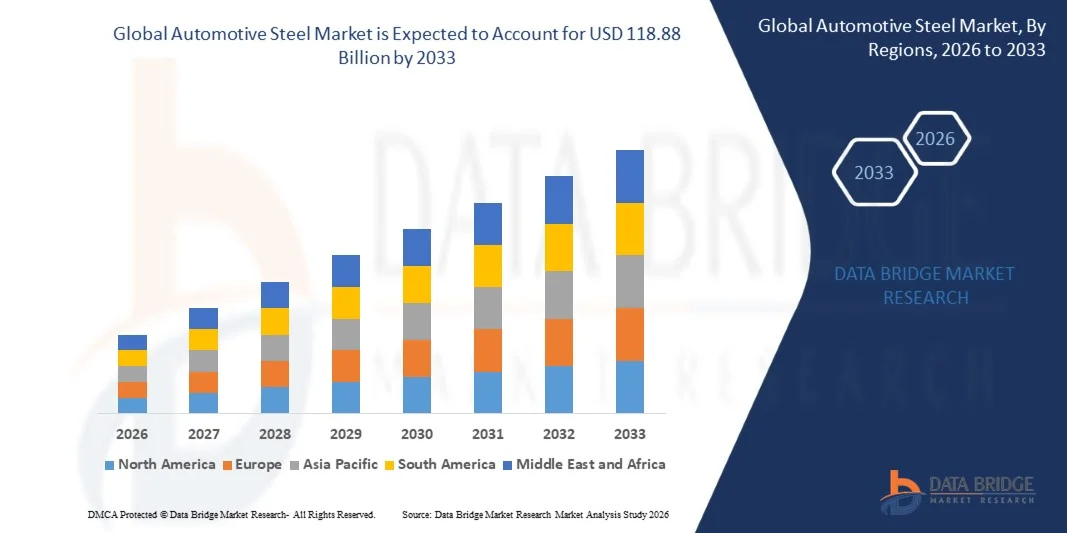
The Automotive Steel Market was valued at USD 88.9 Billion in 2025 and is projected to reach USD 118.88 Billion by 2033, growing at a CAGR of 3.70% from 2026 to 2033. The market is experiencing consistent growth driven by increasing global vehicle production, rising demand for lightweight and fuel-efficient automobiles, and growing adoption of advanced high-strength steel across passenger and commercial vehicles. Expanding electric vehicle manufacturing, continuous advancements in steel processing technologies, and stringent vehicle safety regulations are further supporting market expansion across major automotive manufacturing regions.
The increasing focus on vehicle lightweighting, improved crash performance, and emission reduction is encouraging automotive manufacturers to adopt advanced steel solutions in vehicle design and production. Automotive steel continues to play a critical role in body structures, powertrain components, and suspension systems due to its strength, durability, and cost-effectiveness. Rising investments in electric mobility, coupled with growing demand for sustainable and low-carbon steel production, are further driving innovation and long-term growth within the Automotive Steel Market.
Key Market Trends & Insights
- Asia-Pacific dominated the Automotive Steel Market with the largest revenue share of 49% in 2025, supported by its strong automotive manufacturing base, high vehicle production volumes, and extensive presence of steel producers across major economies
- The passenger vehicles segment led the market with a 63.1% share in 2025, driven by high global automobile production volumes and rising consumer demand for personal transportation
- North America is expected to be the fastest-growing region at a CAGR of 5.7% from 2026 to 2033, fueled by increasing production of electric vehicles, growing demand for lightweight automotive components, and rising investments in advanced manufacturing technologies
- Advanced high strength is the fastest-growing type, projected to register a CAGR of 8.9% from 2026 to 2033, supported by increasing demand for lightweight vehicles that meet stringent fuel efficiency and emission standards
- The mild steel segment dominated the type category with a 41.8% revenue share in 2025, led by its extensive utilization in vehicle manufacturing due to its cost-effectiveness, ease of fabrication, and widespread availability
- Body structure accounted for 40.3% of the market in 2025, preferred by the extensive use of steel in vehicle frames, pillars, roof systems, doors, and crash management components
- The light commercial vehicles segment is the fastest-growing vehicle type category, with a CAGR of 8.1% from 2026 to 2033, driven by the rapid expansion of e-commerce, logistics, and last-mile delivery services worldwide
Market Size & Forecast
- Global Market Value (2025): USD 88.9 Billion
- Expected Market Value (2033): USD 118.88 Billion
- Forecast CAGR (2026–2033): 3.70%
- Leading Region in 2025: Asia-Pacific
- Fastest Growing Region: North America
Report Scope and Automotive Steel Market Segmentation
|
Attributes |
Automotive Steel Key Market Insights |
|
Segments Covered |
|
|
Countries Covered |
North America · U.S. · Canada · Mexico Europe · Germany · France · U.K. · Netherlands · Switzerland · Belgium · Russia · Italy · Spain · Turkey · Rest of Europe Asia-Pacific · China · Japan · India · South Korea · Singapore · Malaysia · Australia · Thailand · Indonesia · Philippines · Rest of Asia-Pacific Middle East and Africa · Saudi Arabia · U.A.E. · South Africa · Egypt · Israel · Rest of Middle East and Africa South America · Brazil · Argentina · Rest of South America |
|
Key Market Players |
· ArcelorMittal (Luxembourg) · Tata Steel (India) · worldsteel (Belgium) · Hyundai Steel (South Korea) · United States Steel Corporation (U.S.) · JSW Steel (India) · POSCO (South Korea) · Nippon Steel Corporation (Japan) · JFE Steel Corporation (Japan) · Nucor Corporation (U.S.) · thyssenkrupp Steel Europe (Germany) · Baosteel Group (China) · HBIS Group (China) · Voestalpine AG (Austria) · SSAB AB (Sweden) · China Steel Corporation (Taiwan) · Steel Authority of India Limited (India) · NLMK Group (Russia) · Salzgitter AG (Germany) |
|
Market Opportunities |
· Growing Demand for Automotive Steel in Electric Vehicle Manufacturing · Expansion of Low-Carbon and Green Steel Solutions for Automakers · Increasing Utilization of Advanced Steel in Vehicle Safety and Crash Management Systems |
|
Value Added Data Infosets |
In addition to the market insights such as market value, growth rate, market segments, geographical coverage, market players, and market scenario, the market report curated by the Data Bridge Market Research team includes in-depth expert analysis, import/export analysis, pricing analysis, production consumption analysis, and pestle analysis. |
Automotive Steel Market Trends
Trend: Rising Adoption of Advanced High-Strength Steel
Automotive manufacturers are increasingly adopting Advanced High-Strength Steel (AHSS) to reduce vehicle weight while maintaining structural integrity, crash performance, and passenger safety. The growing need to comply with stringent fuel efficiency and emission regulations is accelerating the replacement of conventional steel grades with lighter and stronger materials. AHSS is being extensively utilized in body structures, safety cages, doors, and chassis components across passenger and electric vehicles. The trend is further supported by rising investments in lightweight vehicle platforms and next-generation mobility solutions.
Companies such as ArcelorMittal and SSAB are expanding their advanced automotive steel portfolios to meet increasing demand for lightweight and high-performance vehicle materials. In January 2025, ArcelorMittal Nippon Steel India commissioned new automotive steel production lines capable of producing high-strength steel grades with tensile strengths up to 1180 MPa, supporting the industry's transition toward safer and lighter vehicles.
Automotive Steel Market Dynamics
Key Market Driver: Increasing Global Production of Passenger and Electric Vehicles
The continuous growth in passenger vehicle and electric vehicle production is a major factor driving demand for automotive steel worldwide. Automotive steel remains a critical material for vehicle manufacturing due to its strength, durability, affordability, and recyclability. Rising investments in electric mobility, expanding automotive manufacturing facilities, and increasing consumer demand for safer vehicles are further supporting market growth. As vehicle manufacturers scale production, demand for advanced steel solutions continues to increase across structural, powertrain, and safety applications.
According to the International Energy Agency (IEA), global electric vehicle sales exceeded 17 million units in 2024, significantly increasing demand for lightweight and high-strength automotive materials. Major automakers including Toyota Motor Corporation, Volkswagen AG, and Tesla, Inc. are increasingly utilizing advanced automotive steel to improve vehicle safety, efficiency, and performance.
Key Restraint/Challenge: Volatility in Raw Material Prices and Steel Production Costs
A major challenge facing the Automotive Steel market is the fluctuation in prices of key raw materials such as iron ore, coking coal, and scrap steel. Variations in raw material availability, energy costs, and global trade conditions directly impact steel production expenses and profit margins for manufacturers. Rising environmental compliance costs and investments required for low-carbon steel production further add to operational challenges. These factors create uncertainty in pricing and procurement strategies for both steel producers and automotive manufacturers.
Steelmakers across Europe and Asia have experienced increased production costs due to higher energy prices and evolving carbon reduction regulations. Companies such as thyssenkrupp Steel Europe and Tata Steel continue investing heavily in decarbonization technologies, highlighting the substantial financial commitments required to maintain competitiveness while transitioning to sustainable steel production.
Key Market Opportunity: Expansion of Low-Carbon and Green Steel Solutions for Automakers
The growing emphasis on sustainability and carbon-neutral vehicle manufacturing is creating significant opportunities for low-carbon and green automotive steel solutions. Automakers are increasingly seeking materials with reduced environmental impact to meet corporate sustainability targets and evolving regulatory requirements. Advancements in hydrogen-based steelmaking, recycled steel utilization, and renewable energy-powered production processes are improving the commercial viability of green steel. This transition is expected to create new growth avenues across both conventional and electric vehicle manufacturing.
In June 2025, SSAB signed a long-term agreement with Polmotors to supply fossil-free steel for automotive structural components, while in June 2024, Tata Steel Nederland launched Zeremis Recycled automotive steel containing 30% recycled content. These developments demonstrate the increasing adoption of sustainable steel solutions and the expanding market potential for low-carbon automotive materials.
Automotive Steel Market Scope
The automotive steel market is segmented on the basis of type, vehicle type, and application.
- By Type
On the basis of type, the Automotive Steel Market is segmented into Mild Steel, Alloy Steel, High Strength Steel, and Advanced High Strength Steel. The Mild Steel segment dominated the market with the largest share of 41.8% in 2025, driven by its extensive utilization in vehicle manufacturing due to its cost-effectiveness, ease of fabrication, and widespread availability. Automakers continue to rely on mild steel for structural and non-structural vehicle components where affordability and manufacturing efficiency remain critical. The material offers adequate strength and durability for mass-market vehicles while supporting large-scale production requirements. Strong demand from passenger vehicle manufacturers in emerging economies further contributes to segment leadership. Its established supply chain and compatibility with existing production processes continue to reinforce its dominant position.
The Advanced High Strength Steel segment is projected to register the fastest growth at a CAGR of 8.9% from 2026 to 2033, driven by increasing demand for lightweight vehicles that meet stringent fuel efficiency and emission standards. Automotive manufacturers are adopting advanced high strength steel to reduce vehicle weight without compromising safety and crash performance. Growing regulatory focus on carbon emission reduction is accelerating the replacement of conventional materials with high-performance steel grades. Technological advancements in steel processing are improving formability and structural capabilities, enabling broader adoption across vehicle platforms. Rising electric vehicle production is further supporting demand due to the need for lightweight yet durable body structures. Continuous investments in next-generation automotive materials are expected to sustain strong segment growth.
- By Vehicle Type
On the basis of vehicle type, the Automotive Steel Market is segmented into Passenger Vehicles, Light Commercial Vehicles, and Heavy Commercial Vehicles. The Passenger Vehicles segment dominated the market with the largest share of 63.1% in 2025, driven by high global automobile production volumes and rising consumer demand for personal transportation. Automotive steel is extensively used in passenger vehicles for body structures, chassis components, and safety systems due to its strength and cost efficiency. Increasing vehicle ownership across developing economies continues to support steel consumption in this segment. Manufacturers are also incorporating advanced steel grades to improve fuel economy and occupant safety. Expanding production of conventional, hybrid, and electric passenger cars further strengthens segment dominance. Consistent innovation in vehicle design continues to drive material demand across the segment.
The Light Commercial Vehicles segment is projected to register the fastest growth at a CAGR of 8.1% from 2026 to 2033, driven by the rapid expansion of e-commerce, logistics, and last-mile delivery services worldwide. Rising demand for efficient transportation fleets is encouraging production of lightweight and fuel-efficient commercial vehicles. Automotive steel remains a preferred material due to its ability to provide structural strength while supporting payload capacity requirements. Growing investments in urban transportation infrastructure are further supporting vehicle deployment. Manufacturers are increasingly utilizing advanced steel solutions to enhance durability and operational efficiency. Expanding commercial fleet modernization programs are expected to accelerate segment growth over the forecast period.
- By Application
On the basis of application, the Automotive Steel Market is segmented into Body Structure, Power Train, Suspension, and Other. The Body Structure segment dominated the market with the largest share of 40.3% in 2025, driven by the extensive use of steel in vehicle frames, pillars, roof systems, doors, and crash management components. Automotive steel plays a critical role in ensuring structural integrity, passenger safety, and vehicle durability. Increasing implementation of stringent crash safety regulations is encouraging the use of high-strength steel in body structures. Manufacturers continue to optimize vehicle designs through advanced steel grades that reduce weight while maintaining performance standards. Growing production of passenger and commercial vehicles further supports demand in this application area. Its essential role in vehicle construction sustains the segment’s leading market position.
The Suspension segment is projected to register the fastest growth at a CAGR of 7.5% from 2026 to 2033, driven by increasing demand for enhanced vehicle stability, ride comfort, and handling performance. Steel remains a preferred material for suspension systems due to its superior strength, fatigue resistance, and durability under varying road conditions. Growing production of electric and premium vehicles is encouraging the adoption of advanced suspension technologies that require high-performance steel components. Continuous innovations in lightweight suspension designs are improving vehicle efficiency while maintaining safety standards. Rising consumer expectations for improved driving experience are further supporting component upgrades. Expanding investments in advanced automotive engineering are expected to accelerate growth within the segment.
Automotive Steel Market Regional Analysis
Asia-Pacific dominated the automotive steel market and accounted for the largest revenue share of 49% in 2025, supported by its strong automotive manufacturing base, high vehicle production volumes, and extensive presence of steel producers across major economies. The region benefits from rising passenger vehicle demand, expanding commercial vehicle fleets, and increasing investments in electric vehicle manufacturing facilities. Strong industrial infrastructure, cost-efficient production capabilities, and growing adoption of advanced high-strength steel are further accelerating market expansion. Increasing government support for automotive manufacturing and vehicle electrification initiatives continues to strengthen regional demand for automotive steel.
China Automotive Steel Market Insight
China held the largest share in the Asia-Pacific Automotive Steel market in 2025, supported by its position as the world’s largest automobile producer and consumer. The country has a highly developed automotive supply chain and steel manufacturing industry that supports large-scale vehicle production across passenger and commercial segments. Rising demand for electric vehicles and lightweight automotive materials is driving adoption of advanced steel grades. Continuous investments in automotive innovation, smart manufacturing, and emission reduction technologies are further supporting market growth. In addition, strong domestic consumption and export-oriented vehicle production reinforce China's leadership in the regional market.
India Automotive Steel Market Insight
India is witnessing the fastest growth in the Asia-Pacific region, driven by expanding vehicle production, increasing urbanization, and rising consumer demand for personal mobility solutions. Growing investments in automotive manufacturing facilities and supportive government initiatives for domestic vehicle production are significantly supporting market expansion. Increasing adoption of high-strength steel in passenger vehicles and commercial fleets is further accelerating demand. The rapid growth of electric vehicle manufacturing and infrastructure development is creating new opportunities for advanced automotive steel applications. In addition, rising income levels and expanding transportation requirements are contributing to long-term market growth.
Europe Automotive Steel Market Insight
The Europe Automotive Steel market is expanding steadily, supported by strong automotive manufacturing capabilities and increasing focus on vehicle lightweighting and sustainability. Automakers across the region are increasingly utilizing advanced high-strength steel to comply with stringent emission and safety regulations. Growing production of electric and hybrid vehicles is further driving demand for innovative steel solutions. Strong research and development activities in automotive materials and manufacturing technologies are supporting market advancement. In addition, increasing investments in sustainable mobility and low-emission transportation systems continue to strengthen regional demand.
Germany Automotive Steel Market Insight
Germany accounted for the largest share in the Europe Automotive Steel market in 2025, driven by its well-established automotive industry and presence of leading vehicle manufacturers. The country extensively utilizes automotive steel in premium passenger vehicles, commercial vehicles, and electric mobility applications. Increasing focus on vehicle safety, structural performance, and fuel efficiency is supporting demand for advanced steel grades. Strong investments in automotive research and engineering are further contributing to market growth. In addition, continuous expansion of electric vehicle production is reinforcing Germany’s leading position in the regional market.
U.K. Automotive Steel Market Insight
The U.K. market is supported by growing investments in electric vehicle production and increasing adoption of lightweight automotive materials. Automotive manufacturers are focusing on improving vehicle efficiency and meeting stringent environmental regulations, which is driving demand for high-performance steel products. Rising production of premium and specialized vehicles is further supporting market growth. The country is also witnessing increased investment in advanced manufacturing technologies and automotive innovation. In addition, expanding sustainability initiatives across the transportation sector are contributing to market development.
North America Automotive Steel Market Insight
North America is projected to grow at the fastest CAGR of 5.7% from 2026 to 2033, driven by increasing production of electric vehicles, growing demand for lightweight automotive components, and rising investments in advanced manufacturing technologies. Automotive manufacturers are increasingly utilizing high-strength steel to improve fuel efficiency, safety performance, and vehicle durability. Strong demand from passenger vehicles, commercial fleets, and electric mobility applications is further accelerating market growth. Increasing regulatory emphasis on emission reduction and vehicle efficiency standards is encouraging adoption of advanced steel materials. In addition, modernization of automotive production facilities continues to support regional expansion.
U.S. Automotive Steel Market Insight
The U.S. accounted for the largest share in the North America Automotive Steel market in 2025, supported by its strong automotive manufacturing sector and growing investments in electric vehicle production. The country benefits from extensive utilization of automotive steel across passenger vehicles, pickup trucks, sport utility vehicles, and commercial transportation fleets. Rising adoption of advanced high-strength steel for lightweighting and safety enhancement is further strengthening market growth. Increasing investments in domestic automotive production and supply chain expansion are supporting demand for steel materials. In addition, growing focus on vehicle electrification and sustainability initiatives is reinforcing the U.S. leadership position in the regional market.
Automotive Steel Market Share
The automotive steel industry is primarily led by well-established companies, including:
- ArcelorMittal (Luxembourg)
- Tata Steel (India)
- worldsteel (Belgium)
- Hyundai Steel (South Korea)
- United States Steel Corporation (U.S.)
- JSW Steel (India)
- POSCO (South Korea)
- Nippon Steel Corporation (Japan)
- JFE Steel Corporation (Japan)
- Nucor Corporation (U.S.)
- thyssenkrupp Steel Europe (Germany)
- Baosteel Group (China)
- HBIS Group (China)
- Voestalpine AG (Austria)
- SSAB AB (Sweden)
- China Steel Corporation (Taiwan)
- Steel Authority of India Limited (India)
- NLMK Group (Russia)
- Salzgitter AG (Germany)
Latest Developments in Automotive Steel Market
- In June 2025, SSAB entered into a long-term agreement with Polmotors to supply fossil-free steel for structural automotive components, including crash management systems and bumpers. This development is expected to strengthen the transition toward low-carbon automotive manufacturing by accelerating the adoption of sustainable steel across vehicle production. The partnership supports growing demand from automotive OEMs for environmentally responsible materials while advancing decarbonization across the automotive supply chain. The agreement is also likely to encourage wider commercialization of fossil-free steel, creating new growth opportunities within the automotive steel market
- In January 2025, ArcelorMittal Nippon Steel India commissioned two advanced automotive steel production lines at its Hazira facility in Gujarat, including a Continuous Galvanising Line and a Continuous Galvanising and Annealing Line. The expansion significantly enhances domestic production capacity for high-strength automotive steel grades with tensile strengths reaching 1180 MPa. This development is expected to reduce dependence on imported automotive steel while supporting the increasing demand for lightweight and safer vehicles in India. The investment also strengthens the regional automotive steel supply chain and improves the availability of premium-grade steel for vehicle manufacturers
- In October 2024, Thyssenkrupp Steel showcased its latest automotive steel innovations at the International Suppliers Fair, highlighting its bluemint CO₂-reduced steel and powercore Traction electrical steel solutions. These advanced materials are designed to support climate-neutral mobility and improve electric vehicle performance through enhanced motor efficiency. The introduction of such products is contributing to the growing adoption of sustainable and high-performance steel solutions within the automotive sector. This development reinforces the market trend toward electrification and lower-emission vehicle manufacturing
- In June 2024, Tata Steel Nederland launched Zeremis Recycled, an automotive steel product containing 30% recycled content, as part of its broader sustainability strategy. The introduction of recycled-content steel addresses increasing demand from automotive manufacturers seeking circular economy solutions and lower-carbon materials. This initiative is expected to accelerate the adoption of sustainable steel across vehicle manufacturing while helping customers achieve environmental and regulatory targets. The product launch also strengthens the competitive landscape of the automotive steel market by promoting greater use of recycled raw materials
- In September 2023, LISI AUTOMOTIVE partnered with ArcelorMittal to develop and integrate XCarb recycled and renewably produced low-carbon automotive steel into automotive manufacturing applications. The collaboration supports the industry's increasing focus on reducing carbon emissions while maintaining high material performance standards. This development is expected to encourage broader adoption of low-carbon steel technologies across automotive production and strengthen sustainability initiatives throughout the value chain. The partnership also highlights the growing importance of environmentally responsible materials in shaping future automotive steel demand
SKU-
Get online access to the report on the World's First Market Intelligence Cloud

- Interactive Data Analysis Dashboard
- Company Analysis Dashboard for high growth potential opportunities
- Research Analyst Access for customization & queries
- Competitor Analysis with Interactive dashboard
- Latest News, Updates & Trend analysis
- Harness the Power of Benchmark Analysis for Comprehensive Competitor Tracking
Research Methodology
Data collection and base year analysis are done using data collection modules with large sample sizes. The stage includes obtaining market information or related data through various sources and strategies. It includes examining and planning all the data acquired from the past in advance. It likewise envelops the examination of information inconsistencies seen across different information sources. The market data is analysed and estimated using market statistical and coherent models. Also, market share analysis and key trend analysis are the major success factors in the market report. To know more, please request an analyst call or drop down your inquiry.
The key research methodology used by DBMR research team is data triangulation which involves data mining, analysis of the impact of data variables on the market and primary (industry expert) validation. Data models include Vendor Positioning Grid, Market Time Line Analysis, Market Overview and Guide, Company Positioning Grid, Patent Analysis, Pricing Analysis, Company Market Share Analysis, Standards of Measurement, Global versus Regional and Vendor Share Analysis. To know more about the research methodology, drop in an inquiry to speak to our industry experts.
Customization Available
Data Bridge Market Research is a leader in advanced formative research. We take pride in servicing our existing and new customers with data and analysis that match and suits their goal. The report can be customized to include price trend analysis of target brands understanding the market for additional countries (ask for the list of countries), clinical trial results data, literature review, refurbished market and product base analysis. Market analysis of target competitors can be analyzed from technology-based analysis to market portfolio strategies. We can add as many competitors that you require data about in the format and data style you are looking for. Our team of analysts can also provide you data in crude raw excel files pivot tables (Fact book) or can assist you in creating presentations from the data sets available in the report.












