Global Avian Influenza Vaccines Market
Market Size in USD Million
CAGR :
% 
 USD
156.32 Million
USD
246.34 Million
2025
2033
USD
156.32 Million
USD
246.34 Million
2025
2033
 Forecast Period Forecast Period |
2026 - 2033 |
 Market Size (Base Year) Market Size (Base Year) |
USD 156.32 Million |
 Market Size (Forecast Year) Market Size (Forecast Year) |
USD 246.34 Million |
 CAGR CAGR |
% |
| Major Markets Players |
|
Avian Influenza Vaccines Market Overview
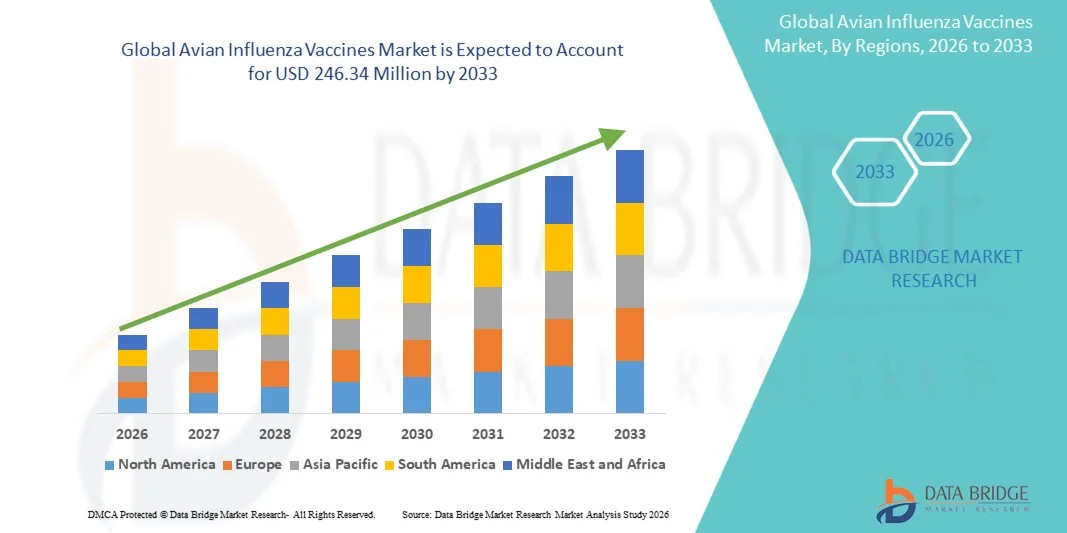
The Avian Influenza Vaccines Market was valued at USD 156.32 million in 2025 and is projected to reach USD 246.34 million by 2033, growing at a CAGR of 5.85% from 2026 to 2033. The market is witnessing steady expansion driven by the increasing prevalence of highly pathogenic avian influenza (HPAI) outbreaks, rising economic losses in poultry production, and growing government-led immunization programs aimed at protecting poultry populations and stabilizing food supply chains.
The rising frequency of zoonotic disease transmission concerns, coupled with intensified global poultry trade and large-scale commercial farming, is encouraging the adoption of preventive vaccination strategies. Advances in recombinant vaccines, inactivated vaccine formulations, and DIVA (Differentiating Infected from Vaccinated Animals) technologies are further strengthening disease control programs. Additionally, supportive regulatory frameworks and emergency vaccination stockpiling initiatives by national veterinary authorities are accelerating market penetration across both developed and emerging regions
Key Market Trends & Insights
- North America dominated the Avian Influenza Vaccines Market with the largest revenue share of 36.28% in 2025, supported by large-scale commercial poultry farming, frequent HPAI outbreaks in the U.S. and Canada, and strong government vaccination preparedness and surveillance programs.
- The Inactivated Vaccines segment led the market with a 46.37% share in 2025, driven by strong regulatory acceptance, proven safety profile, and widespread use in large-scale poultry immunization programs.
- Asia-Pacific is expected to be the fastest-growing region at a CAGR of 6.8% from 2026 to 2033, fueled by expanding poultry production, increasing disease burden, and rising adoption of preventive vaccination strategies in China, India, and Southeast Asia.
- Live Recombinant Vaccines are the fastest-growing vaccine type, projected to register a CAGR of 7.1%, reflecting the surge in demand for broader cross-protection and improved immune response against multiple influenza strains.
- The Chicken segment dominated the application category with a 72.85% revenue share in 2025, led by the large-scale commercial broiler and layer production worldwide.
- H5 Strain accounted for 61.42% of the market, preferred by its high pathogenicity and widespread global outbreaks, particularly H5N1.
- The H7 Strain segment is the fastest-growing strain category, with a CAGR of 7.0%, driven by the increasing outbreak frequency and zoonotic risk concerns. H7 viruses require adaptable vaccination strategies due to variable pathogenicity
Market Size & Forecast
- Global Market Value (2025): USD 156.32 Million
- Expected Market Value (2033): USD 246.34 Million
- Forecast CAGR (2026–2033): 5.85%
- Leading Region in 2025: North America
- Fastest Growing Region: Asia Pacific
Report Scope and Avian Influenza Vaccines Market Segmentation
|
Attributes |
Avian Influenza Vaccines Key Market Insights |
|
Segments Covered |
|
|
Countries Covered |
North America · U.S. · Canada · Mexico Europe · Germany · France · U.K. · Netherlands · Switzerland · Belgium · Russia · Italy · Spain · Turkey · Rest of Europe Asia-Pacific · China · Japan · India · South Korea · Singapore · Malaysia · Australia · Thailand · Indonesia · Philippines · Rest of Asia-Pacific Middle East and Africa · Saudi Arabia · U.A.E. · South Africa · Egypt · Israel · Rest of Middle East and Africa South America · Brazil · Argentina · Rest of South America |
|
Key Market Players |
· Zoetis Inc. (U.S.) · Merck Animal Health (U.S.) · Boehringer Ingelheim Animal Health (Germany) · Elanco Animal Health Inc. (U.S.) · Ceva Santé Animale (France) · Virbac S.A. (France) · Vetoquinol S.A. (France) · Phibro Animal Health Corporation (U.S.) · HIPRA S.A. (Spain) · Vaxxinova International B.V. (Netherlands) · Hester Biosciences Limited (India) · Indian Immunologicals Limited (India) · Biovac Ltd. (South Africa) · Huvepharma EAD (Bulgaria) · Ringpu Biology Co., Ltd. (China) · Chengdu Tecbond Biological Products Co., Ltd. (China) · QYH Biotech Co., Ltd. (China) · Avimex Animal Health (Mexico) · Nisseiken Co., Ltd. (Japan) · KM Biologics Co., Ltd. (Japan) |
|
Market Opportunities |
· Expansion of mass poultry vaccination programs · Rising adoption of DIVA-compatible and next-generation recombinant vaccines · Increasing government investment in strategic vaccine stockpiles and rapid-response immunization frameworks |
|
Value Added Data Infosets |
In addition to the insights on market scenarios such as market value, growth rate, segmentation, geographical coverage, and major players, the market reports curated by the Data Bridge Market Research also include in-depth expert analysis, patient epidemiology, pipeline analysis, pricing analysis, and regulatory framework. |
Avian Influenza Vaccines Market Trends
Trend: Expansion of Government-Led Poultry Vaccination Programs
National veterinary authorities are increasingly implementing large-scale avian influenza vaccination campaigns to control recurring H5 and H7 outbreaks in commercial poultry populations. These programs are being integrated with active surveillance systems and biosecurity protocols to reduce transmission risks across farms and live bird markets. The use of region-specific vaccination strategies and strain-matched vaccine formulations is improving outbreak control efficiency and stabilizing poultry production systems, while supporting long-term food security objectives in high-risk regions. For instance, coordinated vaccination drives in endemic poultry zones are being used to reduce seasonal outbreak intensity and mortality losses.
Avian Influenza Vaccines Market Dynamics
Key Market Driver: Rising Frequency of Highly Pathogenic Avian Influenza Outbreaks
The increasing incidence of highly pathogenic avian influenza outbreaks is driving strong demand for preventive vaccination across commercial poultry farming systems worldwide. Rapid virus mutation and cross-border transmission through migratory birds are creating persistent infection risks, leading governments and producers to adopt proactive immunization strategies. Vaccines are being used to reduce mortality, minimize economic losses, and maintain stable poultry supply chains, particularly in high-density production regions. For instance, recurring H5N1 outbreaks in major poultry-producing countries are accelerating large-scale vaccination and emergency response programs.
Key Restraint/Challenge: Strain Variability and Vaccine Efficacy Limitations
A major challenge in the avian influenza vaccines market is the continuous genetic evolution of influenza viruses, which reduces long-term vaccine effectiveness and requires frequent reformulation. The emergence of new strains across different regions complicates standardization of vaccination protocols and increases regulatory approval timelines. Additionally, maintaining cross-protection against multiple subtypes remains technically complex and costly for manufacturers. For instance, sudden emergence of antigenically drifted HPAI strains often forces rapid updates to existing vaccine compositions, disrupting supply planning and production cycles.
Key Market Opportunity: Development of Next-Generation Recombinant and DIVA-Compatible Vaccines
The advancement of recombinant, vector-based, and DIVA-compatible vaccine technologies presents a significant growth opportunity in the avian influenza vaccines market. These next-generation platforms enable better strain differentiation, improved immune response, and support international poultry trade by allowing infected and vaccinated animals to be distinguished. Increasing investment in advanced vaccine R&D and biotechnological innovation is expanding the potential for broader, longer-lasting protection against evolving influenza strains. For instance, recombinant vaccine platforms are being developed to enhance cross-protection while maintaining compatibility with global surveillance and trade regulations.
Avian Influenza Vaccines Market Scope
The avian influenza vaccines market is segmented on the basis of vaccine type, application, and strain.
- By Vaccine Type
On the basis of vaccine type, the Avian Influenza Vaccines Market is segmented into inactivated vaccines, live recombinant vaccines, and combination vaccines. The Inactivated Vaccines segment dominated the market with a 46.37% share in 2025, owing to strong regulatory acceptance, proven safety profile, and widespread use in large-scale poultry immunization programs. These vaccines are extensively deployed in commercial poultry farms to control H5 and H7 outbreaks due to their stable immune response and long-standing field validation. They are easier to store and distribute under existing veterinary cold-chain systems, making them highly suitable for mass vaccination campaigns. Government-backed disease control programs in high-risk regions further reinforce their dominance. Continuous improvements in antigen matching and adjuvant technology are enhancing their effectiveness. Despite the emergence of newer platforms, inactivated vaccines remain the backbone of global avian influenza prevention strategies.
The Live Recombinant Vaccines segment is projected to register the fastest growth at a CAGR of 7.1% from 2026 to 2033, driven by demand for broader cross-protection and improved immune response against multiple influenza strains. These vaccines offer advantages such as faster immunity development and reduced need for frequent booster doses. Increasing R&D investments in vector-based and genetically engineered vaccine platforms are accelerating adoption. They are particularly valuable in regions experiencing frequent viral mutations and recurrent outbreaks. Growing preference for next-generation vaccine technologies in commercial poultry operations is further boosting demand. Regulatory support for innovative biologics is also strengthening market expansion.
- By Application
On the basis of application, the Avian Influenza Vaccines Market is segmented into chicken, duck and goose, and others. The Chicken segment dominated the market with a 72.85% share in 2025, driven by large-scale commercial broiler and layer production worldwide. Chickens represent the most economically significant poultry category, making them a primary target for vaccination programs. High stocking density in industrial farms increases outbreak risk, necessitating routine immunization. Government-led vaccination campaigns in endemic regions further strengthen adoption in this segment. The availability of standardized vaccine dosing and administration protocols supports large-scale deployment. Continuous growth in global poultry meat and egg consumption is reinforcing dominance of this segment.
The Duck and Goose segment is expected to witness the fastest growth at a CAGR of 6.8% from 2026 to 2033, driven by their role as natural reservoirs and carriers of avian influenza viruses. These species often contribute to silent transmission, increasing the need for targeted vaccination strategies. Rising outbreaks in wetland farming and free-range systems are pushing preventive immunization efforts. Increasing regulatory focus on controlling viral spread from waterfowl to commercial poultry is further supporting demand. Expanding backyard and semi-commercial farming in Asia-Pacific is also contributing to growth. Enhanced surveillance and integrated vaccination programs are accelerating adoption in this segment.
- By Strain
On the basis of strain, the Avian Influenza Vaccines Market is segmented into H5 strain, H7 strain, and H9 strain. The H5 Strain segment dominated the market with the largest share of 61.42% in 2025, driven by the high pathogenicity and frequent global outbreaks associated with H5N1 and related subtypes. This strain causes severe mortality in poultry, leading to significant economic losses and aggressive vaccination responses. Governments prioritize H5-targeted immunization in emergency outbreak control and preventive vaccination programs. Its widespread geographic distribution across Asia, Europe, and Africa reinforces its dominance. Continuous monitoring and strain-matching efforts support vaccine demand stability. Strong international focus on H5 control strategies sustains long-term market leadership.
The H7 Strain segment is projected to register the fastest growth at a CAGR of 7.0% from 2026 to 2033, driven by increasing outbreak occurrences in commercial poultry and zoonotic spillover concerns. H7 viruses are associated with both low and high pathogenic forms, requiring adaptable vaccination strategies. Rising trade-related biosecurity measures are encouraging preventive immunization against H7 variants. Expanding surveillance programs in Europe and North America are improving detection rates, boosting vaccine demand. Advances in multivalent vaccine development are supporting broader protection coverage. Increasing preparedness for potential pandemic threats is further accelerating growth in this segment.
Avian Influenza Vaccines Market Regional Analysis
North America dominated the Avian Influenza Vaccines Market with the largest revenue share of 36.28% in 2025, supported by large-scale commercial poultry farming, frequent HPAI outbreaks in the U.S. and Canada, and strong government vaccination preparedness and surveillance programs. The region also benefits from advanced veterinary healthcare infrastructure, high biosecurity standards, and rapid adoption of updated vaccine formulations across poultry farms. Increasing investments in disease monitoring systems, emergency response stockpiling, and coordinated outbreak control strategies continue to strengthen North America’s leadership position in the global market.
U.S. Avian Influenza Vaccines Market Insight
The U.S. avian influenza vaccines market is witnessing steady growth due to rising incidences of H5N1 outbreaks, strong investments in poultry disease surveillance, and increasing government focus on biosecurity and outbreak preparedness. The country’s advanced veterinary healthcare infrastructure, large-scale commercial poultry production, and active monitoring programs by federal agencies are driving demand for effective vaccination strategies. In addition, growing emphasis on protecting poultry supply chains, reducing economic losses, and strengthening emergency response systems is accelerating vaccine adoption across commercial farms and integrated poultry producers.
Europe Avian Influenza Vaccines Market Insight
The Europe avian influenza vaccines market remains a major contributor to global revenue, driven by recurring outbreak events, strict animal health regulations, and strong policy support for preventive disease control measures. The widespread implementation of surveillance programs, coupled with increasing adoption of vaccination in high-risk poultry regions, is supporting market expansion. Growing investments in advanced vaccine technologies, along with rising focus on sustainable livestock production and food safety standards, continue to strengthen vaccine uptake across the region.
U.K. Avian Influenza Vaccines Market Insight
The U.K. avian influenza vaccines market is experiencing steady growth, supported by recurring avian influenza outbreaks, strong regulatory oversight, and increasing emphasis on poultry health management. Rising adoption of preventive vaccination strategies in commercial poultry farms and enhanced government monitoring programs are contributing to market development. Furthermore, growing investment in veterinary research, improved disease surveillance systems, and integration of advanced vaccine platforms are strengthening the country’s capacity to manage outbreak risks effectively.
Germany Avian Influenza Vaccines Market Insight
The Germany avian influenza vaccines market is expanding steadily due to strong livestock biosecurity standards, advanced veterinary research capabilities, and increasing focus on disease prevention in intensive poultry farming systems. Poultry producers and veterinary authorities are actively adopting vaccination strategies to reduce outbreak risks and economic losses. Continuous advancements in vaccine formulation technologies, along with strict EU animal health regulations and growing emphasis on sustainable poultry production, are further driving market growth in Germany.
Asia-Pacific Avian Influenza Vaccines Market Insight
The Asia-Pacific avian influenza vaccines market is expected to witness rapid growth, driven by large-scale poultry production, frequent outbreak occurrences, and strong government-led immunization programs across China, India, and Southeast Asia. Rising awareness of zoonotic disease risks, expanding commercial farming operations, and increasing investments in veterinary healthcare infrastructure are supporting regional market expansion. Additionally, growing adoption of modern vaccine technologies and enhanced disease surveillance systems is accelerating vaccination coverage across both industrial and backyard poultry sectors.
Japan Avian Influenza Vaccines Market Insight
The Japan avian influenza vaccines market is witnessing consistent growth due to strong biosecurity measures, advanced veterinary healthcare systems, and increasing focus on outbreak prevention in poultry farming. The country’s emphasis on food safety, along with rapid response mechanisms for controlling influenza outbreaks, is supporting vaccine demand. Moreover, rising investment in next-generation vaccine development and integration of advanced surveillance technologies is strengthening Japan’s ability to manage recurring avian influenza threats effectively.
China Avian Influenza Vaccines Market Insight
The China avian influenza vaccines market is growing rapidly, driven by its large poultry population, recurring H5 and H7 outbreaks, and strong government-led vaccination mandates. Expanding commercial poultry farming, increasing investments in veterinary vaccine production capacity, and strict disease control policies are significantly boosting market demand. In addition, rising focus on food security, continuous surveillance programs, and adoption of improved vaccine technologies are positioning China as one of the most influential markets globally for avian influenza vaccines.
Avian Influenza Vaccines Market Share
The avian influenza vaccines industry is primarily led by well-established companies, including:
- Zoetis Inc. (U.S.)
- Merck Animal Health (U.S.)
- Boehringer Ingelheim Animal Health (Germany)
- Elanco Animal Health Inc. (U.S.)
- Ceva Santé Animale (France)
- Virbac S.A. (France)
- Vetoquinol S.A. (France)
- Phibro Animal Health Corporation (U.S.)
- HIPRA S.A. (Spain)
- Vaxxinova International B.V. (Netherlands)
- Hester Biosciences Limited (India)
- Indian Immunologicals Limited (India)
- Biovac Ltd. (South Africa)
- Huvepharma EAD (Bulgaria)
- Ringpu Biology Co., Ltd. (China)
- Chengdu Tecbond Biological Products Co., Ltd. (China)
- QYH Biotech Co., Ltd. (China)
- Avimex Animal Health (Mexico)
- Nisseiken Co., Ltd. (Japan)
- KM Biologics Co., Ltd. (Japan)
Latest Developments in Avian Influenza Vaccines Market
- In December 2024, France expanded its national avian influenza vaccination program following continued outbreak control efforts. France expanded its nationwide poultry vaccination strategy against H5N1 avian influenza, strengthening preventive immunization coverage in high-risk duck production areas. The expansion followed earlier rollout phases that significantly reduced outbreak frequency and improved disease containment outcomes. Authorities continued integrating vaccination with enhanced surveillance systems and strict biosecurity protocols across commercial farms
- In July 2024, the United States increased funding for mRNA-based avian influenza vaccine development. The United States government expanded financial support for next-generation mRNA-based avian influenza vaccines to strengthen preparedness against evolving H5N1 strains. The funding supported collaboration between federal agencies and biotechnology companies to accelerate vaccine development, production scalability, and emergency response readiness
- In November 2023, Zoetis received USDA conditional approval for its H5 avian influenza poultry vaccine. Zoetis announced that its poultry H5 avian influenza vaccine received conditional licensure from the U.S. Department of Agriculture, marking a major regulatory milestone in avian influenza preparedness. The vaccine was developed to reduce mortality and viral shedding associated with highly pathogenic H5 strains in poultry
- In October 2023, France launched Europe’s first large-scale avian influenza vaccination program for ducks. France introduced the first nationwide vaccination campaign targeting H5N1 avian influenza in ducks to control repeated outbreaks in high-risk poultry regions. The program was implemented in response to severe production losses and export disruptions caused by recurring infections
- In March 2021, China strengthened nationwide H5 and H7 avian influenza vaccination programs for poultry. China continued large-scale implementation of inactivated vaccines targeting H5 and H7 avian influenza strains across its poultry sector. The program was designed to reduce recurring outbreaks and protect the country’s extensive poultry production industry from major losses
SKU-
Get online access to the report on the World's First Market Intelligence Cloud

- Interactive Data Analysis Dashboard
- Company Analysis Dashboard for high growth potential opportunities
- Research Analyst Access for customization & queries
- Competitor Analysis with Interactive dashboard
- Latest News, Updates & Trend analysis
- Harness the Power of Benchmark Analysis for Comprehensive Competitor Tracking
Research Methodology
Data collection and base year analysis are done using data collection modules with large sample sizes. The stage includes obtaining market information or related data through various sources and strategies. It includes examining and planning all the data acquired from the past in advance. It likewise envelops the examination of information inconsistencies seen across different information sources. The market data is analysed and estimated using market statistical and coherent models. Also, market share analysis and key trend analysis are the major success factors in the market report. To know more, please request an analyst call or drop down your inquiry.
The key research methodology used by DBMR research team is data triangulation which involves data mining, analysis of the impact of data variables on the market and primary (industry expert) validation. Data models include Vendor Positioning Grid, Market Time Line Analysis, Market Overview and Guide, Company Positioning Grid, Patent Analysis, Pricing Analysis, Company Market Share Analysis, Standards of Measurement, Global versus Regional and Vendor Share Analysis. To know more about the research methodology, drop in an inquiry to speak to our industry experts.
Customization Available
Data Bridge Market Research is a leader in advanced formative research. We take pride in servicing our existing and new customers with data and analysis that match and suits their goal. The report can be customized to include price trend analysis of target brands understanding the market for additional countries (ask for the list of countries), clinical trial results data, literature review, refurbished market and product base analysis. Market analysis of target competitors can be analyzed from technology-based analysis to market portfolio strategies. We can add as many competitors that you require data about in the format and data style you are looking for. Our team of analysts can also provide you data in crude raw excel files pivot tables (Fact book) or can assist you in creating presentations from the data sets available in the report.