


Global Aviation Asset Management Market
Market Size in USD Billion
CAGR :
% 
 USD
301.66 Billion
USD
476.47 Billion
2025
2033
USD
301.66 Billion
USD
476.47 Billion
2025
2033
 Forecast Period Forecast Period |
2026 –2033 |
 Market Size (Base Year) Market Size (Base Year) |
USD 301.66 Billion |
 Market Size (Forecast Year) Market Size (Forecast Year) |
USD 476.47 Billion |
 CAGR CAGR |
% |
| Major Markets Players |
|
Aviation Asset Management Market Size
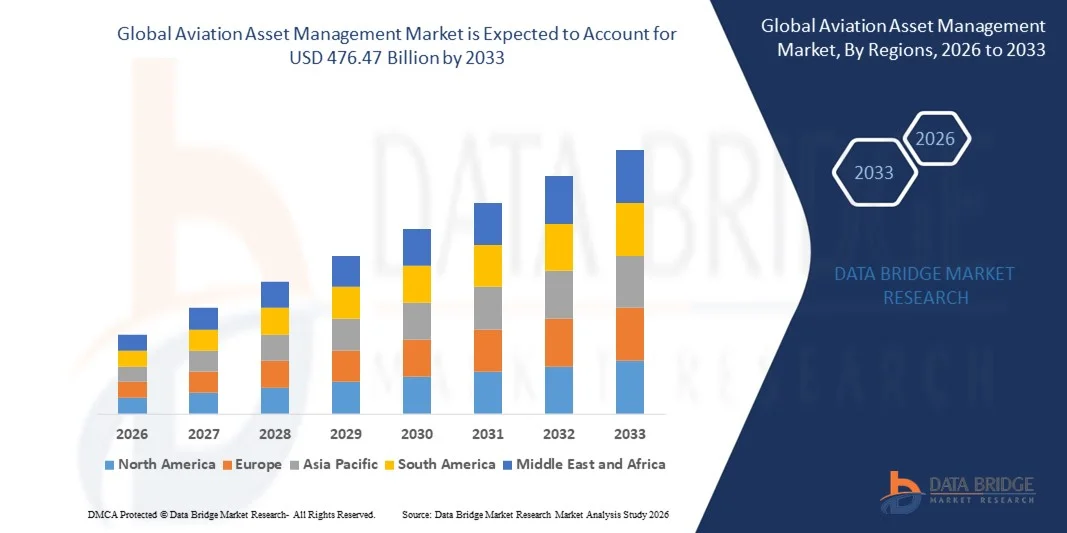
- The global aviation asset management market size was valued at USD 301.66 billion in 2025 and is expected to reach USD 476.47 billion by 2033, at a CAGR of 5.88% during the forecast period
- The market growth is largely fuelled by the rising global air passenger traffic and expanding commercial aircraft fleet across emerging and developed economies
- Increasing aircraft leasing activities, fleet modernization programs, and demand for cost-efficient asset utilization strategies are further supporting market expansion
Aviation Asset Management Market Analysis
- The market is witnessing steady growth due to the increasing shift toward asset-light business models among airlines, encouraging greater reliance on leasing companies and third-party asset managers
- Rising investments in advanced analytics, fleet planning software, and end-of-life asset remarketing solutions are further driving the evolution of aviation asset management services globally
- North America dominated the aviation asset management market with the largest revenue share of 38.76% in 2025, driven by the presence of major airlines, aircraft lessors, and established MRO providers across the region
- Asia-Pacific region is expected to witness the highest growth rate in the global aviation asset management market, driven by rising passenger traffic, growing fleet expansion, and increasing adoption of advanced asset management solutions by airlines and MRO providers
- The Narrow-Body Aircraft segment held the largest market revenue share in 2025 driven by strong demand for domestic and regional travel, expansion of low-cost carriers, and high fleet replacement rates. These aircraft offer better fuel efficiency and lower operating costs, making them highly attractive for leasing portfolios. Asset managers actively focus on narrow-body aircraft due to their stable residual values and consistent market liquidity
Report Scope and Aviation Asset Management Market Segmentation
|
Attributes |
Aviation Asset Management Key Market Insights |
|
Segments Covered |
|
|
Countries Covered |
North America
Europe
Asia-Pacific
Middle East and Africa
South America
|
|
Key Market Players |
|
|
Market Opportunities |
|
|
Value Added Data Infosets |
In addition to the market insights such as market value, growth rate, market segments, geographical coverage, market players, and market scenario, the market report curated by the Data Bridge Market Research team includes in-depth expert analysis, import/export analysis, pricing analysis, production consumption analysis, and pestle analysis. |
Aviation Asset Management Market Trends
Growing Adoption of Asset-Light Business Models and Fleet Modernization
- The increasing shift toward asset-light business models is significantly shaping the aviation asset management market, as airlines aim to optimize capital allocation and improve financial flexibility. Carriers are increasingly relying on operating leases, sale-leaseback agreements, and third-party asset managers to reduce ownership risks while maintaining fleet efficiency. This trend is strengthening demand for professional asset management services across commercial aviation
- Rising global air passenger traffic and expansion of low-cost carriers have accelerated fleet modernization initiatives. Airlines are replacing aging aircraft with fuel-efficient models to reduce operating costs and comply with environmental regulations. Aviation asset managers play a critical role in fleet planning, valuation, acquisition, and remarketing, supporting long-term profitability and operational performance
- Digital transformation trends are influencing asset monitoring and lifecycle management, with companies emphasizing predictive maintenance, real-time asset tracking, and data-driven decision-making. Advanced analytics and fleet management platforms are helping stakeholders enhance asset utilization and residual value forecasting. These technological advancements are improving transparency and efficiency across the asset management ecosystem
- For instance, in 2024, Air Lease Corporation in the U.S. and SMBC Aviation Capital in Ireland expanded their portfolios of next-generation fuel-efficient aircraft to meet rising airline demand. These investments were aligned with sustainability goals and long-term leasing strategies, strengthening competitive positioning and portfolio diversification. The developments also supported airlines in reducing carbon emissions and operating expenses
- While demand for aviation asset management services is growing, sustained market expansion depends on stable aircraft valuations, effective risk management strategies, and continuous digital innovation. Market participants are focusing on portfolio diversification, regulatory compliance, and enhanced analytics capabilities to maintain resilience in a dynamic aviation environment
Aviation Asset Management Market Dynamics
Driver
Rising Aircraft Leasing Activities and Fleet Expansion
- Increasing aircraft leasing penetration is a major driver for the aviation asset management market. Airlines are progressively opting for leasing arrangements to preserve capital, manage balance sheet exposure, and maintain operational flexibility. Asset managers support these strategies through structured financing, asset valuation, and lease portfolio optimization
- Expanding commercial aircraft fleets, particularly in emerging markets, are further influencing market growth. Growing air travel demand, new route development, and fleet renewal programs are encouraging airlines to partner with asset management firms for efficient lifecycle planning and remarketing solutions. This trend strengthens long-term revenue streams for leasing companies and asset managers
- Aviation asset management firms are actively leveraging advanced analytics, digital record-keeping, and predictive maintenance tools to enhance asset performance and reduce downtime. These initiatives align with airline objectives to improve fuel efficiency, regulatory compliance, and operational reliability. Strategic collaborations between lessors, airlines, and maintenance providers are also supporting ecosystem integration
- For instance, in 2023, AerCap Holdings N.V. in Ireland and BOC Aviation in Singapore reported increased leasing transactions and portfolio expansion driven by post-pandemic travel recovery. The companies highlighted strong demand for narrow-body aircraft and long-term lease agreements, reinforcing market confidence and revenue stability
- Although leasing growth supports market expansion, long-term sustainability depends on macroeconomic stability, fuel price trends, and effective asset risk mitigation strategies. Continuous investment in digital platforms and diversified asset portfolios will be essential for maintaining competitive advantage
Restraint/Challenge
Market Volatility and Asset Valuation Risks
- Fluctuations in aircraft demand, residual values, and secondary market conditions remain key challenges for aviation asset management companies. Economic downturns, geopolitical tensions, and travel disruptions can negatively impact lease rates and asset liquidity. Such uncertainties require robust risk assessment and financial planning mechanisms
- Regulatory changes and environmental compliance requirements also pose operational challenges. Stricter emission standards and evolving sustainability frameworks may affect the long-term viability of certain aircraft models, influencing portfolio decisions and asset valuations. Companies must continuously adapt to regulatory shifts and invest in sustainable fleet solutions
- Financing constraints and interest rate volatility further impact asset acquisition and refinancing activities. Rising borrowing costs can affect profitability and limit expansion opportunities for leasing firms. Maintaining access to diversified funding sources is critical for sustaining growth and managing financial exposure
- For instance, in 2024, several mid-sized lessors in the Middle East and Southeast Asia reported pressure on lease yields and aircraft resale values due to fluctuating travel demand and financing costs. These challenges prompted firms to reassess portfolio strategies and strengthen risk management frameworks
- Addressing these challenges will require diversified asset portfolios, advanced data analytics for valuation forecasting, and strong liquidity management. Enhanced collaboration with airlines, maintenance providers, and financial institutions will be essential to ensure long-term resilience and stability in the global aviation asset management market
Aviation Asset Management Market Scope
The market is segmented on the basis of types of aircrafts, mode of purchase, service types, and end users.
- By Types of Aircrafts
On the basis of types of aircrafts, the aviation asset management market is segmented into Wide-Body Aircraft, Narrow-Body Aircraft, and Private Jets. The Narrow-Body Aircraft segment held the largest market revenue share in 2025 driven by strong demand for domestic and regional travel, expansion of low-cost carriers, and high fleet replacement rates. These aircraft offer better fuel efficiency and lower operating costs, making them highly attractive for leasing portfolios. Asset managers actively focus on narrow-body aircraft due to their stable residual values and consistent market liquidity.
The Wide-Body Aircraft segment is expected to witness significant growth from 2026 to 2033 supported by the recovery of long-haul international travel and increasing cross-border connectivity. Airlines are modernizing fleets with next-generation wide-body aircraft to improve fuel efficiency and passenger capacity. Private Jets also contribute steadily to market demand, particularly among high-net-worth individuals and corporate operators seeking flexible ownership and management solutions.
- By Mode Of Purchase
On the basis of mode of purchase, the market is segmented into Direct Purchase, Operating Lease, Finance Lease, and Sale and Lease Back (SLB). The Operating Lease segment accounted for the largest revenue share in 2025 due to airlines’ preference for minimizing capital expenditure and maintaining fleet flexibility. Operating leases allow carriers to scale capacity according to demand cycles without long-term asset ownership risks.
The Sale and Lease Back (SLB) segment is expected to witness significant growth from 2026 to 2033 as airlines seek liquidity optimization and balance sheet strengthening. Finance leases continue to serve carriers requiring longer-term asset control, while direct purchases remain relevant for financially strong airlines aiming to retain full ownership benefits.
- By Service Types
On the basis of service types, the market is segmented into Leasing Services, Technical Services, Regulatory Certifications, and End-to-End. The Leasing Services segment dominated the market in 2025 driven by rising aircraft leasing penetration and expanding lessor portfolios. Long-term lease agreements provide predictable revenue streams and portfolio diversification opportunities for asset managers.
The End-to-End segment is projected to grow steadily from 2026 to 2033 as airlines increasingly prefer integrated solutions covering acquisition, maintenance coordination, compliance support, and remarketing. Technical services and regulatory certifications are also gaining importance due to stringent aviation safety standards and the need for continuous airworthiness compliance.
- By End Users
On the basis of end users, the market is segmented into Airline Operators, Leasing Companies, Cargo Operators, Maintenance, Repair and Overhaul (MRO) Services, and Commercial Platforms. The Airline Operators segment held the largest revenue share in 2025 driven by fleet expansion, modernization initiatives, and route network growth. Airlines rely heavily on asset managers for valuation, financing advisory, and lifecycle management support.
The Leasing Companies segment is expected to witness significant growth from 2026 to 2033 supported by increasing global leasing penetration and rising demand for flexible fleet solutions. Cargo operators are expanding fleets to meet e-commerce demand, while MRO services and commercial platforms contribute to sustained asset lifecycle management and operational efficiency across the aviation ecosystem.
Aviation Asset Management Market Regional Analysis
- North America dominated the aviation asset management market with the largest revenue share of 38.76% in 2025, driven by the presence of major airlines, aircraft lessors, and established MRO providers across the region
- Airlines in the region highly value efficient fleet lifecycle management, cost optimization strategies, and advanced digital asset tracking systems to enhance operational performance and profitability
- This strong market position is further supported by a mature aviation ecosystem, high air passenger traffic, and the increasing adoption of data-driven maintenance and leasing models, establishing aviation asset management as a critical function for both commercial and cargo operators
U.S. Aviation Asset Management Market Insight
The U.S. aviation asset management market captured the largest revenue share in 2025 within North America, fueled by the presence of leading airlines, leasing companies, and aircraft manufacturers. Operators are increasingly focusing on optimizing asset utilization, reducing maintenance costs, and extending aircraft lifespan through predictive analytics and digital monitoring systems. The growing trend of fleet modernization, combined with rising air travel demand and structured leasing arrangements, further propels the aviation asset management industry. Moreover, the integration of advanced technologies such as AI-driven maintenance planning and real-time asset tracking platforms is significantly contributing to the market's expansion.
Europe Aviation Asset Management Market Insight
The Europe aviation asset management market is expected to witness the fastest growth rate from 2026 to 2033, primarily driven by fleet renewal programs and stringent regulatory frameworks governing aircraft safety and emissions. The presence of major aircraft lessors and a strong cross-border aviation network is fostering demand for comprehensive asset management services. European operators are increasingly prioritizing sustainability, asset efficiency, and structured financing models. The region is experiencing significant activity in aircraft leasing, trading, and end-of-life asset management, with service providers supporting both legacy carriers and low-cost airlines.
U.K. Aviation Asset Management Market Insight
The U.K. aviation asset management market is expected to witness the fastest growth rate from 2026 to 2033, driven by the country’s well-established aircraft leasing industry and strong financial services sector. The U.K. serves as a key hub for aviation financing and asset trading activities. Airlines and lessors are increasingly adopting advanced portfolio management strategies to enhance returns and mitigate risks. In addition, the expansion of global leasing operations and structured asset-backed financing solutions is expected to continue stimulating market growth.
Germany Aviation Asset Management Market Insight
The Germany aviation asset management market is expected to witness the fastest growth rate from 2026 to 2033, fueled by the country’s strong engineering capabilities and emphasis on operational efficiency. German airlines and aviation service providers are focusing on optimizing fleet performance and reducing lifecycle costs through digital asset monitoring and predictive maintenance solutions. The country’s robust industrial base and commitment to sustainable aviation practices are supporting structured asset management approaches. Integration of advanced analytics and performance tracking systems is also becoming increasingly prevalent across commercial and cargo fleets.
Asia-Pacific Aviation Asset Management Market Insight
The Asia-Pacific aviation asset management market is expected to witness the fastest growth rate from 2026 to 2033, driven by rapid fleet expansion, rising passenger traffic, and increasing aircraft procurement across emerging economies. The region's growing aviation infrastructure and supportive government policies are encouraging airlines to adopt professional asset management services. Furthermore, the rise of low-cost carriers and cross-border leasing activities is strengthening demand for structured asset lifecycle solutions. As APAC continues to expand its role in global aviation manufacturing and operations, asset management services are becoming more critical to ensure cost control and operational resilience.
Japan Aviation Asset Management Market Insight
The Japan aviation asset management market is expected to witness the fastest growth rate from 2026 to 2033 due to the country’s advanced aviation infrastructure and focus on technological innovation. Japanese airlines are emphasizing fleet modernization and enhanced asset efficiency to remain competitive in international markets. The adoption of digital maintenance platforms and performance monitoring systems is supporting improved asset utilization. Moreover, Japan’s strategic investments in next-generation aircraft and sustainable aviation technologies are likely to spur demand for sophisticated asset management solutions across both passenger and cargo segments.
China Aviation Asset Management Market Insight
The China aviation asset management market accounted for the largest market revenue share in Asia Pacific in 2025, attributed to the country’s expanding airline fleet, rising domestic air travel, and strong government support for aviation development. China has emerged as a major market for aircraft procurement and leasing activities. Aviation operators are increasingly focusing on structured asset financing, maintenance optimization, and fleet lifecycle planning. The push toward expanding airport infrastructure and strengthening domestic leasing capabilities, alongside the presence of large state-backed aviation enterprises, is propelling the market in China.
Aviation Asset Management Market Share
The Aviation Asset Management industry is primarily led by well-established companies, including:
- GECAS (U.S.)
- AerData B.V. (Netherlands)
- Airbus S.A.S. (France)
- GENERAL ELECTRIC COMPANY (U.S.)
- Boeing (U.S.)
- SkyWorks Holdings, LLC (U.S.)
- BBAM Aircraft Leasing & Management (U.S.)
- GA Telesis, LLC (U.S.)
- AerCap (Ireland)
- Acumen (U.K.)
- Aviation Asset Management Inc. (AAMI) (U.S.)
- Charles Taylor (U.K.)
- Air Affairs Australia (Australia)
- AeroTargets International LLC (U.S.)
- L3Harris Technologies, Inc. (U.S.)
- Lockheed Martin Corporation (U.S.)
- Saab (Sweden)
- Leonardo S.p.A. (Italy)
- Raytheon Technologies Corporation (U.S.)
- Thales Group (France)
Latest Developments in Global Aviation Asset Management Market
- In October 2025, Airbus, Strategic Sustainability Initiative, introduced an advanced asset management framework focused on reducing aircraft lifecycle emissions through sustainable materials and optimized maintenance practices. The initiative aims to support airlines in achieving carbon reduction targets while improving long-term asset value retention. By integrating eco-efficient processes into fleet management, Airbus strengthens its sustainability positioning and regulatory alignment. This development is expected to accelerate the adoption of green asset management solutions across the global aviation industry
- In September 2025, Boeing, Service Portfolio Expansion, launched a comprehensive suite of aviation asset management services designed to enhance fleet efficiency and operational performance. The program focuses on predictive maintenance, digital asset tracking, and lifecycle cost optimization for airline operators. Through this expansion, Boeing seeks to diversify revenue streams beyond aircraft manufacturing and build long-term service partnerships. The move reinforces the growing importance of integrated asset management solutions in strengthening airline profitability and market competitiveness
- In August 2024, GE Aviation, Strategic Partnership, entered into a collaboration with a leading data analytics firm to strengthen its predictive maintenance and asset management capabilities. The initiative focuses on integrating advanced analytics and real-time performance monitoring into fleet management solutions to reduce unscheduled maintenance and operational disruptions. By leveraging data-driven insights, the company aims to enhance asset reliability, extend component lifespan, and improve airline cost efficiency. This development reinforces the growing role of digital intelligence in aviation asset management and is expected to elevate competitive standards across the global market
SKU-
Get online access to the report on the World's First Market Intelligence Cloud

- Interactive Data Analysis Dashboard
- Company Analysis Dashboard for high growth potential opportunities
- Research Analyst Access for customization & queries
- Competitor Analysis with Interactive dashboard
- Latest News, Updates & Trend analysis
- Harness the Power of Benchmark Analysis for Comprehensive Competitor Tracking
Research Methodology
Data collection and base year analysis are done using data collection modules with large sample sizes. The stage includes obtaining market information or related data through various sources and strategies. It includes examining and planning all the data acquired from the past in advance. It likewise envelops the examination of information inconsistencies seen across different information sources. The market data is analysed and estimated using market statistical and coherent models. Also, market share analysis and key trend analysis are the major success factors in the market report. To know more, please request an analyst call or drop down your inquiry.
The key research methodology used by DBMR research team is data triangulation which involves data mining, analysis of the impact of data variables on the market and primary (industry expert) validation. Data models include Vendor Positioning Grid, Market Time Line Analysis, Market Overview and Guide, Company Positioning Grid, Patent Analysis, Pricing Analysis, Company Market Share Analysis, Standards of Measurement, Global versus Regional and Vendor Share Analysis. To know more about the research methodology, drop in an inquiry to speak to our industry experts.
Customization Available
Data Bridge Market Research is a leader in advanced formative research. We take pride in servicing our existing and new customers with data and analysis that match and suits their goal. The report can be customized to include price trend analysis of target brands understanding the market for additional countries (ask for the list of countries), clinical trial results data, literature review, refurbished market and product base analysis. Market analysis of target competitors can be analyzed from technology-based analysis to market portfolio strategies. We can add as many competitors that you require data about in the format and data style you are looking for. Our team of analysts can also provide you data in crude raw excel files pivot tables (Fact book) or can assist you in creating presentations from the data sets available in the report.












