


Global Aviation Blockchain Market
Market Size in USD Billion
CAGR :
% 
 USD
17.71 Billion
USD
87.49 Billion
2025
2033
USD
17.71 Billion
USD
87.49 Billion
2025
2033
 Forecast Period Forecast Period |
2026 –2033 |
 Market Size (Base Year) Market Size (Base Year) |
USD 17.71 Billion |
 Market Size (Forecast Year) Market Size (Forecast Year) |
USD 87.49 Billion |
 CAGR CAGR |
% |
| Major Markets Players |
|
Aviation Blockchain Market Size
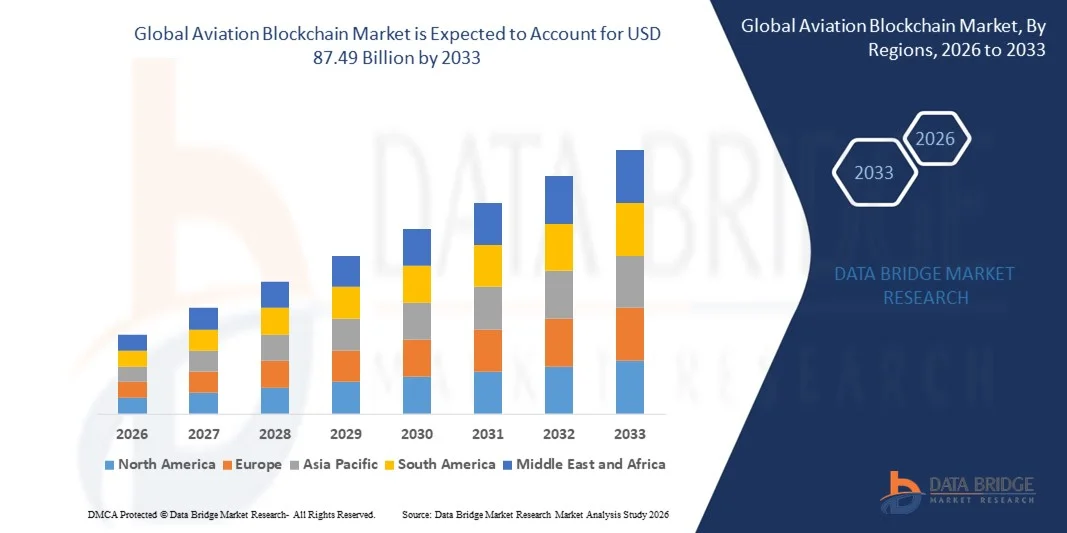
- The global aviation blockchain market size was valued at USD 17.71 billion in 2025 and is expected to reach USD 87.49 billion by 2033, at a CAGR of 22.10% during the forecast period
- The market growth is largely fuelled by the increasing need for secure, transparent, and tamper-proof systems to manage aviation data such as maintenance records, passenger identity, and cargo documentation
- The rising demand for real-time data sharing and operational efficiency across airlines, airports, and aircraft manufacturers is accelerating the adoption of blockchain technology in aviation
Aviation Blockchain Market Analysis
- The market is witnessing rapid growth due to increasing digital transformation initiatives in the aviation industry and the need to improve transparency, traceability, and efficiency across complex aviation ecosystems
- Industry participants are focusing on developing blockchain-based solutions for applications such as smart contracts, supply chain management, and secure passenger data management to enhance operational performance and reduce costs
- North America dominated the aviation blockchain market with the largest revenue share in 2025, driven by the early adoption of advanced digital technologies and the strong presence of major airlines, aircraft manufacturers, and technology providers
- Asia-Pacific region is expected to witness the highest growth rate in the global aviation blockchain market, driven by increasing air passenger traffic, expanding airport infrastructure, growing adoption of blockchain in airline and cargo operations, and strong government support for aviation digital transformation initiatives
- The record-keeping segment held the largest market revenue share in 2025 driven by the increasing need for secure, immutable, and transparent storage of aviation data such as maintenance records, passenger identity information, and operational logs. Blockchain-based record-keeping helps improve traceability, reduce data tampering risks, and enhance coordination among aviation stakeholders, making it a preferred function across the aviation ecosystem
Report Scope and Aviation Blockchain Market Segmentation
|
Attributes |
Aviation Blockchain Key Market Insights |
|
Segments Covered |
|
|
Countries Covered |
North America
Europe
Asia-Pacific
Middle East and Africa
South America
|
|
Key Market Players |
|
|
Market Opportunities |
|
|
Value Added Data Infosets |
In addition to the market insights such as market value, growth rate, market segments, geographical coverage, market players, and market scenario, the market report curated by the Data Bridge Market Research team includes in-depth expert analysis, import/export analysis, pricing analysis, production consumption analysis, and pestle analysis. |
Aviation Blockchain Market Trends
Increasing Adoption Of Blockchain For Secure And Transparent Aviation Operations
- The growing focus on improving data security and operational transparency is significantly shaping the aviation blockchain market, as aviation stakeholders increasingly seek reliable and tamper-proof digital solutions. Blockchain technology is gaining traction due to its ability to provide secure, decentralised, and immutable records for aircraft maintenance, passenger identity, and cargo management. This trend is strengthening its adoption across airlines, airports, and maintenance providers, encouraging industry participants to invest in advanced blockchain platforms that enhance trust and efficiency
- Increasing concerns regarding cybersecurity threats, data breaches, and operational inefficiencies have accelerated the demand for blockchain-based solutions in aviation. Airlines and airport operators are actively adopting blockchain to improve identity verification, streamline maintenance tracking, and enhance data sharing across stakeholders. This has also led to collaborations between technology providers and aviation companies to develop customised blockchain solutions that improve safety and operational reliability
- Digital transformation and automation trends are influencing technology adoption, with aviation companies emphasising secure data exchange, transparency, and real-time information access. These factors are helping organisations improve operational efficiency, reduce fraud risks, and ensure compliance with regulatory requirements. Companies are increasingly integrating blockchain with existing digital systems to optimise workflows and strengthen data integrity across aviation ecosystems
- For instance, in 2024, Lufthansa Group in Germany and SITA in Switzerland expanded blockchain initiatives to improve maintenance tracking and digital identity management. These implementations were introduced to enhance operational transparency and improve coordination among aviation stakeholders. The solutions were also positioned as secure and efficient alternatives to conventional systems, supporting long-term digital transformation goals
- While adoption of blockchain in aviation is increasing, sustained market expansion depends on technological scalability, integration capabilities, and industry-wide standardisation. Companies are focusing on improving interoperability, reducing implementation costs, and enhancing system performance to support broader adoption
Aviation Blockchain Market Dynamics
Driver
Growing Need For Secure Data Management And Operational Efficiency
- Increasing demand for secure, transparent, and tamper-proof data management is a major driver for the aviation blockchain market. Aviation organisations are adopting blockchain technology to protect sensitive operational and passenger data, improve traceability, and enhance trust across complex aviation networks. This trend is also encouraging innovation in decentralised platforms that support secure and efficient aviation operations
- Expanding digitalisation across airline operations, maintenance processes, and cargo management is influencing market growth. Blockchain technology enables real-time tracking, automated verification, and secure information sharing, helping aviation companies improve operational efficiency and reduce administrative complexities. The growing reliance on digital platforms globally further reinforces the importance of blockchain adoption
- Aviation companies and technology providers are actively promoting blockchain-based solutions through product innovation, pilot projects, and strategic partnerships. These efforts are supported by increasing awareness of cybersecurity risks and the need for reliable digital infrastructure. Collaborations between aviation stakeholders and technology firms are helping improve blockchain functionality and accelerate implementation
- For instance, in 2023, International Business Machines Corporation in U.S. and Airbus in France expanded blockchain applications for aviation maintenance and supply chain tracking. These initiatives were introduced to improve operational efficiency and enhance data security. Both companies also emphasised transparency and automation to strengthen operational performance and customer confidence
- Although increasing digitalisation supports market growth, wider adoption depends on technology integration, regulatory alignment, and cost efficiency. Investment in infrastructure development, research, and collaborative innovation will be essential for long-term growth and competitive advantage
Restraint/Challenge
High Implementation Costs And Integration Complexity
- The high cost of blockchain implementation compared to conventional digital systems remains a key challenge, limiting adoption among small and mid-sized aviation companies. Infrastructure investment, system development, and integration expenses contribute to higher initial costs. In addition, ongoing maintenance and technical support requirements can increase operational expenditures
- Limited technical expertise and lack of standardisation also restrict market growth, as blockchain adoption requires specialised knowledge and coordinated implementation across multiple stakeholders. Integration with existing aviation IT systems can be complex and time-consuming. This also creates operational challenges for companies with limited technological capabilities
- Regulatory uncertainty and interoperability issues further impact market expansion, as aviation organisations must ensure compliance with data protection and operational regulations. Differences in regulatory frameworks across countries can slow implementation. Companies must invest in compliance management and system compatibility to ensure successful deployment
- For instance, in 2024, aviation operators in Singapore and U.A.E. reported slower adoption of blockchain solutions due to high implementation costs and integration challenges. Limited technical expertise and regulatory uncertainties were additional barriers. These factors also encouraged some organisations to delay blockchain deployment, affecting short-term adoption
- Addressing these challenges will require cost optimisation, improved technical expertise, and stronger industry collaboration. Partnerships between technology providers, aviation companies, and regulatory bodies will be essential to support implementation and ensure long-term market growth. Furthermore, developing scalable and cost-effective blockchain solutions will be critical for widespread adoption
Aviation Blockchain Market Scope
The market is segmented on the basis of function, deployment, application, and end-use.
- By Function
On the basis of function, the aviation blockchain market is segmented into record-keeping and transactions. The record-keeping segment held the largest market revenue share in 2025 driven by the increasing need for secure, immutable, and transparent storage of aviation data such as maintenance records, passenger identity information, and operational logs. Blockchain-based record-keeping helps improve traceability, reduce data tampering risks, and enhance coordination among aviation stakeholders, making it a preferred function across the aviation ecosystem.
The transactions segment is expected to witness the fastest growth rate from 2026 to 2033, driven by the growing adoption of blockchain for secure financial transactions, automated payments, and smart contract execution. Blockchain-enabled transactions help reduce intermediaries, improve efficiency, and enhance transparency in processes such as airline revenue sharing, leasing, and insurance settlements, supporting its rapid adoption.
- By Deployment
On the basis of deployment, the aviation blockchain market is segmented into public, private, and hybrid. The private segment held the largest market revenue share in 2025 driven by its ability to provide enhanced security, controlled access, and regulatory compliance for sensitive aviation data. Private blockchain networks are widely used by airlines and airports to ensure data privacy while maintaining operational efficiency and secure collaboration.
The hybrid segment is expected to witness the fastest growth rate from 2026 to 2033, driven by its flexibility to combine the benefits of both public transparency and private security. Hybrid blockchain enables selective data sharing and controlled participation, making it suitable for complex aviation environments involving multiple stakeholders and regulatory requirements.
- By Application
On the basis of application, the aviation blockchain market is segmented into passenger identity management, cargo and baggage tracking, flight and crew data management, frequent flyer programs, smart contract, travel insurance, e-ticketing and ticket tokenization, aircraft refueling, airline revenue sharing, leasing, supply chain management, parts tracking, parts health monitoring, inventory management, and aircraft maintenance. The passenger identity management segment held the largest market revenue share in 2025 driven by the increasing need for secure and efficient identity verification systems. Blockchain helps streamline passenger processing, reduce fraud, and improve airport security, enhancing overall passenger experience.
The supply chain management segment is expected to witness the fastest growth rate from 2026 to 2033, driven by the need for improved transparency, traceability, and efficiency in aircraft parts and component tracking. Blockchain technology enables real-time monitoring, reduces operational delays, and ensures authenticity of aviation components, supporting its growing adoption.
- By End-Use
On the basis of end-use, the aviation blockchain market is segmented into airports, airlines, MRO, manufacturers, and lessors. The airlines segment held the largest market revenue share in 2025 driven by the increasing adoption of blockchain technology to improve operational efficiency, enhance passenger services, and secure transaction processes. Airlines are using blockchain for identity management, ticketing, and revenue management, making it a key end-use segment.
The MRO segment is expected to witness the fastest growth rate from 2026 to 2033, driven by the growing need for accurate maintenance records, improved parts tracking, and enhanced operational transparency. Blockchain helps MRO providers improve maintenance efficiency, ensure regulatory compliance, and reduce operational risks, supporting its rapid adoption.
Aviation Blockchain Market Regional Analysis
- North America dominated the aviation blockchain market with the largest revenue share in 2025, driven by the early adoption of advanced digital technologies and the strong presence of major airlines, aircraft manufacturers, and technology providers
- Aviation stakeholders in the region highly value blockchain technology for its ability to enhance data security, improve operational transparency, and streamline processes such as passenger identity verification, maintenance tracking, and supply chain management
- This widespread adoption is further supported by significant investments in digital transformation, strong IT infrastructure, and increasing focus on cybersecurity and operational efficiency, establishing blockchain as a critical technology in the aviation industry
U.S. Aviation Blockchain Market Insight
The U.S. aviation blockchain market captured the largest revenue share in 2025 within North America, fuelled by the rapid adoption of innovative technologies and the growing focus on improving operational efficiency and data security. Aviation companies are increasingly implementing blockchain solutions to enhance passenger processing, maintenance tracking, and financial transactions. The strong presence of major airlines, aircraft manufacturers, and blockchain solution providers, combined with increasing investment in aviation digitalisation, is further driving market growth in the country.
Europe Aviation Blockchain Market Insight
The Europe aviation blockchain market is expected to witness the fastest growth rate from 2026 to 2033, primarily driven by increasing focus on improving aviation safety, transparency, and operational efficiency. The growing adoption of digital technologies and the presence of leading aerospace companies are supporting blockchain implementation. European aviation organisations are increasingly integrating blockchain into operational processes to enhance efficiency, reduce fraud risks, and improve data management across aviation networks.
U.K. Aviation Blockchain Market Insight
The U.K. aviation blockchain market is expected to witness the fastest growth rate from 2026 to 2033, driven by the increasing adoption of advanced digital solutions and strong focus on aviation innovation. Airlines and airport operators are investing in blockchain technology to enhance passenger identity management, improve operational transparency, and strengthen cybersecurity. The country’s well-developed aviation infrastructure and increasing investment in emerging technologies are contributing to market expansion.
Germany Aviation Blockchain Market Insight
The Germany aviation blockchain market is expected to witness the fastest growth rate from 2026 to 2033, fuelled by the strong presence of aircraft manufacturers and increasing focus on digital transformation. Aviation companies in the country are adopting blockchain to improve maintenance tracking, supply chain transparency, and operational efficiency. The emphasis on innovation, automation, and secure digital systems is supporting the growing implementation of blockchain technology.
Asia-Pacific Aviation Blockchain Market Insight
The Asia-Pacific aviation blockchain market is expected to witness the fastest growth rate from 2026 to 2033, driven by rapid expansion of the aviation industry, increasing passenger traffic, and rising investment in digital aviation infrastructure. Governments and aviation companies across the region are adopting blockchain to enhance operational efficiency, improve passenger experience, and strengthen aviation security. The growing aviation ecosystem is creating significant opportunities for blockchain adoption.
Japan Aviation Blockchain Market Insight
The Japan aviation blockchain market is expected to witness the fastest growth rate from 2026 to 2033 due to the country’s advanced technology landscape and strong focus on aviation innovation. Aviation stakeholders are increasingly implementing blockchain solutions to improve operational efficiency, enhance passenger identity verification, and strengthen data security. The increasing integration of digital technologies in aviation operations is supporting market growth.
China Aviation Blockchain Market Insight
The China aviation blockchain market accounted for the largest market revenue share in Asia-Pacific in 2025, attributed to the country’s expanding aviation sector and strong focus on digital transformation. Airlines and airport operators are increasingly adopting blockchain technology to improve operational efficiency, enhance passenger processing, and strengthen supply chain management. The presence of large aviation companies and increasing investment in advanced technologies are key factors driving market growth in China.
Aviation Blockchain Market Share
The Aviation Blockchain industry is primarily led by well-established companies, including:
- IBM (U.S.)
- Microsoft Corporation (U.S.)
- 14Bis Supply Tracking (U.S.)
- Aeron Labs (U.S.)
- Avinoc LTD (U.K.)
- Credits Inc. (U.S.)
- Filament (U.S.)
- Infosys Limited (India)
- Insolar (Switzerland)
- LeewayHertz. (U.S.)
- Moog Inc. (U.S.)
- OLISTICS. (U.K.)
- Enspan.io. (U.K.)
- Quillhash Technologies Pvt. Ltd. (India)
- SkyBuys (U.K.)
- SORAblocks (U.S.)
- Sweetbridge. (U.S.)
- Volantio Inc (U.S.)
- Winding Tree (Switzerland)
- Zamna Technologies Limited (U.K.)
Latest Developments in Global Aviation Blockchain Market
- In April 2024, Greater Toronto Airports Authority in partnership with SITA, conducted a pilot deployment at Toronto Pearson Airport for its Airport Operations Total Optimizer, a digital management platform designed to integrate multiple operational data sources, improving real-time decision-making, operational efficiency, and setting a benchmark for blockchain-enabled airport operational transparency and optimization across global aviation markets
- In August 2023, SITA partnered with Envision Digital to deploy AIoT-enabled digital solutions for airports, enabling real-time tracking of emissions, energy use, and operational data, supporting sustainability goals, reducing operational costs, and accelerating adoption of secure digital and blockchain-compatible environmental monitoring systems
- In April 2023, CGI signed a five-year digital transformation agreement with Fraport AG to modernize operations at Frankfurt Airport, enhancing passenger experience, enabling secure data exchange, and strengthening the foundation for blockchain-driven digital ecosystems and smart airport infrastructure development
- In January 2023, Alstef Group secured a contract from Kyzylorda Airport to implement an advanced baggage handling system, improving operational automation, efficiency, and data accuracy, while supporting the aviation industry’s shift toward digitally connected and blockchain-integrated asset and baggage tracking solutions
- In July 2022, Air Marakanda collaborated with TAV Technologies, a subsidiary of Groupe ADP, to digitize operations at Samarkand International Airport, enhancing operational visibility, enabling secure digital data management, and contributing to the broader adoption of blockchain-supported aviation digital transformation initiatives worldwide
SKU-
Get online access to the report on the World's First Market Intelligence Cloud

- Interactive Data Analysis Dashboard
- Company Analysis Dashboard for high growth potential opportunities
- Research Analyst Access for customization & queries
- Competitor Analysis with Interactive dashboard
- Latest News, Updates & Trend analysis
- Harness the Power of Benchmark Analysis for Comprehensive Competitor Tracking
Research Methodology
Data collection and base year analysis are done using data collection modules with large sample sizes. The stage includes obtaining market information or related data through various sources and strategies. It includes examining and planning all the data acquired from the past in advance. It likewise envelops the examination of information inconsistencies seen across different information sources. The market data is analysed and estimated using market statistical and coherent models. Also, market share analysis and key trend analysis are the major success factors in the market report. To know more, please request an analyst call or drop down your inquiry.
The key research methodology used by DBMR research team is data triangulation which involves data mining, analysis of the impact of data variables on the market and primary (industry expert) validation. Data models include Vendor Positioning Grid, Market Time Line Analysis, Market Overview and Guide, Company Positioning Grid, Patent Analysis, Pricing Analysis, Company Market Share Analysis, Standards of Measurement, Global versus Regional and Vendor Share Analysis. To know more about the research methodology, drop in an inquiry to speak to our industry experts.
Customization Available
Data Bridge Market Research is a leader in advanced formative research. We take pride in servicing our existing and new customers with data and analysis that match and suits their goal. The report can be customized to include price trend analysis of target brands understanding the market for additional countries (ask for the list of countries), clinical trial results data, literature review, refurbished market and product base analysis. Market analysis of target competitors can be analyzed from technology-based analysis to market portfolio strategies. We can add as many competitors that you require data about in the format and data style you are looking for. Our team of analysts can also provide you data in crude raw excel files pivot tables (Fact book) or can assist you in creating presentations from the data sets available in the report.












