


Global Baby Feeding Bottle Market
Market Size in USD Billion
CAGR :
% 
 USD
3.48 Billion
USD
5.46 Billion
2025
2033
USD
3.48 Billion
USD
5.46 Billion
2025
2033
 Forecast Period Forecast Period |
2026 –2033 |
 Market Size (Base Year) Market Size (Base Year) |
USD 3.48 Billion |
 Market Size (Forecast Year) Market Size (Forecast Year) |
USD 5.46 Billion |
 CAGR CAGR |
% |
| Major Markets Players |
|
Baby Feeding Bottle Market Size
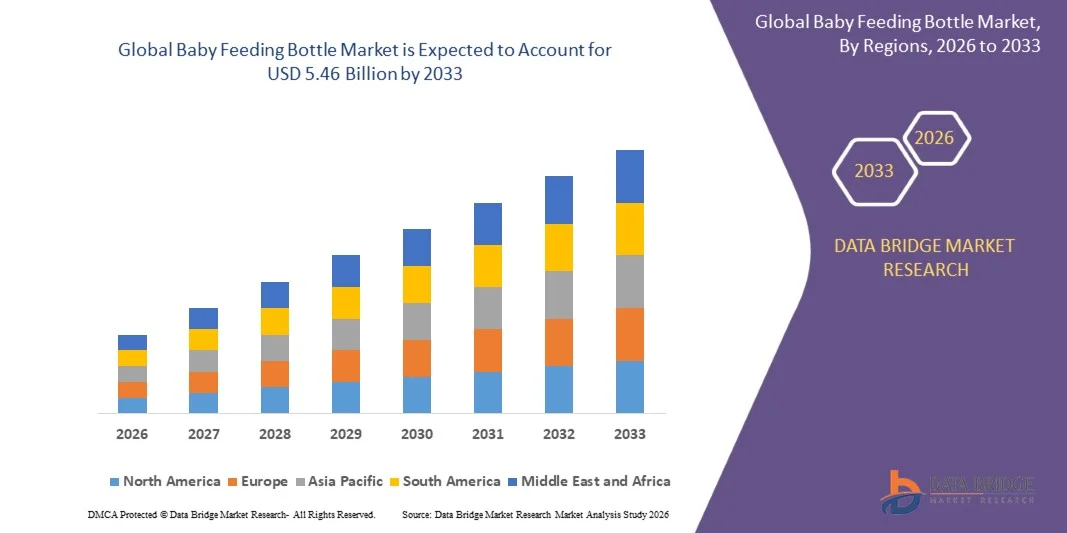
- The global baby feeding bottle market size was valued at USD 3.48 billion in 2025 and is expected to reach USD 5.46 billion by 2033, at a CAGR of 5.8% during the forecast period
- The market growth is largely fueled by rising awareness of infant nutrition, hygiene, and safety, leading to increased demand for reliable and hygienic baby feeding solutions across both developed and emerging economies. Increasing urbanization and the growing number of working parents are further accelerating the adoption of convenient feeding products that support structured infant care routines
- Furthermore, expanding product innovation in terms of material safety, anti-colic designs, and ergonomic bottle structures is strengthening consumer confidence and boosting market adoption. These converging factors, along with growing preference for BPA-free, glass, and silicone-based feeding bottles, are significantly driving the expansion of the baby feeding bottle industry
Baby Feeding Bottle Market Analysis
- Baby feeding bottles are essential infant care products designed to feed babies with milk or formula using safe and controlled flow systems. These bottles are manufactured using materials such as plastic, glass, silicone, and stainless steel, and are designed with features such as anti-colic valves, ergonomic shapes, and temperature resistance to enhance feeding comfort and safety
- The escalating demand for baby feeding bottles is primarily fueled by rising birth rates in developing regions, increasing participation of women in the workforce, and growing awareness of infant health and feeding safety standards, which together are supporting consistent market growth across global regions
- Asia-Pacific dominated baby feeding bottle market with a share of 33.7% in 2025, due to high birth rates, large infant population base, and strong demand for affordable baby care products
- North America is expected to be the fastest growing region in the baby feeding bottle market during the forecast period due to high adoption of premium baby care products and increasing focus on infant health and safety
- Plastic segment dominated the market in 2025, due to its lightweight nature, affordability, and widespread availability across both developed and emerging markets. Parents often prefer plastic bottles due to their durability, ease of handling, and reduced risk of breakage during daily use and travel. Manufacturers also focus on BPA-free plastic innovations, which strengthens consumer trust and supports large-scale adoption
Report Scope and Baby Feeding Bottle Market Segmentation
|
Attributes |
Baby Feeding Bottle Key Market Insights |
|
Segments Covered |
|
|
Countries Covered |
North America · U.S. · Canada · Mexico Europe · Germany · France · U.K. · Netherlands · Switzerland · Belgium · Russia · Italy · Spain · Turkey · Rest of Europe Asia-Pacific · China · Japan · India · South Korea · Singapore · Malaysia · Australia · Thailand · Indonesia · Philippines · Rest of Asia-Pacific Middle East and Africa · Saudi Arabia · U.A.E. · South Africa · Egypt · Israel · Rest of Middle East and Africa South America · Brazil · Argentina · Rest of South America |
|
Key Market Players |
· Mayborn Group Limited (U.K.) · Koninklijke Philips N.V. (Netherlands) · Lansinoh Laboratories, Inc. (U.S.) · NOVATEX GmbH (Germany) · Handi-Craft Company (U.S.) · Munchkin, Inc. (U.S.) · Babisil International Ltd. (U.K.) · Pigeon Corporation (Japan) · Linco Baby Merchandise Works Co., Ltd (Taiwan) · Comotomo (South Korea) · ALPHA BABY CARE CO., LTD (China) · Richell Corporation (Japan) · Steribottle Ltd (U.K.) · Artsana S.p.A. (Italy) · Evenflo Feeding, Inc. (U.S.) · Nurnberg Gummi Babyartikel GmbH & Co. KG (Germany) · Mimijumi (U.S.) · Betta Baby Bottle (Japan) · Pacific Baby INC (U.S.) · Takaso Products Sdn Bhd (Malaysia) |
|
Market Opportunities |
· Expansion of Premium and Smart Baby Feeding Bottle Innovations · Growing Penetration of E-Commerce and Direct-To-Consumer Sales Channels |
|
Value Added Data Infosets |
In addition to the insights on market scenarios such as market value, growth rate, segmentation, geographical coverage, and major players, the market reports curated by the Data Bridge Market Research also include in-depth expert analysis, pricing analysis, brand share analysis, consumer survey, demography analysis, supply chain analysis, value chain analysis, raw material/consumables overview, vendor selection criteria, PESTLE Analysis, Porter Analysis, and regulatory framework. |
Baby Feeding Bottle Market Trends
“Growing Demand for Eco-Friendly and BPA-Free Baby Feeding Bottles”
- A significant trend in the baby feeding bottle market is the increasing shift toward eco-friendly, BPA-free, and safer material-based feeding bottles driven by rising parental concern regarding infant health and chemical safety exposure. This trend is further reinforced by growing awareness of sustainable parenting practices and the preference for glass, silicone, and high-grade polypropylene alternatives over conventional plastic bottles
- For instance, Koninklijke Philips N.V. (Philips Avent) and Pigeon Corporation have expanded their BPA-free and anti-colic feeding bottle portfolios, focusing on safe material composition and improved infant comfort. Such product innovations strengthen consumer trust and support the shift toward safer and environmentally responsible baby feeding solutions
- The adoption of sustainable baby care products is increasing as parents become more conscious of long-term environmental impact and product recyclability. Manufacturers are responding by developing reusable, durable, and non-toxic feeding bottles that align with global sustainability expectations
- Premiumization of baby feeding products is also emerging as a key trend, with growing demand for advanced features such as anti-colic systems, temperature-resistant materials, and ergonomic designs. This is encouraging brands to invest in differentiated product offerings that combine safety with enhanced usability
- E-commerce expansion is accelerating the visibility of eco-friendly and premium baby feeding bottles, allowing parents to compare safety certifications, material quality, and brand reputation more easily. This digital shift is supporting faster adoption of innovative feeding solutions across urban markets
- Overall, the increasing focus on infant safety, sustainability, and product innovation is reshaping purchasing behavior and strengthening demand for advanced baby feeding bottle solutions globally
Baby Feeding Bottle Market Dynamics
Driver
“Rising Awareness of Infant Health, Hygiene, and Safe Feeding Practices”
- The baby feeding bottle market is primarily driven by increasing awareness among parents regarding infant health, hygiene, and safe feeding practices, which has led to strong demand for high-quality and contamination-free feeding solutions. This awareness is further supported by pediatric recommendations emphasizing safe feeding materials and proper bottle sterilization practices
- For instance, Mayborn Group Limited (Tommee Tippee) and Handi-Craft Company (Dr. Brown’s) have introduced advanced anti-colic and hygiene-focused feeding bottle systems designed to improve infant digestion and reduce feeding discomfort. These innovations strengthen consumer confidence and drive adoption of scientifically designed feeding solutions
- Rising birth rates in emerging economies and growing nuclear family structures are increasing dependency on standardized infant care products. This shift is encouraging parents to opt for branded and certified baby feeding bottles that ensure consistent quality and safety
- Healthcare professionals and hospitals are increasingly recommending BPA-free and medically tested feeding bottles, which is further boosting demand across both developed and developing regions. This institutional influence is reinforcing safe feeding practices among new parents
- Overall, increasing emphasis on infant well-being, supported by healthcare guidance and parental awareness, is a key factor driving sustained growth in the baby feeding bottle market
Restraint/Challenge
“High Competition from Low-Cost and Unorganized Market Players”
- The baby feeding bottle market faces significant challenges due to intense competition from low-cost and unorganized regional manufacturers offering inexpensive alternatives. These products often attract price-sensitive consumers, particularly in emerging markets, thereby pressuring established global brands on pricing and margins
- For instance, regional manufacturers in Asia-Pacific markets, including smaller-scale producers in China and Southeast Asia, supply low-priced plastic feeding bottles that compete directly with branded products from companies such as Koninklijke Philips N.V. and Pigeon Corporation. This price competition limits premium product penetration in certain markets
- The presence of counterfeit and non-certified products in some regions raises concerns regarding product safety and quality compliance. This affects consumer trust and creates additional challenges for regulated manufacturers focusing on safety standards
- Strong price sensitivity in developing economies often leads consumers to prioritize affordability over advanced features or premium materials. This limits the adoption of high-end feeding bottles despite increasing awareness of safety benefits
- Overall, the dominance of low-cost alternatives and fragmented market structure continues to challenge premium manufacturers in terms of pricing pressure, brand differentiation, and market share expansion
Baby Feeding Bottle Market Scope
The market is segmented on the basis of material, capacity, and distribution channel.
- By Material
On the basis of material, the baby feeding bottle market is segmented into plastic, glass, stainless steel, silicone, and others. The plastic segment dominated the largest market revenue share in 2025, driven by its lightweight nature, affordability, and widespread availability across both developed and emerging markets. Parents often prefer plastic bottles due to their durability, ease of handling, and reduced risk of breakage during daily use and travel. Manufacturers also focus on BPA-free plastic innovations, which strengthens consumer trust and supports large-scale adoption. The compatibility of plastic bottles with various nipple types and sterilization methods further reinforces their dominant position in the market. Growing demand from mass-market consumers continues to sustain the leadership of this segment.
The glass segment is anticipated to witness the fastest growth rate from 2026 to 2033, driven by increasing consumer preference for chemical-free and eco-friendly feeding solutions. Glass bottles are perceived as safer for infants due to their non-toxic nature and resistance to chemical leaching, which is gaining importance among health-conscious parents. Rising awareness regarding sustainability and reduced plastic usage is further supporting the shift toward glass-based alternatives. Manufacturers are also introducing silicone sleeves and tempered designs to improve safety and usability, making glass bottles more practical for everyday use. Premium positioning and long-term durability are accelerating adoption in urban households.
- By Capacity
On the basis of capacity, the baby feeding bottle market is segmented into up to 4 oz, 4.1 to 6 oz, 6.1 to 9 oz, and greater than 9 oz. The 6.1 to 9 oz segment dominated the largest market revenue share in 2025, driven by its suitability for infants in the mid-feeding stage where standard milk intake requirements are higher. This capacity range is widely recommended by pediatric guidelines, making it a preferred choice among parents and healthcare professionals. Its versatility allows it to be used across different feeding stages, reducing the need for frequent bottle replacement. Strong availability across major retail and pharmacy channels further supports its dominance. The balance between convenience and functionality continues to reinforce its leading position in the market.
The up to 4 oz segment is expected to witness the fastest growth rate from 2026 to 2033, driven by rising demand for newborn-specific feeding solutions. This smaller capacity is ideal for early-stage infants who require frequent but smaller feedings, making it highly relevant for initial months of childcare. Increasing awareness around specialized infant nutrition and early-life feeding precision is supporting adoption of this segment. Parents are also increasingly purchasing dedicated newborn kits that include smaller bottles for better feeding management. Growing hospital recommendations for controlled feeding volumes further contribute to its rapid expansion.
- By Distribution Channel
On the basis of distribution channel, the baby feeding bottle market is segmented into pharmacy and drug stores, specialty stores, hypermarkets and supermarkets, convenience stores, online retailing, and other retailing formats. The pharmacy and drug stores segment dominated the largest market revenue share in 2025, driven by strong consumer trust in healthcare-associated retail environments. Parents often prefer purchasing baby feeding products from pharmacies due to perceived product authenticity and access to professional guidance. These stores also stock a wide range of pediatric-recommended brands, ensuring reliable availability. The presence of bundled infant care products further enhances purchase convenience. Established retail networks and strong brand partnerships continue to sustain dominance of this channel.
The online retailing segment is anticipated to witness the fastest growth rate from 2026 to 2033, driven by increasing digital adoption and convenience-focused shopping behavior among parents. E-commerce platforms offer a wider product variety, competitive pricing, and doorstep delivery, making them highly attractive for infant care purchases. Detailed product descriptions, reviews, and comparison features also help parents make informed decisions. Rapid expansion of mobile commerce and improved logistics infrastructure are further strengthening online accessibility. Subscription models and discount-driven sales strategies continue to accelerate growth in this channel.
Baby Feeding Bottle Market Regional Analysis
- Asia-Pacific dominated the baby feeding bottle market with the largest revenue share of 33.7% in 2025, driven by high birth rates, large infant population base, and strong demand for affordable baby care products
- The region benefits from strong manufacturing capabilities, cost-efficient production infrastructure, and widespread availability of baby feeding bottles across retail and pharmacy channels
- Rising urbanization, increasing female workforce participation, and growing awareness of infant nutrition are accelerating market expansion across both urban and semi-urban areas
China Baby Feeding Bottle Market Insight
China held the largest share in the Asia-Pacific baby feeding bottle market in 2025, supported by its large infant population and well-established baby care product manufacturing ecosystem. The country has strong production capacity for plastic and silicone-based feeding bottles, enabling large-scale domestic supply and exports. High penetration of modern retail channels and e-commerce platforms is further strengthening product accessibility. In addition, increasing focus on infant health and safety standards is driving demand for premium and BPA-free feeding bottles.
India Baby Feeding Bottle Market Insight
India is witnessing the fastest growth in the Asia-Pacific region, driven by a rising birth rate, expanding middle-class population, and increasing awareness of infant hygiene and nutrition. Growing urbanization and higher adoption of working-parent households are boosting demand for convenient baby feeding solutions. The expansion of pharmacy networks and online retail platforms is improving product availability across tier 2 and tier 3 cities. In addition, rising preference for branded and safe infant care products is accelerating long-term market growth.
Europe Baby Feeding Bottle Market Insight
The Europe baby feeding bottle market is expanding steadily, supported by strong demand for premium, safe, and eco-friendly infant feeding products. Consumers in the region show high preference for glass and silicone bottles due to health and sustainability concerns. Strict regulatory standards regarding infant product safety are driving manufacturers to focus on high-quality materials and BPA-free solutions. In addition, growing awareness of sustainable parenting practices is encouraging adoption of recyclable and reusable feeding bottles.
Germany Baby Feeding Bottle Market Insight
Germany accounted for the largest share in the Europe baby feeding bottle market in 2025, driven by high consumer awareness and strong demand for premium infant care products. The country has a well-developed retail and pharmacy network ensuring easy product availability. Parents increasingly prefer glass and high-quality silicone bottles due to safety and durability concerns. In addition, strong regulatory compliance and emphasis on infant health standards are reinforcing Germany’s leading position in the regional market.
U.K. Baby Feeding Bottle Market Insight
The U.K. market is supported by strong demand from urban households and increasing preference for premium and ergonomically designed feeding bottles. Growing awareness of BPA-free and eco-friendly products is encouraging a shift toward safer material options. The presence of well-established retail chains and expanding online platforms is improving accessibility. In addition, rising focus on infant wellness and product innovation is supporting steady market growth.
North America Baby Feeding Bottle Market Insight
North America is projected to grow at the fastest CAGR from 2026 to 2033, driven by high adoption of premium baby care products and increasing focus on infant health and safety. Strong consumer preference for technologically advanced and ergonomic feeding bottles is supporting market expansion. Rising demand for BPA-free, glass, and silicone bottles is further accelerating growth. In addition, strong e-commerce penetration and product innovation by leading brands are boosting regional demand.
U.S. Baby Feeding Bottle Market Insight
The U.S. accounted for the largest share in the North America baby feeding bottle market in 2025, supported by high consumer spending on infant care and strong brand presence. The country has a well-established retail and online distribution ecosystem ensuring wide product accessibility. Parents increasingly prefer advanced feeding bottles with anti-colic and temperature-control features. In addition, strong product innovation and focus on infant safety standards are reinforcing the U.S. leadership position in the regional market.
Baby Feeding Bottle Market Share
The baby feeding bottle industry is primarily led by well-established companies, including:
- Mayborn Group Limited (U.K.)
- Koninklijke Philips N.V. (Netherlands)
- Lansinoh Laboratories, Inc. (U.S.)
- NOVATEX GmbH (Germany)
- Handi-Craft Company (U.S.)
- Munchkin, Inc. (U.S.)
- Babisil International Ltd. (U.K.)
- Pigeon Corporation (Japan)
- Linco Baby Merchandise Works Co., Ltd (Taiwan)
- Comotomo (South Korea)
- ALPHA BABY CARE CO., LTD (China)
- Richell Corporation (Japan)
- Steribottle Ltd (U.K.)
- Artsana S.p.A. (Italy)
- Evenflo Feeding, Inc. (U.S.)
- Nurnberg Gummi Babyartikel GmbH & Co. KG (Germany)
- Mimijumi (U.S.)
- Betta Baby Bottle (Japan)
- Pacific Baby INC (U.S.)
- Takaso Products Sdn Bhd (Malaysia)
Latest Developments in Global Baby Feeding Bottle Market
- In April 2026, Philips Avent launched an upgraded Natural Response Baby Bottle line featuring enhanced flow control technology designed to better mimic breastfeeding patterns. The innovation introduced a redesigned nipple system that allows milk to be released only when the baby actively sucks, helping reduce overfeeding and supporting more natural feeding behavior. The bottles were also manufactured using BPA-free, high-grade materials with improved durability and sterilization compatibility. This launch strengthened Philips Avent’s position in the advanced functional baby feeding bottle segment and reflected growing demand for breastfeeding-compatible bottle designs
- In June 2025, Munchkin introduced the Bond™ Silicone Glass Bottle, strengthening its position in the premium baby feeding bottle segment by addressing growing parental concerns around material safety and durability. The product combined a borosilicate glass inner layer with a permanently bonded silicone exterior, ensuring milk contact only with glass while improving break resistance and grip comfort. The integrated silicone anti-colic valve system helped reduce air intake during feeding, enhancing infant comfort and supporting functional innovation in the market. This launch reinforced the shift toward hybrid material solutions that combine safety, usability, and premium design positioning
- In March 2025, Hegen expanded its portfolio with the launch of the Hegen Lifestyle Bottle, supporting the company’s strategy to build a long-term feeding and hydration ecosystem for families. The product was developed using Polyphenylsulfone (PPSU) material and incorporated the brand’s Press-to-Close, Twist-to-Open (PCTO™) mechanism for improved usability and leak prevention. It also introduced modular silicone accessories such as handles and protective boots, enhancing personalization and extending product lifecycle beyond infant feeding. This development strengthened the trend of multipurpose bottle systems designed for extended usage across different age groups
- In February 2024, Emulait entered a strategic distribution partnership with Jet-Set-Go, significantly improving its market penetration across North America. The collaboration enabled wider availability of Emulait’s biomimetic baby bottles, which are designed using 3D scanning technology to replicate the natural anatomy of breastfeeding. By leveraging an established retail and distribution network, the company expanded access to its science-driven feeding solution across the U.S. and Canada. This development reinforced the growing demand for advanced, breastfeeding-alternative bottle designs in the premium segment
- In January 2024, Pigeon Singapore partnered with LyondellBasell to enhance sustainability in baby feeding bottle manufacturing through the use of CirculenRenew bio-based polypropylene. The initiative focused on integrating renewable feedstock materials into components such as caps, hoods, and handles of SofTouch nursing bottles, reducing reliance on conventional virgin plastics. This collaboration contributed to lowering carbon footprint while maintaining product safety and performance standards. It also highlighted the increasing industry shift toward eco-friendly and circular economy-based material adoption in infant care products
SKU-
Get online access to the report on the World's First Market Intelligence Cloud

- Interactive Data Analysis Dashboard
- Company Analysis Dashboard for high growth potential opportunities
- Research Analyst Access for customization & queries
- Competitor Analysis with Interactive dashboard
- Latest News, Updates & Trend analysis
- Harness the Power of Benchmark Analysis for Comprehensive Competitor Tracking
Research Methodology
Data collection and base year analysis are done using data collection modules with large sample sizes. The stage includes obtaining market information or related data through various sources and strategies. It includes examining and planning all the data acquired from the past in advance. It likewise envelops the examination of information inconsistencies seen across different information sources. The market data is analysed and estimated using market statistical and coherent models. Also, market share analysis and key trend analysis are the major success factors in the market report. To know more, please request an analyst call or drop down your inquiry.
The key research methodology used by DBMR research team is data triangulation which involves data mining, analysis of the impact of data variables on the market and primary (industry expert) validation. Data models include Vendor Positioning Grid, Market Time Line Analysis, Market Overview and Guide, Company Positioning Grid, Patent Analysis, Pricing Analysis, Company Market Share Analysis, Standards of Measurement, Global versus Regional and Vendor Share Analysis. To know more about the research methodology, drop in an inquiry to speak to our industry experts.
Customization Available
Data Bridge Market Research is a leader in advanced formative research. We take pride in servicing our existing and new customers with data and analysis that match and suits their goal. The report can be customized to include price trend analysis of target brands understanding the market for additional countries (ask for the list of countries), clinical trial results data, literature review, refurbished market and product base analysis. Market analysis of target competitors can be analyzed from technology-based analysis to market portfolio strategies. We can add as many competitors that you require data about in the format and data style you are looking for. Our team of analysts can also provide you data in crude raw excel files pivot tables (Fact book) or can assist you in creating presentations from the data sets available in the report.












