




Global Baby Monitors Market
Market Size in USD Billion
CAGR :
% 
 USD
1.73 Billion
USD
2.65 Billion
2025
2033
USD
1.73 Billion
USD
2.65 Billion
2025
2033
 Forecast Period Forecast Period |
2026 - 2033 |
 Market Size (Base Year) Market Size (Base Year) |
USD 1.73 Billion |
 Market Size (Forecast Year) Market Size (Forecast Year) |
USD 2.65 Billion |
 CAGR CAGR |
% |
| Major Markets Players |
|
Baby Monitors Market Overview
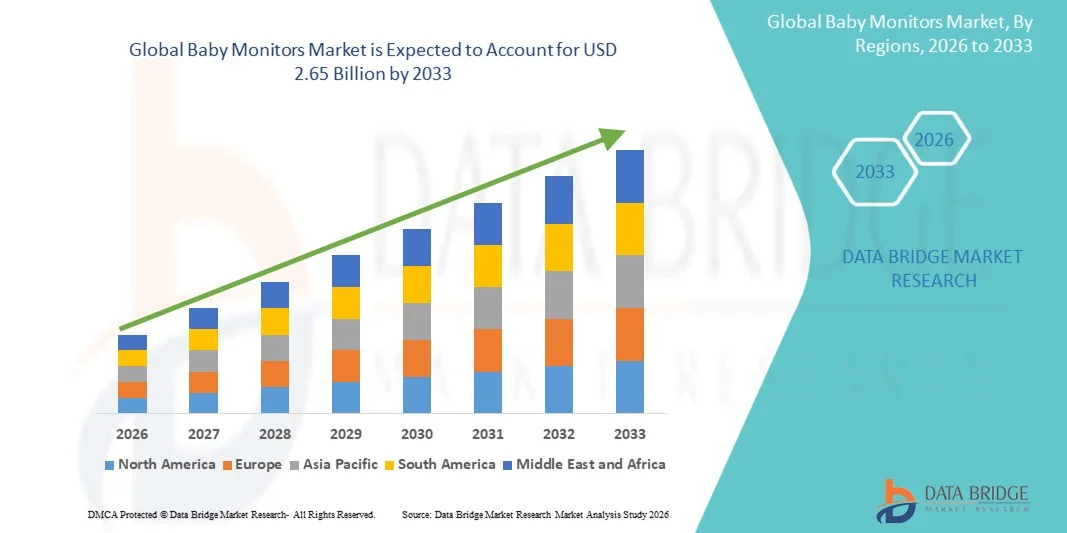
The Baby Monitors Market was valued at USD 1.73 billion in 2025 and is projected to reach USD 2.65 billion by 2033, growing at a CAGR of 5.50% from 2026 to 2033. The market is witnessing steady growth driven by increasing parental awareness regarding infant safety, rising adoption of smart home devices, and rapid technological advancements in audio, video, and wearable monitoring systems. Integration of Wi-Fi connectivity, AI-based alerts, and mobile app-based remote monitoring is further enhancing product demand across urban households.
The growing number of nuclear families, increasing working parent population, and higher disposable incomes are significantly contributing to market expansion. In addition, concerns over Sudden Infant Death Syndrome (SIDS) and the need for continuous infant supervision are pushing demand for advanced monitoring solutions. Smart baby monitors with features such as sleep tracking, temperature sensing, two-way communication, and cloud connectivity are increasingly replacing traditional audio-only devices, offering enhanced convenience, real-time monitoring, and improved child safety outcome
Key Market Trends & Insights
- North America dominated the Baby Monitors Market with the largest revenue share of 34.38% in 2025, supported by high consumer spending on smart baby care products, strong penetration of connected home devices, and early adoption of advanced monitoring technologies.
- The Video Baby Monitors segment led the market with a 40.45% share in 2025, driven by the rising parental preference for real-time visual monitoring and enhanced infant safety awareness.
- Asia-Pacific is expected to be the fastest-growing region at a CAGR of 7.9% from 2026 to 2033, fueled by rising birth rates, expanding middle-class population, and increasing adoption of smart childcare devices in China, India, and Southeast Asia.
- Motion Sensor Baby Monitors are the fastest-growing product type, projected to register a CAGR of 8.1%, reflecting the surge in demand for advanced infant safety monitoring.
- The Wireless/Wi-Fi Baby Monitors segment dominated the mode of communication category with a 70.4% revenue share in 2025, led by increasing adoption of smart home ecosystems and remote monitoring capabilities.
- Medium accounted for 45.8% of the market, preferred by strong demand from middle-income households seeking a balance between affordability and advanced features.
- The Commercial segment is the fastest-growing application category, with a CAGR of 7.9%, driven by increasing adoption in daycare centers, hospitals, and maternity care facilities.
Market Size & Forecast
- Global Market Value (2025): USD 1.73 Billion
- Expected Market Value (2033): USD 2.65 Billion
- Forecast CAGR (2026–2033): 5.50%
- Leading Region in 2025: North America
- Fastest Growing Region: Asia Pacific
Report Scope and Baby Monitors Market Segmentation
|
Attributes |
Baby Monitors Key Market Insights |
|
Segments Covered |
|
|
Countries Covered |
North America · U.S. · Canada · Mexico Europe · Germany · France · U.K. · Netherlands · Switzerland · Belgium · Russia · Italy · Spain · Turkey · Rest of Europe Asia-Pacific · China · Japan · India · South Korea · Singapore · Malaysia · Australia · Thailand · Indonesia · Philippines · Rest of Asia-Pacific Middle East and Africa · Saudi Arabia · U.A.E. · South Africa · Egypt · Israel · Rest of Middle East and Africa South America · Brazil · Argentina · Rest of South America |
|
Key Market Players |
· Owlet, Inc. (U.S.) · Nanit Inc. (U.S.) · Motorola Mobility LLC (U.S.) · VTech Holdings Limited (Hong Kong) · Summer Infant, Inc. (U.S.) · Angelcare Monitor Inc. (Canada) · Arlo Technologies, Inc. (U.S.) · Xiaomi Corporation (China) · Anker Innovations Limited (China) · iBaby Labs, Inc. (U.S.) · Hubble Connected Limited (U.K.) · Dorel Juvenile Group, Inc. (U.S.) · Infant Optics Inc. (U.S.) · CuboAi Technologies Inc. (Taiwan) · Google LLC (U.S.) · Samsung Electronics Co., Ltd. (South Korea) · LeFun Technology Co., Ltd. (China) · HelloBaby (China) · Philips Electronics Nederland B.V. (Netherlands) |
|
Market Opportunities |
· Expansion of AI-powered predictive monitoring systems · Rising opportunity in integration of baby monitors with broader smart home ecosystems · Growing demand in emerging economies |
|
Value Added Data Infosets |
In addition to the insights on market scenarios such as market value, growth rate, segmentation, geographical coverage, and major players, the market reports curated by the Data Bridge Market Research also include in-depth expert analysis, patient epidemiology, pipeline analysis, pricing analysis, and regulatory framework. |
Baby Monitors Market Trends
Trend: Growth in Smart AI-Enabled Infant Monitoring Systems
Parents are increasingly adopting smart baby monitors integrated with AI-based cry detection, sleep tracking, and biometric sensing to enhance infant safety and early health awareness. These advanced systems leverage machine learning algorithms to analyze baby behavior patterns and provide real-time alerts through mobile applications. For instance, companies such as Nanit and Owlet are integrating computer vision and wearable sensor technologies to deliver continuous, data-driven insights on infant sleep quality and breathing patterns, creating a more proactive parenting experience.
Baby Monitors Market Dynamics
Key Market Driver: Rising Demand for Connected Home-Based Infant Safety Solutions
The growing penetration of smart homes and IoT-enabled devices is significantly driving the adoption of connected baby monitors that allow parents to remotely track infants through smartphones and voice assistants. Increasing dual-income households and urban lifestyles are further strengthening the need for real-time, remote infant supervision solutions. For instance, Amazon Alexa-compatible monitors and Google Home-integrated systems are enabling seamless monitoring, alerts, and environmental control, improving convenience and safety for modern parents.
Key Restraint/Challenge: Data Privacy and Cybersecurity Concerns in Connected Devices
A major challenge in the Baby Monitors Market is the risk of data breaches, hacking, and unauthorized access due to increasing reliance on Wi-Fi and cloud-connected monitoring systems. Privacy concerns regarding continuous audio-video surveillance of infants are limiting consumer confidence in some regions, particularly where data protection regulations are evolving. For instance, reported incidents of hacked IP-based baby monitors have raised concerns among parents and regulators, highlighting the need for stronger encryption and cybersecurity frameworks across smart childcare devices.
Key Market Opportunity: Expansion of Affordable Smart Monitoring Solutions in Emerging Markets
The integration of cost-effective smartphone-based baby monitors presents a significant growth opportunity in emerging economies with rising internet penetration and increasing birth rates. Manufacturers are focusing on low-cost video monitoring devices with essential smart features to cater to price-sensitive consumers while maintaining safety and usability. For instance, brands such as Xiaomi and local startups in Asia are offering budget-friendly Wi-Fi-enabled baby monitors with app connectivity, expanding accessibility to smart infant care technologies in developing regions.
Baby Monitors Market Scope
The baby monitors market is segmented on the basis of product type, mode of communication, range, price range, application, and distribution channel.
- By Product Type
On the basis of product type, the Baby Monitors Market is segmented into audio baby monitors, video baby monitors, and motion sensor baby monitors. The Video Baby Monitors segment dominated the market with an 40.45% share in 2025, owing to rising parental preference for real-time visual monitoring and enhanced infant safety awareness. These devices offer live video streaming, night vision capability, and mobile app integration, allowing parents to continuously observe infants remotely. Increasing adoption of Wi-Fi-enabled cameras and smart home connectivity is further strengthening this segment. Growing urbanization and dual-income households are also driving demand for convenient monitoring solutions. Technological improvements in HD imaging and cloud storage are enhancing user experience. However, concerns regarding data privacy and cybersecurity remain a key challenge.
The Motion Sensor Baby Monitors segment is expected to register the fastest growth at a CAGR of 8.1% from 2026 to 2033, driven by increasing demand for advanced infant safety monitoring. These systems detect subtle movements, breathing patterns, and sleep disruptions, providing early alerts for potential health risks. Rising awareness of Sudden Infant Death Syndrome (SIDS) is significantly supporting adoption. Integration with wearable devices and AI-powered analytics is improving accuracy and responsiveness. Declining sensor costs are making these solutions more accessible to middle-income households. Increasing focus on preventive healthcare for infants is further accelerating market growth.
- By Mode of Communication
On the basis of mode of communication, the Baby Monitors Market is segmented into wired and wireless/Wi-Fi baby monitors. The Wireless/Wi-Fi Baby Monitors segment dominated the market with a 70.4% share in 2025, driven by increasing adoption of smart home ecosystems and remote monitoring capabilities. These devices allow real-time audio and video streaming via smartphones, tablets, and connected platforms. Growing internet penetration and smartphone usage are significantly enhancing adoption rates. Parents prefer Wi-Fi-enabled monitors for their flexibility, mobility, and advanced smart features. Integration with AI alerts, cloud storage, and voice assistants is further boosting demand. However, cybersecurity risks and connectivity dependence remain key concerns.
The Wireless/Wi-Fi Baby Monitors segment is also expected to register the fastest growth at a CAGR of 8.10% from 2026 to 2033, driven by continuous innovation in IoT-enabled childcare solutions. Advanced features such as motion detection, cry analysis, and environmental monitoring are improving product value. Increasing demand for remote parenting solutions among working parents is further accelerating growth. Expansion of smart home adoption in emerging economies is supporting market penetration. Declining hardware costs and subscription-based services are enhancing affordability. Growing integration with digital health platforms is further strengthening this segment’s long-term outlook.
- By Range
On the basis of range, the Baby Monitors Market is segmented into up to 249 ft, 250–499 ft, 500–749 ft, 750–999 ft, 1,000–1,499 ft, and above 1,499 ft. The 250–499 ft range segment dominated the market with a 35.40% share in 2025, due to its suitability for standard residential usage and compact household environments. This range provides sufficient coverage for most urban homes while maintaining strong signal stability. It is widely preferred by first-time parents due to affordability and ease of installation. Manufacturers also focus on this segment by integrating core smart features at lower price points. Increasing demand from nuclear families is further supporting adoption. However, limited usability in larger properties restricts expansion in premium segments.
The Above 1,499 ft range segment is expected to register the fastest growth at a CAGR of 7.9% from 2026 to 2033, driven by demand for high-performance monitors in larger homes and premium housing segments. These systems offer extended connectivity range with minimal signal loss, making them suitable for multi-floor residences. Increasing adoption in luxury households and commercial childcare centers is supporting growth. Advanced transmission technologies such as FHSS and enhanced Wi-Fi protocols are improving performance reliability. Rising consumer willingness to invest in premium safety solutions is further accelerating demand. Expansion of high-end smart home infrastructure is strengthening long-term growth potential.
- By Price Range
On the basis of price range, the Baby Monitors Market is segmented into low, medium, and high price categories. The Medium Price Range segment dominated the market with a 45.8% share in 2025, driven by strong demand from middle-income households seeking a balance between affordability and advanced features. These products typically include video streaming, basic smart alerts, and app connectivity. Increasing urbanization and rising disposable incomes are supporting adoption in this segment. Manufacturers focus heavily on this category due to high volume sales potential. Expanding e-commerce penetration is also boosting accessibility. However, limited advanced AI features compared to premium devices may restrict differentiation.
The High Price Range segment is expected to register the fastest growth at a CAGR of 8.9% from 2026 to 2033, driven by increasing demand for premium, AI-enabled, and multifunctional baby monitoring systems. These devices offer advanced features such as biometric tracking, sleep analytics, and cloud-based insights. Rising consumer preference for comprehensive infant safety solutions is fueling adoption among affluent households. Integration with smart home ecosystems is further enhancing product appeal. Continuous innovation by leading brands is expanding premium offerings. Growing focus on preventive infant healthcare is supporting long-term demand.
- By Application
On the basis of application, the Baby Monitors Market is segmented into residential and commercial usage. The Residential segment dominated the market with a 70% share in 2025, driven by increasing awareness of infant safety and widespread adoption among parents at home. Rising dual-income households and urban lifestyles are strengthening demand for remote monitoring solutions. Video and smart baby monitors are becoming essential household childcare devices. Integration with smartphones and smart home systems is enhancing convenience and usability. Growing concerns about infant health and safety are further boosting adoption. However, reliance on stable internet connectivity remains a limitation in some regions.
The Commercial segment is expected to register the fastest growth at a CAGR of 7.9% from 2026 to 2033, driven by increasing adoption in daycare centers, hospitals, and maternity care facilities. These institutions require continuous monitoring systems to ensure infant safety and compliance with care standards. Advanced multi-camera systems and centralized monitoring platforms are improving operational efficiency. Rising investments in childcare infrastructure are further supporting demand. Growing regulatory focus on infant safety in institutional care settings is accelerating adoption. Expansion of professional childcare services globally is strengthening this segment’s long-term outlook.
- By Distribution Channel
On the basis of distribution channel, the Baby Monitors Market is segmented into online retail stores, offline retail stores, e-commerce platforms, specialty stores, and supermarket/hypermarket channels. The Online Retail/E-Commerce segment dominated the market with a 45.50% share in 2025, driven by increasing digital purchasing behavior and wider product availability. Consumers prefer online platforms due to competitive pricing, product comparisons, and doorstep delivery convenience. Rising smartphone penetration and improved logistics networks are further supporting growth. E-commerce platforms also offer extensive product variety and customer reviews, enhancing decision-making. Seasonal discounts and promotional campaigns are boosting sales volumes. However, lack of physical product inspection remains a minor drawback.
The Online Retail/E-Commerce segment is also expected to register the fastest growth at a CAGR of 9% from 2026 to 2033, driven by rapid digital transformation and expanding internet access in emerging markets. Increasing trust in online payment systems and return policies is improving consumer confidence. Manufacturers are strengthening direct-to-consumer (DTC) channels to enhance margins and engagement. Integration of AI-driven product recommendations is further improving user experience. Growth of mobile commerce is accelerating adoption across younger parent demographics. Expanding global e-commerce infrastructure is expected to sustain long-term dominance of this channel.
Baby Monitors Market Regional Analysis
North America dominated the Baby Monitors Market with the largest revenue share of 34.38% in 2025, supported by high consumer spending on smart baby care products, strong penetration of connected home devices, and early adoption of advanced monitoring technologies. The region also benefits from widespread penetration of Wi-Fi-connected households, strong presence of leading market players, and high awareness regarding infant safety and monitoring solutions. Increasing demand for video-based and app-controlled baby monitors, along with growing adoption among working parents, continues to strengthen North America’s leadership position in the global market.
U.S. Baby Monitors Market Insight
The U.S. baby monitors market is witnessing strong growth due to rising adoption of smart home ecosystems, high consumer spending on infant care products, and increasing awareness of advanced child safety solutions. The country’s well-established retail infrastructure, strong presence of leading smart device manufacturers, and early adoption of AI-powered monitoring technologies are driving demand. In addition, growing preference for video-enabled, Wi-Fi-connected, and app-based monitoring systems is accelerating product penetration across households, particularly among working parents seeking real-time remote infant supervision.
Europe Baby Monitors Market Insight
The Europe baby monitors market remains a key contributor to global revenue, driven by strong safety regulations, high parental awareness, and increasing demand for technologically advanced infant monitoring systems. The widespread adoption of smart home devices and growing preference for privacy-focused, secure monitoring solutions are supporting market expansion across the region. Increasing investments in childcare technology innovation, along with strong retail penetration and consumer trust in premium baby care brands, continue to enhance adoption of video and sensor-based baby monitors throughout Europe.
U.K. Baby Monitors Market Insight
The U.K. baby monitors market is experiencing steady growth, supported by rising demand for smart parenting solutions, increasing dual-income households, and strong penetration of e-commerce platforms. Parents are increasingly adopting Wi-Fi-enabled and AI-integrated baby monitors for real-time tracking and enhanced infant safety. Furthermore, integration of advanced features such as sleep analytics, motion detection, and smartphone connectivity is improving user experience, positioning the U.K. as an important market for innovative and premium baby monitoring solutions.
Germany Baby Monitors Market Insight
The Germany baby monitors market is expanding steadily due to strong consumer preference for high-quality, privacy-focused monitoring devices and growing adoption of smart home technologies. Increasing awareness of infant health and safety, along with demand for reliable and secure monitoring systems, is driving market growth. Manufacturers are focusing on advanced sensor-based and video monitoring solutions with enhanced data protection features, while rising innovation in IoT-enabled childcare devices continues to support adoption across urban households.
Asia-Pacific Baby Monitors Market Insight
The Asia-Pacific baby monitors market is expected to witness rapid growth, driven by rising birth rates, increasing urbanization, and expanding middle-class populations across countries such as China, India, and Japan. Growing adoption of smartphones, improving internet connectivity, and increasing awareness of infant safety are supporting regional market expansion. In addition, the availability of affordable smart monitoring devices and rising demand for feature-rich yet cost-effective childcare solutions are accelerating adoption across both urban and semi-urban households.
Japan Baby Monitors Market Insight
The Japan baby monitors market is witnessing consistent growth due to high technological adoption, strong focus on infant safety, and increasing preference for advanced smart home devices. Parents are increasingly adopting AI-enabled and sensor-based monitoring systems for precise tracking of infant health and sleep patterns. Moreover, integration of compact, high-quality, and privacy-focused monitoring solutions aligns with Japan’s demand for efficient and space-saving household technologies, further supporting market growth.
China Baby Monitors Market Insight
The China baby monitors market is growing rapidly, driven by increasing urbanization, rising disposable incomes, and strong demand for smart parenting solutions. Expanding e-commerce platforms, widespread smartphone usage, and growing awareness of infant safety are significantly boosting product adoption. In addition, strong domestic manufacturing capabilities and continuous innovation in AI-powered and Wi-Fi-enabled baby monitors are making advanced childcare technologies more accessible and affordable, positioning China as one of the fastest-growing markets globally.
Baby Monitors Market Share
The baby monitors industry is primarily led by well-established companies, including:
- Owlet, Inc. (U.S.)
- Nanit Inc. (U.S.)
- Motorola Mobility LLC (U.S.)
- VTech Holdings Limited (Hong Kong)
- Summer Infant, Inc. (U.S.)
- Angelcare Monitor Inc. (Canada)
- Arlo Technologies, Inc. (U.S.)
- Xiaomi Corporation (China)
- Anker Innovations Limited (China)
- iBaby Labs, Inc. (U.S.)
- Hubble Connected Limited (U.K.)
- Dorel Juvenile Group, Inc. (U.S.)
- Infant Optics Inc. (U.S.)
- CuboAi Technologies Inc. (Taiwan)
- Google LLC (U.S.)
- Samsung Electronics Co., Ltd. (South Korea)
- LeFun Technology Co., Ltd. (China)
- HelloBaby (China)
- Philips Electronics Nederland B.V. (Netherlands)
Latest Developments in Baby Monitors Market
- In March 2024, Nanit advanced its AI-based baby monitoring ecosystem, enhancing features such as computer vision-driven sleep tracking, breathing motion detection, and environmental monitoring, enabling parents to receive deeper, data-driven insights into infant sleep patterns and safety conditions, further reinforcing its position in the premium smart baby monitor segment
- In June 2023, Owlet received FDA clearance for its Dream Sock infant monitoring device, marking a major regulatory milestone as the wearable became clinically recognized for tracking infant pulse rate and oxygen saturation, significantly strengthening its credibility and adoption potential in both home and healthcare environments
- In June 2022, CuboAi expanded its AI-powered baby monitor presence in the U.S. market, introducing its CuboAi Plus Smart Baby Monitor with features such as face-cover detection, rollover alerts, and sleep analytics, using computer vision technology to provide enhanced real-time infant safety monitoring beyond traditional video systems
- In August 2021, Owlet completed its SPAC merger with Sandbridge Acquisition Corp, becoming a publicly listed company and strengthening its position in the wearable infant monitoring space, particularly through its Smart Sock technology that tracks oxygen levels and heart rate, reflecting rising investor confidence in AI-driven baby safety solutions
- In August 2021, Google launched the Nest Cam (battery), expanding its smart home ecosystem into baby monitoring applications by offering AI-based motion detection, HD video streaming, and seamless Google Home integration, enabling parents to use a single connected device for both home security and infant monitoring through real-time mobile alerts
SKU-
Get online access to the report on the World's First Market Intelligence Cloud

- Interactive Data Analysis Dashboard
- Company Analysis Dashboard for high growth potential opportunities
- Research Analyst Access for customization & queries
- Competitor Analysis with Interactive dashboard
- Latest News, Updates & Trend analysis
- Harness the Power of Benchmark Analysis for Comprehensive Competitor Tracking
Research Methodology
Data collection and base year analysis are done using data collection modules with large sample sizes. The stage includes obtaining market information or related data through various sources and strategies. It includes examining and planning all the data acquired from the past in advance. It likewise envelops the examination of information inconsistencies seen across different information sources. The market data is analysed and estimated using market statistical and coherent models. Also, market share analysis and key trend analysis are the major success factors in the market report. To know more, please request an analyst call or drop down your inquiry.
The key research methodology used by DBMR research team is data triangulation which involves data mining, analysis of the impact of data variables on the market and primary (industry expert) validation. Data models include Vendor Positioning Grid, Market Time Line Analysis, Market Overview and Guide, Company Positioning Grid, Patent Analysis, Pricing Analysis, Company Market Share Analysis, Standards of Measurement, Global versus Regional and Vendor Share Analysis. To know more about the research methodology, drop in an inquiry to speak to our industry experts.
Customization Available
Data Bridge Market Research is a leader in advanced formative research. We take pride in servicing our existing and new customers with data and analysis that match and suits their goal. The report can be customized to include price trend analysis of target brands understanding the market for additional countries (ask for the list of countries), clinical trial results data, literature review, refurbished market and product base analysis. Market analysis of target competitors can be analyzed from technology-based analysis to market portfolio strategies. We can add as many competitors that you require data about in the format and data style you are looking for. Our team of analysts can also provide you data in crude raw excel files pivot tables (Fact book) or can assist you in creating presentations from the data sets available in the report.












