


Global Baby Wipes Market
Market Size in USD Billion
CAGR :
% 
 USD
6.78 Billion
USD
8.79 Billion
2025
2033
USD
6.78 Billion
USD
8.79 Billion
2025
2033
 Forecast Period Forecast Period |
2026 - 2033 |
 Market Size (Base Year) Market Size (Base Year) |
USD 6.78 Billion |
 Market Size (Forecast Year) Market Size (Forecast Year) |
USD 8.79 Billion |
 CAGR CAGR |
% |
| Major Markets Players |
|
Baby Wipes Market Overview
The Baby Wipes Market was valued at USD 6.78 Billion in 2025 and is projected to reach USD 8.79 Billion by 2033, growing at a CAGR of 3.30% from 2026 to 2033. The market is experiencing consistent growth driven by rising infant hygiene awareness, increasing demand for convenient baby care products, and growing disposable income across developing economies. Expanding availability of biodegradable and skin-friendly wipes, along with increasing penetration of e-commerce and organized retail channels, is further supporting market expansion globally.
The increasing focus on infant health and personal hygiene, combined with rising demand for chemical-free and dermatologically tested baby care products, is encouraging manufacturers to introduce premium and eco-friendly baby wipes. Parents are increasingly preferring wipes formulated with natural ingredients, aloe vera, and fragrance-free compositions to prevent skin irritation and allergies in infants. Growing urbanization and busy lifestyles are further accelerating adoption of disposable baby wipes for daily hygiene and on-the-go convenience.
Key Market Trends & Insights
- North America dominated the Baby Wipes Market with the largest revenue share of 29.5% in 2025, supported by high consumer awareness regarding infant hygiene, strong demand for premium baby care products, and widespread adoption of convenient disposable hygiene solutions
- The wet wipes segment led the market with a 72.6% share in 2025, driven by its convenience, ready-to-use functionality, and strong suitability for infant skin cleansing
- Asia-Pacific is expected to be the fastest-growing region at a CAGR of 5.8% from 2026 to 2033, fueled by rising birth rates, rapid urbanization, and increasing disposable income across emerging economies
- Natural is the fastest-growing type, projected to register a CAGR of 14.2% from 2026 to 2033, supported by increasing consumer shift toward organic and chemical-free baby care products
- The plastic cases segment dominated the packaging type category with a 57.3% revenue share in 2025, led by durability, ease of dispensing, and strong protection against moisture loss
- Spunlace accounted for 48.2% of the market in 2025, preferred by its superior softness, high absorbency, and skin-friendly texture suitable for infant hygiene applications
- The airlaid segment is the fastest-growing technology category, with a CAGR of 13.8% from 2026 to 2033, driven by rising demand for ultra-absorbent and biodegradable wipe structures
Market Size & Forecast
- Global Market Value (2025): USD 6.78 Billion
- Expected Market Value (2033): USD 8.79 Billion
- Forecast CAGR (2026–2033): 3.30%
- Leading Region in 2025: North America
- Fastest Growing Region: Asia-Pacific
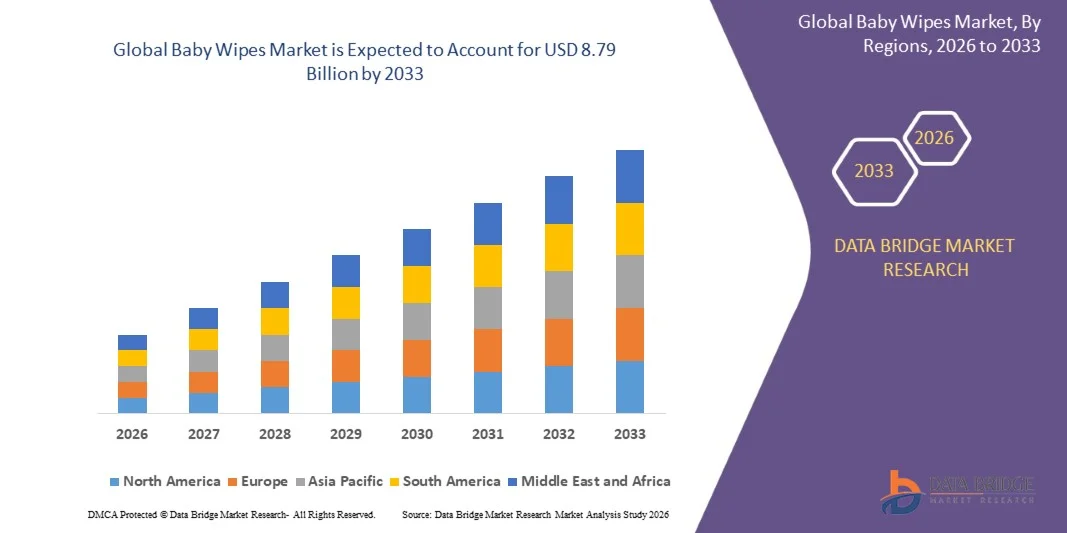
Report Scope and Baby Wipes Market Segmentation
|
Attributes |
Baby Wipes Key Market Insights |
|
Segments Covered |
|
|
Countries Covered |
North America · U.S. · Canada · Mexico Europe · Germany · France · U.K. · Netherlands · Switzerland · Belgium · Russia · Italy · Spain · Turkey · Rest of Europe Asia-Pacific · China · Japan · India · South Korea · Singapore · Malaysia · Australia · Thailand · Indonesia · Philippines · Rest of Asia-Pacific Middle East and Africa · Saudi Arabia · U.A.E. · South Africa · Egypt · Israel · Rest of Middle East and Africa South America · Brazil · Argentina · Rest of South America |
|
Key Market Players |
· Johnson & Johnson Private Limited (India) · Procter & Gamble. (U.S.) · KCWW. (South Korea) · Unicharm Corporation (Japan) · Svenska Cellulosa Aktiebolaget SCA (Sweden) · Comark International (U.S.) · Farlin Corporation (Taiwan) · Cotton Babies, Inc (U.S.) · The Himalaya Drug Company (India) · Fujian Hengan Group Ltd. (China) · Pigeon India (India) · Artsana S.p.A. (Italy) · Babisil International Ltd. (U.K.) · Linette Hellas SA (Greece) · Bodywise (UK) Limited (U.K.) · S. C. Johnson & Son, Inc. (U.S.) · D&G Laboratories Inc. (U.S.) · WaterWipes (Ireland) · Seventh Generation Inc (U.S.) |
|
Market Opportunities |
· Expansion of Plant-Based and Compostable Baby Wipes · Growing Penetration of E-Commerce Distribution Channels · Increasing Demand for Premium and Dermatologically Tested Baby Wipes |
|
Value Added Data Infosets |
In addition to the insights on market scenarios such as market value, growth rate, segmentation, geographical coverage, and major players, the market reports curated by the Data Bridge Market Research also include in-depth expert analysis, pricing analysis, brand share analysis, consumer survey, demography analysis, supply chain analysis, value chain analysis, raw material/consumables overview, vendor selection criteria, PESTLE Analysis, Porter Analysis, and regulatory framework. |
Baby Wipes Market Trends
Trend: Rising Demand for Biodegradable and Chemical-Free Baby Wipes
Consumers are increasingly preferring biodegradable and chemical-free baby wipes due to growing awareness regarding infant skin sensitivity, sustainability concerns, and harmful effects of synthetic ingredients. Manufacturers are focusing on introducing wipes made from plant-based fibers, organic cotton, and plastic-free materials to meet rising demand for eco-friendly baby care products. Increasing adoption of fragrance-free, alcohol-free, and hypoallergenic formulations is further strengthening product demand across premium baby care categories.
Companies such as WaterWipes and Seventh Generation Inc are expanding their portfolios with biodegradable and plant-based baby wipes to address growing consumer preference for sustainable and skin-safe baby hygiene products.
Baby Wipes Market Dynamics
Key Market Driver: Rising Infant Hygiene Awareness
Growing awareness regarding infant hygiene and skin protection is significantly driving demand for baby wipes across developed and developing economies. Parents are increasingly adopting baby wipes for convenient diaper changing, hand cleaning, and daily infant care due to rising concerns regarding bacterial infections and skin irritation. Increasing birth rates in emerging economies and expanding urban middle-class populations are further supporting market growth.
Major companies such as Johnson & Johnson Private Limited, Procter & Gamble., and Unicharm Corporation are continuously launching dermatologically tested and sensitive-skin baby wipes to strengthen their presence in the global baby care industry.
Key Restraint/Challenge: Environmental Concerns Over Plastic Waste
A major challenge in the baby wipes market is the increasing environmental concern associated with plastic-based nonwoven materials used in disposable wipes. Many conventional baby wipes contain synthetic fibers that contribute to landfill waste and water pollution, leading to growing scrutiny from environmental organizations and regulatory authorities. Rising consumer awareness regarding sustainability is compelling manufacturers to reduce plastic content and improve product recyclability, which increases production costs and operational complexity.
Regulatory initiatives across Europe targeting single-use plastic products and non-biodegradable hygiene materials are further pressuring manufacturers to invest in sustainable wipe production technologies and biodegradable raw materials.
Key Market Opportunity: Expansion of Plant-Based and Compostable Baby Wipes
The growing demand for sustainable baby care solutions is creating strong growth opportunities for plant-based and compostable baby wipes globally. Manufacturers are increasingly investing in biodegradable nonwoven fabrics, natural ingredients, and eco-friendly packaging solutions to align with changing consumer preferences and environmental regulations. Rising demand for premium baby hygiene products through online retail and organic product stores is further supporting expansion of compostable wipe categories.
Companies such as The Himalaya Drug Company and WaterWipes are actively expanding natural and plant-based baby wipe product lines, supporting innovation and sustainability initiatives across the Baby Wipes Market.
Baby Wipes Market Scope
The baby wipes market is segmented on the basis of technology, product type, type, distribution channel, and packaging type.
- By Technology
On the basis of technology, the Baby Wipes Market is segmented into Spunlace, Airlaid, Coform, Needlepunch, and Composite. The Spunlace segment dominated the market with a share of 48.2% in 2025, driven by its superior softness, high absorbency, and skin-friendly texture suitable for infant hygiene applications. Manufacturers prefer spunlace nonwoven fabric due to its ability to balance strength and gentle cleaning performance, which enhances consumer acceptance. Strong scalability in large-volume production supports cost efficiency across global baby care brands. Expanding demand for premium wet wipes further reinforces its leading position in the market.
The Airlaid segment is projected to register the fastest growth at a CAGR of 13.8% from 2026 to 2033, driven by rising demand for ultra-absorbent and biodegradable wipe structures. Increasing preference for eco-conscious hygiene products is accelerating adoption of airlaid materials across developed markets. Advances in fiber bonding technology are improving softness and liquid retention capacity. Growing shift toward sustainable baby care solutions is strengthening penetration in premium product lines.
- By Product Type
On the basis of product type, the market is segmented into Wet and Dry wipes. The Wet wipes segment dominated the market with a share of 72.6% in 2025, driven by its convenience, ready-to-use functionality, and strong suitability for infant skin cleansing. Parents increasingly prefer wet wipes for diaper changes and quick cleaning needs, which supports consistent demand across households and healthcare settings. Strong product availability across retail channels enhances accessibility and repeat purchases. Continuous innovation in moisturizing and hypoallergenic formulations strengthens market leadership.
The Dry wipes segment is projected to register the fastest growth at a CAGR of 12.5% from 2026 to 2033, driven by rising demand for customizable and cost-efficient baby hygiene solutions. Increasing adoption in sensitive skin care routines where users prefer adding controlled moisture is supporting segment expansion. Growing focus on multi-purpose usage across cleaning and personal care applications is further boosting demand. Expanding awareness of reduced preservative exposure strengthens its appeal in health-conscious consumer groups.
- By Type
On the basis of type, the market is segmented into Natural, Synthetic, and Blended wipes. The Blended segment dominated the market with a share of 44.9% in 2025, driven by its balanced performance in softness, durability, and cost efficiency. Manufacturers prefer blended materials to optimize absorbency while maintaining structural integrity during usage. Strong suitability for mass-market baby care products enhances widespread adoption across emerging and developed economies. Continuous product optimization supports its stable leadership position.
The Natural segment is projected to register the fastest growth at a CAGR of 14.2% from 2026 to 2033, driven by increasing consumer shift toward organic and chemical-free baby care products. Rising concerns regarding skin sensitivity and allergen exposure are accelerating demand for plant-based fibers and biodegradable wipes. Regulatory support for sustainable hygiene products is further strengthening market penetration. Expanding premium baby care product launches is enhancing growth momentum across key regions.
- By Distribution Channel
On the basis of distribution channel, the market is segmented into Supermarkets and Hypermarkets, Pharmacies, Online, and Convenience Stores. The Supermarkets and Hypermarkets segment dominated the market with a share of 39.7% in 2025, driven by wide product assortment, strong brand visibility, and bulk purchasing convenience. Consumers prefer physical retail channels for immediate availability and product comparison. Strong promotional campaigns and discount offerings further enhance sales volume. Established retail infrastructure supports sustained dominance in urban and semi-urban regions.
The Online segment is projected to register the fastest growth at a CAGR of 15.4% from 2026 to 2033, driven by rapid expansion of e-commerce platforms and increasing digital purchasing behavior among parents. Doorstep delivery convenience and subscription-based purchasing models are strengthening repeat demand. Enhanced product variety and user reviews are improving buying confidence. Rising smartphone penetration and digital payment adoption are further accelerating online channel expansion.
- By Packaging Type
On the basis of packaging type, the market is segmented into Plastic Cases and Tub packaging. The Plastic Cases segment dominated the market with a share of 57.3% in 2025, driven by durability, ease of dispensing, and strong protection against moisture loss. These packaging formats are widely used in household baby care products due to their convenience and portability. Strong compatibility with retail shelving and branding requirements enhances market penetration. Continuous design improvements support sustained consumer preference.
The Tub segment is projected to register the fastest growth at a CAGR of 13.1% from 2026 to 2033, driven by rising demand for refillable and sustainable packaging solutions. Increasing environmental awareness is encouraging consumers to shift toward reusable containers that reduce plastic waste. Manufacturers are introducing cost-efficient refill systems to support long-term usage. Expanding adoption in premium baby care lines is further accelerating segment growth.
Baby Wipes Market Regional Analysis
North America dominated the baby wipes market and accounted for the largest revenue share of 29.5% in 2025, driven by high consumer awareness regarding infant hygiene, strong demand for premium baby care products, and widespread adoption of convenient disposable hygiene solutions. The region benefits from strong purchasing power, high penetration of branded baby care products, and increasing preference for hypoallergenic and chemical free wipes. Parents across the U.S. and Canada increasingly prioritize skin safe and dermatologist tested products, which supports continuous product innovation and premiumization trends. In addition, the strong presence of leading baby care manufacturers and well established retail distribution networks continues to reinforce North America’s leadership position in the global market.
U.S. Baby Wipes Market Insight
The U.S. Baby Wipes market is experiencing strong growth driven by rising demand for premium infant hygiene products, increasing awareness regarding baby skin health, and growing preference for plant based and biodegradable wipes. Consumers are increasingly seeking alcohol free, fragrance free, and dermatologically tested wipes to ensure safe infant care. The country’s highly developed retail and e commerce infrastructure supports easy availability of diverse baby wipe product categories across supermarkets, pharmacies, and online channels. In addition, continuous innovation in sustainable packaging and eco friendly materials is further accelerating market expansion across the U.S.
Canada Baby Wipes Market Insight
The Canada Baby Wipes market is witnessing steady growth supported by rising demand for organic baby care products and increasing consumer preference for environmentally sustainable hygiene solutions. Parents are increasingly adopting baby wipes with natural ingredients and biodegradable fibers due to growing awareness regarding infant skin sensitivity. The country’s expanding online retail sector and strong focus on product safety standards are supporting broader product accessibility and consumer confidence. In addition, increasing birth rates in urban regions and growing premium baby care spending are further contributing to market growth in Canada.
Europe Baby Wipes Market Insight
The Europe Baby Wipes market is expanding steadily due to increasing demand for sustainable personal care products, strong regulatory focus on product safety, and rising adoption of biodegradable wipes across households. The region benefits from high consumer awareness regarding eco friendly baby hygiene solutions and increasing preference for reusable and recyclable packaging formats. Manufacturers are increasingly introducing wipes free from harsh chemicals and synthetic fragrances to comply with strict European safety regulations. Rising premium baby care consumption and continuous innovation in natural fiber technologies continue to support regional market growth.
U.K. Baby Wipes Market Insight
The U.K. Baby Wipes market is growing steadily, driven by increasing consumer preference for sustainable and plastic free wipes along with rising awareness regarding infant skin protection. Parents are increasingly choosing biodegradable and compostable wipes to reduce environmental impact while maintaining hygiene standards. Strong retail availability of premium baby care brands and growing online purchasing behavior are further supporting market expansion. In addition, increasing investments in eco friendly baby care packaging and product innovation are strengthening demand across the U.K.
Germany Baby Wipes Market Insight
The Germany Baby Wipes market is expanding due to rising demand for organic baby hygiene products, increasing environmental consciousness, and strong preference for dermatologically tested wipes. Consumers are increasingly prioritizing baby wipes manufactured with biodegradable fibers and chemical free formulations to ensure infant safety. The country’s strong regulatory framework for consumer safety and sustainable product standards is encouraging manufacturers to introduce eco certified baby wipes. In addition, growing adoption of premium baby care products and increasing retail penetration are further accelerating market development in Germany.
Asia-Pacific Baby Wipes Market Insight
The Asia-Pacific Baby Wipes market is expected to register the fastest growth with a CAGR of 5.8% from 2026 to 2033, driven by rising birth rates, rapid urbanization, and increasing disposable income across emerging economies. Expanding awareness regarding infant hygiene and growing adoption of convenient baby care products are significantly boosting regional demand. Countries such as China, India, Japan, and South Korea are witnessing increasing penetration of branded baby hygiene products through supermarkets and e commerce platforms. In addition, rising investments in affordable and eco friendly baby wipe manufacturing are further accelerating regional market expansion.
Japan Baby Wipes Market Insight
The Japan Baby Wipes market is witnessing steady growth supported by strong consumer preference for high quality infant hygiene products and increasing demand for sensitive skin friendly wipes. Parents are increasingly choosing premium wipes with natural ingredients and antibacterial properties to enhance infant care standards. The country’s advanced manufacturing capabilities and strong focus on product innovation are supporting the development of ultra soft and highly absorbent wipe materials. In addition, rising demand for compact and travel friendly packaging formats is strengthening market growth in Japan.
China Baby Wipes Market Insight
The China Baby Wipes market is growing rapidly due to rising urban population, increasing birth related consumer spending, and expanding adoption of branded baby care products. Consumers are increasingly purchasing baby wipes through online retail channels due to wider product availability and competitive pricing. The country’s rapidly expanding e commerce ecosystem and growing middle class population are significantly driving demand for premium and imported baby wipe products. In addition, increasing focus on biodegradable materials and safe infant hygiene solutions is further supporting market growth in China.
Baby Wipes Market Share
The baby wipes industry is primarily led by well-established companies, including:
- Johnson & Johnson Private Limited (India)
- Procter & Gamble. (U.S.)
- (South Korea)
- Unicharm Corporation (Japan)
- Svenska Cellulosa Aktiebolaget SCA (Sweden)
- Comark International (U.S.)
- Farlin Corporation (Taiwan)
- Cotton Babies, Inc (U.S.)
- The Himalaya Drug Company (India)
- Fujian Hengan Group Ltd. (China)
- Pigeon India (India)
- Artsana S.p.A. (Italy)
- Babisil International Ltd. (U.K.)
- Linette Hellas SA (Greece)
- Bodywise (UK) Limited (U.K.)
- C. Johnson & Son, Inc. (U.S.)
- D&G Laboratories Inc. (U.S.)
- WaterWipes (Ireland)
- Seventh Generation Inc (U.S.)
Latest Developments in Baby Wipes Market
- In April 2026, Kimberly-Clark Corporation expanded its baby care portfolio with the launch of eco friendly biodegradable baby wipes under its Huggies brand, developed using plant based fibers and recyclable packaging materials. The development strengthened the company’s position in the premium sustainable baby hygiene segment as consumers increasingly shifted toward environmentally responsible infant care products. The launch also supported growing retailer demand for low plastic and skin safe baby care solutions across North America and Europe
- In March 2026, Johnson & Johnson introduced an advanced hypoallergenic baby wipes range enriched with naturally derived moisturizers and dermatologist approved formulations for newborn skin protection. The product launch enhanced competition in the premium sensitive skin baby wipes category while supporting rising consumer preference for chemical free and fragrance free infant hygiene products. The initiative further strengthened the company’s focus on expanding science backed baby care innovations across global markets
- In February 2026, Piramal Pharma Limited through its consumer healthcare division launched Little’s AquaSense Baby Wipes formulated with 99.9% RO purified water to provide gentle and safe cleansing solutions for newborns and infants. The wipes are pH balanced, dermatologically tested, and free from alcohol and parabens, making them highly suitable for sensitive skin applications. In addition, the biodegradable formulation supported rising market demand for environmentally sustainable baby hygiene products and strengthened the company’s positioning in premium infant care solutions
- In January 2026, Harper Hygienics launched Kindii Water Care baby wipes specifically designed for newborns and infants with ultra sensitive skin using a minimalist formula containing 99.9% water and only three ingredients. The fragrance free and dermatologically tested product line responded to increasing parental demand for gentle and transparent baby care formulations with reduced chemical exposure. The development further accelerated innovation in the natural and water based baby wipes segment across European markets
- In December 2025, The Honest Company expanded distribution of its plant based baby wipes across major international retail and e commerce platforms to strengthen global market penetration. The expansion increased accessibility of premium clean label baby hygiene products among health conscious consumers seeking non toxic and sustainable infant care alternatives. The initiative also intensified competition within the organic and naturally derived baby wipes segment across Asia-Pacific and North America
SKU-
Get online access to the report on the World's First Market Intelligence Cloud

- Interactive Data Analysis Dashboard
- Company Analysis Dashboard for high growth potential opportunities
- Research Analyst Access for customization & queries
- Competitor Analysis with Interactive dashboard
- Latest News, Updates & Trend analysis
- Harness the Power of Benchmark Analysis for Comprehensive Competitor Tracking
Research Methodology
Data collection and base year analysis are done using data collection modules with large sample sizes. The stage includes obtaining market information or related data through various sources and strategies. It includes examining and planning all the data acquired from the past in advance. It likewise envelops the examination of information inconsistencies seen across different information sources. The market data is analysed and estimated using market statistical and coherent models. Also, market share analysis and key trend analysis are the major success factors in the market report. To know more, please request an analyst call or drop down your inquiry.
The key research methodology used by DBMR research team is data triangulation which involves data mining, analysis of the impact of data variables on the market and primary (industry expert) validation. Data models include Vendor Positioning Grid, Market Time Line Analysis, Market Overview and Guide, Company Positioning Grid, Patent Analysis, Pricing Analysis, Company Market Share Analysis, Standards of Measurement, Global versus Regional and Vendor Share Analysis. To know more about the research methodology, drop in an inquiry to speak to our industry experts.
Customization Available
Data Bridge Market Research is a leader in advanced formative research. We take pride in servicing our existing and new customers with data and analysis that match and suits their goal. The report can be customized to include price trend analysis of target brands understanding the market for additional countries (ask for the list of countries), clinical trial results data, literature review, refurbished market and product base analysis. Market analysis of target competitors can be analyzed from technology-based analysis to market portfolio strategies. We can add as many competitors that you require data about in the format and data style you are looking for. Our team of analysts can also provide you data in crude raw excel files pivot tables (Fact book) or can assist you in creating presentations from the data sets available in the report.












