




Global Balantidiasis Market
Market Size in USD Billion
CAGR :
% 
 USD
85.42 Billion
USD
109.22 Billion
2025
2033
USD
85.42 Billion
USD
109.22 Billion
2025
2033
 Forecast Period Forecast Period |
2026 –2033 |
 Market Size (Base Year) Market Size (Base Year) |
USD 85.42 Billion |
 Market Size (Forecast Year) Market Size (Forecast Year) |
USD 109.22 Billion |
 CAGR CAGR |
% |
| Major Markets Players |
|
Balantidiasis Market Size
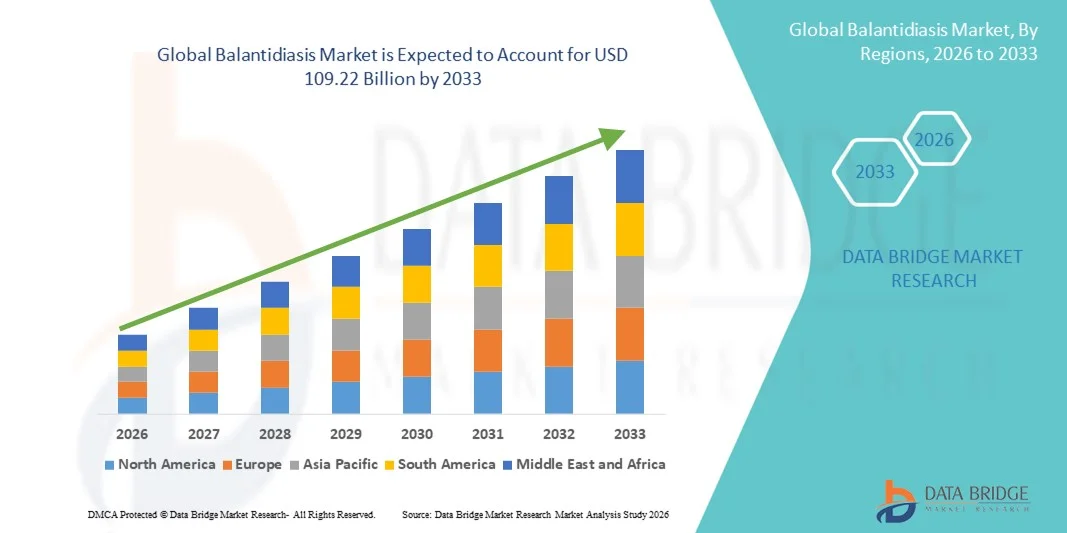
- The global Balantidiasis market size was valued at USD 85.42 billion in 2025 and is expected to reach USD 109.22 billion by 2033, at a CAGR of 3.12% during the forecast period
- The market growth is largely fueled by the increasing prevalence of Balantidiasis, particularly in regions with poor sanitation and limited access to clean water, leading to higher demand for effective diagnostic and treatment solutions in both clinical and community healthcare settings
- Furthermore, rising awareness among healthcare providers and consumers about intestinal parasitic infections, coupled with advancements in rapid diagnostic tests and therapeutic interventions, is establishing Balantidiasis solutions as essential for effective disease management. These converging factors are accelerating the adoption of Balantidiasis diagnostics and treatments, thereby significantly boosting the industry's growth
Balantidiasis Market Analysis
- Balantidiasis diagnostics and treatment solutions, including antiparasitic drugs, rapid diagnostic kits, and preventive care measures, are increasingly vital components of modern healthcare systems in both clinical and community settings due to their effectiveness, accessibility, and integration into public health initiatives
- The escalating demand for Balantidiasis solutions is primarily fueled by the rising prevalence of the disease in regions with poor sanitation, growing awareness about intestinal parasitic infections, and an increased focus on preventive healthcare and rapid diagnosis
- North America dominated the balantidiasis market with the largest revenue share of 37.8% in 2025, characterized by advanced healthcare infrastructure, high awareness of parasitic infections, and a strong presence of key diagnostic and pharmaceutical players, with the U.S. witnessing substantial growth in Balantidiasis testing and treatment adoption, particularly in rural and underserved communities
- Asia-Pacific is expected to be the fastest-growing region in the balantidiasis market during the forecast period due to increasing urbanization, rising disposable incomes, and growing awareness about intestinal infections, especially in countries such as India and China
- The Antibiotics segment dominated the largest market revenue share of 52.7% in 2025, owing to its effectiveness in treating mild to moderate infections and preventing complications
Report Scope and Balantidiasis Market Segmentation
|
Attributes |
Balantidiasis Key Market Insights |
|
Segments Covered |
|
|
Countries Covered |
North America
Europe
Asia-Pacific
Middle East and Africa
South America
|
|
Key Market Players |
|
|
Market Opportunities |
|
|
Value Added Data Infosets |
In addition to the insights on market scenarios such as market value, growth rate, segmentation, geographical coverage, and major players, the market reports curated by the Data Bridge Market Research also include in-depth expert analysis, patient epidemiology, pipeline analysis, pricing analysis, and regulatory framework. |
Balantidiasis Market Trends
Enhanced Convenience Through Awareness and Diagnostic Advancements
- A significant and accelerating trend in the global Balantidiasis market is the growing emphasis on awareness, early diagnosis, and improved treatment options. This is helping healthcare providers and patients manage infections more effectively and reduce complications
- For instance, in 2025, several healthcare organizations in Southeast Asia launched public awareness campaigns highlighting proper hygiene, sanitation, and early testing for Balantidiasis, leading to increased patient engagement and testing rates
- Advances in rapid diagnostic testing, including PCR-based and antigen detection methods, are allowing for faster and more accurate identification of Balantidium coli infections, improving patient outcomes
- Integration of Balantidiasis management programs with community health initiatives is helping reduce infection rates in endemic areas, particularly through education on water sanitation and safe food handling
- This trend toward awareness, early detection, and accessible treatment is reshaping patient expectations, encouraging healthcare providers to offer more comprehensive screening and care programs
- The demand for convenient, effective, and safe diagnostic and treatment solutions is growing across hospitals, clinics, and public health programs, as patients and providers increasingly prioritize prevention and timely intervention
Balantidiasis Market Dynamics
Driver
Rising Incidence of Infection and Focus on Preventive Healthcare
- The increasing prevalence of Balantidiasis, particularly in developing regions with poor sanitation and limited access to clean water, is a key driver for the growing demand for diagnostic tools, medications, and awareness programs
- For instance, in 2024, a public health initiative in rural India introduced rapid stool antigen testing and educational programs on hygiene practices. This increased early detection rates and reduced infection incidence, strengthening the Diagnostic Tools and Therapeutics segments
- As populations become more aware of the risks associated with untreated Balantidiasis, there is a rising demand for comprehensive treatment options, including antiparasitic medications and preventive strategies
- Government-led programs and NGOs promoting clean water, sanitation, and hygiene (WASH) initiatives are further stimulating the market, encouraging proactive healthcare measures
- Access to affordable diagnostics, community health programs, and preventive care kits is a critical factor supporting market growth in both urban and rural settings
Restraint/Challenge
Limited Awareness, High Costs, and Inadequate Infrastructure
- Despite growing awareness, many populations in endemic regions remain uninformed about Balantidiasis prevention and treatment, leading to misdiagnosis, delayed care, and persistent infection rates
- For instance, a 2023 study in sub-Saharan Africa reported that over 40% of suspected cases went untreated due to lack of diagnostic facilities, highlighting the need for expanded testing and education programs
- The relatively high cost of advanced diagnostic tests and antiparasitic medications compared to conventional treatments can limit adoption, particularly among low-income populations
- Poor healthcare infrastructure in rural and underserved areas can hinder access to timely diagnosis and treatment, delaying intervention and increasing transmission risk
- Limited availability of rapid diagnostic kits, lack of trained healthcare personnel, and insufficient public health funding are additional challenges affecting market growth
- Cultural practices and lack of awareness about proper food handling, sanitation, and water safety can also contribute to ongoing infection rates
- Addressing these challenges through improved education, affordable diagnostic and treatment options, enhanced healthcare infrastructure, and government-led public health initiatives will be vital for sustained market growth
Balantidiasis Market Scope
The market is segmented on the basis of diagnosis, treatment, and end-users.
- By Diagnosis
On the basis of diagnosis, the Balantidiasis market is segmented into Physical Examination, Stool Examination, Sigmoidoscopy, and Biopsy. The Stool Examination segment dominated the largest market revenue share of 45.3% in 2025, owing to its high accuracy, non-invasive nature, and cost-effectiveness. Stool examination is widely used in hospitals and diagnostic centers for rapid detection of Balantidium coli. The procedure allows for early diagnosis, aiding timely treatment and reducing complications. It is easy to perform, requires minimal patient preparation, and can be repeated as needed for monitoring. The segment benefits from standardization of laboratory protocols, improving reliability across regions. Growing awareness among healthcare professionals and patients increases adoption. Integration with automated microscopy and lab equipment enhances efficiency. Stool examination is preferred in both pediatric and adult populations due to safety and convenience. It supports large-scale screenings during outbreaks. Accessibility in rural and urban healthcare settings strengthens its dominance. The increasing prevalence of gastrointestinal infections drives consistent demand. Overall, stool examination remains the first-line diagnostic tool for Balantidiasis due to accuracy, speed, and ease of use.
The Sigmoidoscopy segment is expected to witness the fastest CAGR of 19.4% from 2026 to 2033, driven by its ability to provide direct visualization of the colon and rectum, aiding accurate detection of lesions and severe infections. Adoption is increasing in specialized clinics and hospitals with advanced endoscopic facilities. Growing emphasis on early and precise diagnosis supports its uptake. Sigmoidoscopy allows for biopsy collection during the procedure, enhancing diagnostic confidence. Rising awareness among gastroenterologists regarding comprehensive examination protocols fuels demand. Technological advancements in flexible scopes improve patient comfort and procedure efficiency. Training programs for healthcare professionals increase adoption. Urban healthcare infrastructure and hospital investments in endoscopy suites support market growth. Insurance coverage in some regions makes the procedure more accessible. The segment benefits from research linking colon health to Balantidiasis severity. It is increasingly used for follow-up and monitoring of complicated cases. Overall, sigmoidoscopy is witnessing rapid adoption due to enhanced diagnostic accuracy and procedural innovation.
- By Treatment
On the basis of treatment, the Balantidiasis market is segmented into Antibiotics and Appendectomy. The Antibiotics segment dominated the largest market revenue share of 52.7% in 2025, owing to its effectiveness in treating mild to moderate infections and preventing complications. Antibiotics such as tetracycline and metronidazole are widely prescribed due to high success rates and ease of oral administration. Hospitals and clinics prefer antibiotics for outpatient management. The treatment is cost-effective and widely available in generic formulations. Adoption is supported by established clinical guidelines and physician trust. Rapid symptom relief and low invasiveness enhance patient compliance. Antibiotic therapy is suitable for both adults and children. Growing prevalence of Balantidiasis in endemic regions drives steady demand. Integration with diagnostic labs ensures timely prescription and monitoring. Healthcare providers emphasize early antibiotic intervention to reduce hospitalization. Awareness campaigns for proper use reduce recurrence and resistance. Overall, antibiotics remain the dominant treatment option due to efficacy, accessibility, and ease of administration.
The Appendectomy segment is expected to witness the fastest CAGR of 17.8% from 2026 to 2033, driven by increasing cases of severe infection leading to complications such as intestinal perforation. Surgical intervention is growing in specialized hospitals with advanced surgical facilities. Minimally invasive appendectomy techniques improve patient recovery and reduce hospital stays. Rising investments in surgical infrastructure and skilled workforce enhance adoption. Urban hospitals and referral centers are increasingly offering appendectomy services for complicated Balantidiasis. Medical tourism in some countries supports growth. Appendectomy ensures definitive treatment when antibiotics fail, driving clinical preference. Awareness among physicians regarding complication management is increasing. Post-operative care integration with diagnostics improves outcomes. Insurance coverage for surgical procedures boosts accessibility. Research on surgical safety and recovery protocols enhances confidence. Overall, appendectomy adoption is increasing rapidly due to its critical role in managing severe cases.
- By End-Users
On the basis of end-users, the Balantidiasis market is segmented into Hospitals, Clinics, and Diagnostic Centers. The Hospitals segment dominated the largest market revenue share of 48.6% in 2025, supported by availability of trained specialists, advanced diagnostic and treatment facilities, and structured patient care protocols. Hospitals offer integrated management, combining diagnosis, treatment, and follow-up in one setting. Adoption is driven by patient trust, accessibility, and comprehensive care services. Hospitals invest in laboratory infrastructure for stool examination and endoscopy. Multi-disciplinary teams improve treatment outcomes. Hospitals often implement standardized protocols for antibiotic therapy. Urban hospital concentration enhances market share. Government and private funding support hospital allergy and infectious disease departments. Integration of digital health and EHR systems streamlines patient management. Specialized units handle complicated cases, boosting hospital preference. Hospitals remain preferred for both routine and severe Balantidiasis cases. Continuous research and clinical trials strengthen credibility and adoption.
The Diagnostic Centers segment is expected to witness the fastest CAGR of 18.2% from 2026 to 2033, driven by rising demand for specialized, rapid, and affordable diagnostic services. Diagnostic centers are expanding their stool examination and endoscopy services. Growth is fueled by increasing awareness of early detection and preventive care. Investment in automated laboratory equipment enhances efficiency. Partnerships with hospitals and clinics broaden service reach. Urban and semi-urban regions see increasing center penetration. Technological integration supports faster and accurate reporting. Centers offer convenience for outpatient diagnosis and follow-up. Adoption is also supported by private insurance coverage and employer health programs. Rising focus on quality control and accreditation boosts trust. Research collaborations with academic institutions enhance diagnostic capabilities. Overall, diagnostic centers are rapidly growing due to accessibility, speed, and affordability of services.
Balantidiasis Market Regional Analysis
- North America dominated the balantidiasis market with the largest revenue share of 37.8% in 2025, characterized by its well-established healthcare infrastructure, high awareness of parasitic infections, and the presence of key diagnostic and pharmaceutical players
- The region’s growth is further supported by extensive public health programs, research initiatives, and educational campaigns aimed at preventing and managing parasitic infections. The U.S. witnessed substantial adoption of Balantidiasis testing and treatment, particularly in rural and underserved communities, where the disease prevalence is higher
- Advanced laboratory facilities, easy accessibility to diagnostic kits, and the availability of modern therapeutics are major factors propelling market expansion
U.S. Balantidiasis Market Insight
The U.S. balantidiasis market captured the largest revenue share within North America, driven by proactive screening programs, increasing prevalence in immunocompromised populations, and rising healthcare awareness. Healthcare providers and community health initiatives play a crucial role in promoting early detection and timely treatment of Balantidiasis. Additionally, government-supported programs targeting parasitic infections, combined with the widespread availability of advanced diagnostic tools and novel therapeutics, are significantly contributing to market growth.
Europe Balantidiasis Market Insight
The Europe balantidiasis market is projected to grow steadily over the forecast period, supported by increased awareness about intestinal parasitic infections, stringent hygiene and sanitation regulations, and access to modern healthcare services. Countries such as Germany, France, and the U.K. are witnessing higher adoption of diagnostic testing and treatment solutions for Balantidiasis, driven by public health campaigns, research programs, and technological advancements in parasitic disease management. The rising preference for early diagnosis and preventive care is further stimulating market growth.
U.K. Balantidiasis Market Insight
The U.K. balantidiasis market is anticipated to grow at a noteworthy CAGR during the forecast period, fueled by rising awareness of intestinal infections and the increasing availability of diagnostic and treatment services. Government health initiatives, community awareness programs, and the adoption of modern laboratory techniques for accurate detection are encouraging both healthcare providers and patients to actively participate in early diagnosis and treatment. The increasing prevalence of Balantidiasis among vulnerable populations such as children and the elderly also drives market demand.
Germany Balantidiasis Market Insight
The Germany balantidiasis market is expected to expand at a considerable CAGR, supported by a combination of robust healthcare infrastructure, high public awareness of parasitic infections, and strong government focus on disease prevention. Advanced diagnostic tools, development of novel therapeutics, and widespread educational campaigns on hygiene and sanitation contribute significantly to market growth. Additionally, Germany’s emphasis on preventive healthcare and research innovation is driving the adoption of comprehensive management solutions for Balantidiasis.
Asia-Pacific Balantidiasis Market Insight
The Asia-Pacific balantidiasis market is poised to be the fastest-growing region during the forecast period, with an anticipated CAGR surpassing other regions. Growth is fueled by rapid urbanization, rising disposable incomes, increasing healthcare accessibility, and heightened awareness of intestinal infections in countries such as India, China, and Japan. Government initiatives promoting infectious disease control, coupled with expanding healthcare infrastructure and affordable diagnostic services, are driving widespread adoption of testing and treatment solutions. Furthermore, the increasing prevalence of Balantidiasis in both rural and urban populations underscores the growing demand for effective management strategies across the region.
Japan Balantidiasis Market Insight
The Japan balantidiasis market is gaining momentum due to high healthcare standards, increasing public awareness, and the adoption of advanced diagnostic methods. The country’s focus on preventive healthcare and management of parasitic infections, particularly among children and the elderly, is driving market growth. Rising urbanization, technological adoption in healthcare, and well-organized public health campaigns further contribute to the increasing demand for testing and treatment solutions.
China Balantidiasis Market Insight
The China balantidiasis market accounted for the largest revenue share in the Asia-Pacific region in 2025. Growth is driven by rising awareness of intestinal infections, expanding middle-class populations, rapid urbanization, and increasing access to healthcare services. Government initiatives promoting parasitic infection control, along with affordable diagnostic kits and the growing availability of effective therapeutics, are key factors propelling market expansion. The country’s focus on preventive care and research in parasitic diseases, alongside improved rural healthcare infrastructure, further reinforces China’s market leadership in the region.
Balantidiasis Market Share
The Balantidiasis industry is primarily led by well-established companies, including:
- Pfizer (U.S.)
- GlaxoSmithKline (U.K.)
- Novartis (Switzerland)
- Sanofi (France)
- Johnson & Johnson (U.S.)
- Bayer AG (Germany)
- Mylan (U.S.)
- Dr. Reddy’s Laboratories (India)
- Abbott Laboratories (U.S.)
- Merck & Co. (U.S.)
- Takeda Pharmaceutical (Japan)
- Astellas Pharma (Japan)
- Sun Pharmaceutical Industries (India)
- Teva Pharmaceutical Industries (Israel)
- Ferring Pharmaceuticals (Switzerland)
- Cipla (India)
- Lupin Limited (India)
- Bristol-Myers Squibb (U.S.)
- Amgen (U.S.)
- Shionogi & Co., Ltd. (Japan)
Latest Developments in Global Balantidiasis Market
- In October 2023, a biotech company focused on neglected tropical diseases entered into a partnership with a diagnostic manufacturer to develop rapid point‑of‑care testing for Balantidiasis, aiming to improve detection and treatment accessibility in resource‑constrained settings — addressing long‑standing challenges in timely diagnosis of Balantioides coli infections
- In November 2023, Hardy Diagnostics received regulatory approval for an improved microscopy staining kit designed specifically for Balantioides coli, offering enhanced visualization and diagnostic accuracy for clinical laboratories diagnosing balantidiasis
- In February 2024, a pharmaceutical developer announced new investments in early‑stage research for a novel therapeutic agent targeting Balantidiasis, focusing on reducing parasite load and improving clinical outcomes in severe cases, signaling renewed interest in innovating beyond traditional antibiotics
- In March 2024, Bio‑Rad Laboratories introduced a new multiplex PCR assay for comprehensive parasitological screening — this assay includes Balantioides coli detection alongside other protozoan parasites commonly encountered in tropical medicine, enhancing molecular diagnostic capabilities
- In June 2024, Thermo Fisher Scientific announced a partnership with the World Health Organization to develop point‑of‑care diagnostic devices designed for parasitic disease detection including balantidiasis, particularly for resource‑limited settings to facilitate faster field diagnosis
- In September 2024, Abbott Laboratories launched its enhanced molecular diagnostic platform capable of detecting multiple parasitic pathogens including Balantioides coli, with improved sensitivity and reduced turnaround time for clinical laboratories in endemic regions
SKU-
Get online access to the report on the World's First Market Intelligence Cloud

- Interactive Data Analysis Dashboard
- Company Analysis Dashboard for high growth potential opportunities
- Research Analyst Access for customization & queries
- Competitor Analysis with Interactive dashboard
- Latest News, Updates & Trend analysis
- Harness the Power of Benchmark Analysis for Comprehensive Competitor Tracking
Research Methodology
Data collection and base year analysis are done using data collection modules with large sample sizes. The stage includes obtaining market information or related data through various sources and strategies. It includes examining and planning all the data acquired from the past in advance. It likewise envelops the examination of information inconsistencies seen across different information sources. The market data is analysed and estimated using market statistical and coherent models. Also, market share analysis and key trend analysis are the major success factors in the market report. To know more, please request an analyst call or drop down your inquiry.
The key research methodology used by DBMR research team is data triangulation which involves data mining, analysis of the impact of data variables on the market and primary (industry expert) validation. Data models include Vendor Positioning Grid, Market Time Line Analysis, Market Overview and Guide, Company Positioning Grid, Patent Analysis, Pricing Analysis, Company Market Share Analysis, Standards of Measurement, Global versus Regional and Vendor Share Analysis. To know more about the research methodology, drop in an inquiry to speak to our industry experts.
Customization Available
Data Bridge Market Research is a leader in advanced formative research. We take pride in servicing our existing and new customers with data and analysis that match and suits their goal. The report can be customized to include price trend analysis of target brands understanding the market for additional countries (ask for the list of countries), clinical trial results data, literature review, refurbished market and product base analysis. Market analysis of target competitors can be analyzed from technology-based analysis to market portfolio strategies. We can add as many competitors that you require data about in the format and data style you are looking for. Our team of analysts can also provide you data in crude raw excel files pivot tables (Fact book) or can assist you in creating presentations from the data sets available in the report.












