Global Bamboo Products Market
Market Size in USD Billion
CAGR :
% 
 USD
84.04 Billion
USD
124.63 Billion
2025
2033
USD
84.04 Billion
USD
124.63 Billion
2025
2033
 Forecast Period Forecast Period |
2026 –2033 |
 Market Size (Base Year) Market Size (Base Year) |
USD 84.04 Billion |
 Market Size (Forecast Year) Market Size (Forecast Year) |
USD 124.63 Billion |
 CAGR CAGR |
% |
| Major Markets Players |
|
What is the Global Bamboo Products Market Size and Growth Rate?
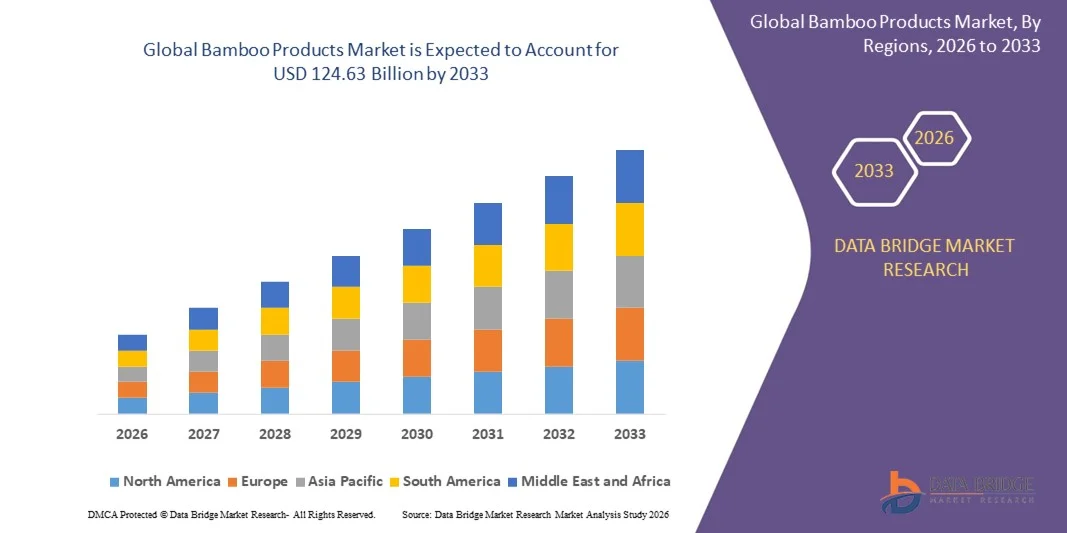
- The global bamboo products market size was valued at USD 84.04 billion in 2025 and is expected to reach USD 124.63 billion by 2033, at a CAGR of5.05% during the forecast period
- The rise in the emphasis on infrastructure development across the globe acts as one of the major factors driving the growth of bamboo products market
- The rise in the incorporation of sustainable construction material in compliance with the complete sustainability, and adoption of environmentally friendly material in various regions and increase in the consumer awareness regarding the uses and benefits of bamboos accelerate the market growth
What are the Major Takeaways of Bamboo Products Market?
- The surge in inclination towards bamboo wood over timber as they are easier to harvest, transport, and are relatively affordable and increase in use of sustainable building/ construction resources further influence the market
- In addition, change in climatic conditions, urbanization and industrialization and growth in environmental consciousness positively affect the bamboo products market. Furthermore, rise in level of sustainable development and government support extends profitable opportunities to the market players
- Asia-Pacific dominated the bamboo products market with a 42.05% revenue share in 2025, driven by abundant bamboo resources, well-established processing capabilities, and strong demand across construction, furniture, packaging, and lifestyle applications in China, India, Japan, Southeast Asia, and South Korea
- North America is projected to register the fastest CAGR of 8.26% from 2026 to 2033, driven by rising environmental awareness, strict sustainability regulations, and growing demand for eco-friendly building materials, furniture, and packaging across the U.S. and Canada
- The Building and Construction Products segment dominated the market with an estimated 38.6% share in 2025, driven by rising adoption of bamboo flooring, panels, decking, scaffolding, and structural components as sustainable alternatives to hardwood and steel
Report Scope and Bamboo Products Market Segmentation
|
Attributes |
Bamboo Products Key Market Insights |
|
Segments Covered |
|
|
Countries Covered |
North America
Europe
Asia-Pacific
Middle East and Africa
South America
|
|
Key Market Players |
|
|
Market Opportunities |
|
|
Value Added Data Infosets |
In addition to the insights on market scenarios such as market value, growth rate, segmentation, geographical coverage, and major players, the market reports curated by the Data Bridge Market Research also include in-depth expert analysis, pricing analysis, brand share analysis, consumer survey, demography analysis, supply chain analysis, value chain analysis, raw material/consumables overview, vendor selection criteria, PESTLE Analysis, Porter Analysis, and regulatory framework. |
What is the Key Trend in the Bamboo Products Market?
Increasing Shift Toward Sustainable, Eco-Friendly, and High-Performance Bamboo Products
- The bamboo products market is witnessing strong adoption of sustainably sourced, biodegradable, and renewable bamboo materials across construction, furniture, packaging, textiles, and consumer goods
- Manufacturers are increasingly introducing engineered bamboo products, such as laminated bamboo boards, bamboo composites, and treated bamboo materials, offering enhanced durability, moisture resistance, and load-bearing capacity
- Growing demand for lightweight, cost-efficient, and environmentally responsible alternatives to plastic, hardwood, and metal is accelerating bamboo usage across residential, commercial, and industrial applications
- For instance, companies such as MOSO, Smith & Fong, Zhejiang Tianzhen, Gek Guan, and Reforest Design have expanded their bamboo flooring, panels, and structural solutions with improved finishes and sustainability certifications
- Rising emphasis on green building standards, carbon footprint reduction, and circular economy practices is driving adoption of bamboo-based products
- As sustainability becomes a core purchasing criterion, Bamboo Products will remain vital for eco-friendly construction, packaging innovation, and sustainable consumer goods development
What are the Key Drivers of Bamboo Products Market?
- Rising demand for sustainable, renewable, and biodegradable materials across construction, furniture, packaging, and lifestyle products
- For instance, in 2025, leading bamboo product manufacturers expanded production capacities and introduced certified bamboo solutions to meet growing demand from green building and eco-packaging industries
- Growing adoption of green construction, eco-friendly furniture, and plastic replacement initiatives across the U.S., Europe, and Asia-Pacific is boosting market growth
- Advancements in bamboo treatment technologies, engineered processing, and surface finishing have improved product strength, durability, and aesthetic appeal
- Increasing use of bamboo in flooring, wall panels, kitchenware, textiles, and disposable packaging is expanding application scope
- Supported by government incentives, sustainability regulations, and rising consumer awareness, the Bamboo Products market is expected to witness strong long-term growth
Which Factor is Challenging the Growth of the Bamboo Products Market?
- High costs associated with advanced processing, treatment, and certification of premium bamboo products limit adoption in price-sensitive markets
- For instance, during 2024–2025, fluctuations in raw bamboo supply, transportation costs, and energy prices impacted manufacturing margins for several producers
- Variability in bamboo quality, species availability, and regional cultivation practices creates supply chain inconsistencies
- Limited awareness in emerging markets regarding engineered bamboo performance, durability, and long-term benefits slows adoption
- Competition from low-cost plastics, conventional wood products, and composite materials creates pricing pressure and affects product differentiation
- To address these challenges, companies are focusing on process optimization, sustainable sourcing partnerships, product standardization, and consumer education to expand global adoption of Bamboo Products
How is the Bamboo Products Market Segmented?
The market is segmented on the basis of product type, sales channel, and end user.
- By Product Type
On the basis of product type, the bamboo products market is segmented into Lifestyle Products, Building and Construction Products, Packaging and Storage Products, Educational, and Recreational Products. The Building and Construction Products segment dominated the market with an estimated 38.6% share in 2025, driven by rising adoption of bamboo flooring, panels, decking, scaffolding, and structural components as sustainable alternatives to hardwood and steel. Strong demand from green building projects, commercial spaces, and residential construction has reinforced segment leadership. Advancements in engineered bamboo, laminated structures, and treatment technologies have improved durability, moisture resistance, and load-bearing performance.
The Packaging and Storage Products segment is expected to grow at the fastest CAGR from 2026 to 2033, supported by increasing regulations on single-use plastics and growing demand for biodegradable packaging. Rising adoption of bamboo-based food containers, trays, cutlery, and storage solutions across retail, foodservice, and e-commerce sectors continues to accelerate market expansion.
- By Sales Channel
On the basis of sales channel, the bamboo products market is segmented into Offline and Online channels. The Offline segment dominated the market with a 64.2% share in 2025, supported by strong presence of specialty stores, furniture outlets, construction material suppliers, and wholesale distributors. Consumers often prefer offline channels to physically assess product quality, finish, strength, and dimensions, particularly for construction materials and furniture. Long-standing supplier relationships and bulk procurement practices further reinforce offline dominance.
The Online segment is projected to grow at the fastest CAGR from 2026 to 2033, driven by rapid expansion of e-commerce platforms, direct-to-consumer (DTC) brands, and digital marketplaces. Online channels offer wider product variety, competitive pricing, doorstep delivery, and increasing availability of customized bamboo products. Rising internet penetration, digital payments, and cross-border e-commerce are accelerating online adoption globally.
- By End User
On the basis of end user, the bamboo products market is segmented into Personal and Residential, Commercial, Industrial, and Infrastructure sectors. The Personal and Residential segment dominated the market with a 41.8% share in 2025, driven by strong consumer demand for eco-friendly furniture, home décor, kitchenware, flooring, and lifestyle products. Rising environmental awareness, urbanization, and preference for sustainable home solutions continue to support growth.
The Commercial segment is expected to grow at the fastest CAGR from 2026 to 2033, fueled by increasing use of bamboo products in offices, hotels, retail spaces, educational institutions, and healthcare facilities. Corporate sustainability initiatives, green building certifications, and demand for durable yet sustainable materials are driving rapid adoption across commercial applications.
Which Region Holds the Largest Share of the Bamboo Products Market?
- Asia-Pacific dominated the bamboo products market with a 42.05% revenue share in 2025, driven by abundant bamboo resources, well-established processing capabilities, and strong demand across construction, furniture, packaging, and lifestyle applications in China, India, Japan, Southeast Asia, and South Korea. The region benefits from cost-efficient manufacturing, large-scale cultivation, and growing adoption of sustainable materials across residential and commercial sectors
- Leading manufacturers in Asia-Pacific are expanding engineered bamboo, laminated panels, flooring, packaging, and furniture solutions, supported by government initiatives promoting renewable materials and green manufacturing. Continuous investment in production capacity and export-oriented supply chains strengthens regional leadership
- High availability of raw materials, skilled labor, and rising domestic consumption, combined with strong export demand, further reinforce Asia-Pacific’s dominance in the global Bamboo Products market
China Bamboo Products Market Insight
China is the largest contributor in Asia-Pacific, supported by extensive bamboo cultivation, advanced manufacturing infrastructure, and strong export capabilities. High demand for bamboo flooring, panels, furniture, and packaging, along with government support for sustainable materials, drives consistent market growth.
India Bamboo Products Market Insight
India contributes significantly due to rising bamboo-based construction, furniture, handicrafts, and packaging demand. Government initiatives promoting bamboo cultivation, rural employment, and sustainable materials support expanding market adoption.
Japan Bamboo Products Market Insight
Japan shows steady growth supported by premium construction, interior design applications, and strong preference for high-quality, eco-friendly materials. Focus on durability, aesthetics, and sustainability reinforces demand for engineered bamboo products.
North America Bamboo Products Market
North America is projected to register the fastest CAGR of 8.26% from 2026 to 2033, driven by rising environmental awareness, strict sustainability regulations, and growing demand for eco-friendly building materials, furniture, and packaging across the U.S. and Canada. Increasing adoption of green building certifications and plastic-free initiatives is accelerating bamboo product usage.
U.S. Bamboo Products Market Insight
The U.S. leads regional growth, supported by strong demand for bamboo flooring, decking, furniture, and disposable packaging. Expansion of sustainable construction and eco-conscious consumer preferences continues to boost market penetration.
Canada Bamboo Products Market Insight
Canada contributes steadily due to rising adoption of sustainable materials in residential and commercial construction. Government policies supporting green infrastructure and renewable materials strengthen long-term market growth.
Which are the Top Companies in Bamboo Products Market?
The bamboo products industry is primarily led by well-established companies, including:
- Reenington LLC (U.S.)
- MOSO (Netherlands)
- Utsav Handicraft (India)
- Luit Nirman (India)
- S. Senniah Gowder (India)
- caneocane.in (India)
- Jiangxi Kang Ti Long Bamboo Industry Co., Ltd. (China)
- Zhejiang Tianzhen Bamboo & Wood Development Co., Ltd. (China)
- Gek Guan Enterprise Sdn Bhd (Malaysia)
- Reforest Design (U.S.)
- July Bambu Co. Ltd. (China)
- Bamboo Village Company (U.S.)
- Kerala State Bamboo Corporation Ltd (India)
- Smith & Fong (U.S.)
- Huayu Electrical Appliance Group Co., Ltd. (China)
- Pappco Greenware (India)
- Bamboo Master (India)
- MEYSHER INDUSTRIAL GROUP LTD (China)
What are the Recent Developments in Global Bamboo Products Market?
- In February 2025, the Indian Army partnered with IIT Guwahati to develop epoxy-based bamboo composite materials for constructing bunkers in high-altitude regions, offering lightweight, transport-friendly structures with enhanced protection, marking a significant advancement in the use of bamboo in defense infrastructure
- In August 2024, New York–headquartered Colgate-Palmolive reintroduced its 100% natural bamboo toothbrush with biodegradable, recyclable paper-based tub and lid packaging, reinforcing the company’s commitment to sustainable personal care solutions
- In July 2024, Michigan-based Herman Miller expanded its Eames Lounge Chair and Ottoman range by introducing bamboo-based upholstery, integrating sustainable materials into its iconic furniture designs and strengthening its eco-conscious product portfolio
- In January 2023, Utah-based Cariloha partnered with Nationwide Marketing Group to distribute eco-friendly bamboo bedding and apparel through over 5,000 retail partners across 14,000 locations in the U.S. and Canada, significantly broadening market reach for responsibly sourced bamboo products
SKU-
Get online access to the report on the World's First Market Intelligence Cloud

- Interactive Data Analysis Dashboard
- Company Analysis Dashboard for high growth potential opportunities
- Research Analyst Access for customization & queries
- Competitor Analysis with Interactive dashboard
- Latest News, Updates & Trend analysis
- Harness the Power of Benchmark Analysis for Comprehensive Competitor Tracking
Research Methodology
Data collection and base year analysis are done using data collection modules with large sample sizes. The stage includes obtaining market information or related data through various sources and strategies. It includes examining and planning all the data acquired from the past in advance. It likewise envelops the examination of information inconsistencies seen across different information sources. The market data is analysed and estimated using market statistical and coherent models. Also, market share analysis and key trend analysis are the major success factors in the market report. To know more, please request an analyst call or drop down your inquiry.
The key research methodology used by DBMR research team is data triangulation which involves data mining, analysis of the impact of data variables on the market and primary (industry expert) validation. Data models include Vendor Positioning Grid, Market Time Line Analysis, Market Overview and Guide, Company Positioning Grid, Patent Analysis, Pricing Analysis, Company Market Share Analysis, Standards of Measurement, Global versus Regional and Vendor Share Analysis. To know more about the research methodology, drop in an inquiry to speak to our industry experts.
Customization Available
Data Bridge Market Research is a leader in advanced formative research. We take pride in servicing our existing and new customers with data and analysis that match and suits their goal. The report can be customized to include price trend analysis of target brands understanding the market for additional countries (ask for the list of countries), clinical trial results data, literature review, refurbished market and product base analysis. Market analysis of target competitors can be analyzed from technology-based analysis to market portfolio strategies. We can add as many competitors that you require data about in the format and data style you are looking for. Our team of analysts can also provide you data in crude raw excel files pivot tables (Fact book) or can assist you in creating presentations from the data sets available in the report.