




Global Barley Flakes Market
Market Size in USD Billion
CAGR :
% 
 USD
8.46 Billion
USD
12.33 Billion
2025
2033
USD
8.46 Billion
USD
12.33 Billion
2025
2033
 Forecast Period Forecast Period |
2026 –2033 |
 Market Size (Base Year) Market Size (Base Year) |
USD 8.46 Billion |
 Market Size (Forecast Year) Market Size (Forecast Year) |
USD 12.33 Billion |
 CAGR CAGR |
% |
| Major Markets Players |
|
Barley Flake Market Overview
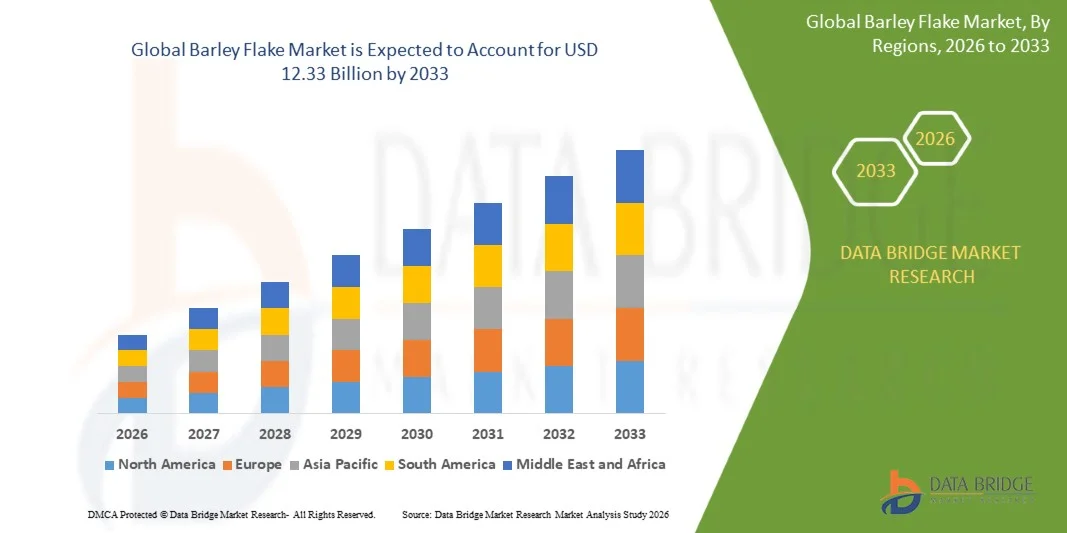
The Barley Flake Market was valued at USD 8.46 billion in 2025 and is projected to reach USD 12.33 billion by 2033, growing at a CAGR of 4.81% from 2026 to 2033. The market is witnessing steady growth driven by increasing consumer preference for healthy breakfast cereals, rising demand for whole grain and high-fiber food products, and expanding applications of barley flakes in food processing industries such as bakery, snacks, and ready-to-eat meals
The growing awareness of digestive health benefits and weight management associated with barley consumption is significantly supporting market expansion. In addition, the rising shift toward clean-label and plant-based diets, coupled with increasing adoption of natural and minimally processed ingredients by food manufacturers, is further accelerating demand for barley flakes across both developed and emerging markets.
Key Market Trends & Insights
- North America dominated the barley flake market with the largest revenue share of approximately 34.7% in 2025, supported by strong demand for healthy breakfast cereals, high consumer awareness regarding functional nutrition, and widespread adoption of whole grain based food products. The region benefits from high disposable incomes, strong retail penetration of packaged health foods, and growing preference for organic and clean label ingredients across food processing and household consumption segments.
- Asia-Pacific is expected to be the fastest-growing region, recording a CAGR of approximately 5.6–6.1% from 2026 to 2033. Growth is driven by rapid urbanization, rising disposable incomes, increasing awareness of dietary health benefits, and expanding consumption of functional foods in countries such as China, India, and Japan. The region is also witnessing strong growth in e commerce food retail and modernization of food supply chains, further improving accessibility of barley based products.
- The Conventional segment held the largest market revenue share of approximately 72.4% in 2025 driven by large scale barley cultivation, established supply chains, and widespread use in mass market food processing applications. Conventional barley flakes are preferred due to their lower cost, consistent availability, and extensive usage in breakfast cereals, bakery products, and packaged food formulations across global markets.
- The Organic segment is projected to register the fastest growth at a CAGR of 9.2% from 2026 to 2033, driven by rising consumer demand for clean label, chemical free, and sustainably sourced food products. Increasing adoption of organic certification standards, especially in Europe and North America, along with premium pricing trends in health focused retail categories, is accelerating segment expansion.
- The Hulled segment held the largest estimated revenue share of approximately 38.6% in 2025, driven by its minimal processing, high nutritional value, and strong application in health food formulations and whole grain cereal products. Hulled barley flakes are widely preferred due to their high fiber content and retention of essential nutrients.
- The Toasted segment is projected to register the fastest growth at a CAGR of 8.8% from 2026 to 2033, supported by increasing demand for enhanced flavor profiles, improved texture, and ready to eat breakfast products. Toasted barley flakes are increasingly used in granola bars, bakery toppings, and snack formulations, particularly in premium and functional food categories.
- The Food Industry segment dominated the market with an estimated revenue share of approximately 78.1% in 2025, driven by extensive utilization in breakfast cereals, bakery products, snacks, and health food formulations. Barley flakes are widely incorporated into processed food products due to their functional nutrition, fiber content, and product versatility.
- The Beverages segment is projected to register the fastest growth at a CAGR of 7.9% from 2026 to 2033, driven by increasing adoption in plant based drinks, functional beverages, and nutritional shakes. Rising demand for fiber enriched beverages and clean label drink formulations is further supporting segment expansion.
- The Supermarkets segment held the largest estimated revenue share of approximately 46.3% in 2025, driven by strong consumer preference for physical product verification, wide product availability, and established retail penetration of packaged food products.
- The Online Retail segment is projected to register the fastest growth at a CAGR of 11.4% from 2026 to 2033, supported by increasing e commerce penetration, rising digital grocery adoption, and growing consumer preference for doorstep delivery of health food products. Expanding online availability of organic and specialty barley flake variants is further accelerating segment growth.
Market Size & Forecast
- Global Market Value (2025): USD 8.46 Billion
- Expected Market Value (2033): USD 12.33 Billion
- Forecast CAGR (2026–2033): 4.81%
- Leading Region in 2025: North America
- Fastest Growing Region: Asia-Pacific
Report Scope and Barley Flake Market Segmentation
|
Attributes |
Barley Flake Key Market Insights |
|
Segments Covered |
· By Product: Conventional and Organic · By Type: Hulled, Dried, Toasted, and Others · By End-User: Food Industry, Beverages, and Others · By Distribution Channel: Online Retail, Supermarkets, Convenience Stores, and Others |
|
Countries Covered |
North America · U.S. · Canada · Mexico Europe · Germany · France · U.K. · Netherlands · Switzerland · Belgium · Russia · Italy · Spain · Turkey · Rest of Europe Asia-Pacific · China · Japan · India · South Korea · Singapore · Malaysia · Australia · Thailand · Indonesia · Philippines · Rest of Asia-Pacific Middle East and Africa · Saudi Arabia · U.A.E. · South Africa · Egypt · Israel · Rest of Middle East and Africa South America · Brazil · Argentina · Rest of South America |
|
Key Market Players |
• Kellogg Co. (U.S.) |
|
Market Opportunities |
• Rising Demand For Functional Food Products |
|
Value Added Data Infosets |
In addition to the insights on market scenarios such as market value, growth rate, segmentation, geographical coverage, and major players, the market reports curated by the Data Bridge Market Research also include in-depth expert analysis, pricing analysis, brand share analysis, consumer survey, demography analysis, supply chain analysis, value chain analysis, raw material/consumables overview, vendor selection criteria, PESTLE Analysis, Porter Analysis, and regulatory framework. |
Barley Flake Market Trends
Trend: Growing Demand For Functional Whole Grain And Clean Label Food Products
Increasing consumer preference for nutritious, minimally processed, and high fiber food products is driving strong demand for barley flakes across the global food industry. Rising awareness regarding digestive health, cholesterol management, and weight control is encouraging consumers to shift toward whole grain cereals and plant based breakfast alternatives. Conventional refined grain products are increasingly being replaced by nutrient dense options, such as barley flakes, due to their rich beta glucan content and associated health benefits.
In modern food applications, manufacturers are increasingly incorporating barley flakes into breakfast cereals, bakery products, granola bars, and instant food mixes to enhance nutritional value and product positioning. For instance in breakfast formulations, barley flakes are being blended with oats and quinoa to develop high fiber cereal mixes that support heart health and sustained energy release. In bakery applications, barley flake enrichment is improving texture, flavor profile, and functional nutrition in bread and snack products.
The rapid expansion of health conscious urban populations and clean label consumption trends is also increasing demand for natural, additive free ingredients in packaged foods. In addition, sports nutrition and weight management segments continue to adopt barley based formulations due to their low glycemic index and satiety enhancing properties. Growing product innovation through fortified cereal launches in 2025 across Europe and North America is showing improved dietary fiber content of nearly 20–35% compared to conventional refined grain based products
Barley Flake Market Dynamics
Key Market Driver: Rising Demand For High Fiber And Functional Food Ingredients
Consumers worldwide are increasingly prioritizing dietary health, gut wellness, and preventive nutrition, creating strong demand for functional grain based ingredients such as barley flakes. Rising prevalence of lifestyle related conditions such as obesity, diabetes, and cardiovascular diseases is further accelerating the shift toward high fiber food consumption patterns.
Food manufacturers are actively incorporating barley flakes into health focused product lines to improve nutritional labeling and meet regulatory guidelines on whole grain content. For instance in packaged cereals and ready to eat meals, barley flakes are used to enhance beta glucan levels, which help reduce cholesterol and support digestive health.
Similarly, the bakery and snack industry is increasingly adopting barley flakes as a clean label ingredient to replace refined flour based formulations. Market studies in 2024 across Europe demonstrated that products enriched with barley flakes achieved up to 15–25% higher fiber content compared to standard wheat based alternatives, supporting strong consumer acceptance in premium health food categories.
Key Restraint/Challenge: Limited Processing Infrastructure And Lower Consumer Awareness In Emerging Markets
Despite growing demand, the barley flake market faces challenges related to limited processing infrastructure and uneven raw material availability in several developing regions. Barley processing into flaked form requires specialized milling, steaming, and rolling equipment, which increases production complexity and cost for manufacturers.
In addition, consumer awareness regarding the nutritional benefits of barley flakes remains relatively low in many Asia-Pacific and Latin American markets compared to oats and wheat based cereals. This limits mass adoption in mainstream food categories and restricts penetration in price sensitive segments.
Market studies indicate that production costs for barley based processed cereals can be 10–18% higher than conventional grain products in regions with limited barley cultivation infrastructure, impacting competitiveness in low margin packaged food segments.
Key Market Opportunity: Expansion In Functional Foods, Breakfast Cereals And Plant Based Diets
Growing global adoption of plant based diets and functional nutrition is creating significant opportunities for barley flake manufacturers across breakfast cereals, health snacks, and ready to eat meal segments. Increasing demand for natural energy sources and fiber rich diets is encouraging food brands to launch barley enriched product innovations targeting health conscious consumers.
Food companies are increasingly developing fortified cereal blends and protein fiber mixes, for instance combining barley flakes with nuts, seeds, and dried fruits to enhance nutritional density and product appeal. In bakery applications, barley flakes are being used to develop high fiber breads and gluten reduced formulations for specialty dietary markets.
In addition, expansion of organic and clean label product portfolios in North America and Europe is accelerating barley flake adoption in premium food categories. New product launches in 2025 across retail chains in Germany and the U.S. showed up to 30–40% higher consumer preference for whole grain enriched cereals compared to refined grain alternatives, highlighting strong future growth potential.
Barley Flake Market Scope
The market is segmented on the basis of product, type, end-user, and distribution channel.
- By Product
On the basis of product, the barley flake market is segmented into Conventional and Organic. The Conventional segment held the largest market revenue share of approximately 72.4% in 2025 driven by large scale barley cultivation, established supply chains, and widespread use in mass market food processing applications. Conventional barley flakes are preferred due to their lower cost, consistent availability, and extensive usage in breakfast cereals, bakery products, and packaged food formulations across global markets.
The Organic segment is projected to register the fastest growth at a CAGR of 9.2% from 2026 to 2033, driven by rising consumer demand for clean label, chemical free, and sustainably sourced food products. Increasing adoption of organic certification standards, especially in Europe and North America, along with premium pricing trends in health focused retail categories, is accelerating segment expansion.
- By Type
On the basis of type, the market is segmented into Hulled, Dried, Toasted, and Others. The Hulled segment held the largest estimated revenue share of approximately 38.6% in 2025, driven by its minimal processing, high nutritional value, and strong application in health food formulations and whole grain cereal products. Hulled barley flakes are widely preferred due to their high fiber content and retention of essential nutrients.
The Toasted segment is projected to register the fastest growth at a CAGR of 8.8% from 2026 to 2033, supported by increasing demand for enhanced flavor profiles, improved texture, and ready to eat breakfast products. Toasted barley flakes are increasingly used in granola bars, bakery toppings, and snack formulations, particularly in premium and functional food categories.
- By End-User
On the basis of end-user, the market is segmented into Food Industry, Beverages, and Others. The Food Industry segment dominated the market with an estimated revenue share of approximately 78.1% in 2025, driven by extensive utilization in breakfast cereals, bakery products, snacks, and health food formulations. Barley flakes are widely incorporated into processed food products due to their functional nutrition, fiber content, and product versatility.
The Beverages segment is projected to register the fastest growth at a CAGR of 7.9% from 2026 to 2033, driven by increasing adoption in plant based drinks, functional beverages, and nutritional shakes. Rising demand for fiber enriched beverages and clean label drink formulations is further supporting segment expansion.
- By Distribution Channel
On the basis of distribution channel, the market is segmented into Online Retail, Supermarkets, Convenience Stores, and Others. The Supermarkets segment held the largest estimated revenue share of approximately 46.3% in 2025, driven by strong consumer preference for physical product verification, wide product availability, and established retail penetration of packaged food products.
The Online Retail segment is projected to register the fastest growth at a CAGR of 11.4% from 2026 to 2033, supported by increasing e commerce penetration, rising digital grocery adoption, and growing consumer preference for doorstep delivery of health food products. Expanding online availability of organic and specialty barley flake variants is further accelerating segment growth.
Barley Flake Market Regional Analysis
North America Barley Flake Market Insight
North America dominated the barley flake market with the largest revenue share of approximately 34.7% in 2025, supported by strong demand for healthy breakfast cereals, rising adoption of whole grain diets, and increasing consumer awareness regarding digestive health and functional nutrition. Consumers in the region are increasingly shifting toward high fiber and plant based food products, such as barley flakes, due to their beta glucan content and cholesterol reducing benefits. This widespread adoption is further supported by high disposable incomes, strong retail penetration of packaged health foods, and growing preference for clean label and organic food products across both residential and commercial food applications.
U.S. Barley Flake Market Insight
The U.S. barley flake market captured the largest revenue share within North America in 2025, driven by rapid growth in functional food consumption and expanding demand for healthy breakfast alternatives. Consumers are increasingly prioritizing high fiber, low glycemic index foods to support weight management and cardiovascular health, boosting barley flake adoption in cereals, snack bars, and bakery products. The growing popularity of plant based diets, combined with strong penetration of health focused retail brands and e commerce grocery platforms, is further supporting market expansion. In addition, increasing product innovation in fortified cereals and ready to eat meal kits is strengthening market growth.
Europe Barley Flake Market Insight
The Europe barley flake market is expected to witness the fastest growth rate from 2026 to 2033, primarily driven by strong demand for organic and whole grain food products, stringent food quality regulations, and rising consumer preference for sustainable nutrition. Increasing awareness regarding lifestyle diseases and dietary fiber intake is fostering the adoption of barley flakes across breakfast cereals, bakery, and health snack applications. The region is witnessing significant growth in clean label and organic food consumption, with barley flakes being widely integrated into functional food formulations across both retail and food service channels.
U.K. Barley Flake Market Insight
The U.K. barley flake market is expected to witness strong growth from 2026 to 2033, driven by increasing health consciousness, rising demand for high fiber breakfast foods, and growing preference for minimally processed grains. Consumers are increasingly shifting toward whole grain cereals and plant based diets to improve digestive health and overall wellness. In addition, strong supermarket penetration and expanding online grocery platforms are supporting product accessibility. The growing focus on preventive health nutrition and clean label food trends is further encouraging adoption of barley flake based products across households and food manufacturers.
Germany Barley Flake Market Insight
The Germany barley flake market is expected to witness strong growth from 2026 to 2033, fueled by rising demand for organic food products, well established whole grain consumption habits, and strong emphasis on sustainable nutrition. Germany’s highly health conscious population is increasingly adopting barley flakes in breakfast cereals, bakery products, and functional food formulations. The country’s strong organic certification ecosystem and advanced food processing industry further support market expansion. In addition, growing preference for environmentally friendly and minimally processed food ingredients is accelerating adoption in both retail and industrial food segments.
Asia-Pacific Barley Flake Market Insight
The Asia-Pacific barley flake market is expected to witness the fastest growth rate from 2026 to 2033, supported by rising urbanization, increasing disposable incomes, and growing awareness of healthy dietary habits in countries such as China, India, and Japan. The region is experiencing rapid expansion of health food consumption, driven by changing lifestyles and increasing prevalence of lifestyle related diseases. Government initiatives promoting nutritional security and food diversification are further supporting market growth. In addition, expanding retail modernization and e commerce penetration are improving accessibility of barley flake based products across urban populations.
Japan Barley Flake Market Insight
The Japan barley flake market is expected to witness steady growth from 2026 to 2033 due to the country’s strong focus on preventive healthcare, aging population, and demand for easily digestible, nutrient rich foods. Japanese consumers are increasingly adopting barley based foods due to their digestive health benefits and suitability for low calorie diets. The integration of barley flakes into traditional and modern food formats, such as breakfast cereals and convenience meals, is further supporting demand. In addition, strong retail infrastructure and emphasis on functional nutrition are driving consistent market expansion.
China Barley Flake Market Insight
The China barley flake market accounted for the largest revenue share in Asia-Pacific of approximately 41.9% in 2025, driven by rapid urbanization, expanding middle class population, and increasing health awareness among consumers. Rising demand for nutritious breakfast foods and functional grain based products is supporting strong adoption of barley flakes across retail and food processing sectors. The country’s growing e commerce ecosystem and strong domestic food manufacturing base are further accelerating market penetration. In addition, increasing focus on healthy eating and dietary diversification is boosting long term demand across urban households.
Barley Flake Market Share
The Barley Flake industry is primarily led by well-established companies, including:
• Kellogg Co. (U.S.)
• Nestlé (Switzerland)
• The Quaker Oats Company (U.S.)
• King Arthur Flour Company, Inc. (U.S.)
• Honeyville, Inc. (U.S.)
• Cereal Food Manufacturing Company (U.S.)
• Bob’s Red Mill Natural Food (U.S.)
• Rude Health (U.K.)
• Naturally Yours (U.K.)
• Gaurang Foods (India)
• VLS Foods Pvt. Ltd. (India)
• VEE GREEN ORGANIC LIFE CARE PRIVATE LIMITED (India)
• Nith River Milling (Canada)
• Hodmedod's British Pulses & Grains (U.K.)
Latest Developments in Barley Flake Market
- In October 2022, AB Mauri, a U.K. based food ingredient company, announced a distribution agreement with Healthy Grain, an Australian wholegrain specialist, to expand the availability of its BARLEYMAX product across Ireland and Great Britain. The development focuses on supplying barley based ingredients in flake, flour, and kibble forms for use in bakery and noodle applications. This initiative is expected to strengthen the presence of high fiber barley ingredients in mainstream food manufacturing and improve accessibility for food producers. It is likely to support the growing demand for functional whole grain products and accelerate adoption across processed food categories in the region.
- In November 2022, Dongseo Foods, a South Korea based food company, launched a new granola product named “Post Tongbori Granola” featuring whole barley nutrition and nutty flavor. The product includes barley flakes, whole barley, and mango flavored cranberries to enhance taste and nutritional profile. This development aims to cater to increasing consumer demand for healthy breakfast cereals and functional snack options. It is expected to strengthen the use of barley based ingredients in packaged foods and boost growth in the health focused breakfast cereal segment in the Korean market.
SKU-
Get online access to the report on the World's First Market Intelligence Cloud

- Interactive Data Analysis Dashboard
- Company Analysis Dashboard for high growth potential opportunities
- Research Analyst Access for customization & queries
- Competitor Analysis with Interactive dashboard
- Latest News, Updates & Trend analysis
- Harness the Power of Benchmark Analysis for Comprehensive Competitor Tracking
Global Barley Flakes Market, Supply Chain Analysis and Ecosystem Framework
To support market growth and help clients navigate the impact of geopolitical shifts, DBMR has integrated in-depth supply chain analysis into its Global Barley Flakes Market research reports. This addition empowers clients to respond effectively to global changes affecting their industries. The supply chain analysis section includes detailed insights such as Global Barley Flakes Market consumption and production by country, price trend analysis, the impact of tariffs and geopolitical developments, and import and export trends by country and HSN code. It also highlights major suppliers with data on production capacity and company profiles, as well as key importers and exporters. In addition to research, DBMR offers specialized supply chain consulting services backed by over a decade of experience, providing solutions like supplier discovery, supplier risk assessment, price trend analysis, impact evaluation of inflation and trade route changes, and comprehensive market trend analysis.
Research Methodology
Data collection and base year analysis are done using data collection modules with large sample sizes. The stage includes obtaining market information or related data through various sources and strategies. It includes examining and planning all the data acquired from the past in advance. It likewise envelops the examination of information inconsistencies seen across different information sources. The market data is analysed and estimated using market statistical and coherent models. Also, market share analysis and key trend analysis are the major success factors in the market report. To know more, please request an analyst call or drop down your inquiry.
The key research methodology used by DBMR research team is data triangulation which involves data mining, analysis of the impact of data variables on the market and primary (industry expert) validation. Data models include Vendor Positioning Grid, Market Time Line Analysis, Market Overview and Guide, Company Positioning Grid, Patent Analysis, Pricing Analysis, Company Market Share Analysis, Standards of Measurement, Global versus Regional and Vendor Share Analysis. To know more about the research methodology, drop in an inquiry to speak to our industry experts.
Customization Available
Data Bridge Market Research is a leader in advanced formative research. We take pride in servicing our existing and new customers with data and analysis that match and suits their goal. The report can be customized to include price trend analysis of target brands understanding the market for additional countries (ask for the list of countries), clinical trial results data, literature review, refurbished market and product base analysis. Market analysis of target competitors can be analyzed from technology-based analysis to market portfolio strategies. We can add as many competitors that you require data about in the format and data style you are looking for. Our team of analysts can also provide you data in crude raw excel files pivot tables (Fact book) or can assist you in creating presentations from the data sets available in the report.












