




Global Battery Electrolyte Market
Market Size in USD Billion
CAGR :
% 
 USD
7.17 Billion
USD
13.36 Billion
2025
2033
USD
7.17 Billion
USD
13.36 Billion
2025
2033
 Forecast Period Forecast Period |
2026 –2033 |
 Market Size (Base Year) Market Size (Base Year) |
USD 7.17 Billion |
 Market Size (Forecast Year) Market Size (Forecast Year) |
USD 13.36 Billion |
 CAGR CAGR |
% |
| Major Markets Players |
|
Battery Electrolyte Market Size
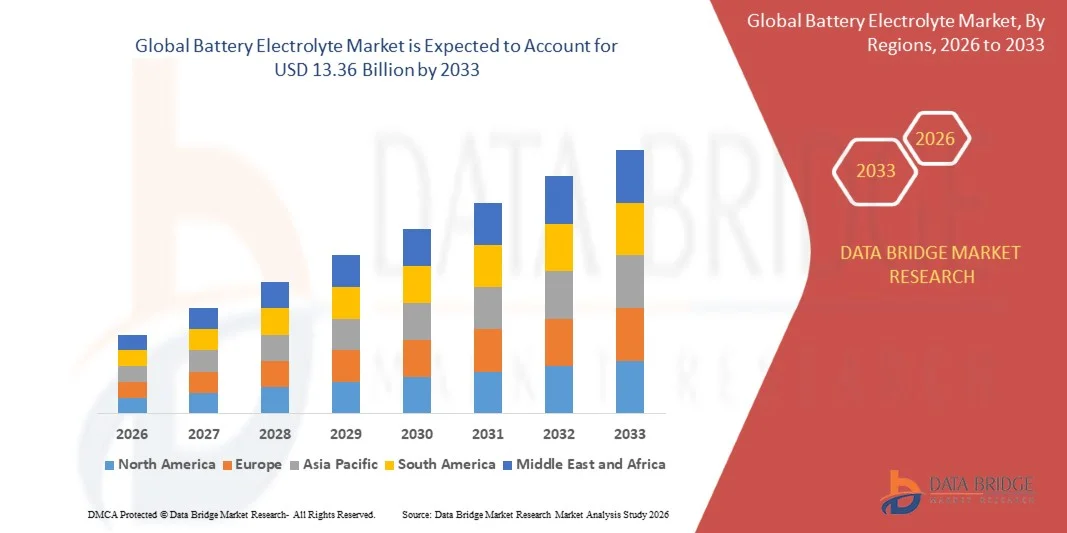
- The global battery electrolyte market size was valued at USD 7.17 billion in 2025 and is expected to reach USD 13.36 billion by 2033, at a CAGR of 8.1% during the forecast period
- The market growth is largely fueled by the rapid adoption of electric vehicles, renewable energy storage systems, and portable electronics, driving increased demand for high-performance battery electrolytes. Technological advancements in lithium-ion, solid-state, and gel electrolytes are enabling improved safety, energy density, and lifecycle, which is accelerating the deployment of advanced battery solutions across multiple sectors
- Furthermore, rising consumer and industrial demand for reliable, long-lasting, and high-efficiency batteries is establishing high-quality electrolytes as a critical component for modern energy storage and mobility applications. These converging factors are boosting the production and adoption of electrolytes, thereby significantly propelling the growth of the battery electrolyte market
Battery Electrolyte Market Analysis
- Battery electrolytes are chemical substances that enable ion transport between the anode and cathode, facilitating the electrochemical reactions required for energy storage in batteries. They are available in various forms, including liquid, gel, and solid electrolytes, and are essential for lithium-ion, lead-acid, and other advanced battery chemistries used in EVs, industrial storage, and consumer electronics
- The escalating demand for battery electrolytes is primarily fueled by the growth of electric mobility, increasing energy storage installations for renewable power integration, and rising use of portable devices. In addition, manufacturers are focusing on developing safer, higher-performance, and cost-effective electrolyte solutions to meet regulatory standards and the evolving needs of end-users, further driving market expansion
- Asia-Pacific dominated the battery electrolyte market with a share of 35.2% in 2025, due to rapid industrialization, expanding electric vehicle adoption, and increasing investments in energy storage infrastructure
- North America is expected to be the fastest growing region in the battery electrolyte market during the forecast period due to increasing EV deployment, expanding renewable energy storage, and technological advancements in lithium-ion and solid-state batteries
- Gel electrolyte segment dominated the market with a market share of 42.8% in 2025, due to its enhanced safety features, leakage resistance, and stable performance across a wide temperature range. Its ability to combine the advantages of both liquid and solid electrolytes makes it ideal for use in lithium-ion and lead-acid batteries for consumer electronics, electric vehicles, and energy storage applications
Report Scope and Battery Electrolyte Market Segmentation
|
Attributes |
Battery Electrolyte Key Market Insights |
|
Segments Covered |
|
|
Countries Covered |
North America
Europe
Asia-Pacific
Middle East and Africa
South America
|
|
Key Market Players |
|
|
Market Opportunities |
|
|
Value Added Data Infosets |
In addition to the insights on market scenarios such as market value, growth rate, segmentation, geographical coverage, and major players, the market reports curated by the Data Bridge Market Research also include import export analysis, production capacity overview, production consumption analysis, price trend analysis, climate change scenario, supply chain analysis, value chain analysis, raw material/consumables overview, vendor selection criteria, PESTLE Analysis, Porter Analysis, and regulatory framework. |
Battery Electrolyte Market Trends
“Growing Use of Advanced Electrolytes in EVs and Energy Storage”
- A key trend in the battery electrolyte market is the rising adoption of advanced electrolytes in electric vehicles (EVs) and energy storage systems, driven by the need for higher energy density, improved safety, and longer lifecycle performance. These advanced electrolytes are becoming essential for lithium-ion, solid-state, and next-generation battery technologies to meet the increasing global demand for electrification
- For instance, companies such as BASF and Mitsubishi Chemical are supplying high-performance liquid and solid electrolytes for EV battery packs, enabling longer driving ranges and faster charging capabilities. Their products enhance ionic conductivity and thermal stability, which are critical for large-scale energy storage and automotive applications
- The push toward solid-state batteries is accelerating, as these electrolytes reduce risks associated with flammability and thermal runaway, positioning them as safer alternatives for high-energy applications. This trend is attracting investment from automakers and battery developers seeking to commercialize next-generation battery chemistries
- The stationary energy storage sector is incorporating advanced electrolyte solutions to improve the efficiency and durability of grid-scale batteries. Electrolytes with optimized formulations support stable cycling, allowing utilities and renewable energy providers to enhance storage reliability and extend system lifespans
- Battery manufacturers are increasingly focusing on electrolyte formulations that support fast-charging technologies while maintaining chemical stability. This focus is driving innovation in electrolyte additives, solvents, and solid-state compositions that meet evolving performance benchmarks
- The market is witnessing growing collaboration between battery developers, chemical suppliers, and EV OEMs to co-develop customized electrolyte solutions. This trend is shaping a future where advanced electrolytes become central to high-performance, safe, and long-lasting energy storage systems
Battery Electrolyte Market Dynamics
Driver
“Rising Demand for Safe, High-Performance Batteries”
- The growing need for safe, high-performance batteries across electric mobility and energy storage applications is a primary driver for the battery electrolyte market. Consumers and industries are increasingly prioritizing batteries with high energy density, fast-charging ability, and enhanced safety features
- For instance, Panasonic supplies advanced electrolytes for Tesla’s EV battery packs, improving thermal stability and cycle life. Their formulations help reduce risks of short circuits and thermal runaway, supporting reliable and efficient EV operation
- The push for sustainable transportation and renewable energy storage is fueling investments in high-performance electrolyte technologies. These electrolytes play a critical role in extending battery lifespan and maintaining consistent performance under extreme operating conditions
- Increasing regulatory requirements for battery safety and environmental compliance are driving the development of non-flammable and eco-friendly electrolytes. These regulations encourage manufacturers to innovate and differentiate products through advanced chemical formulations
- Consumer preference for fast-charging and long-range EVs continues to strengthen this driver. High-performance electrolytes enable batteries to achieve these objectives, ensuring market growth and technological advancement across automotive and stationary storage sectors
Restraint/Challenge
“High Production Costs and Complex Manufacturing”
- The battery electrolyte market faces challenges due to the high production costs and complex manufacturing processes involved in producing advanced electrolytes. These processes require precision handling, high-purity raw materials, and specialized facilities to ensure safety and performance standards are met
- For instance, Umicore and Solvay employ sophisticated chemical synthesis and purification techniques to produce high-performance electrolytes for lithium-ion and solid-state batteries. These procedures increase operational costs and require stringent quality controls to prevent contamination or performance degradation
- Scaling production of solid-state and high-voltage electrolytes involves extensive research, development, and testing, which prolongs time-to-market and raises capital expenditure. Maintaining consistency and safety in large-scale production remains a key operational challenge
- The reliance on rare or high-cost raw materials, such as lithium salts and fluorinated solvents, adds volatility to supply chains and further elevates production expenses. Manufacturers must balance performance requirements with cost efficiency to remain competitive
- Meeting the growing demand for EV and energy storage applications while controlling costs continues to challenge electrolyte producers. Addressing these constraints is crucial for sustaining market growth, ensuring safety, and delivering high-quality battery solutions
Battery Electrolyte Market Scope
The market is segmented on the basis of battery type, electrolyte type, and end-user.
• By Battery Type
On the basis of battery type, the battery electrolyte market is segmented into Lead-Acid, Lithium-Ion, Nickel Metal, and Others. The Lithium-Ion segment dominated the largest market revenue share in 2025, driven by its high energy density, long cycle life, and increasing deployment in consumer electronics and electric vehicles. Lithium-Ion batteries are preferred for their lightweight design and ability to support fast charging, making them highly suitable for portable devices and renewable energy storage systems. The segment also benefits from continuous technological innovations and compatibility with advanced solid and gel electrolytes, enhancing performance and safety.
The Lead-Acid segment is expected to witness the fastest growth rate from 2026 to 2033, fueled by rising industrial applications and backup power solutions. For instance, companies such as Exide Industries are expanding production to cater to growing demand in UPS systems and industrial machinery. Lead-Acid batteries remain cost-effective, reliable, and easy to recycle, contributing to their widespread adoption in emerging markets. Their robustness and simplicity make them particularly suitable for large-scale energy storage and transportation infrastructure.
• By Electrolyte Type
On the basis of electrolyte type, the market is segmented into Liquid Electrolyte, Solid Electrolyte, Gel Electrolyte, Sodium Chloride, Nitric Acid, Sulphuric Acid, and Other. The Gel Electrolyte segment held the largest market revenue share of 42.8% in 2025, driven by its enhanced safety features, leakage resistance, and stable performance across a wide temperature range. Its ability to combine the advantages of both liquid and solid electrolytes makes it ideal for use in lithium-ion and lead-acid batteries for consumer electronics, electric vehicles, and energy storage applications. The segment also benefits from growing demand in portable devices and industrial batteries due to its low maintenance requirements and long cycle life, supporting consistent energy delivery and reliability.
The Solid Electrolyte segment is projected to register the fastest CAGR from 2026 to 2033, driven by growing research in safer, high-performance batteries. For instance, QuantumScape is advancing solid-state electrolytes for next-generation electric vehicle batteries, offering higher energy density and lower risk of leakage or thermal runaway. Solid electrolytes are gaining traction in high-end applications, particularly in EVs and advanced energy storage systems, due to their enhanced safety, durability, and ability to operate across a wide temperature range.
• By End-User
On the basis of end-user, the battery electrolyte market is segmented into Industrial, Transportation, Energy Storage, Consumer Electronics, Electric Vehicle Battery (EVs), Residential, and Others. The Electric Vehicle Battery (EVs) segment dominated the largest market revenue share in 2025, driven by the rapid adoption of electric mobility and government incentives promoting EV infrastructure. Lithium-Ion and solid-state electrolytes are extensively deployed in this segment, supporting high energy density, fast charging, and long-term performance. The market growth is further supported by collaborations between automakers and battery manufacturers to develop high-efficiency, sustainable energy solutions.
The Industrial segment is anticipated to witness the fastest growth rate from 2026 to 2033, fueled by increasing demand for backup power systems, large-scale machinery, and uninterrupted power supply solutions. For instance, companies such as ABB are expanding battery storage and industrial power solutions that rely on high-capacity electrolytes. Industrial applications require robust, durable, and cost-effective electrolyte systems capable of handling frequent charge-discharge cycles while ensuring safety and longevity, driving market expansion across regions.
Battery Electrolyte Market Regional Analysis
- Asia-Pacific dominated the battery electrolyte market with the largest revenue share of 35.2% in 2025, driven by rapid industrialization, expanding electric vehicle adoption, and increasing investments in energy storage infrastructure
- The region’s cost-effective manufacturing landscape, rising adoption of renewable energy systems, and supportive government policies for EVs and battery production are accelerating market growth
- The availability of skilled labor, growing R&D capabilities, and rapid technological advancements across developing economies are contributing to increased consumption of advanced battery electrolytes for both industrial and consumer applications
China Battery Electrolyte Market Insight
China held the largest share in the Asia-Pacific battery electrolyte market in 2025, owing to its position as a global leader in lithium-ion battery production and EV manufacturing. The country's strong industrial base, favorable government incentives for energy storage and electric mobility, and extensive export capabilities are major growth drivers. Demand is further supported by ongoing investments in solid and gel electrolytes for high-performance applications and expansion of domestic EV infrastructure.
India Battery Electrolyte Market Insight
India is witnessing the fastest growth in the Asia-Pacific region, fueled by rising EV adoption, increasing renewable energy projects, and growing industrial battery requirements. Government initiatives such as FAME India (Faster Adoption and Manufacturing of Hybrid and Electric Vehicles) and domestic manufacturing incentives are boosting electrolyte demand. In addition, expanding research in lithium-ion and solid-state technologies, coupled with growing consumer electronics production, is driving robust market growth.
Europe Battery Electrolyte Market Insight
The Europe battery electrolyte market is expanding steadily, supported by stringent environmental regulations, increasing focus on green mobility, and investments in sustainable battery manufacturing. The region emphasizes high-quality, safe, and eco-friendly electrolytes for automotive, energy storage, and industrial applications. Growing adoption of EVs, advanced energy storage systems, and cross-industry collaborations are further enhancing market development.
Germany Battery Electrolyte Market Insight
Germany’s battery electrolyte market is driven by leadership in electric mobility, strong chemical and automotive industries, and extensive R&D infrastructure. The country fosters innovation in high-performance electrolytes and collaborates with academic and industrial partners to advance solid-state and gel electrolyte technologies. Demand is particularly strong for EV batteries, industrial storage, and consumer electronics applications.
U.K. Battery Electrolyte Market Insight
The U.K. market is supported by a mature automotive and energy storage sector, efforts to localize battery supply chains, and increasing investments in advanced battery research. Rising focus on EV adoption, academic-industry partnerships, and production of high-purity electrolytes for specialty batteries is strengthening the market. The country continues to play a key role in sustainable battery technologies and innovative electrolyte solutions.
North America Battery Electrolyte Market Insight
North America is projected to grow at the fastest CAGR from 2026 to 2033, driven by increasing EV deployment, expanding renewable energy storage, and technological advancements in lithium-ion and solid-state batteries. The region benefits from strong R&D initiatives, rising government incentives, and growing collaborations between battery manufacturers and automotive companies. Adoption of high-performance and safe electrolytes for consumer electronics and industrial applications is boosting market expansion.
U.S. Battery Electrolyte Market Insight
The U.S. accounted for the largest share in the North America market in 2025, underpinned by its extensive EV industry, advanced energy storage projects, and significant investment in lithium-ion battery production. The country’s focus on innovation, regulatory compliance, and sustainability is driving adoption of high-performance liquid, gel, and solid electrolytes. Presence of major battery manufacturers and a mature distribution network further reinforce the U.S.’s leading position in the region.
Battery Electrolyte Market Share
The battery electrolyte industry is primarily led by well-established companies, including:
- Mitsubishi Chemical Corporation (Japan)
- UBE Industries, Ltd. (Japan)
- Capchem (China)
- Johnson Controls (U.S.)
- Guangzhou Tinci Materials Technology Co. (China)
- GS Yuasa International Ltd. (Japan)
- 3M (U.S.)
- BASF SE (Germany)
- American Elements (U.S.)
- Tokyo Chemical Industry UK Ltd. (U.K.)
- GELEST, Inc. (U.S.)
- Targray (Canada)
- Ohara Corporation (Japan)
- Daikin America, Inc. (U.S.)
- NOHMs Technologies, Inc. (U.S.)
- Stella Chemifa Corporation (Japan)
- GuangDong JinGuang High-Tech Co., Ltd. (China)
- Guotai Huarong Poland Sp. z o.o. (Poland)
- TOMIYAMA PURE CHEMICAL INDUSTRIES, Ltd. (Japan)
Latest Developments in Global Battery Electrolyte Market
- In March 2026, Jiangxi Hangsheng New Energy commenced operations at its annual 50,000-tonne lithium battery electrolyte project in Longnan, Jiangxi Province, significantly expanding large-scale electrolyte production capacity. This development strengthens regional supply infrastructure, ensures stable raw material availability, and enhances China’s position in the global battery materials value chain. It addresses the growing demand from electric vehicles and energy storage systems, reduces dependency on imports for high-purity electrolytes, and positions manufacturers to scale rapidly with the increasing adoption of lithium-ion batteries across Asia and international markets
- In December 2025, Orbia Fluor & Energy Materials completed the expansion of its custom electrolyte facility, enabling higher production throughput and broader formulation capabilities for lithium-ion and advanced battery chemistries. The expansion supports the rising demand for tailored electrolyte solutions, allowing OEMs and battery manufacturers to optimize performance for EVs, portable electronics, and grid storage applications. It enhances Orbia’s competitive positioning in the market, ensures faster delivery of high-performance electrolytes, and strengthens its capacity to meet the evolving technical and regulatory requirements of global battery producers
- In January 2024, Australian Vanadium (AVL) announced the development of a flow battery electrolyte plant in Wangara, Western Australia, targeting 33 MWh of annual production. This initiative is set to bolster local flow battery supply, accelerate adoption of renewable energy storage solutions, and support grid-scale projects requiring stable and safe electrolytes. By establishing domestic production, AVL reduces reliance on imports, fosters technological advancement in vanadium redox flow batteries, and positions Australia as a key player in the growing global energy storage and renewable sector
- In October 2023, Toyota and Idemitsu announced a collaboration to produce sulfide solid electrolytes for electric vehicles, aiming to advance next-generation solid-state battery technology. The partnership is expected to enhance battery safety, increase energy density, and extend lifecycle performance, supporting faster adoption of EVs worldwide. This development also encourages innovation in battery chemistry, strengthens the supply chain for high-performance solid electrolytes, and positions both companies at the forefront of sustainable and efficient energy storage solutions
- In April 2023, Neogen Chemicals and MU Ionic Solutions announced a partnership to manufacture electrolytes for EV batteries in India, expanding domestic production capacity. This collaboration supports India’s rapidly growing EV market by ensuring a reliable supply of high-quality electrolytes, reducing dependency on imports, and promoting local manufacturing initiatives. It also enables battery manufacturers to meet increasing demand efficiently, facilitates the adoption of lithium-ion and advanced battery technologies, and contributes to the country’s push toward energy transition and sustainable mobility
SKU-
Get online access to the report on the World's First Market Intelligence Cloud

- Interactive Data Analysis Dashboard
- Company Analysis Dashboard for high growth potential opportunities
- Research Analyst Access for customization & queries
- Competitor Analysis with Interactive dashboard
- Latest News, Updates & Trend analysis
- Harness the Power of Benchmark Analysis for Comprehensive Competitor Tracking
Global Battery Electrolyte Market, Supply Chain Analysis and Ecosystem Framework
To support market growth and help clients navigate the impact of geopolitical shifts, DBMR has integrated in-depth supply chain analysis into its Global Battery Electrolyte Market research reports. This addition empowers clients to respond effectively to global changes affecting their industries. The supply chain analysis section includes detailed insights such as Global Battery Electrolyte Market consumption and production by country, price trend analysis, the impact of tariffs and geopolitical developments, and import and export trends by country and HSN code. It also highlights major suppliers with data on production capacity and company profiles, as well as key importers and exporters. In addition to research, DBMR offers specialized supply chain consulting services backed by over a decade of experience, providing solutions like supplier discovery, supplier risk assessment, price trend analysis, impact evaluation of inflation and trade route changes, and comprehensive market trend analysis.
Research Methodology
Data collection and base year analysis are done using data collection modules with large sample sizes. The stage includes obtaining market information or related data through various sources and strategies. It includes examining and planning all the data acquired from the past in advance. It likewise envelops the examination of information inconsistencies seen across different information sources. The market data is analysed and estimated using market statistical and coherent models. Also, market share analysis and key trend analysis are the major success factors in the market report. To know more, please request an analyst call or drop down your inquiry.
The key research methodology used by DBMR research team is data triangulation which involves data mining, analysis of the impact of data variables on the market and primary (industry expert) validation. Data models include Vendor Positioning Grid, Market Time Line Analysis, Market Overview and Guide, Company Positioning Grid, Patent Analysis, Pricing Analysis, Company Market Share Analysis, Standards of Measurement, Global versus Regional and Vendor Share Analysis. To know more about the research methodology, drop in an inquiry to speak to our industry experts.
Customization Available
Data Bridge Market Research is a leader in advanced formative research. We take pride in servicing our existing and new customers with data and analysis that match and suits their goal. The report can be customized to include price trend analysis of target brands understanding the market for additional countries (ask for the list of countries), clinical trial results data, literature review, refurbished market and product base analysis. Market analysis of target competitors can be analyzed from technology-based analysis to market portfolio strategies. We can add as many competitors that you require data about in the format and data style you are looking for. Our team of analysts can also provide you data in crude raw excel files pivot tables (Fact book) or can assist you in creating presentations from the data sets available in the report.












