


Global Battery Free Rfid Sensor Market
Market Size in USD Million
CAGR :
% 
 USD
796.77 Million
USD
2,035.63 Million
2025
2033
USD
796.77 Million
USD
2,035.63 Million
2025
2033
 Forecast Period Forecast Period |
2026 –2033 |
 Market Size (Base Year) Market Size (Base Year) |
USD 796.77 Million |
 Market Size (Forecast Year) Market Size (Forecast Year) |
USD 2,035.63 Million |
 CAGR CAGR |
% |
| Major Markets Players |
|
Battery Free Radio Frequency Identification (RFID) Sensor Market Size
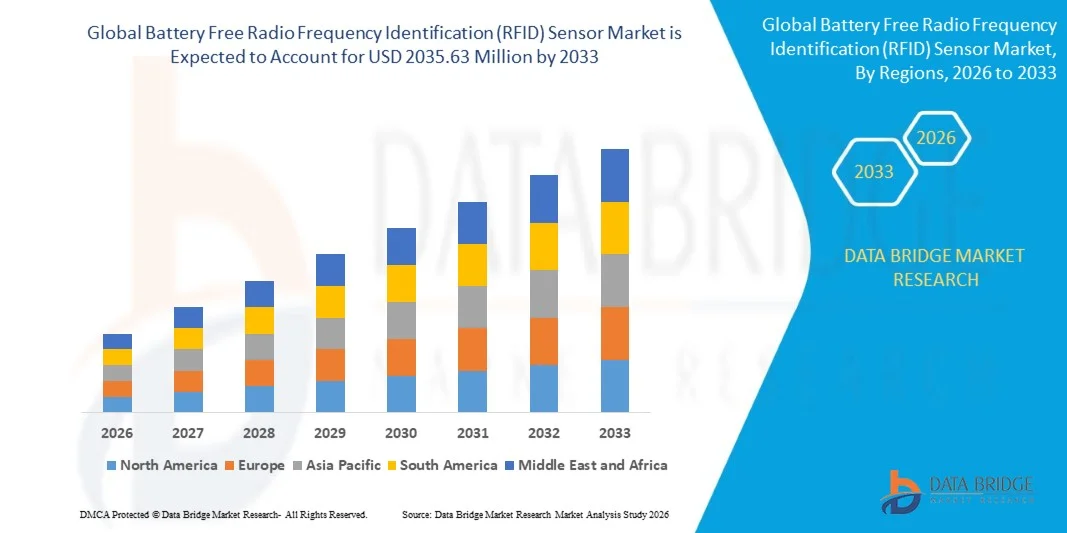
- The global Battery Free Radio Frequency Identification (RFID) Sensor market size was valued at USD 796.77 million in 2025 and is expected to reach USD 2035.63 million by 2033, at a CAGR of 12.44% during the forecast period
- The market growth is largely fueled by the increasing adoption of IoT-enabled tracking systems and rapid advancements in battery-free sensing technologies, enabling continuous monitoring of assets without the need for external power sources or maintenance
- Furthermore, rising demand for cost-efficient, low-maintenance, and energy-harvesting RFID solutions across logistics, healthcare, and industrial automation sectors is accelerating the deployment of battery-free RFID sensors in real-time tracking applications
Battery Free Radio Frequency Identification (RFID) Sensor Market Analysis
- Battery-free RFID sensors, which operate without embedded power sources by leveraging RF energy harvesting, are becoming essential components in modern asset tracking, supply chain visibility, and industrial monitoring systems due to their durability, reduced maintenance requirements, and ability to function in harsh environments
- The escalating demand for these sensors is primarily driven by the rapid expansion of smart logistics networks, increasing focus on operational efficiency, and growing adoption of Industry 4.0 practices that require scalable, real-time, and maintenance-free sensing solutions
- North America dominated the Battery Free Radio Frequency Identification (RFID) Sensor market with a share of 26% in 2025, due to strong demand for energy-efficient asset tracking solutions and rapid adoption of IoT-enabled identification systems across logistics and industrial sectors
- Asia-Pacific is expected to be the fastest growing region in the Battery Free Radio Frequency Identification (RFID) Sensor market during the forecast period due to rapid industrialization, expanding manufacturing bases, and increasing digital transformation initiatives in countries such as China, Japan, and India
- Ultra-high frequency segment dominated the market with a market share of 46.5% in 2025, due to its long-read range and ability to support high-speed data capture across large-scale industrial and logistics environments. UHF technology is widely preferred in supply chain and asset tracking systems due to efficient bulk scanning and improved operational visibility
Report Scope and Battery Free Radio Frequency Identification (RFID) Sensor Market Segmentation
|
Attributes |
Battery Free Radio Frequency Identification (RFID) Sensor Key Market Insights |
|
Segments Covered |
|
|
Countries Covered |
North America · U.S. · Canada · Mexico Europe · Germany · France · U.K. · Netherlands · Switzerland · Belgium · Russia · Italy · Spain · Turkey · Rest of Europe Asia-Pacific · China · Japan · India · South Korea · Singapore · Malaysia · Australia · Thailand · Indonesia · Philippines · Rest of Asia-Pacific Middle East and Africa · Saudi Arabia · U.A.E. · South Africa · Egypt · Israel · Rest of Middle East and Africa South America · Brazil · Argentina · Rest of South America |
|
Key Market Players |
· Farsens (Spain) · Phase IV Engineering Inc. (U.S.) · Metalcraft (U.S.) · Semiconductor Components Industries, LLC (U.S.) · GAO Group (Canada) · Omni-ID (U.S.) · Digi-Key Electronics (U.S.) · Powercast Corp. (U.S.) · Inductosense (U.K.) · Infineon Technologies AG (Germany) · Axzon (U.S.) · Texas Instruments Incorporated (U.S.) |
|
Market Opportunities |
· Expansion of Smart Logistics and Cold Chain Monitoring Solutions · Growing Deployment in Predictive Maintenance and Industrial IoT Infrastructures |
|
Value Added Data Infosets |
In addition to the insights on market scenarios such as market value, growth rate, segmentation, geographical coverage, and major players, the market reports curated by the Data Bridge Market Research also include in-depth expert analysis, geographically represented company-wise production and capacity, network layouts of distributors and partners, detailed and updated price trend analysis and deficit analysis of supply chain and demand. |
Battery Free Radio Frequency Identification (RFID) Sensor Market Trends
“Growth of Energy Harvesting Passive RFID Sensors”
- A significant trend in the Battery Free Radio Frequency Identification (RFID) Sensor market is the rapid advancement of energy harvesting technologies that enable fully passive sensing capabilities without embedded batteries. This is strengthening real-time monitoring applications across logistics, industrial automation, and supply chain visibility by improving operational sustainability and reducing maintenance dependency
- For instance, Powercast Corp. has developed RF energy harvesting-based RFID sensor solutions that enable battery-free temperature and environmental monitoring in industrial and logistics environments. Such innovations are improving long-term deployment efficiency and enabling continuous asset tracking in remote and large-scale operations
- The integration of ultra-low power semiconductor designs is expanding the functionality of passive RFID sensors, allowing multi-parameter sensing such as temperature, strain, and humidity. This is increasing their adoption in sectors requiring high accuracy monitoring without frequent device replacement or maintenance
- Companies such as Axzon are advancing chip-level sensing technologies that support battery-free operation in industrial monitoring applications. These developments are enhancing sensor reliability and enabling scalable deployment across smart infrastructure systems
- The adoption of energy harvesting RFID systems is also accelerating in cold chain logistics, where uninterrupted environmental monitoring is critical for product integrity. This is reinforcing demand for maintenance-free tracking solutions across pharmaceuticals and food supply networks
- The market is witnessing increased incorporation of passive sensing technologies into Industry 4.0 ecosystems, supporting smarter, more efficient data-driven operations. This trend is strengthening the role of battery-free RFID sensors as essential components in next-generation industrial and logistics automation
Battery Free Radio Frequency Identification (RFID) Sensor Market Dynamics
Driver
“Rising Demand for Maintenance-Free Tracking Systems”
- The growing demand for maintenance-free and cost-efficient asset tracking solutions is a major driver of the Battery Free Radio Frequency Identification (RFID) Sensor market, as industries seek to eliminate battery replacement cycles and reduce operational downtime. This is driving widespread adoption across logistics, manufacturing, and healthcare sectors where continuous monitoring is essential
- For instance, Infineon Technologies AG provides enabling semiconductor technologies that support low-power and battery-free RFID sensing applications used in industrial and IoT environments. These solutions help enterprises achieve real-time visibility while minimizing maintenance complexity and operational costs
- The expansion of large-scale supply chain networks is increasing the need for scalable tracking systems that can operate without power sources, improving efficiency in asset monitoring. This is further supporting adoption in warehouses, transportation, and retail logistics operations
- Companies such as Omni-ID are supplying rugged RFID-based tracking solutions designed for industrial asset visibility without reliance on batteries. These systems are enhancing operational transparency in harsh environments such as oil and gas and heavy manufacturing
- The increasing preference for sustainable and low-maintenance IoT solutions continues to strengthen demand for battery-free sensing technologies. This is positioning maintenance-free RFID systems as a critical enabler of long-term digital transformation across industries
Restraint/Challenge
“Integration Complexity and Lack of Standardization”
- The Battery Free Radio Frequency Identification (RFID) Sensor market faces significant challenges due to integration complexity with existing IoT infrastructure and the lack of universal standards for interoperability across devices and platforms. This limits seamless deployment across diverse industrial ecosystems
- For instance, Texas Instruments Incorporated develops RFID and sensing semiconductor solutions that require customized integration into end-user systems, highlighting the complexity involved in deploying battery-free sensor technologies at scale. Such integration requirements increase development time and technical barriers for end users
- The absence of standardized communication protocols across RFID sensor platforms creates compatibility issues between different manufacturers’ systems. This slows down large-scale adoption in multi-vendor industrial environments where interoperability is critical
- Companies such as Farsens design specialized battery-free RFID sensor solutions that often require tailored integration with specific reader systems and application environments. This increases implementation complexity and restricts plug-and-play scalability
- The evolving nature of RFID sensing technologies further complicates standardization efforts, as new sensing capabilities continue to emerge rapidly. This ongoing fragmentation in technology frameworks is restraining seamless ecosystem development and slowing uniform global adoption
Battery Free Radio Frequency Identification (RFID) Sensor Market Scope
The market is segmented on the basis of frequency, application, and industries.
- By Frequency
On the basis of frequency, the battery free radio frequency identification (RFID) sensor market is segmented into low frequency, high frequency and NFC, and ultra-high frequency. The ultra-high frequency segment dominated the market with the largest revenue share of 46.5% in 2025, driven by its long-read range and ability to support high-speed data capture across large-scale industrial and logistics environments. UHF technology is widely preferred in supply chain and asset tracking systems due to efficient bulk scanning and improved operational visibility. Its compatibility with automated warehouse systems and real-time tracking solutions further strengthens adoption. Strong scalability across complex networks supports its leading position in industrial deployments.
The NFC segment is anticipated to witness the fastest growth rate from 2026 to 2033, driven by rising adoption in consumer electronics and smart packaging applications. NFC-based battery free RFID sensors enable seamless short-range communication, making them suitable for authentication, contactless interaction, and IoT-enabled smart devices. Growing integration in retail and mobile-based applications supports wider acceptance. Increasing demand for secure and user-friendly connectivity solutions further accelerates expansion. Expanding use in personalized and interactive applications contributes to rapid segment growth.
- By Application
On the basis of application, the battery free RFID sensor market is segmented into food quality monitoring, supply chain management, condition monitoring, structural health monitoring, ambient lighting, temperature detectors, biometrics, humidity or moisture detectors, pressure detectors, and others. The supply chain management segment dominated the market with the largest revenue share in 2025, driven by increasing demand for real-time asset tracking and inventory visibility across global logistics networks. Battery free RFID sensors enhance operational efficiency by enabling continuous monitoring without maintenance requirements. Their use in warehouse automation and transportation tracking improves accuracy and reduces losses. Strong adoption across retail and logistics ecosystems supports sustained dominance.
The structural health monitoring segment is expected to witness the fastest growth rate from 2026 to 2033, driven by increasing investments in smart infrastructure and predictive maintenance systems. Battery free RFID sensors enable continuous monitoring of bridges, buildings, and industrial structures without external power dependency. Rising emphasis on safety, early fault detection, and cost-efficient maintenance supports adoption. Integration with IoT-based analytics platforms enhances real-time decision-making capabilities. Expanding smart city initiatives further accelerates segment growth.
- By Industries
On the basis of industries, the battery free RFID sensor market is segmented into IT and telecommunications, retail, logistics, automotive, aerospace and defense, commercial, food and beverages, and others. The logistics segment dominated the market with the largest revenue share in 2025, driven by extensive deployment of tracking and monitoring systems across global supply chains. Battery free RFID sensors improve visibility, reduce operational delays, and enhance inventory accuracy in large-scale distribution networks. Growing e-commerce activities and demand for real-time shipment tracking further strengthen adoption. Integration with automated warehouse systems supports long-term market leadership.
The aerospace and defense segment is anticipated to witness the fastest growth rate from 2026 to 2033, driven by rising demand for high-precision asset tracking and maintenance monitoring in mission-critical environments. Battery free RFID sensors offer reliable performance in harsh conditions without requiring internal power sources. Increasing focus on safety, component traceability, and operational efficiency supports adoption in defense logistics and aircraft maintenance. Advanced integration with digital tracking systems enhances mission readiness and asset management. Expanding defense modernization programs further drives rapid segment growth.
Battery Free Radio Frequency Identification (RFID) Sensor Market Regional Analysis
- North America dominated the Battery Free Radio Frequency Identification (RFID) Sensor market with the largest revenue share of 26% in 2025, driven by strong demand for energy-efficient asset tracking solutions and rapid adoption of IoT-enabled identification systems across logistics and industrial sectors
- The region benefits from early deployment of battery-free sensing technologies in supply chain management, healthcare tracking, and smart manufacturing environments where continuous monitoring without maintenance is highly valued
- This widespread adoption is further supported by strong investments in digital infrastructure, high automation levels in warehouses, and the growing need for cost-effective, maintenance-free RFID solutions, positioning battery-free RFID sensors as a key enabler of next-generation tracking systems
U.S. Battery Free Radio Frequency Identification (RFID) Sensor Market Insight
The U.S. accounted for the largest revenue share in North America in 2025, driven by rapid integration of smart logistics platforms and increasing demand for real-time visibility in inventory and asset management systems. Enterprises are prioritizing battery-free RFID sensors to reduce operational costs and eliminate battery dependency in large-scale deployments. The growing expansion of Industry 4.0 initiatives and smart retail ecosystems is further accelerating adoption. In addition, strong presence of technology providers and early adoption of IoT-based tracking solutions are significantly strengthening market growth across the country.
Europe Battery Free Radio Frequency Identification (RFID) Sensor Market Insight
The Europe battery free Radio Frequency Identification (RFID) sensor market is projected to expand at a substantial CAGR during the forecast period, supported by stringent sustainability regulations and increasing demand for low-maintenance tracking technologies. The region’s focus on reducing electronic waste is encouraging the shift toward battery-free sensing solutions in industrial automation and transportation systems. Adoption is rising across manufacturing, healthcare, and retail sectors where efficiency and traceability are critical. Growth is further supported by digital transformation initiatives and increasing investment in smart infrastructure projects across major economies.
U.K. Battery Free Radio Frequency Identification (RFID) Sensor Market Insight
The U.K. battery free Radio Frequency Identification (RFID) sensor market is expected to grow at a notable CAGR, driven by rising adoption of smart logistics systems and increasing emphasis on operational efficiency in retail and warehousing sectors. Businesses are increasingly adopting battery-free RFID technology to improve asset tracking accuracy while reducing maintenance requirements. The expansion of e-commerce and demand for faster supply chain visibility are further supporting market growth. In addition, strong focus on digital innovation and automation across enterprises is encouraging wider deployment of advanced RFID solutions.
Germany Battery Free Radio Frequency Identification (RFID) Sensor Market Insight
The Germany battery free Radio Frequency Identification (RFID) sensor market is anticipated to expand steadily during the forecast period, fueled by strong industrial automation capabilities and a high focus on sustainable manufacturing practices. German industries are increasingly integrating battery-free RFID sensors into production lines for real-time monitoring and predictive maintenance applications. The country’s emphasis on precision engineering and energy efficiency is further boosting adoption. Moreover, growing deployment in automotive manufacturing and smart factory ecosystems is strengthening demand for advanced, maintenance-free tracking technologies.
Asia-Pacific Battery Free Radio Frequency Identification (RFID) Sensor Market Insight
The Asia-Pacific battery free Radio Frequency Identification (RFID) sensor market is poised to grow at the fastest CAGR during the forecast period of 2026 to 2033, driven by rapid industrialization, expanding manufacturing bases, and increasing digital transformation initiatives in countries such as China, Japan, and India. Rising demand for cost-effective and scalable tracking solutions is accelerating adoption across logistics, retail, and smart city applications. Government-led initiatives promoting IoT and automation are further supporting market expansion. In addition, APAC emerging as a global manufacturing hub for RFID components is improving accessibility and affordability of battery-free sensor technologies.
Japan Battery Free Radio Frequency Identification (RFID) Sensor Market Insight
The Japan battery free Radio Frequency Identification (RFID) sensor market is gaining momentum due to strong technological advancement, high adoption of IoT systems, and increasing demand for efficient asset tracking solutions in urban infrastructure. The country’s focus on smart factories and precision manufacturing is driving integration of battery-free RFID sensors in industrial operations. Growing elderly population is also encouraging adoption in healthcare and assisted living environments for seamless monitoring solutions. Furthermore, Japan’s emphasis on automation and reliability is supporting long-term adoption of maintenance-free sensor technologies.
China Battery Free Radio Frequency Identification (RFID) Sensor Market Insight
The China battery free Radio Frequency Identification (RFID) sensor market accounted for the largest revenue share in Asia Pacific in 2025, attributed to rapid urbanization, strong industrial expansion, and large-scale deployment of smart logistics systems. The country’s extensive e-commerce ecosystem is significantly driving demand for efficient and low-cost tracking solutions. Government support for smart city development and industrial digitalization is further accelerating adoption. In addition, strong domestic manufacturing capabilities and availability of cost-effective RFID solutions are making battery-free sensors widely accessible across multiple end-use industries.
Battery Free Radio Frequency Identification (RFID) Sensor Market Share
The Battery Free Radio Frequency Identification (RFID) Sensor industry is primarily led by well-established companies, including:
- Farsens (Spain)
- Phase IV Engineering Inc. (U.S.)
- Metalcraft (U.S.)
- Semiconductor Components Industries, LLC (U.S.)
- GAO Group (Canada)
- Omni-ID (U.S.)
- Digi-Key Electronics (U.S.)
- Powercast Corp. (U.S.)
- Inductosense (U.K.)
- Infineon Technologies AG (Germany)
- Axzon (U.S.)
- Texas Instruments Incorporated (U.S.)
Latest Developments in Global Battery Free Radio Frequency Identification (RFID) Sensor Market
- In January 2025, Tageos expanded its battery-free RFID sensing portfolio by enhancing integration of advanced RAIN RFID sensor inlays designed for more precise environmental monitoring across logistics and industrial applications. The upgrade focuses on improving detection stability for parameters such as temperature and humidity in dynamic supply chain environments where real-time accuracy is critical. This development is strengthening the Battery Free Radio Frequency Identification (RFID) Sensor market by enabling more dependable cold chain monitoring without batteries, reducing operational downtime and maintenance costs, and supporting broader deployment in pharmaceuticals, food logistics, and perishable goods tracking systems
- In August 2024, Identiv introduced upgraded passive RFID sensor tag solutions tailored for industrial monitoring and warehouse automation with improved sensing reliability and extended operational range. These enhancements allow better asset visibility across large-scale storage and distribution facilities, supporting seamless tracking of goods without the need for battery-powered devices. This advancement is positively impacting the market by enabling scalable deployment of smart inventory systems, improving operational efficiency, and reducing infrastructure complexity in high-volume logistics environments where continuous monitoring is essential
- In March 2024, Asygn advanced its AS321X chip platform by integrating enhanced energy harvesting mechanisms and expanded multi-sensing functionality to support next-generation battery-free RFID sensor applications. The improved chip design enables sensors to capture additional parameters such as vibration and structural changes, broadening their use beyond traditional environmental monitoring. This innovation is driving market growth by enabling adoption in predictive maintenance, industrial equipment monitoring, and infrastructure health assessment, reducing reliance on battery-based sensors while improving long-term operational sustainability
- In 2023, Identiv, in collaboration with Asygn, launched battery-free on-metal sensor tags powered by the AS321X IC platform, enabling temperature and strain sensing without the need for embedded batteries. These tags are specifically designed for challenging industrial and logistics environments where metal surfaces often interfere with conventional RFID performance. This development is reinforcing the market by combining secure RFID identification with advanced sensing capabilities, improving accuracy in asset tracking, enhancing data reliability in harsh environments, and expanding adoption across manufacturing and supply chain operations
- In 2022, Tageos introduced its EOS-840 Sensor product line based on Asygn’s AS321x chips, marking one of the earliest versatile battery-free RFID sensor inlays capable of monitoring temperature, strain, and ambient light simultaneously. The solution was designed for broad applicability across industrial, retail, and logistics sectors, enabling organizations to collect real-time environmental data without relying on batteries. This launch significantly boosted the market by expanding multi-parameter sensing capabilities, accelerating the transition toward maintenance-free IoT infrastructure, and supporting cost-efficient large-scale deployment of smart tracking systems
SKU-
Get online access to the report on the World's First Market Intelligence Cloud

- Interactive Data Analysis Dashboard
- Company Analysis Dashboard for high growth potential opportunities
- Research Analyst Access for customization & queries
- Competitor Analysis with Interactive dashboard
- Latest News, Updates & Trend analysis
- Harness the Power of Benchmark Analysis for Comprehensive Competitor Tracking
Global Battery Free Rfid Sensor Market, Supply Chain Analysis and Ecosystem Framework
To support market growth and help clients navigate the impact of geopolitical shifts, DBMR has integrated in-depth supply chain analysis into its Global Battery Free Rfid Sensor Market research reports. This addition empowers clients to respond effectively to global changes affecting their industries. The supply chain analysis section includes detailed insights such as Global Battery Free Rfid Sensor Market consumption and production by country, price trend analysis, the impact of tariffs and geopolitical developments, and import and export trends by country and HSN code. It also highlights major suppliers with data on production capacity and company profiles, as well as key importers and exporters. In addition to research, DBMR offers specialized supply chain consulting services backed by over a decade of experience, providing solutions like supplier discovery, supplier risk assessment, price trend analysis, impact evaluation of inflation and trade route changes, and comprehensive market trend analysis.
Research Methodology
Data collection and base year analysis are done using data collection modules with large sample sizes. The stage includes obtaining market information or related data through various sources and strategies. It includes examining and planning all the data acquired from the past in advance. It likewise envelops the examination of information inconsistencies seen across different information sources. The market data is analysed and estimated using market statistical and coherent models. Also, market share analysis and key trend analysis are the major success factors in the market report. To know more, please request an analyst call or drop down your inquiry.
The key research methodology used by DBMR research team is data triangulation which involves data mining, analysis of the impact of data variables on the market and primary (industry expert) validation. Data models include Vendor Positioning Grid, Market Time Line Analysis, Market Overview and Guide, Company Positioning Grid, Patent Analysis, Pricing Analysis, Company Market Share Analysis, Standards of Measurement, Global versus Regional and Vendor Share Analysis. To know more about the research methodology, drop in an inquiry to speak to our industry experts.
Customization Available
Data Bridge Market Research is a leader in advanced formative research. We take pride in servicing our existing and new customers with data and analysis that match and suits their goal. The report can be customized to include price trend analysis of target brands understanding the market for additional countries (ask for the list of countries), clinical trial results data, literature review, refurbished market and product base analysis. Market analysis of target competitors can be analyzed from technology-based analysis to market portfolio strategies. We can add as many competitors that you require data about in the format and data style you are looking for. Our team of analysts can also provide you data in crude raw excel files pivot tables (Fact book) or can assist you in creating presentations from the data sets available in the report.












