


What is the Bespoke Packaging Market Size and Growth Rate?
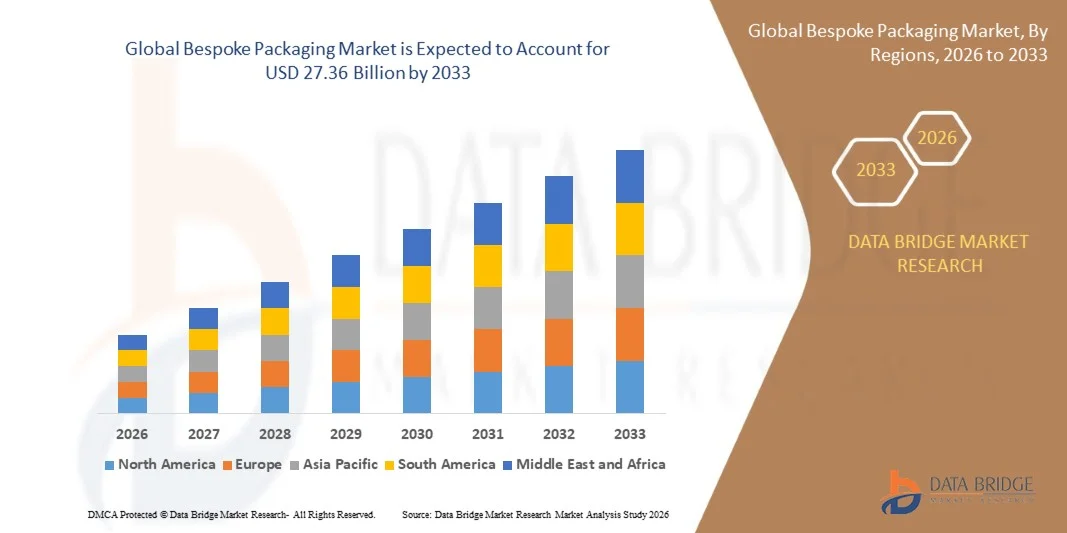
- As per Data Bridge Market Research analysis, the bespoke packaging market was valued at USD 16.41 billion in 2025 and is projected to reach USD 27.36 billion by 2033, growing at a CAGR of 6.60% from 2026 to 2033.
- The market is experiencing consistent growth driven by rising demand for personalized and visually appealing packaging solutions, increasing brand differentiation, advancements in digital printing technologies, and expanding applications across food and beverages, personal care and cosmetics, healthcare, and consumer goods.
- The increasing emphasis on brand identity and customer experience, combined with the rapid expansion of e-commerce and growing sustainability requirements, is compelling businesses to adopt customized packaging solutions. Digital printing, innovative materials, and flexible packaging formats are enabling brands to develop cost-effective, distinctive, and environmentally conscious packaging designs that enhance product presentation and consumer engagement.
Market Size & Forecast
- Global Market Value (2025): USD 16.41 Billion
- Expected Market Value (2033): USD 27.36 Billion
- Forecast CAGR (2026–2033): 6.60%
- Leading Region in 2025: North America
- Fastest Growing Region: Asia Pacific
What are the Major Takeaways of the Bespoke Packaging Market?
- North America dominated the bespoke packaging market with the largest revenue share of 32.6% in 2025, supported by a mature consumer goods sector, advanced packaging capabilities, strong e-commerce activity, and increasing demand for specialized packaging solutions.
- Asia-Pacific is expected to be the fastest-growing region at a CAGR of 9.0% from 2026 to 2033, fueled by expanding e-commerce, rising disposable incomes, rapid industrialization, and increasing demand for customized packaging solutions across China and India.
- The boxes and cartons segment led the market with a 37.4% share in 2025, driven by their versatility, strong protective properties, and widespread use across e-commerce, retail, fashion, food, and consumer goods.
- Pouches are the fastest-growing product type, projected to register a CAGR of 5.0%, reflecting the surge in demand for lightweight, flexible, convenient, and customizable packaging formats.
- The paper and paperboard segment dominated the material category with a 45.29% revenue share in 2025, led by its versatility, lightweight characteristics, recyclability, and extensive use in boxes, mailers, envelopes, and cartons
- Recyclable packaging accounted for 30% of the market share in 2025, preferred by increasing consumer preference for recyclable solutions and growing efforts by brands to reduce packaging waste.
- The compostable packaging segment is the fastest-growing sustainability category, with a CAGR of 7.0%, driven by increasing interest in packaging alternatives designed to reduce persistent waste
Report Scope and Bespoke Packaging Market Segmentation
|
Attributes |
Bespoke Packaging Key Market Insights |
|
Segments Covered |
|
|
Countries Covered |
North America
Europe
Asia-Pacific
Middle East and Africa
South America
|
|
Key Market Players |
|
|
Market Opportunities |
|
|
Value Added Data Infosets |
In addition to the insights on market scenarios such as market value, growth rate, segmentation, geographical coverage, and major players, the market reports curated by the Data Bridge Market Research also include import export analysis, production capacity overview, production consumption analysis, price trend analysis, climate change scenario, supply chain analysis, value chain analysis, raw material/consumables overview, vendor selection criteria, PESTLE Analysis, Porter Analysis, and regulatory framework. |
What is the Key Trend in the Bespoke Packaging Market?
- Brands are increasingly adopting personalized and digitally printed bespoke packaging to strengthen brand identity, differentiate products, and create distinctive unboxing experiences across e-commerce, cosmetics, food, and consumer goods.
- For instance, in January 2024, Atlantic Packaging highlighted the use of customizable digital printing for luxury packaging, enabling brands to create differentiated designs while enhancing customer experience through personalized packaging solutions.
- Digital printing and variable-data technologies are enabling short production runs, customized graphics, limited-edition packaging, and customer-specific designs without requiring conventional large-volume printing setups.
- E-commerce and direct-to-consumer brands are increasingly using customized boxes, inserts, labels, and printed mailers to enhance the unboxing experience and encourage repeat purchases.
- For instance, in September 2025, Innova Market Insights reported that personalized packaging powered by digital printing was gaining traction globally, with 53% of surveyed consumers showing positive engagement with personalized-packaging campaigns and brands increasingly using customized designs, seasonal themes, and culturally relevant packaging.
- As brands continue to prioritize personalization, digital printing, and differentiated customer experiences, bespoke packaging is expected to become increasingly integrated into branding and e-commerce strategies, reinforcing customized packaging as a core tool for consumer engagement.
What are the Key Drivers of the Bespoke Packaging Market?
- The rapid expansion of e-commerce and direct-to-consumer retail has significantly increased demand for bespoke packaging capable of protecting products while delivering distinctive brand experiences during delivery.
- For instance, in June 2025, McKinsey’s global packaging survey of 11,136 consumers across 11 countries found that packaging remains an important consideration and that brand is particularly significant in markets such as India and China, supporting the growing role of packaging in product differentiation and brand positioning.
- Brands across cosmetics, food, beverages, luxury goods, and consumer products are integrating customized packaging into their marketing strategies to strengthen recognition, communicate product positioning, and improve customer engagement.
- For instance, in July 2024, Berry Global developed a custom, nestable, recyclable polypropylene jar for Grillo’s Pickles to address consumer complaints about spillage, demonstrating how brands are adopting bespoke packaging to improve product functionality and consumer experience.
- With businesses increasingly using packaging as an extension of their brand identity and customer experience, demand for customized formats, graphics, structures, and finishes will continue supporting the expansion of the bespoke packaging market
Which Factors are Challenging the Growth of the Bespoke Packaging Market?
- Bespoke packaging generally requires higher design, tooling, setup, material, printing, and finishing costs than standardized packaging, particularly for complex structures and low-volume customized orders.
- For instance, in June 2026, packaging supplier InnoRhino reported that custom packaging costs can include design, structural engineering, sampling, printing, finishing, tooling, labor, quality control, and freight, while minimum order quantities can increase unit costs when fixed setup expenses are spread across smaller production runs.
- These higher production costs can limit adoption among small businesses and startups that have restricted packaging budgets or cannot achieve the minimum order quantities required for cost-efficient production.
- For instance, custom packaging pricing in India varies substantially according to dimensions, material, printing method, finishing, die-cutting, structural complexity, and order quantity, while higher minimum order quantities can reduce per-unit costs by spreading setup expenses.
- For instance, in June 2025, the Times of India reported that Indian printers were facing substantially higher costs for packaging-related equipment and premium paper and printing materials, with industry participants noting that expensive technology was making it harder for smaller printing businesses to remain competitive.
- The high cost of customization, combined with tooling requirements, minimum order quantities, and complex production processes, continues to constrain adoption among smaller brands and price-sensitive businesses, limiting broader penetration of premium bespoke packaging solutions.
How is the Bespoke Packaging Market Segmented?
The bespoke packaging market is segmented on the basis of product, material, sustainability, and end-use industry.
- By Product
On the basis of product, the bespoke packaging market is segmented into mailers and envelopes, boxes and cartons, bags and totes, pouches, bottles, and others. The boxes and cartons segment dominated the market with a 37.4% share in 2025, owing to their versatility, strong protective properties, and widespread use across e-commerce, retail, fashion, food, and consumer goods. These packaging formats can be manufactured in customized sizes, shapes, structures, and printed designs according to specific product requirements. Boxes and cartons also provide substantial opportunities for branding through graphics, embossing, coatings, and premium finishes. Their compatibility with paper and paperboard further supports demand for recyclable and visually appealing packaging solutions. The continued expansion of e-commerce is increasing the requirement for appropriately sized customized shipping and presentation boxes.
The pouches segment is projected to register the fastest growth at a CAGR of 5.0% from 2026 to 2033, driven by increasing demand for lightweight, flexible, convenient, and customizable packaging formats. Pouches can be designed with resealable closures, spouts, windows, specialized barriers, and customized graphics according to product requirements. Their lightweight structure can reduce material consumption and transportation requirements compared with certain rigid packaging formats. Growing applications across food, beverages, personal care, and consumer products are expanding their adoption. Digital printing technologies are also enabling customized graphics, shorter production runs, and greater design flexibility.
- By Material
On the basis of material, the bespoke packaging market is segmented into paper and paperboard, glass, plastic, metal, textile, leather, and wood. The paper and paperboard segment dominated the market with a 45.29% share in 2025, supported by its versatility, lightweight characteristics, recyclability, and extensive use in boxes, mailers, envelopes, and cartons. Paper and paperboard provide strong printing and customization capabilities, allowing brands to incorporate detailed graphics, textures, finishes, and structural designs. These materials can be converted into numerous packaging formats for different product categories and applications. Growing sustainability concerns are encouraging brands to move toward fiber-based packaging solutions. Their established recycling characteristics also make them attractive for companies seeking to reduce packaging waste.
The paper and paperboard segment is projected to register the fastest growth at a CAGR of 5.5% from 2026 to 2033, driven by increasing preference for recyclable, lightweight, and fiber-based packaging materials. Paper-based packaging can accommodate customized shapes, printing, coatings, inserts, and structural features for different products. Advancements in printing and converting technologies are improving the visual quality and design flexibility of paper-based packaging. Brands are increasingly using customized paperboard packaging to communicate sustainability commitments while maintaining premium presentation. The growing use of paper-based boxes, cartons, mailers, bags, and sleeves is further expanding its application base.
- By Sustainability
On the basis of sustainability, the bespoke packaging market is segmented into recyclable packaging, biodegradable packaging, compostable packaging, reusable packaging, recycled content packaging, and conventional packaging. The Recyclable Packaging segment dominated the market with 30% share in 2025, driven by increasing consumer preference for recyclable solutions and growing efforts by brands to reduce packaging waste. Recyclable materials can be incorporated into customized boxes, cartons, mailers, bags, bottles, and other packaging formats. They allow businesses to combine brand differentiation with environmental considerations. Paper and paperboard are particularly important for recyclable bespoke packaging because they offer broad conversion and printing possibilities. Increasing regulatory attention toward packaging waste is also encouraging businesses to improve the recyclability of customized packaging.
The compostable packaging segment is expected to register the fastest growth at a CAGR of 7.0% from 2026 to 2033, supported by increasing interest in packaging alternatives designed to reduce persistent waste. Compostable materials are being developed for customized pouches, bags, food packaging, wraps, and other applications. Increasing sustainability commitments are encouraging brands to explore materials that can offer alternatives to conventional packaging. Advances in bio-based materials, coatings, and barrier technologies are improving the potential functionality of compostable packaging. Food and beverage applications are particularly relevant because brands are seeking customized formats that combine convenience with sustainability.
- By End-Use Industry
On the basis of end-use industry, the bespoke packaging market is segmented into fashion accessories and apparels, food, beverages, consumer goods and durables, personal care and cosmetics, and others. The fashion accessories and apparels segment dominated the market with a 33.8% share in 2025, supported by rising demand for premium presentation, customized designs, and stronger brand differentiation. Fashion brands widely use customized boxes, bags, tissue paper, tags, and other packaging components to reinforce their visual identity. Bespoke packaging also provides opportunities for incorporating distinctive colors, textures, finishes, logos, and structural designs. The growth of online fashion retail has increased the importance of branded packaging in creating memorable unboxing experiences. Premium and luxury brands particularly use customized packaging to strengthen product positioning and customer engagement.
The personal care and cosmetics segment is projected to register the fastest growth at a CAGR of 5.5% from 2026 to 2033, driven by premiumization, product differentiation, and increasing demand for visually distinctive packaging. Cosmetics brands use customized bottles, cartons, pouches, jars, and secondary packaging to establish recognizable brand identities. Premium finishes such as embossing, specialty coatings, and customized printing can improve shelf appeal and product presentation. The expansion of direct-to-consumer and online beauty brands is further increasing demand for distinctive packaging and branded unboxing experiences. Sustainability considerations are also encouraging cosmetic companies to explore recyclable and recycled-content packaging materials.
Which Region Holds the Largest Share of the Bespoke Packaging Market?
- North America dominated the bespoke packaging market with the largest revenue share of 32.6% in 2025, supported by a mature consumer goods sector, advanced packaging capabilities, strong e-commerce activity, and increasing demand for specialized packaging solutions.
- The region also benefits from strong demand across food and beverages, personal care, consumer goods, and luxury products, along with increasing adoption of sustainable materials and customized packaging formats. Growing emphasis on brand differentiation, premium presentation, and personalized customer experiences continues to strengthen North America’s position in the global bespoke packaging market.
U.S. Bespoke Packaging Market Insight
The U.S. bespoke packaging market is witnessing strong growth due to rising demand for customized packaging across e-commerce, food and beverages, personal care, and consumer goods. The country’s mature retail ecosystem, along with increasing adoption of personalized designs, premium packaging, and sustainable materials, is driving demand for tailored packaging solutions. In addition, growing emphasis on brand differentiation, memorable unboxing experiences, and environmentally responsible packaging is accelerating the adoption of bespoke packaging across businesses.
Asia-Pacific Bespoke Packaging Market Insight
The Asia-Pacific bespoke packaging market is expected to witness rapid growth, driven by expanding e-commerce, rising consumer spending, and increasing demand for customized packaging across China, India, Japan, and Southeast Asia. Growing awareness regarding sustainable packaging, rising adoption of personalized designs, and increasing demand for distinctive brand experiences are supporting regional market expansion. In addition, the growing presence of consumer brands and digital-commerce businesses is accelerating the adoption of customized packaging solutions across food, beverages, cosmetics, and consumer products.
Japan Bespoke Packaging Market Insight
The Japan bespoke packaging market is witnessing consistent growth due to rising demand for premium presentation, product personalization, and sustainable packaging solutions. Consumer goods, cosmetics, food, and beverage brands are increasingly adopting customized packaging to strengthen brand identity and enhance product presentation. Moreover, increasing focus on environmentally responsible materials, efficient packaging designs, and distinctive customer experiences is further contributing to market growth in Japan.
China Bespoke Packaging Market Insight
The China bespoke packaging market is growing rapidly, driven by expanding e-commerce, increasing consumer demand for personalized products, and the growing importance of packaging in brand differentiation. Rising adoption of customized boxes, pouches, mailers, and other packaging formats across consumer goods, food, beverages, and cosmetics is significantly boosting market demand. In addition, increasing emphasis on sustainable materials, digital commerce, and innovative packaging designs is supporting the continued expansion of bespoke packaging solutions in China.
U.K. Bespoke Packaging Market Insight
The U.K. bespoke packaging market is experiencing steady growth, supported by rising adoption of customized packaging in e-commerce, food and beverages, cosmetics, and premium consumer products. Increasing investments in sustainable packaging materials and growing demand for visually distinctive packaging solutions are contributing to market growth. Furthermore, stronger emphasis on packaging waste reduction, recyclability, and brand-focused customer experiences is encouraging businesses to adopt more innovative and tailored packaging solutions across the U.K.
Germany Bespoke Packaging Market Insight
The Germany bespoke packaging market is expanding steadily due to the country’s strong manufacturing base, advanced e-commerce infrastructure, and increasing adoption of sustainable and customized packaging technologies. Retailers, consumer goods companies, and online businesses are increasingly utilizing tailored packaging designs to improve product protection, logistics efficiency, brand presentation, and customer experience. Continuous advancements in recyclable materials, circular packaging solutions, and packaging design, along with strong environmental regulations, are further driving market growth in Germany.
Which are the Top Companies in Bespoke Packaging Market?
The bespoke packaging industry is primarily led by well-established companies, including:
- Amcor plc (Switzerland)
- Mondi plc (U.K.)
- Smurfit Westrock plc (Ireland)
- Sonoco Products Company (U.S.)
- Graphic Packaging International, LLC (U.S.)
- ProAmpac (U.S.)
- Huhtamaki Inc. (U.S.)
- Coveris (Austria)
- Winpak Ltd. (Canada)
- Tetra Pak International SA (Switzerland)
- August Faller GmbH & Co. KG (Germany)
- QUADPACK INDUSTRIES, S.A. (Spain)
- International Paper Company (U.S.)
- Mayr-Melnhof Karton AG (Austria)
- SIG Group AG (Switzerland)
- Constantia Flexibles Group GmbH (Austria)
- Printpack, Inc. (U.S.)
- Pactiv Evergreen Inc. (U.S.)
- Fedrigoni S.p.A. (Italy)
- Edelmann Group (Germany)
What are Latest Developments in Bespoke Packaging Market?
- In May 2025, Amazon announced the expansion of custom-fit packaging technology across its European fulfillment network, enabling machines to automatically create cardboard boxes and paper bags tailored to individual products. The initiative is designed to reduce unnecessary packaging material while improving package fit and delivery efficiency. The development highlights the growing use of automated, right-sized packaging to deliver more customized packaging solutions for e-commerce orders.
- In December 2024, Placon announced an expansion of production capacity at its food and medical packaging facilities in Plymouth, Minnesota, and Madison, Wisconsin. The expansion was aimed at supporting growing demand for its custom thermoformed packaging solutions, including food, retail, and medical applications. The development strengthens Placon’s ability to provide tailored packaging designs and production capabilities for customers requiring application-specific packaging.
- In February 2024, Amcor, Stonyfield Organic, and Cheer Pack North America launched an all-polyethylene spouted pouch for Stonyfield’s YoBaby refrigerated yogurt. The custom-engineered packaging replaced a multilayer structure with an all-PE design intended to improve recyclability while maintaining barrier performance, durability, and premium graphics. The development demonstrates how packaging suppliers are combining customization, functionality, and sustainability in flexible packaging solutions.
- In December 2022, Amazon highlighted the use of new packaging machines that measure product dimensions and create more correctly sized packaging. The technology supports the production of packaging tailored more closely to individual products, helping reduce excess material and improve packaging efficiency. This development illustrates the increasing integration of automated sizing technology into customized e-commerce packaging operations.
- In September 2021, Fantastapack launched Fantastapack Pro, a new division focused on custom packaging solutions and inserts. The division uses digital print technology together with structural design capabilities to develop customized boxes and inserts tailored to individual customer requirements. Fantastapack Pro was designed to help brands improve product protection and create more distinctive unboxing experiences through packaging engineered around specific products.

- Interactive Data Analysis Dashboard
- Company Analysis Dashboard for high growth potential opportunities
- Research Analyst Access for customization & queries
- Competitor Analysis with Interactive dashboard
- Latest News, Updates & Trend analysis
- Harness the Power of Benchmark Analysis for Comprehensive Competitor Tracking
Global Bespoke Packaging Market, Supply Chain Analysis and Ecosystem Framework
To support market growth and help clients navigate the impact of geopolitical shifts, DBMR has integrated in-depth supply chain analysis into its Global Bespoke Packaging Market research reports. This addition empowers clients to respond effectively to global changes affecting their industries. The supply chain analysis section includes detailed insights such as Global Bespoke Packaging Market consumption and production by country, price trend analysis, the impact of tariffs and geopolitical developments, and import and export trends by country and HSN code. It also highlights major suppliers with data on production capacity and company profiles, as well as key importers and exporters. In addition to research, DBMR offers specialized supply chain consulting services backed by over a decade of experience, providing solutions like supplier discovery, supplier risk assessment, price trend analysis, impact evaluation of inflation and trade route changes, and comprehensive market trend analysis.
Data collection and base year analysis are done using data collection modules with large sample sizes. The stage includes obtaining market information or related data through various sources and strategies. It includes examining and planning all the data acquired from the past in advance. It likewise envelops the examination of information inconsistencies seen across different information sources. The market data is analysed and estimated using market statistical and coherent models. Also, market share analysis and key trend analysis are the major success factors in the market report. To know more, please request an analyst call or drop down your inquiry.
The key research methodology used by DBMR research team is data triangulation which involves data mining, analysis of the impact of data variables on the market and primary (industry expert) validation. Data models include Vendor Positioning Grid, Market Time Line Analysis, Market Overview and Guide, Company Positioning Grid, Patent Analysis, Pricing Analysis, Company Market Share Analysis, Standards of Measurement, Global versus Regional and Vendor Share Analysis. To know more about the research methodology, drop in an inquiry to speak to our industry experts.
Data Bridge Market Research is a leader in advanced formative research. We take pride in servicing our existing and new customers with data and analysis that match and suits their goal. The report can be customized to include price trend analysis of target brands understanding the market for additional countries (ask for the list of countries), clinical trial results data, literature review, refurbished market and product base analysis. Market analysis of target competitors can be analyzed from technology-based analysis to market portfolio strategies. We can add as many competitors that you require data about in the format and data style you are looking for. Our team of analysts can also provide you data in crude raw excel files pivot tables (Fact book) or can assist you in creating presentations from the data sets available in the report.













