


What is the Beverage Cans Market Size and Growth Rate?
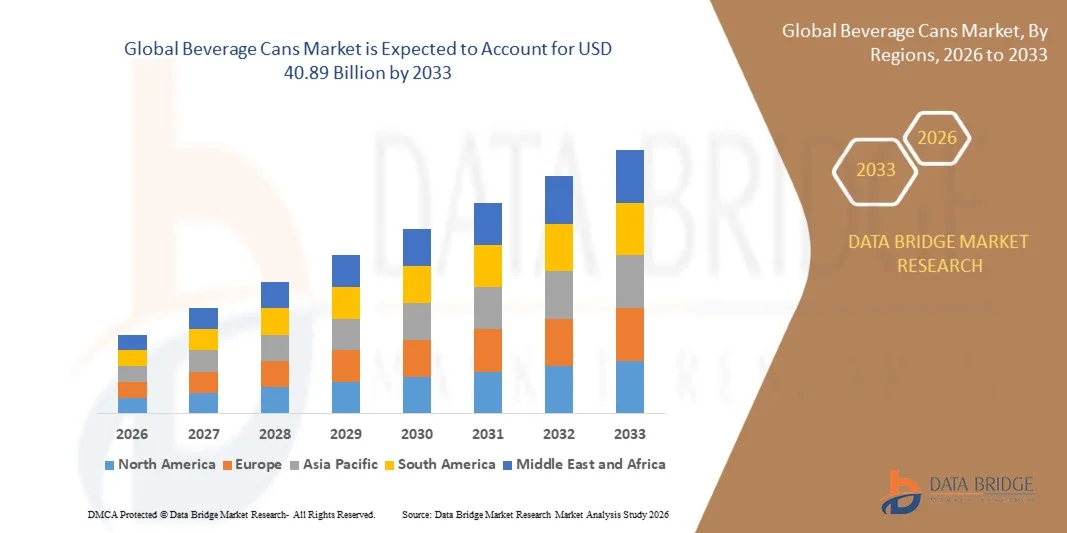
- As per Data Bridge Market Research analysis, the beverage cans market was valued at USD 28.43 billion in 2025 and is projected to reach USD 40.89 billion by 2033, growing at a CAGR of 4.65% from 2026 to 2033.
- The market is experiencing consistent growth driven by the rising global consumption of beverages, including carbonated soft drinks, beer, and energy drinks, along with increasing restrictions on single-use plastics and growing consumer preference for sustainable and convenient packaging solutions. The inherent advantages of metal cans, such as superior physical properties, lightweight, and high recyclability, are positioning them as a preferred packaging choice over alternatives like PET bottles and glass containers.
- The increasing focus on sustainability and circular economy mandates is a primary growth catalyst. Government regulations, such as Poland's universal deposit-return system established in January 2026, are accelerating aluminum can recovery and reducing waste. In addition, beverage brands are increasingly shifting from PET bottles to infinitely recyclable aluminum cans to meet sustainability targets and reduce plastic footprints.
Market Size & Forecast
- Market Value (2025): USD 28.43 Billion
- Expected Market Value (2033): USD 40.89 Billion
- Forecast CAGR (2026–2033): 4.65%
- Leading Region in 2025: North America
- Fastest Growing Region: Asia-Pacific
What are the Major Takeaways of the Beverage Cans Market?
- North America dominated the beverage cans market and accounted for the largest revenue share of approximately 36.5% in 2025, supported by strong sustainability regulations, high recycling rates, and rising substitution of plastic bottles with aluminum packaging.
- Asia-Pacific aluminum beverage cans market is expected to witness the fastest growth rate from 2026 to 2033, driven by rising packaged beverage consumption, rapid urbanization, and the expanding middle-class population across countries such as China, India, Japan, South Korea, and Thailand.
- The aluminum segment dominated the market in 2025 owing to its lightweight nature, superior recyclability, corrosion resistance, and excellent barrier properties that preserve beverage quality. Growing consumer preference for sustainable packaging and increasing adoption by beverage manufacturers further strengthen the dominance of aluminum cans.
- The steel segment is projected to register the fastest growth from 2026 to 2033, driven by technological advancements in lightweight steel packaging, increasing recycling initiatives, and rising demand for durable packaging solutions across selected beverage categories and emerging markets.
- The Non-alcoholic beverages segment led the market in 2025, supported by strong demand for carbonated soft drinks, energy drinks, ready-to-drink tea and coffee, functional beverages, and flavored beverages. Rising consumption of convenience beverages and increasing preference for recyclable packaging continue to drive segment growth.
- The water segment is expected to witness the fastest growth from 2026 to 2033, driven by increasing consumer awareness of sustainable alternatives to plastic bottles, growing demand for premium canned water, and expanding adoption of eco-friendly packaging.
Report Scope and Beverage Cans Market Segmentation
|
Attributes |
Beverage Cans Key Market Insights |
|
Segments Covered |
|
|
Countries Covered |
North America
Europe
Asia-Pacific
Middle East and Africa
South America
|
|
Key Market Players |
|
|
Market Opportunities |
|
|
Value Added Data Infosets |
In addition to the insights on market scenarios such as market value, growth rate, segmentation, geographical coverage, and major players, the market reports curated by the Data Bridge Market Research also include import export analysis, production capacity overview, production consumption analysis, price trend analysis, climate change scenario, supply chain analysis, value chain analysis, raw material/consumables overview, vendor selection criteria, PESTLE Analysis, Porter Analysis, and regulatory framework. |
What is the Key Trend in the Beverage Cans Market?
- Beverage manufacturers are increasingly adopting lightweight, highly recyclable aluminum cans to meet sustainability targets, reduce carbon emissions, and support circular packaging initiatives while responding to growing consumer demand for environmentally friendly beverage packaging.
- For instance, in January 2025, Ball Corporation entered into a strategic alliance with Meadow to expand the use of fully recyclable aluminum cans into new product categories through Meadow's circular packaging technology, supporting reusable and recyclable packaging solutions.
- Can manufacturers be increasingly investing in lightweight can designs, higher recycled-content aluminum, advanced printing technologies, and closed-loop recycling systems to improve packaging efficiency while lowering material usage and greenhouse gas emissions.
- For instance, in May 2025, Ball Corporation partnered with Açaí Motion® to launch an Aluminium Stewardship Initiative (ASI)-certified aluminum beverage can, ensuring traceability across the supply chain while promoting circular economy principles and sustainable beverage packaging.
- Beverage brands are also increasing investments in recycling infrastructure, low-carbon aluminum production, and premium can formats to strengthen sustainability commitments and meet evolving consumer and regulatory expectations. Recent industry performance also reflects growing consumer preference for aluminum beverage cans because of their recyclability and circularity.
- As governments, beverage producers, and packaging manufacturers continue prioritizing circular economy initiatives and low-carbon packaging solutions, the adoption of sustainable aluminum beverage cans is expected to accelerate, reinforcing aluminum as the preferred packaging material across carbonated soft drinks, energy drinks, beer, ready-to-drink beverages, and functional beverages.
What are the Key Drivers of the Beverage Cans Market?
- The growing consumption of ready-to-drink (RTD) beverages, carbonated soft drinks, energy drinks, alcoholic beverages, and functional drinks, coupled with increasing consumer preference for lightweight, recyclable, and convenient packaging, is driving strong demand for beverage cans worldwide. Aluminum cans offer excellent recyclability, product protection, and portability, making them a preferred packaging solution for beverage manufacturers and consumers alike.
- For instance, in January 2021, Crown Holdings announced the construction of a new beverage can manufacturing facility in Virginia, U.S., to meet increasing demand for aluminum beverage cans from beverage producers across the region. The facility is designed to expand production capacity while supporting sustainable packaging initiatives.
- Beverage companies and can manufacturers be investing in new production facilities, lightweight can technologies, and recycling infrastructure to improve manufacturing efficiency, reduce carbon emissions, and strengthen circular packaging systems while meeting rising consumer demand.
- For instance, in April 2024, Novelis announced the opening of the Ulsan Aluminum Recycling Center in South Korea, increasing the supply of recycled aluminum for beverage packaging and supporting beverage can manufacturers with low-carbon aluminum materials.
- Increasing government support for recyclable packaging, expanding aluminum recycling programs, and sustainability commitments from global beverage brands are further accelerating the adoption of aluminum beverage cans across both developed and emerging markets.
- As beverage consumption continues to rise and manufacturers prioritize environmentally responsible packaging solutions, beverage cans are expected to witness sustained demand, supported by ongoing investments in production capacity, recycling infrastructure, and low-carbon packaging technologies.
Which Factors are Challenging the Growth of the Beverage Cans Market?
- Beverage can manufacturers face significant challenges from fluctuating aluminum prices, rising energy costs, and increasing transportation expenses, all of which increase production costs and pressure profit margins. Since aluminum is the primary raw material used in beverage cans, supply chain disruptions and commodity price volatility directly affect manufacturing costs and pricing strategies.
- For instance, in August 2024, Ball Corporation stated in its Q2 2024 financial results that beverage can sales reflected the contractual pass-through of lower aluminum costs, while year-over-year operating earnings were partially offset by higher manufacturing costs. The company also emphasized continued cost management initiatives to mitigate fluctuations in aluminum prices and production expenses.
- Geopolitical tensions, energy market instability, and disruptions in global aluminum supply chains continue to impact raw material availability, creating uncertainty for can manufacturers and beverage producers seeking stable procurement and long-term supply contracts.
- Rising production costs, combined with fluctuating aluminum prices and energy-intensive manufacturing processes, continue to challenge the growth of the Beverage Cans Market, particularly in price-sensitive regions where manufacturers must balance cost competitiveness with increasing demand for sustainable, recyclable packaging.
How is the Beverage Cans Market Segmented?
The beverage cans market is segmented on the basis of material type, beverage type, application and distribution channel.
- By Material Type
On the basis of material type, the beverage cans market is segmented into aluminum, steel, and others. The aluminum segment dominated the market in 2025 owing to its lightweight nature, superior recyclability, corrosion resistance, and excellent barrier properties that preserve beverage quality. Growing consumer preference for sustainable packaging and increasing adoption by beverage manufacturers further strengthen the dominance of aluminum cans.
The steel segment is projected to register the fastest growth from 2026 to 2033, driven by technological advancements in lightweight steel packaging, increasing recycling initiatives, and rising demand for durable packaging solutions across selected beverage categories and emerging markets.
- By Beverage Type
On the basis of beverage type, the beverage cans market is segmented into alcoholic beverages, non-alcoholic beverages, and water. The non-alcoholic beverages segment led the market in 2025, supported by strong demand for carbonated soft drinks, energy drinks, ready-to-drink tea and coffee, functional beverages, and flavored beverages. Rising consumption of convenience beverages and increasing preference for recyclable packaging continue to drive segment growth.
The water segment is expected to witness the fastest growth from 2026 to 2033, driven by increasing consumer awareness of sustainable alternatives to plastic bottles, growing demand for premium canned water, and expanding adoption of eco-friendly packaging.
- By Capacity
On the basis of capacity, the beverage cans market is segmented into <100 ml, 100–250 ml, 250–500 ml, and above 500 ml. The 250–500 ml segment dominated the market in 2025 owing to its widespread use for carbonated soft drinks, beer, energy drinks, and ready-to-drink beverages. Standard can sizes offer convenience, portability, and compatibility with retail distribution channels, making them the preferred choice among manufacturers.
The above 500 ml segment is anticipated to register the fastest growth from 2026 to 2033, driven by rising demand for value-sized beverage packaging, increasing consumption of energy drinks and flavored water, and growing popularity of large-format cans in convenience stores and foodservice outlets.
- By Application
On the basis of application, the beverage cans market is segmented into carbonated soft drinks, alcoholic beverages, fruit and vegetable juices, and others. The carbonated soft drinks segment accounted for the largest market share in 2025 due to high global consumption, extensive use of aluminum cans by leading beverage brands, and strong consumer preference for portable and recyclable packaging solutions.
The alcoholic beverages segment is expected to witness the fastest growth from 2026 to 2033, driven by increasing consumption of canned beer, ready-to-drink cocktails, hard seltzers, and craft alcoholic beverages. Growing demand for convenient, lightweight, and sustainable packaging is further supporting segment expansion.
- By Distribution Channel
On the basis of distribution channel, the beverage cans market is segmented into direct sales to beverage manufacturers, company-owned sales teams, physical stores, wholesalers, online, and vending machines. The direct sales to beverage manufacturers segment dominated the market in 2025 owing to long-term supply agreements between can manufacturers and beverage producers, large-volume procurement, and integrated supply chain operations that ensure cost efficiency and cosistent product availability.
The online segment is projected to register the fastest growth from 2026 to 2033, driven by the expansion of e-commerce platforms, increasing procurement by small and medium-sized beverage companies, and the growing digitalization of B2B packaging distribution networks.
Which Region Holds the Largest Share of the Beverage Cans Market?
- North America dominated the beverage cans market and accounted for the largest revenue share of approximately 36.5% in 2025, supported by strong sustainability regulations, high recycling rates, and rising substitution of plastic bottles with aluminum packaging.
- The region also benefits from government support and key players working together to promote local aluminum production and recycling capabilities to ensure supply chain resilience. Investments in low-carbon aluminum, rolling mills, and high-speed canning lines are positioning North America as a technology and production forerunner.
U.S. Beverage Cans Market Insight
The U.S. dominated the beverage cans market and accounted for the largest revenue share in 2025, driven by strong domestic beverage consumption and increasing sustainability initiatives among leading beverage manufacturers. Government efforts to strengthen domestic manufacturing and promote low-carbon industrial production are supporting investments in aluminum rolling mills, recycling infrastructure, and can-sheet manufacturing capacity. Furthermore, state-level container deposit programs are enhancing aluminum collection and recycling rates, ensuring a more reliable supply of recycled aluminum for beverage can production.
Asia-Pacific Beverage Cans Market Insight
The Asia-Pacific aluminum beverage cans market is expected to witness the fastest growth rate from 2026 to 2033, driven by rising packaged beverage consumption, rapid urbanization, and the expanding middle-class population across countries such as China, India, Japan, South Korea, and Thailand. Increasing consumer preference for convenient, on-the-go beverage packaging and the growing demand for energy drinks, carbonated soft drinks, and ready-to-drink alcoholic beverages are supporting market expansion. In addition, government initiatives promoting sustainable packaging, coupled with investments in high-speed can manufacturing lines, recycling infrastructure, and regional production facilities, are accelerating aluminum can adoption and strengthening the region's production capabilities.
China Beverage Cans Market Insight
China is expected to witness the fastest growth rate from 2026 to 2033 in beverage can usage because domestic beverage brands are expanding and consumers are increasing their demand for premium and ready-to-drink beverages. The government supports domestic aluminium can production and import substitution policies, resulting in multinational and local beverage companies establishing regional can manufacturing facilities.
Japan Beverage Cans Market Insight
The Japan beverage cans market is expected to witness the fastest growth rate from 2026 to 2033 due to the country's mature beverage industry, strong recycling culture, and high consumer preference for convenient packaging. Beverage cans are widely used across coffee, tea, soft drinks, alcoholic beverages, and functional drinks owing to their portability and excellent product preservation. Furthermore, continuous innovations in vending machine distribution, premium beverage offerings, and lightweight can technology are expected to support sustained market growth.
Europe Beverage Cans Market Insight
The Europe beverage cans market is expected to witness the fastest growth rate from 2026 to 2033, primarily driven by stringent sustainability regulations, high recycling targets, and growing consumer demand for environmentally friendly packaging. Increasing consumption of canned beverages, particularly energy drinks, beer, sparkling beverages, and flavored water, is encouraging manufacturers to adopt aluminum cans. The region is also experiencing rising investments in circular economy initiatives and low-carbon packaging solutions, supporting continued market expansion across both established and emerging beverage categories.
U.K. Beverage Cans Market Insight
The U.K. beverage cans market is expected to witness the fastest growth rate from 2026 to 2033, driven by increasing preference for recyclable beverage packaging and growing demand for canned premium beverages. Consumers are increasingly choosing aluminum cans for soft drinks, craft beer, cider, and ready-to-drink beverages owing to their convenience and sustainability benefits. Furthermore, government initiatives promoting recycling and circular packaging, along with strong retail availability of canned beverages, are expected to continue supporting market growth.
Germany Beverage Cans Market Insight
The Germany beverage cans market is expected to witness the fastest growth rate from 2026 to 2033, fueled by strong environmental awareness, advanced recycling infrastructure, and increasing consumption of canned beverages. The country's emphasis on sustainable packaging and resource efficiency is encouraging beverage manufacturers to expand the use of aluminum cans. Growing demand for energy drinks, carbonated beverages, beer, and functional beverages, together with innovations in lightweight can manufacturing, is further contributing to market development.
Which are the Top Companies in Beverage Cans Market?
The beverage cans industry is primarily led by well-established companies, including:
- Ardagh Group S.A. (Luxembourg)
- CPMC Holdings Limited (China)
- Toyo Seikan Group Holdings Ltd. (Japan)
- Can-One Berhad (Malaysia)
- CANPACK S.A. (Poland)
- Ball Corporation (U.S.)
- Envases Group (Spain)
- Universal Can Corporation (Japan)
- Interpack Group Inc. (China)
- GZI Industries Limited (Nigeria)
- Showa Denko K.K. (Japan)
- Swan Industries (Thailand) Company Limited (Thailand)
- Nampak Ltd. (South Africa)
- The Olayan Group (Liechtenstein)
- Techpack Solutions (South Korea)
- Orora Packaging Australia Pty Ltd. (Australia)
- MSCANCO (Germany)
- Ceylon Beverage Can (Pvt) Ltd. (Sri Lanka)
- Jiangsu Baosteel Metal Product Co., Ltd. (China)
- Asia Packaging (Vietnam)
- Silgan Holdings Inc. (U.S.)
What are Latest Developments in Beverage Cans Market?
- In November 2025, Ball Corporation announced an additional investment of USD 60 million in its aluminum beverage can manufacturing facility at Sri City, India, to expand production capacity. The investment is intended to strengthen the regional supply chain, improve manufacturing efficiency, and meet the growing demand for aluminum beverage cans across South Asia.
- In September 2025, Ardagh Group S.A. unveiled its latest sustainable metal and glass packaging solutions at Drinktec 2025 in Munich, Germany. The company highlighted innovative aluminum can formats, including embossed cans and wine cans, designed to enhance brand differentiation while supporting circular packaging initiatives and sustainability goals for beverage manufacturers.
- In February 2024, Novelis announced a major expansion of its aluminum rolling and recycling operations in Bay Minette, Alabama, U.S. The investment is aimed at increasing the production of beverage can sheet, expanding the use of recycled aluminum, and strengthening circular manufacturing practices to support the growing global demand for sustainable beverage packaging.
- In May 2025, VulCan Packaging became North America's first commercial-scale producer of aTULC (Aluminum Toyo Ultimate Can) aluminum beverage cans, introducing an advanced dry-forming manufacturing process. This innovative technology eliminates the need for bisphenol-based internal coatings and significantly reduces water consumption, while improving shelf life, print quality, and recyclability, supporting more sustainable beverage can production.
- In December 2024, Ball Corporation collaborated with Dabur India Limited to introduce Real Bites juice in fully recyclable aluminum cans in the Indian market. The launch expands Dabur's sustainable beverage packaging portfolio by offering a convenient and environmentally friendly alternative, reflecting the increasing consumer preference for recyclable packaging solutions and reinforcing aluminum cans as one of the world's most recycled beverage containers.

- Interactive Data Analysis Dashboard
- Company Analysis Dashboard for high growth potential opportunities
- Research Analyst Access for customization & queries
- Competitor Analysis with Interactive dashboard
- Latest News, Updates & Trend analysis
- Harness the Power of Benchmark Analysis for Comprehensive Competitor Tracking
Global Beverage Cans Market, Supply Chain Analysis and Ecosystem Framework
To support market growth and help clients navigate the impact of geopolitical shifts, DBMR has integrated in-depth supply chain analysis into its Global Beverage Cans Market research reports. This addition empowers clients to respond effectively to global changes affecting their industries. The supply chain analysis section includes detailed insights such as Global Beverage Cans Market consumption and production by country, price trend analysis, the impact of tariffs and geopolitical developments, and import and export trends by country and HSN code. It also highlights major suppliers with data on production capacity and company profiles, as well as key importers and exporters. In addition to research, DBMR offers specialized supply chain consulting services backed by over a decade of experience, providing solutions like supplier discovery, supplier risk assessment, price trend analysis, impact evaluation of inflation and trade route changes, and comprehensive market trend analysis.
Data collection and base year analysis are done using data collection modules with large sample sizes. The stage includes obtaining market information or related data through various sources and strategies. It includes examining and planning all the data acquired from the past in advance. It likewise envelops the examination of information inconsistencies seen across different information sources. The market data is analysed and estimated using market statistical and coherent models. Also, market share analysis and key trend analysis are the major success factors in the market report. To know more, please request an analyst call or drop down your inquiry.
The key research methodology used by DBMR research team is data triangulation which involves data mining, analysis of the impact of data variables on the market and primary (industry expert) validation. Data models include Vendor Positioning Grid, Market Time Line Analysis, Market Overview and Guide, Company Positioning Grid, Patent Analysis, Pricing Analysis, Company Market Share Analysis, Standards of Measurement, Global versus Regional and Vendor Share Analysis. To know more about the research methodology, drop in an inquiry to speak to our industry experts.
Data Bridge Market Research is a leader in advanced formative research. We take pride in servicing our existing and new customers with data and analysis that match and suits their goal. The report can be customized to include price trend analysis of target brands understanding the market for additional countries (ask for the list of countries), clinical trial results data, literature review, refurbished market and product base analysis. Market analysis of target competitors can be analyzed from technology-based analysis to market portfolio strategies. We can add as many competitors that you require data about in the format and data style you are looking for. Our team of analysts can also provide you data in crude raw excel files pivot tables (Fact book) or can assist you in creating presentations from the data sets available in the report.













