Global Beverage Coolers Market
Market Size in USD Billion
CAGR :
% 
 USD
7.19 Billion
USD
10.14 Billion
2025
2033
USD
7.19 Billion
USD
10.14 Billion
2025
2033
 Forecast Period Forecast Period |
2026 –2033 |
 Market Size (Base Year) Market Size (Base Year) |
USD 7.19 Billion |
 Market Size (Forecast Year) Market Size (Forecast Year) |
USD 10.14 Billion |
 CAGR CAGR |
% |
| Major Markets Players |
|
Beverage Coolers Market Size
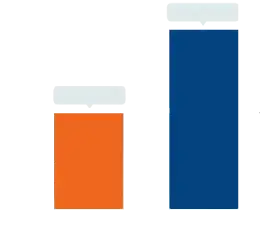
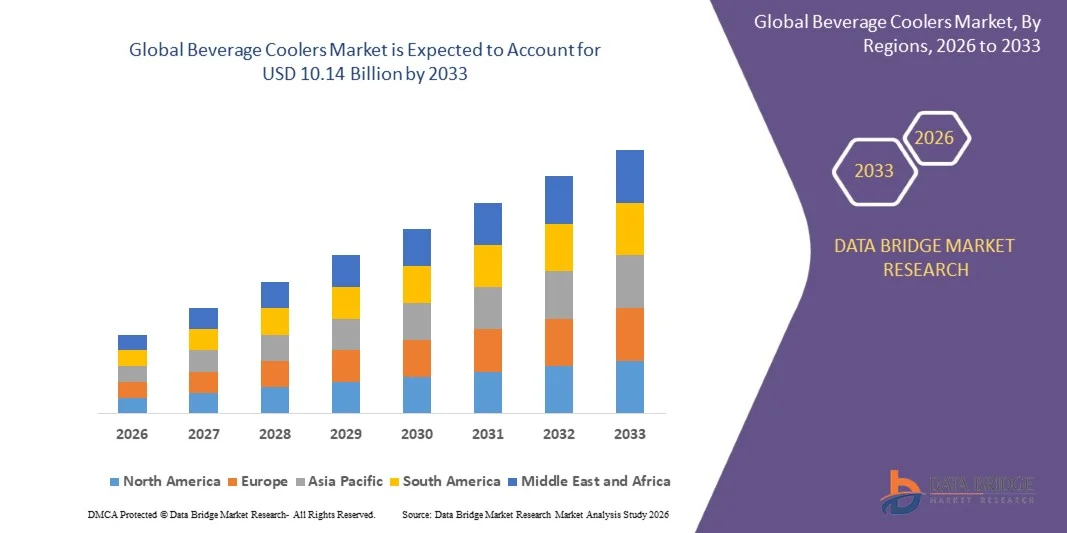
- The global beverage coolers market size was valued at USD 7.19 billion in 2025 and is expected to reach USD 10.14 billion by 2033, at a CAGR of 4.40% during the forecast period
- The market growth is largely fueled by the rising demand for convenient and efficient beverage storage solutions across residential and commercial settings, driven by changing lifestyles and increasing consumption of both alcoholic and non-alcoholic beverages
- Furthermore, growing consumer preference for premium kitchen appliances with advanced temperature control, energy efficiency, and aesthetic appeal is establishing beverage coolers as an essential component of modern homes and hospitality environments. These converging factors are accelerating product adoption, thereby significantly boosting the market growth
Beverage Coolers Market Analysis
- Beverage coolers are specialized refrigeration units designed to store and maintain optimal temperatures for a wide range of drinks, including wine, beer, soft drinks, and other beverages across residential and commercial applications
- The escalating demand for beverage coolers is primarily fueled by the increasing trend of home entertainment, expansion of the foodservice and hospitality sectors, and a rising preference for compact, energy-efficient, and technologically advanced cooling appliances
- North America dominated beverage coolers market with a share of 39.2% in 2025, due to strong demand for premium kitchen appliances and increasing consumption of both alcoholic and non-alcoholic beverages
- Asia-Pacific is expected to be the fastest growing region in the beverage coolers market during the forecast period due to rapid urbanization, rising disposable incomes, and changing consumer lifestyles in countries such as China, Japan, and India
- Freestanding segment dominated the market with a market share of 45.5% in 2025, due to its ease of installation, flexibility in placement, and wide availability across various capacities and designs. Consumers favor freestanding units for their portability and minimal structural requirements, making them suitable for both residential and commercial applications
Report Scope and Beverage Coolers Market Segmentation
|
Attributes |
Beverage Coolers Key Market Insights |
|
Segments Covered |
|
|
Countries Covered |
North America · U.S. · Canada · Mexico Europe · Germany · France · U.K. · Netherlands · Switzerland · Belgium · Russia · Italy · Spain · Turkey · Rest of Europe Asia-Pacific · China · Japan · India · South Korea · Singapore · Malaysia · Australia · Thailand · Indonesia · Philippines · Rest of Asia-Pacific Middle East and Africa · Saudi Arabia · U.A.E. · South Africa · Egypt · Israel · Rest of Middle East and Africa South America · Brazil · Argentina · Rest of South America |
|
Key Market Players |
|
|
Market Opportunities |
· Expansion of E-Commerce Distribution Channels · Growing Demand for Portable and Outdoor Beverage Cooling Solutions |
|
Value Added Data Infosets |
In addition to the insights on market scenarios such as market value, growth rate, segmentation, geographical coverage, and major players, the market reports curated by the Data Bridge Market Research also include in-depth expert analysis, pricing analysis, brand share analysis, consumer survey, demography analysis, supply chain analysis, value chain analysis, raw material/consumables overview, vendor selection criteria, PESTLE Analysis, Porter Analysis, and regulatory framework. |
Beverage Coolers Market Trends
“Increasing Demand for Smart and Energy-Efficient Beverage Coolers”
- A significant trend in the beverage coolers market is the rising demand for smart and energy-efficient cooling solutions, driven by increasing consumer focus on sustainability and advanced home appliances. This trend is strengthening the role of beverage coolers as intelligent and eco-friendly components within modern kitchens and commercial environments
- For instance, LG Electronics offers smart refrigeration solutions with inverter compressors and energy-efficient cooling technologies that reduce power consumption while maintaining optimal beverage storage conditions. These innovations enhance operational efficiency and align with growing environmental regulations and consumer expectations
- The integration of IoT-enabled features such as remote temperature monitoring and mobile app control is expanding rapidly, allowing users to manage cooling systems with greater convenience and precision. This is reinforcing the shift toward connected appliances in residential and hospitality sectors
- Consumers are increasingly prioritizing appliances with low energy consumption ratings and eco-friendly refrigerants, which is encouraging manufacturers to develop sustainable cooling technologies. This trend is shaping product innovation and influencing purchasing decisions across global markets
- The demand for aesthetically advanced beverage coolers with glass doors, LED lighting, and customizable designs is also rising, particularly in premium residential and commercial spaces. This is elevating the importance of design alongside functionality in product development
- The market is witnessing continuous advancement in compressor efficiency, insulation technologies, and smart cooling systems, which is strengthening product performance and reducing long-term operational costs. This growing emphasis on smart and energy-efficient solutions is driving sustained innovation and expansion across the beverage coolers market
Beverage Coolers Market Dynamics
Driver
“Rising Consumption of Beverages and Growth of Hospitality Sector”
- The increasing consumption of alcoholic and non-alcoholic beverages across global markets is driving strong demand for efficient cooling and storage solutions. This growth is closely linked with expanding urban lifestyles and evolving consumer preferences for ready-to-drink and premium beverage products
- For instance, Danby Appliances Inc. offers a wide range of beverage centers and coolers designed for both residential and commercial applications, supporting the growing need for organized and temperature-controlled beverage storage. These solutions enhance accessibility and product preservation across diverse usage environments
- The rapid expansion of the hospitality sector, including bars, restaurants, hotels, and lounges, is significantly increasing the adoption of beverage coolers for display and storage purposes. This is strengthening the demand for high-capacity and durable cooling equipment
- The growing trend of home entertainment and personal bar setups is further contributing to increased product adoption among residential consumers. This is expanding the market beyond traditional commercial applications
- The continuous growth of foodservice and retail sectors, combined with increasing beverage consumption, is reinforcing this driver. The need for efficient, reliable, and visually appealing cooling solutions is sustaining long-term demand in the beverage coolers market
Restraint/Challenge
“High Initial Cost and Energy Consumption Concerns”
- The beverage coolers market faces challenges due to the relatively high initial cost associated with advanced and premium cooling units, which can limit adoption among price-sensitive consumers. These costs are influenced by the integration of smart technologies, high-quality materials, and specialized cooling systems
- For instance, Perlick Corporation manufactures high-end beverage refrigeration systems with advanced features and durable construction, resulting in premium pricing that may restrict affordability for small-scale users. This creates a barrier for wider market penetration, particularly in developing regions
- Energy consumption concerns also pose a challenge, as continuous operation of cooling units contributes to higher electricity usage and operating expenses. This is particularly relevant for commercial establishments managing multiple units
- Consumers and businesses are increasingly evaluating long-term energy costs, which can discourage the adoption of less efficient models. This is placing pressure on manufacturers to balance performance with energy savings
- The market continues to face constraints related to cost sensitivity and energy efficiency expectations, requiring manufacturers to innovate while maintaining affordability and sustainability. These challenges collectively influence purchasing decisions and overall market growth trajectory
Beverage Coolers Market Scope
The market is segmented on the basis of product type, type, temperature zones, size, cooler height, number of shelves, shelves material, finish, door swing, control type, distribution channel, application, and end-user.
- By Product Type
On the basis of product type, the beverage coolers market is segmented into less than 200L, 200–500L, 500–1000L, and more than 1000L. The 200–500L segment dominated the largest market revenue share in 2025, driven by its optimal balance between storage capacity and space efficiency suitable for both residential and small commercial settings. Consumers prefer this range as it accommodates a moderate number of beverages without requiring extensive installation space while offering energy efficiency and affordability. Its versatility across households, offices, and retail outlets further strengthens its demand as a standard capacity choice in the market.
The more than 1000L segment is anticipated to witness the fastest growth rate from 2026 to 2033, fueled by increasing demand from large-scale commercial establishments such as supermarkets, hotels, and entertainment venues. These high-capacity coolers enable bulk storage and continuous cooling performance which is essential for high footfall locations. Growing expansion of hospitality and organized retail sectors is further accelerating adoption of larger capacity beverage cooling solutions.
- By Type
On the basis of type, the beverage coolers market is segmented into freestanding, built-in and undercounter, countertop, dual zone, thermoelectric, and others. The freestanding segment held the largest market revenue share of 45.5% in 2025 driven by its ease of installation, flexibility in placement, and wide availability across various capacities and designs. Consumers favor freestanding units for their portability and minimal structural requirements, making them suitable for both residential and commercial applications. The availability of diverse designs and cost-effective options also supports its widespread adoption.
The built-in and undercounter segment is expected to witness the fastest CAGR from 2026 to 2033, driven by rising demand for integrated kitchen and bar solutions in modern homes and premium commercial spaces. These coolers offer seamless design integration, space optimization, and enhanced aesthetic appeal which align with evolving interior preferences. Increasing adoption of modular kitchens and luxury hospitality infrastructure is further supporting segment growth.
- By Temperature Zones
On the basis of temperature zones, the beverage coolers market is segmented into single zone, dual zone, triple zone, and multi zone beverage coolers. The single zone segment dominated the largest market revenue share in 2025 driven by its simplicity, cost efficiency, and suitability for users storing a single type of beverage. These coolers are widely adopted in households and small retail outlets due to their ease of use and consistent cooling performance. Lower maintenance requirements and affordability make them a preferred entry-level option.
The dual zone segment is anticipated to witness the fastest growth rate from 2026 to 2033, fueled by increasing demand for storing different beverages at distinct temperature settings. Consumers are increasingly seeking flexibility to store wines, soft drinks, and other beverages in a single unit with customized cooling zones. Rising preference for multifunctional appliances in residential and hospitality sectors is accelerating demand for dual zone coolers.
- By Size
On the basis of size, the beverage coolers market is segmented into 6–50 bottle, 51–100 bottle, 101–200 bottle, and more than 201 bottle. The 6–50 bottle segment dominated the largest market revenue share in 2025 driven by strong demand from residential users and small office spaces. Compact size, affordability, and ease of installation make these units highly attractive for personal use and limited storage requirements. Their energy efficiency and minimal footprint further contribute to widespread adoption.
The 101–200 bottle segment is expected to witness the fastest CAGR from 2026 to 2033, driven by growing demand from mid-sized commercial establishments and premium residential consumers. These units offer higher storage capacity while maintaining manageable space requirements which suits expanding hospitality businesses. Increasing interest in beverage collection and storage among consumers is further supporting segment growth.
- By Cooler Height
On the basis of cooler height, the beverage coolers market is segmented into 28 to 32 inch, 33 to 36 inch, 38 to 56 inch, and above 56 inches. The 33 to 36 inch segment held the largest market revenue share in 2025 driven by its compatibility with standard kitchen and bar counter heights. This range offers an ideal balance between storage capacity and ergonomic accessibility, making it widely preferred for both residential and commercial installations. Its adaptability across various layouts supports consistent demand.
The above 56 inch segment is anticipated to witness the fastest growth rate from 2026 to 2033, fueled by increasing demand for high-capacity vertical storage solutions in commercial environments. These taller units maximize storage efficiency while occupying less floor space, making them suitable for retail and hospitality settings. Expansion of large-scale beverage service operations is further driving segment adoption.
- By Number of Shelves
On the basis of number of shelves, the beverage coolers market is segmented into 1–2, 3–4, 5–6, 7–9, 9–12, and more than 13 shelves. The 3–4 shelves segment dominated the largest market revenue share in 2025 driven by its balanced storage capability and ease of organization. These coolers provide sufficient compartmentalization for different beverages while maintaining compact dimensions suitable for residential and small commercial use. Their practical design supports efficient storage without complexity.
The 7–9 shelves segment is expected to witness the fastest CAGR from 2026 to 2033, driven by increasing demand for organized and larger storage capacities in commercial and premium residential settings. More shelves allow better categorization and accessibility which is essential for high-volume usage environments. Growing emphasis on storage efficiency and product display is further boosting demand.
- By Shelves Material
On the basis of shelves material, the beverage coolers market is segmented into metal, tempered glass, wood, and others. The metal segment held the largest market revenue share in 2025 driven by its durability, strength, and cost effectiveness. Metal shelves can support heavier loads and withstand frequent usage, making them suitable for commercial applications. Their long lifespan and low maintenance requirements further enhance their adoption.
The tempered glass segment is anticipated to witness the fastest growth rate from 2026 to 2033, fueled by rising demand for aesthetic appeal and improved visibility of stored beverages. Glass shelves enhance product presentation which is particularly valuable in retail and hospitality environments. Increasing preference for modern and visually appealing appliances is driving segment growth.
- By Finish
On the basis of finish, the beverage coolers market is segmented into blacks, glass, panel ready, silver tones, stainless steel, and wood finishes. The stainless steel segment dominated the largest market revenue share in 2025 driven by its premium appearance, durability, and resistance to corrosion. It is widely preferred in both residential and commercial spaces due to its modern look and easy maintenance. Compatibility with contemporary kitchen and bar designs further supports demand.
The panel ready segment is expected to witness the fastest CAGR from 2026 to 2033, driven by increasing demand for customizable and integrated appliance designs. These finishes allow users to match coolers with surrounding cabinetry, enhancing overall interior aesthetics. Rising trend of personalized and modular interiors is accelerating segment adoption.
- By Door Swing
On the basis of door swing, the beverage coolers market is segmented into French door, left side door, reversible door, right side door, and side by side door. The reversible door segment held the largest market revenue share in 2025 driven by its flexibility and adaptability to different installation environments. Users benefit from the ability to adjust door opening direction based on space constraints which enhances convenience. This versatility supports its widespread preference across residential and commercial settings.
The French door segment is anticipated to witness the fastest growth rate from 2026 to 2033, fueled by increasing demand for premium and stylish appliance designs. French door coolers offer enhanced accessibility and larger storage openings which improve user experience. Growing consumer inclination toward luxury kitchen and bar appliances is driving segment growth.
- By Control Type
On the basis of control type, the beverage coolers market is segmented into digital, electronic, touch, and turn knob. The digital segment dominated the largest market revenue share in 2025 driven by its precision, ease of use, and advanced temperature control capabilities. Digital interfaces allow users to monitor and adjust settings accurately which enhances cooling efficiency and convenience. Increasing integration of smart features further supports segment demand.
The touch segment is expected to witness the fastest CAGR from 2026 to 2033, driven by rising demand for modern and user-friendly interfaces. Touch controls offer sleek design and intuitive operation which align with evolving consumer preferences for smart appliances. Growing adoption of technologically advanced home solutions is accelerating segment growth.
- By Distribution Channel
On the basis of distribution channel, the beverage coolers market is segmented into specialty stores, supermarkets/hypermarkets, e-commerce, and others. The specialty stores segment held the largest market revenue share in 2025 driven by personalized customer service and availability of a wide range of premium products. Consumers prefer these stores for expert guidance and product demonstrations which influence purchase decisions. Strong brand presence in specialty outlets further supports dominance.
The e-commerce segment is anticipated to witness the fastest growth rate from 2026 to 2033, fueled by increasing online shopping adoption and convenience of doorstep delivery. Digital platforms provide extensive product comparisons, reviews, and competitive pricing which attract consumers. Expansion of online retail infrastructure is significantly driving segment growth.
- By Application
On the basis of application, the beverage coolers market is segmented into alcoholic and non-alcoholic. The alcoholic segment dominated the largest market revenue share in 2025 driven by high demand for wine, beer, and other alcoholic beverage storage in both residential and commercial settings. Proper temperature control is essential for preserving quality which increases reliance on dedicated coolers. Growth of wine culture and hospitality sector further supports demand.
The non-alcoholic segment is expected to witness the fastest CAGR from 2026 to 2033, driven by increasing consumption of soft drinks, juices, and functional beverages. Rising health awareness and diversification of beverage options are contributing to higher storage requirements. Expansion of retail and convenience stores is further boosting segment adoption.
- By End-User
On the basis of end-user, the beverage coolers market is segmented into residential, commercial, bars, hotels and restaurants, lounges, corporate offices, movie theatres, bookstores, and others. The residential segment held the largest market revenue share in 2025 driven by growing adoption of home appliances and rising preference for in-house beverage storage solutions. Increasing disposable income and lifestyle upgrades are encouraging consumers to invest in beverage coolers for convenience and entertainment purposes. Expansion of smart home ecosystems further supports segment demand.
The hotels and restaurants segment is anticipated to witness the fastest growth rate from 2026 to 2033, fueled by rapid expansion of the hospitality industry and increasing focus on customer experience. Efficient beverage storage and service are critical in these establishments which drives demand for advanced cooling solutions. Rising tourism and dining trends are significantly accelerating segment growth.
Beverage Coolers Market Regional Analysis
- North America dominated the beverage coolers market with the largest revenue share of 39.2% in 2025, driven by strong demand for premium kitchen appliances and increasing consumption of both alcoholic and non-alcoholic beverages
- Consumers in the region highly value convenience, aesthetic appeal, and advanced cooling technologies offered by beverage coolers across residential and commercial settings
- This widespread adoption is further supported by high disposable incomes, well-established retail infrastructure, and growing preference for home entertainment setups, establishing beverage coolers as a key appliance across households and hospitality sectors
U.S. Beverage Coolers Market Insight
The U.S. beverage coolers market captured the largest revenue share in 2025 within North America, fueled by high consumer spending on home appliances and rising demand for compact refrigeration solutions. Consumers are increasingly focusing on premium kitchen upgrades and personalized beverage storage options. The growing trend of home bars and entertainment spaces, along with strong penetration of e-commerce and smart appliances, further propels the beverage coolers market. Moreover, continuous product innovation and availability of energy-efficient models significantly contribute to market expansion.
Europe Beverage Coolers Market Insight
The Europe beverage coolers market is projected to expand at a substantial CAGR throughout the forecast period, primarily driven by increasing demand for energy-efficient and aesthetically appealing cooling solutions. The rise in urban living and compact housing is fostering the adoption of space-saving appliances. European consumers are also inclined toward premium and eco-friendly products with advanced temperature control features. The region is witnessing steady growth across residential and commercial sectors, with beverage coolers gaining traction in kitchens, bars, and hospitality spaces.
U.K. Beverage Coolers Market Insight
The U.K. beverage coolers market is anticipated to grow at a noteworthy CAGR during the forecast period, driven by rising demand for modern kitchen appliances and growing home entertainment culture. In addition, increasing preference for organized and efficient beverage storage solutions is supporting market growth. The U.K.’s strong retail and online distribution network, along with increasing consumer awareness regarding energy-efficient appliances, is expected to further boost adoption.
Germany Beverage Coolers Market Insight
The Germany beverage coolers market is expected to expand at a considerable CAGR during the forecast period, fueled by strong demand for technologically advanced and energy-efficient appliances. Germany’s focus on sustainability and high-quality manufacturing promotes the adoption of durable and eco-friendly beverage cooling solutions. The integration of modern cooling technologies and premium design aesthetics is also gaining popularity among consumers, particularly in residential and commercial kitchens.
Asia-Pacific Beverage Coolers Market Insight
The Asia-Pacific beverage coolers market is poised to grow at the fastest CAGR during the forecast period of 2026 to 2033, driven by rapid urbanization, rising disposable incomes, and changing consumer lifestyles in countries such as China, Japan, and India. The region’s increasing adoption of modern kitchen appliances and growing hospitality sector are fueling demand. Furthermore, expanding retail networks and rising availability of affordable beverage coolers are accelerating market penetration across a broader consumer base.
Japan Beverage Coolers Market Insight
The Japan beverage coolers market is gaining momentum due to the country’s advanced technology adoption and strong preference for compact and efficient appliances. The Japanese market places significant emphasis on design, energy efficiency, and space optimization. The increasing number of urban households and demand for premium kitchen appliances are driving adoption. Moreover, the integration of smart features and precise temperature control systems is supporting market growth.
China Beverage Coolers Market Insight
The China beverage coolers market accounted for the largest market revenue share in Asia Pacific in 2025, attributed to rapid urbanization, expanding middle-class population, and increasing consumer spending on home appliances. China represents a major manufacturing hub for beverage coolers, ensuring affordability and wide product availability. The growing trend of modern kitchens and rising demand from hospitality and retail sectors are key factors driving the market in the country.
Beverage Coolers Market Share
The beverage coolers industry is primarily led by well-established companies, including:
- AB Electrolux (Sweden)
- VIKING RANGE, LLC (U.S.)
- Haier Inc. (China)
- Perlick Corporation (U.S.)
- Danby (Canada)
- Climadiff (France)
- FRIGOGLASS (Greece)
- Liebherr-International Deutschland GmbH (U.S.)
- mvpappliances (U.S.)
- Miele & Cie. KG (Germany)
- Shenzhen SICAO Electric Appliances Co., Ltd (SICAO) (China)
- LG Electronics (South Korea)
- Siemens (Germany)
- DATRON HANDELSGES M.B.H. (Austria)
- NewAir (U.S.)
- Vestfrost Solutions (Denmark)
- Avanti Products (Brand of The Legacy Companies) (U.S.)
- U-Line (U.S.)
- WHYNTER LLC (U.S.)
- Vinotemp (U.S.)
Latest Developments in Global Beverage Coolers Market
- In February 2026, Whirlpool Corporation introduced an advanced range of smart beverage coolers integrated with IoT-enabled temperature management and energy optimization features. This launch strengthened the shift toward connected and energy-efficient cooling solutions, enabling users to remotely monitor and control storage conditions through mobile applications. The development accelerated competition in the premium segment while reinforcing the growing demand for smart kitchen appliances and enhancing consumer preference for technologically advanced beverage cooling systems
- In September 2025, Liebherr expanded its residential appliance portfolio with a new line of fully integrated under-counter beverage refrigerators designed for seamless kitchen integration. The introduction of compact yet high-capacity units with premium finishes and user-friendly technologies elevated product innovation in the residential segment. This development contributed to rising demand for aesthetically appealing and space-efficient cooling solutions, further strengthening the adoption of built-in beverage coolers in modern homes
- In May 2025, Hoshizaki America, Inc. launched the Valiance series of commercial refrigeration equipment at a major industry event, targeting cost-conscious foodservice operators. The introduction of reliable and energy-efficient units at accessible price points expanded product accessibility for small and mid-sized businesses. This move supported market growth by increasing adoption across the commercial segment while intensifying competition in affordable refrigeration solutions
- In October 2024, Haier Smart Home Co., Ltd. completed the acquisition of the commercial refrigeration business from Carrier Global Corporation, significantly strengthening its presence in the global cooling market. The integration of established brands and advanced technologies expanded the company’s capabilities beyond residential appliances into commercial refrigeration. This strategic development enhanced market consolidation and accelerated innovation in sustainable and large-scale beverage cooling solutions
- In June 2024, Dometic introduced the CFX2 series of portable electric coolers designed for flexible and mobile beverage cooling applications. The launch addressed increasing consumer demand for outdoor and travel-friendly cooling solutions with advanced temperature control and power compatibility features. This innovation expanded the scope of beverage coolers beyond traditional settings, driving growth in the portable and recreational segment while supporting diversification within the market
SKU-
Get online access to the report on the World's First Market Intelligence Cloud

- Interactive Data Analysis Dashboard
- Company Analysis Dashboard for high growth potential opportunities
- Research Analyst Access for customization & queries
- Competitor Analysis with Interactive dashboard
- Latest News, Updates & Trend analysis
- Harness the Power of Benchmark Analysis for Comprehensive Competitor Tracking
Research Methodology
Data collection and base year analysis are done using data collection modules with large sample sizes. The stage includes obtaining market information or related data through various sources and strategies. It includes examining and planning all the data acquired from the past in advance. It likewise envelops the examination of information inconsistencies seen across different information sources. The market data is analysed and estimated using market statistical and coherent models. Also, market share analysis and key trend analysis are the major success factors in the market report. To know more, please request an analyst call or drop down your inquiry.
The key research methodology used by DBMR research team is data triangulation which involves data mining, analysis of the impact of data variables on the market and primary (industry expert) validation. Data models include Vendor Positioning Grid, Market Time Line Analysis, Market Overview and Guide, Company Positioning Grid, Patent Analysis, Pricing Analysis, Company Market Share Analysis, Standards of Measurement, Global versus Regional and Vendor Share Analysis. To know more about the research methodology, drop in an inquiry to speak to our industry experts.
Customization Available
Data Bridge Market Research is a leader in advanced formative research. We take pride in servicing our existing and new customers with data and analysis that match and suits their goal. The report can be customized to include price trend analysis of target brands understanding the market for additional countries (ask for the list of countries), clinical trial results data, literature review, refurbished market and product base analysis. Market analysis of target competitors can be analyzed from technology-based analysis to market portfolio strategies. We can add as many competitors that you require data about in the format and data style you are looking for. Our team of analysts can also provide you data in crude raw excel files pivot tables (Fact book) or can assist you in creating presentations from the data sets available in the report.