




Global Bioadhesive Market
Market Size in USD Billion
CAGR :
% 
 USD
6.27 Billion
USD
15.70 Billion
2025
2033
USD
6.27 Billion
USD
15.70 Billion
2025
2033
 Forecast Period Forecast Period |
2026 –2033 |
 Market Size (Base Year) Market Size (Base Year) |
USD 6.27 Billion |
 Market Size (Forecast Year) Market Size (Forecast Year) |
USD 15.70 Billion |
 CAGR CAGR |
% |
| Major Markets Players |
|
Bioadhesive Market Size
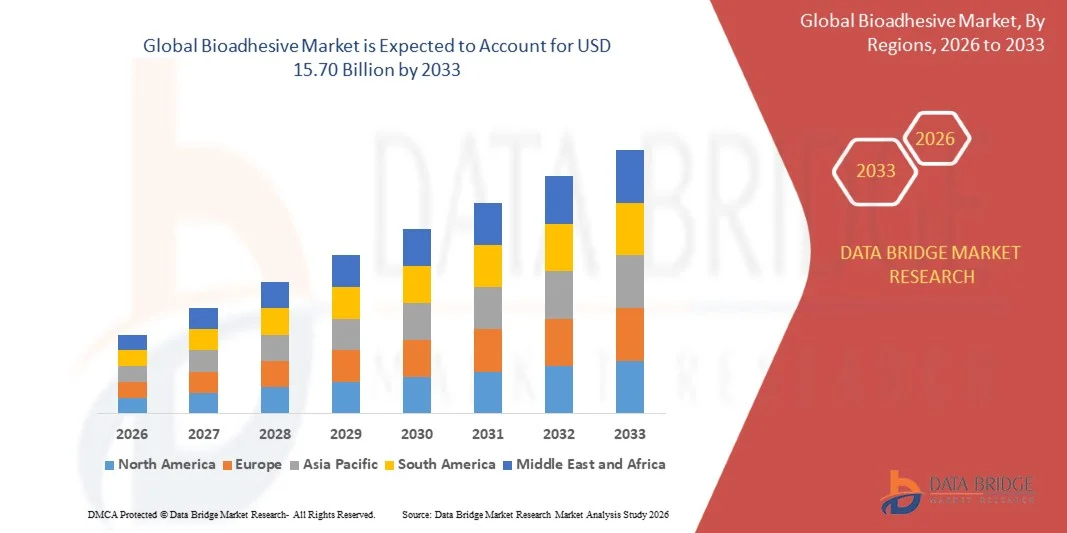
- The global bioadhesive market size was valued at USD 6.27 billion in 2025 and is expected to reach USD 15.70 billion by 2033, at a CAGR of 12.14% during the forecast period
- The market growth is largely fueled by the increasing demand for sustainable and environmentally friendly adhesive solutions across industries, driven by rising regulatory pressure to reduce the use of synthetic chemicals and non-biodegradable materials
- Furthermore, growing adoption of bio-based materials in packaging, healthcare, and construction sectors is establishing bioadhesives as a preferred alternative to conventional adhesives. These converging factors are accelerating the shift toward green materials, thereby significantly boosting the market growth
Bioadhesive Market Analysis
- Bioadhesives are natural adhesives derived from biological sources such as plants and animals, widely used for bonding applications in packaging, medical, wood, and personal care industries due to their biodegradability and non-toxic nature
- The escalating demand for bioadhesives is primarily fueled by increasing environmental awareness, stringent government regulations, and rising preference for sustainable materials, along with expanding applications in healthcare and packaging sectors
- North America dominated the bioadhesive market with a share of around 40% in 2025, due to strong demand for sustainable and environmentally friendly adhesive solutions across packaging, healthcare, and construction industries
- Asia-Pacific is expected to be the fastest growing region in the bioadhesive market during the forecast period due to rapid industrialization, increasing environmental awareness, and growing demand for sustainable products in emerging economies
- Plant based segment dominated the market with a market share of 71.2% in 2025, due to rising demand for sustainable, biodegradable, and non-toxic adhesive solutions across industries. Increasing regulatory pressure to reduce synthetic chemical usage and growing consumer preference for eco-friendly materials have accelerated the adoption of plant-derived adhesives from sources such as starch, soy, and cellulose
Report Scope and Bioadhesive Market Segmentation
|
Attributes |
Bioadhesive Key Market Insights |
|
Segments Covered |
|
|
Countries Covered |
North America
Europe
Asia-Pacific
Middle East and Africa
South America
|
|
Key Market Players |
|
|
Market Opportunities |
|
|
Value Added Data Infosets |
In addition to the insights on market scenarios such as market value, growth rate, segmentation, geographical coverage, and major players, the market reports curated by the Data Bridge Market Research also include import export analysis, production capacity overview, production consumption analysis, price trend analysis, climate change scenario, supply chain analysis, value chain analysis, raw material/consumables overview, vendor selection criteria, PESTLE Analysis, Porter Analysis, and regulatory framework. |
Bioadhesive Market Trends
“Increasing Adoption of Sustainable and Bio-Based Adhesive Solutions”
- A significant trend in the bioadhesive market is the increasing adoption of sustainable and bio-based adhesive solutions, driven by rising environmental concerns and regulatory pressure to reduce dependence on synthetic and petroleum-based chemicals across industries. This shift is positioning bioadhesives as essential materials for companies aiming to achieve sustainability targets and comply with global environmental standards
- For instance, Henkel AG & Co. KGaA has introduced bio-based adhesive solutions for packaging applications that support recyclability and reduced carbon footprint, enabling manufacturers to align with eco-friendly production goals while maintaining performance efficiency
- The packaging industry is witnessing strong integration of bioadhesives as companies transition toward biodegradable and compostable materials to meet consumer demand for sustainable products. This trend is reinforcing the role of bioadhesives in reducing plastic waste and improving overall packaging sustainability
- Healthcare applications are increasingly adopting bioadhesives for wound care and surgical use due to their biocompatibility and reduced toxicity, supporting safer and more efficient medical treatments. This is accelerating innovation in medical-grade adhesive formulations and expanding their clinical use
- Industries such as construction and woodworking are incorporating bioadhesives to meet green building standards and reduce emissions associated with conventional adhesives. This growing preference is enhancing the demand for plant-based adhesive solutions with improved durability and environmental compatibility
- The market is experiencing a steady transition toward renewable raw materials such as starch, soy, and lignin, which are being utilized to develop high-performance adhesives. This trend is strengthening the global movement toward sustainable industrial practices and driving long-term growth in the bioadhesive market
Bioadhesive Market Dynamics
Driver
“Rising Demand from Packaging and Healthcare Industries”
- The rising demand from packaging and healthcare industries is a key driver for the bioadhesive market, as these sectors increasingly prioritize sustainability, safety, and regulatory compliance in their material selection processes. Bioadhesives offer advantages such as biodegradability, low toxicity, and compatibility with sensitive applications, making them highly suitable for these industries
- For instance, DuPont has developed bioadhesive solutions such as medical-grade skin adhesives used in wound care and wearable devices, supporting improved patient outcomes and expanding the use of bio-based materials in healthcare applications
- The rapid expansion of the e-commerce and food packaging industries is driving demand for sustainable adhesive solutions that meet environmental standards and ensure product safety. Bioadhesives are increasingly used in paperboard packaging, labeling, and sealing applications to support recyclable packaging systems
- In the healthcare sector, the growing use of bioadhesives in surgical procedures and drug delivery systems is enhancing treatment efficiency and reducing complications associated with traditional adhesives. This is contributing to increased adoption in advanced medical technologies
- The continued expansion of these end-use industries, combined with increasing regulatory support for sustainable materials, is reinforcing the demand for bioadhesives. This driver is playing a critical role in accelerating market growth and broadening application scope across global industries
Restraint/Challenge
“Performance Limitations Compared to Synthetic Adhesives”
- The bioadhesive market faces challenges related to performance limitations compared to synthetic adhesives, particularly in terms of bonding strength, durability, and resistance to extreme environmental conditions. These limitations can restrict their use in high-performance industrial applications where reliability is critical
- For instance, 3M Company continues to rely on advanced synthetic adhesive technologies for applications requiring high strength and long-term durability, highlighting the gap that bioadhesives must overcome to achieve similar performance standards in demanding environments
- Bioadhesives often exhibit lower resistance to moisture, heat, and chemical exposure, which can impact their effectiveness in industries such as construction and automotive. This creates challenges for manufacturers aiming to replace conventional adhesives in such applications
- The variability in raw material quality derived from natural sources can lead to inconsistencies in product performance, affecting reliability and scalability in industrial production. This adds complexity to formulation and quality control processes
- These performance and cost-related challenges continue to influence market adoption and require ongoing innovation to enhance product capabilities. Addressing these limitations is essential for expanding the use of bioadhesives across high-demand and performance-intensive applications
Bioadhesive Market Scope
The market is segmented on the basis of type and application.
• By Type
On the basis of type, the bioadhesive market is segmented into plant based and animal based. The plant based segment dominated the largest market revenue share of 71.2% in 2025, driven by rising demand for sustainable, biodegradable, and non-toxic adhesive solutions across industries. Increasing regulatory pressure to reduce synthetic chemical usage and growing consumer preference for eco-friendly materials have accelerated the adoption of plant-derived adhesives from sources such as starch, soy, and cellulose. These adhesives offer strong bonding performance while aligning with environmental compliance requirements, making them suitable for packaging, paper, and wood applications. In addition, advancements in formulation technologies have improved the durability and moisture resistance of plant-based adhesives, enhancing their commercial viability across diverse end-use sectors.
The animal based segment is anticipated to witness the fastest growth rate from 2026 to 2033, fueled by its strong bonding characteristics and increasing use in specialized applications such as medical, woodworking, and packaging. Animal-based adhesives, including gelatin and casein, provide superior adhesion on specific substrates and are valued for their natural origin and compatibility with biodegradable products. Growing demand in niche industries requiring high-performance natural adhesives and the revival of traditional adhesive applications in premium products are contributing to segment growth. Furthermore, their expanding usage in biomedical and pharmaceutical fields, where biocompatibility is critical, is expected to further drive demand.
• By Application
On the basis of application, the bioadhesive market is segmented into packaging and paper, construction, wood, personal care, medical, and others. The packaging and paper segment dominated the largest market revenue share in 2025, driven by increasing demand for sustainable packaging solutions and the rapid expansion of e-commerce and food packaging industries. Bioadhesives are widely used in paperboard, cartons, and labeling applications due to their biodegradability and compliance with environmental regulations. The shift toward reducing plastic usage and enhancing recyclability in packaging materials has further strengthened the adoption of bio-based adhesives. In addition, their cost-effectiveness and compatibility with large-scale manufacturing processes make them a preferred choice in the packaging sector.
The medical segment is expected to witness the fastest CAGR from 2026 to 2033, driven by the growing use of bioadhesives in wound care, surgical procedures, and drug delivery systems. Bioadhesives offer advantages such as biocompatibility, reduced risk of infection, and improved healing outcomes, making them suitable for advanced healthcare applications. Increasing investments in biomedical research and the rising demand for minimally invasive surgical solutions are further supporting segment growth. Moreover, continuous innovation in tissue engineering and regenerative medicine is expanding the scope of bioadhesives in the medical field, contributing to their rapid adoption.
Bioadhesive Market Regional Analysis
- North America dominated the bioadhesive market with the largest revenue share of around 40% in 2025, driven by strong demand for sustainable and environmentally friendly adhesive solutions across packaging, healthcare, and construction industries
- Consumers and industries in the region emphasize regulatory compliance, biodegradability, and reduced environmental impact, encouraging the shift toward bio-based adhesives from synthetic alternatives
- This widespread adoption is supported by advanced manufacturing capabilities, high awareness regarding green materials, and increasing investments in research and development, positioning bioadhesives as a preferred solution across multiple end-use sectors
U.S. Bioadhesive Market Insight
The U.S. bioadhesive market captured the largest revenue share within North America in 2025, fueled by rising demand for sustainable packaging and growing adoption in medical and personal care applications. Industries are increasingly focusing on reducing carbon footprints and complying with environmental standards, which is accelerating the use of plant-based adhesives. The strong presence of key market players and continuous innovation in bio-based materials further support market expansion. Moreover, increasing investments in biotechnology and healthcare sectors are enhancing the development and application scope of bioadhesives.
Europe Bioadhesive Market Insight
The Europe bioadhesive market is projected to expand at a substantial CAGR throughout the forecast period, primarily driven by stringent environmental regulations and strong emphasis on sustainability. The region’s focus on circular economy practices and reduction of synthetic chemical usage is encouraging industries to adopt bio-based adhesive solutions. Increasing demand from packaging, construction, and automotive sectors is further boosting market growth. The integration of eco-friendly materials into manufacturing processes is becoming a key trend across European countries.
U.K. Bioadhesive Market Insight
The U.K. bioadhesive market is anticipated to grow at a noteworthy CAGR during the forecast period, driven by increasing awareness regarding sustainable materials and rising demand for eco-friendly packaging solutions. Government initiatives promoting green technologies and waste reduction are supporting market growth. The expanding e-commerce sector is also contributing to higher demand for biodegradable adhesives in packaging applications. Furthermore, advancements in bio-based product innovation are strengthening the market outlook.
Germany Bioadhesive Market Insight
The Germany bioadhesive market is expected to expand at a considerable CAGR during the forecast period, fueled by strong industrial base and increasing adoption of sustainable materials in manufacturing. Germany’s focus on innovation and environmental responsibility is encouraging the use of bioadhesives in automotive, construction, and packaging sectors. The presence of advanced research institutions and continuous technological developments are further driving market growth. In addition, the demand for high-performance and eco-friendly adhesive solutions is rising steadily across industries.
Asia-Pacific Bioadhesive Market Insight
The Asia-Pacific bioadhesive market is poised to grow at the fastest CAGR during the forecast period of 2026 to 2033, driven by rapid industrialization, increasing environmental awareness, and growing demand for sustainable products in emerging economies. Rising disposable incomes and expanding packaging and healthcare industries are accelerating the adoption of bioadhesives. Government initiatives supporting green manufacturing and bio-based industries are further contributing to market growth. The region is also witnessing increased production capabilities, making bioadhesives more accessible and cost-effective.
Japan Bioadhesive Market Insight
The Japan bioadhesive market is gaining momentum due to the country’s strong focus on technological innovation and sustainability. The increasing demand for eco-friendly and high-performance materials in healthcare, packaging, and electronics industries is driving adoption. Japan’s advanced research capabilities are supporting the development of innovative bioadhesive formulations. Moreover, the growing aging population is contributing to higher demand for bioadhesives in medical and healthcare applications.
China Bioadhesive Market Insight
The China bioadhesive market accounted for the largest market revenue share in Asia Pacific in 2025, attributed to rapid industrial growth, expanding manufacturing sector, and increasing focus on sustainable development. The country’s strong presence in packaging and construction industries is driving significant demand for bio-based adhesives. Government regulations promoting environmental protection and green materials are further accelerating market adoption. In addition, the availability of cost-effective raw materials and large-scale production capabilities are supporting market expansion.
Bioadhesive Market Share
The bioadhesive industry is primarily led by well-established companies, including:
- Henkel AG & Co. KGaA (Germany)
- Ashland Global Holdings Inc. (U.S.)
- Dow Inc. (U.S.)
- Arkema S.A. (France)
- Bio Adhesive Alliance Inc. (U.S.)
- EcoSynthetix Inc. (Canada)
- Meredian Holdings Group Inc. (U.S.)
- Jowat SE (Germany)
- Kollodis BioSciences Inc. (U.S.)
- Tate & Lyle PLC (U.K.)
- L.D. Davis Industries Inc. (U.S.)
- 3M Company (U.S.)
- Paramelt B.V. (Netherlands)
Latest Developments in Global Bioadhesive Market
- In January 2025, Henkel AG & Co. KGaA expanded its bio-based adhesive portfolio with new formulations tailored for sustainable packaging applications, enabling manufacturers to transition toward biodegradable and recyclable materials in response to tightening environmental regulations. This development strengthens Henkel’s competitive positioning in the bioadhesive market while accelerating the adoption of eco-friendly adhesives across food packaging and e-commerce sectors, where sustainability and compliance have become critical purchasing criteria
- In September 2024, Arkema S.A. enhanced its bioadhesive product line through advanced research and development initiatives focused on high-performance plant-based materials, improving durability, bonding strength, and environmental compatibility. This move supports the growing demand for sustainable yet high-efficiency adhesives in construction and industrial applications, enabling Arkema to capture a larger share in segments that require both performance and regulatory compliance
- In March 2024, Ashland Global Holdings Inc. introduced innovative bioadhesive technologies for personal care and medical applications, focusing on enhanced biocompatibility, skin safety, and long-lasting adhesion. This advancement expands the use of bioadhesives in high-growth healthcare and cosmetics markets, allowing Ashland to strengthen its presence in premium segments where product safety, performance, and regulatory approval play a decisive role in adoption
- In October 2023, DuPont launched the Liveo MG 7-9960 soft skin adhesive designed for advanced wound care and medical device attachment, addressing the increasing need for gentle yet durable adhesives for sensitive skin. This innovation supports the expansion of bioadhesives in healthcare by improving patient comfort and device reliability, thereby driving higher adoption in wearable medical technologies and long-term treatment applications
- In May 2023, H.B. Fuller Company acquired Beardow Adams to expand its global production footprint and product portfolio in industrial adhesives, enhancing its ability to serve diverse end-use industries. This strategic acquisition strengthens market competitiveness by improving supply chain efficiency, accelerating innovation, and enabling the company to better address evolving trends such as sustainability, food safety, and the rapid growth of e-commerce-driven packaging demand
SKU-
Get online access to the report on the World's First Market Intelligence Cloud

- Interactive Data Analysis Dashboard
- Company Analysis Dashboard for high growth potential opportunities
- Research Analyst Access for customization & queries
- Competitor Analysis with Interactive dashboard
- Latest News, Updates & Trend analysis
- Harness the Power of Benchmark Analysis for Comprehensive Competitor Tracking
Global Bioadhesive Market, Supply Chain Analysis and Ecosystem Framework
To support market growth and help clients navigate the impact of geopolitical shifts, DBMR has integrated in-depth supply chain analysis into its Global Bioadhesive Market research reports. This addition empowers clients to respond effectively to global changes affecting their industries. The supply chain analysis section includes detailed insights such as Global Bioadhesive Market consumption and production by country, price trend analysis, the impact of tariffs and geopolitical developments, and import and export trends by country and HSN code. It also highlights major suppliers with data on production capacity and company profiles, as well as key importers and exporters. In addition to research, DBMR offers specialized supply chain consulting services backed by over a decade of experience, providing solutions like supplier discovery, supplier risk assessment, price trend analysis, impact evaluation of inflation and trade route changes, and comprehensive market trend analysis.
Research Methodology
Data collection and base year analysis are done using data collection modules with large sample sizes. The stage includes obtaining market information or related data through various sources and strategies. It includes examining and planning all the data acquired from the past in advance. It likewise envelops the examination of information inconsistencies seen across different information sources. The market data is analysed and estimated using market statistical and coherent models. Also, market share analysis and key trend analysis are the major success factors in the market report. To know more, please request an analyst call or drop down your inquiry.
The key research methodology used by DBMR research team is data triangulation which involves data mining, analysis of the impact of data variables on the market and primary (industry expert) validation. Data models include Vendor Positioning Grid, Market Time Line Analysis, Market Overview and Guide, Company Positioning Grid, Patent Analysis, Pricing Analysis, Company Market Share Analysis, Standards of Measurement, Global versus Regional and Vendor Share Analysis. To know more about the research methodology, drop in an inquiry to speak to our industry experts.
Customization Available
Data Bridge Market Research is a leader in advanced formative research. We take pride in servicing our existing and new customers with data and analysis that match and suits their goal. The report can be customized to include price trend analysis of target brands understanding the market for additional countries (ask for the list of countries), clinical trial results data, literature review, refurbished market and product base analysis. Market analysis of target competitors can be analyzed from technology-based analysis to market portfolio strategies. We can add as many competitors that you require data about in the format and data style you are looking for. Our team of analysts can also provide you data in crude raw excel files pivot tables (Fact book) or can assist you in creating presentations from the data sets available in the report.












